History

Protestant Reformation
The Protestant Reformation was a 16th-century religious movement that sought to reform the Roman Catholic Church and resulted in the creation of Protestantism. It was sparked by Martin Luther's 95 Theses, which criticized the Church's practices and led to widespread religious and social change across Europe. The Reformation challenged the authority of the Pope and emphasized the importance of individual faith and scripture.
Written by Perlego with AI-assistance
Related key terms
1 of 5
12 Key excerpts on "Protestant Reformation"
 eBook - PDF
- Sacha Golob, Jens Timmermann(Authors)
- 2017(Publication Date)
- Cambridge University Press(Publisher)
16 The Protestant Reformation jesse couenhoven The Protestant Reformation was a diverse spiritual, intellectual, and political revolution. It spanned multiple countries – particularly the areas we now call Germany, Switzerland, and Great Britain – though its influence was felt throughout Europe. Even France, under Henry IV, flirted with disestablish- ing Catholicism. Partly because of its gradual political progress, the Reformation worked its influence out over decades of European history, with seminal figures appearing in different places at a variety of times. Thus, it might be more accurate to talk of reformations than of a single reformation movement. This suggestion is substantiated by the lasting divisions between the main churches born of the Reformation, the Lutheran, Reformed, and Anglican denominations. It should not be forgotten that alongside these reformations another revolu- tion of thought and practice was taking place – the “Radical Reformation,” which birthed such movements as the Mennonites and Brethren, among others. These diverse, often populist reformers sought to make radical changes to the ethos of their day, experimenting with the abolition of hierarchies of authority, permitting women to preach, living in communities that shared goods in common, and practicing pacifism. Because of the Reformation’s complexity, it is not possible to speak with any accuracy of “the moral philosophy of the Protestant Reformation” as if there were one such thing. Consider, for example, the attitude of leading reformers towards ancient philosophy. Although Martin Luther was bitterly opposed to Aristotle’s influence on the moral theology of his day, his favored follower Phillip Melanchthon was openly deeply influenced by Aristotle, and their sometime ally and opponent Huldrych Zwingli drew on Stoic as well as Greek philosophy in his defense of divine predestination. eBook - PDF
Christianity and History
Essays
- Elmore Harris Harbison(Author)
- 2015(Publication Date)
- Princeton University Press(Publisher)
II C H R I S T I A N I T Y IN H I S T O R Y : T H E P R O T E S T A N T R E F O R M A T I O N 7 · T H E P R O T E S T A N T R E F O R M A T I O N * T HE Protestant Reformation was a vastly complex religious upheaval within Western Christendom which began in 1517 with Martin Luther's protest against the abuse of indulgences. It reached the climax of its creative and destructive power in European society within the next century and a half. Now after four centuries the force of this revolutionary movement is largely spent, but Protes- tants can never entirely forget that they are heirs of a revo- lutionary tradition. It is well to be humble about any attempt to understand such a movement. Like a river, placid on the surface, but fed by countless unseen springs and rivulets, the Reforma- tion is a simple historical movement only to those who are content to look at the surface and ignore the myriad cross- currents beneath. Too many Protestants today, for in- stance, think of the Reformation as simply a revolt of in- telligent and long-suffering people against obvious and intolerable "abuses" in the Roman Church, on the analogy of their grammar-school picture of the American Revolu- tion. "The movements of the human spirit, its sudden flashes, its expansions and its pauses, must ever remain a mystery to our eyes, since we can but know this or that of the forces at work in it, never all of them together." So a very great historian, Leopold von Ranke, wrote a hundred years ago of the Reformation—and we know of some com- plications today of which even he was ignorant. * In 1957, a friend of mine on the faculty of Princeton Theological Seminary, Hugh Thomson Kerr, Jr., had the task of lining up visiting lecturers for a course primarily for church-school teachers on the history of the Church. He asked if I thought I could sum up my thought about the Reformation in about 5,000 words. eBook - ePub
Western Civilization: A Global and Comparative Approach
Volume I: To 1715
- Kenneth L. Campbell(Author)
- 2014(Publication Date)
- Routledge(Publisher)
The Protestant and Catholic reformationsIn early modern Europe, every Christian from princes to paupers viewed religion as central to their thoughts and experiences, partly because their faith emphasized that each Christian had the duty to love others and partly because of the power and control exercised by the institutional church. Most people, including Jews and Muslims, believed in God and God’s ultimate control over life and death. Many Christians believed that saints could and did aid them in successfully completing their daily tasks, in preserving them from danger, or in helping them to convalesce after an accident or illness. Religious images and symbols confronted people everywhere they went. Yet even in the Middle Ages, the potential for division among Christians existed, despite the church’s concerns with preserving a level of conformity and extirpating heresy by whatever means necessary. The social and economic changes of the late medieval world prepared the way for the acceptance of new ideas, new attitudes toward the church, and new institutional realities.The Reformation of the sixteenth century was a religious movement that challenged the abuses, practices, and certain doctrines of the established church. It also promoted the search for a more personal faith in the context of a reformed church believed to coincide more closely with that of the first Christians. Early reformers such as Martin Luther, Huldrych Zwingli, and John Calvin concluded that the church failed to provide meaning to their personal understanding of Christianity. Many Europeans proved open to reform ideas and would reject Catholicism for a reformed faith that offered a different path to God and a different interpretation of the Christian experience. The Reformation ended up creating a complex legacy that divided Europe into rival religious camps, leading to a further intertwining of politics and religion and more than a century of religious strife and warfare.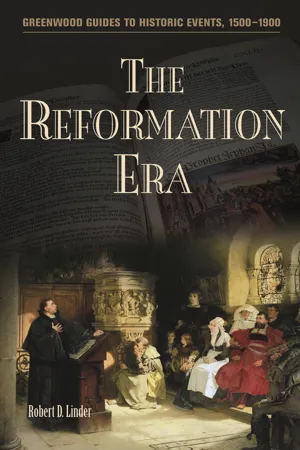 eBook - PDF
- Robert D. Linder(Author)
- 2007(Publication Date)
- Greenwood(Publisher)
Another new term used in place of ‘‘Protestant’’ is ‘‘Reformation churches.’’ Even the term ‘‘origins of the Reformation’’ has been called into question by some revisionist historians because it suggests that a reformation was bound to occur, and this, in turn, can lead to studying the Late Middle Ages largely to uncover factors that make the Reformation inevitable. Since nothing in history is ‘‘inevitable,’’ and since standard usages of the past often still serve well the needs of the present, this work will take such matters as recent challenges to standard terminology into consideration without violating the can- ons of common sense. In any event, the Reformation resulted in a lasting division in a Church that, at least in Western Europe, had retained its essential unity for more than a thousand years. This fact alone makes this era of immense importance. Moreover, the legal existence of more than one Christian Church was difficult to accept after a millennium of religious unity, and this fact was only reluctantly acknowledged when it became evident that neither dialogue nor suppression could restore the Church’s unity. Religious divisions, as well as political, economic, and social factors, led to military conflict that vexed Europe between 1550 and 1648. At a local level, parishes, villages, guilds, and families also experienced strife as religious disagreement 3 The Road to Reformation forced many of those who made spiritual choices in this period to seek a new life elsewhere. This produced the great migratory trek to other places that still continues for many people of European descent even today. Further, these terrible conflicts helped over the long term to undermine some of the most positive aspects of the reform move- ments and eventually lessened rather than increased the impact of Christianity upon society. The Medieval Background To paraphrase William Inge, the twentieth-century Dean of Lon- don’s St. eBook - PDF
Western Civilization
A Brief History, Volume II: Since 1500
- Jackson Spielvogel(Author)
- 2016(Publication Date)
- Cengage Learning EMEA(Publisher)
Martin Luther established the twin pillars of the Protestant Reformation: the doctrine of jus-tification by faith alone and the Bible as the sole authority in re-ligious affairs. Although Luther felt that his revival of Christian-ity based on his interpretation of the Bible should be acceptable to all, others soon appeared who also read the Bible but interpreted it in different ways. Protestantism fragmented into different sects—Zwinglianism, Calvinism, Anglicanism, Anabaptism—which, though united in their dislike of Catholicism, were themselves divided over the interpretation of the sacraments and religious practices. As reform ideas spread, religion and politics became ever more intertwined. Although Lutheranism was legally acknowledged in the Holy Roman Empire by the Peace of Augsburg in 1555, it had lost much of its momentum and outside of Scandinavia had scant ability to attract new supporters. Its energy was largely replaced by the new Protestant form of Calvinism, which had a clarity of doctrine and a fervor that made it attractive to a whole new gen-eration of Europeans. But while Calvinism’s activism enabled it to spread across Europe, Catholicism was also experiencing its own revival. New religious orders based on reform, a revived and reformed papacy, and the Council of Trent, which reaffirmed traditional Catholic doctrine, gave the Catholic Church a renewed vitality. By the middle of the sixteenth cen-tury, it was apparent that the religious passions of the Reformation era had brought an end to the religious unity of medieval Europe. The religious divi-sion (Catholic versus Protestant) was instrumental in beginning a series of religious wars that were also compli-cated by economic, social, and political forces. eBook - PDF
- C. Scott Dixon(Author)
- 2008(Publication Date)
- Wiley-Blackwell(Publisher)
The Reformation, in this view, can only be understood in its relation to the social, cultural and political forces of the age. Even Protestant historians, inspired by Ranke and legiti-mized by archival evidence, began to turn their backs on estab-lished interpretations. In his History of Dogma (1886) Adolf von Harnack related Luther’s ideas to centuries of Christian thought and ended by criticizing the reformer for being unfair to some central Catholic ideas. Still more revisionist was the work of Ernst Troeltsch, like Harnack a Protestant scholar, who extended his critique to the movement as a whole. In con-trast to the many scholars who thought of the Reformation as the point of division between the medieval and the modern age, 188 Reformation Histories Troeltsch held that the movement should be understood as a continuation of medieval culture, for the century of Reform, no less than the age which preceded it, tied Church to State, de-valued the secular world and delayed the arrival of modernity in its search for religious truth. Of course, not all Protestants agreed with Troeltsch, and indeed one corollary of this revi-sionism was a return to, and a confirmation of, the themes that had long been at the heart of Reformation scholarship. Karl Holl, professor of theology at Berlin, was perhaps the most influential voice in this ‘Luther Renaissance’, a scholarly cam-paign to reassess Luther’s theological legacy in the context of its age (Wohlfeil, 1982, pp. 52–6). But by the age of Holl there was too much depth and variety in Reformation scholarship to return to the previous narratives. No greater evidence of the transformation exists than the rediscovery of the radical tradi-tion. Thinkers throughout Europe and North America began to reassess the place of the radical Reformation in the traditional histories. eBook - PDF
New England Nation
The Country the Puritans Built
- B. Daniels(Author)
- 2012(Publication Date)
- Palgrave Macmillan(Publisher)
C H A P T E R 1 Protestant Reform History is rich in irony. Historical triumphs have a habit of breeding tragedy—of sowing the seeds of failure. Great leaders rise through virtue then fall through pride. Great empires collapse because they conquer too much to defend. History is full of rising and falling, of conquering and collapsing. Fate loves paradox. The Roman Catholic Church reached its high water mark near the end of the thirteenth century. Arching over mere political principalities, the papacy’s dominion extended to virtually all of Europe and to every Christian soul outside of the Eastern Orthodox Churches. As the church grew more powerful, its leaders flexed their muscles and seemed less concerned with matters of the spirit and more concerned with matters of the flesh. Popes treated kings with disdain, amassed great wealth, and lost touch with their flock. Charges of corruption, arbitrariness, and arrogance swirled around the church hierarchy. Inevitably, such power and such abuses of power called forth enemies to the papacy’s monopoly of Christendom. In the fourteenth and fifteenth centuries, the church came increasingly under attack from within its midst by pious scholars and theologians across Europe. Ironi- cally, none of these reformers wanted to divide Christianity into competing groups but their combined effort resulted in just that. For two centuries, clerical dissent remained within the fold but after several generations of attempted reform, the church shattered into shards of protest in the early sixteenth century. Martin Luther (1483–1546), an Augustinian monk, provided the Protes- tant Reformation’s most dramatic moment when he nailed his 95 theses to the door of the Wittenberg castle church in Saxony on October 31, 1517. These theses and the Roman church’s reaction to them sparked a social, intellectual, political, and economic revolution. By the middle of the cen- tury, rival sects competed for the hearts, minds, and souls of Christians. eBook - PDF
- Leonora Nattrass, James Epstein(Authors)
- 2021(Publication Date)
- Routledge(Publisher)
Here, then, we are, at the end of three hundred years as to religion, from the day when Henry VIII. began the work of “Reforma at the end of tion”: here we are, after passing through scenes of plunder three hundred years from the and of blood, such as the world never beheld before: here Reformation. 308 History of the Protestant Reformation we are, with these awful questions still before us; and here, we are, too, with forty sorts of Protestant religion, instead of the one fold, in which our forefathers lived for nine hundred years; here we are, divided and split up into sects each con demning all the rest to eternal flames; here we are, a motley herd of Church people, Methodists, Calvinists, Quakers, and Jews, chopping and changing with every wind; while the faith of St. Austin and St. Patrick still remains what it was when it inspired the heart and sanctified the throne of Alfred. 449. Such, as far as religion is concerned, have been the effects of what is called the “Reformation”; what its effects have been in other respects; how it has enfeebled and impov erished the nation; how it has corrupted and debased the people; and how it has brought barracks, taxing-houses, poor- houses, mad houses, and jails, to supply the place of convents, hospitals, guilds, and alms-houses, we shall see in the next number; and then we shall have before us the whole of the consequences of this great, memorable, and fatal event. 309 LETTER XVI. F o r m e r P o p u l a t io n o f E n g l a n d a n d I r e l a n d . F o r m e r W e a l t h . F o r m e r P o w e r . F o r m e r F r e e d o m . F o r m e r P l e n t y , E a s e , a n d H a p p in e s s . Kensington, 31 st March, 1826. M y F r ie n d s , Retrospect 450. T h is Letter is to conclude my task, which task was to make good this assertion, that the event called the “Reformation” had impoverished and degraded the main body of the of the people of England and Ireland. eBook - ePub
- C. Scott Dixon(Author)
- 2012(Publication Date)
- Wiley-Blackwell(Publisher)
48 But the majority of Reformation historians write from the perspective of a national or linguistic community with reference to the history of a particular country, kingdom, or territory.Modern scholars did not invent this tendency to naturalize the Reformation. It was evident from the very beginning. In the Dutch Republic, for instance, where the Reformed church ultimately became the public church, Protestantism was closely identified with the revolt against Philip II (1527–1598) of Habsburg Spain. Whatever the realities behind the uprising, it was depicted as a war for independence between Calvinist rebels and Catholic overlords, and this was woven into the story of the nation. One of the most powerful and lyrical analyses of this religious self-imaging appears in Simon Schama’s The Embarrassment of Riches (1987), a work which draws on a wealth of sources to show how the Dutch rebels were able to constitute a notion of identity by ransacking Scripture.49 Such biblical self-imaging was effected through different rhetorical strategies. Analogies and typologies invested the leading figures with religious significance. William of Orange became David, king of Judah, or Moses, the newfound pater patriae . Allegories invested the entire nation with meaning and identity, and so the Dutch became the chosen people and the Netherlands a second Israel. Imagined genealogies traced the history of the sixteenth-century Netherlands from the present back to the days of Old Testament kings. It was a powerful form of discourse, for it provided a sense of meaning, purpose, and historical continuity to an uprooted people, not to mention, as Schama notes, a way of explaining “the moral ambiguity of good fortune” once the Republic became the premier economic power in Europe.50 It all seemed a seamless fit, and it is easy to see why Dutch Calvinists, like Calvinists and Lutherans throughout Europe, moved so readily between the biblical past and the Protestant present.51
- R. W. Scribner(Author)
- 1988(Publication Date)
- Hambledon Continuum(Publisher)
THE REFORMATION AS A SOCIAL MOVEMENT In recent years it has become common to speak of the social dimensions of the Reformation, to relate it to social historical phenomena, and to adopt socio-logical terminology in its analysis *. This trend has gathered such momentum that some church historians have begun to call for a reversal of its course, to argue that the Reformation as a religious phenomenon should be rescued from the in-cursions of the social historian 2 . This is highly ironic, for serious social analysis of the Reformation has scarcely begun. We could have no clearer proof of this than the frequent use of the term movement (Bewegung) to describe the Refor-mation as some kind of popular social event. The term is rarely defined precisely, and the social historical implications of its use less rarely evaluated3. In this paper I want to examine more closely the nature of the Reformation as a move-ment and to bring out some of these implications. The term movement is most commonly applied to the beginning of the Reformation in Wittenberg in 1521—22 4 . I should like to give a brief resume* of these well-known events in order to establish a more precise understanding of how they constitute a movement. The events can be divided into those which were public and those which were private. Thus during the autumn of 1521 the implications of the religious revival sparked off by Luther's ideas were hotly 1 See, for example, the use of the notion of legitimation in P. Blickle, Die Revolu-tion von 1525, Miindien 1975; the argument for the use of historical sociology in Thomas A. Brady Jr., Ruling Class, Regime and Reformation in Strasbourg 1520— 1555, Leiden 1978, pp. 19—47; and the more extended application of sociological therory in O. Rammstedt y Sekte und soziale Bewegung, Koln 1966, and id., Stadt-unruhen 1525, in: H.-U. Wehler (ed.), Der deutsche Bauernkrieg 1524—1526, Got-tingen 1975, pp. eBook - PDF
A Short History of Europe
From the Greeks and Romans to the Present Day
- A. Alcock(Author)
- 2002(Publication Date)
- Palgrave Macmillan(Publisher)
9 Reformation, Counter Reformation and Religious War 1500±1650ad By the middle of the fifteenth century Germany was seething with dissatisfaction with the Church. Because of the weakness of German central political power the Papacy had a much stronger position than in England, France and Spain where the Church was much more `national'. Thus the Papacy was still able to appoint French and Italians to German bishoprics and, since less money was com- ing from the countries with `national' churches, it was demanding increased contributions from Germany. A second source of resentment was the behaviour of the senior clergy, who considered their bishoprics as feudal fiefs and a means of maintaining standards of living commensurate with their social status rather than paying attention to their spiritual functions. These were left to the parish clergy, who were in many cases theologically ignorant or illiterate, and poorly paid. 1 Third, at a time of intensification rather than decline in religious belief, there was resentment at the deterioration of ecclesiastical means of salvation into substitutes such as confessions and the sale of indulgences. Martin Luther, a Saxon (1483±46) had studied law at Leipzig University, joined the Augustinian Order of Hermits in 1505 and was ordained in 1507. His Order sent him to Wittenberg University to teach moral philosophy, where by 1511 he was a Doctor of Theology and Professor of Biblical Studies. And it was in Wittenberg on 31 October 1517 that Luther posted on the door of the castle church his ninety-five theses attacking the sale of indulgences, the Church's preoccupation with material pos- sessions, and contrasting those material possessions with its true wealth, namely, the Gospel. Crucial to an understanding of Lutheranism and its significance are Luther's interpretation of the relations between God and Man, and, linked to it, his views on politics and society, particularly the place of labour. 124 eBook - PDF
Renaissance Humanism, Volume 3
Foundations, Forms, and Legacy
- Albert Rabil, Jr.(Authors)
- 2016(Publication Date)
37^HUMANISM AND THE Protestant Reformation Lewis W. Spitz T HE BRILLIANT, THOUGH ERRATIC, FRIEDRICH NIETZSCHE DE-scribed Luther as a vengeful, unlucky priest who brought to shame the one cleverly refined beautiful brilliant possibility—Cae-sar Borgia as pope. ( Der Anti-Christ, aph. 61). Of course, history was not Nietzsche's strong point, for Cesare Borgia, duke of Valentinois and Romagna and son of Pope Alexander VI, died in 1507 under trying cir-cumstances, roughly a decade before the posting of the Ninety-five The-ses by Martin Luther. Nevertheless, Nietzsche's thought does point up the fact that one school of writers in the historiographical tradition from Jacob Burckhardt's time to the present has seen Renaissance and Refor-mation, humanism and Protestantism, as antithetical. Another interpre-tive tradition has paired Renaissance and Reformation as twin sources of modernity, a view that has led to the periodization of history into ancient, medieval, and modern, with the modern beginning with the Renaissance. The debate over the relation between the two historic movements was given classical expression in the writings of Wilhelm Dilthey, who saw the Reformation as the religious expression of the Renaissance, and Ernst Troeltsch, for whom the Reformation represented the revival of other-worldly religiosity, antithetical both to the artistically ennobled natural-ism of the Renaissance and to the secularized, scientized culture of modern times. 1 The role of humanism in the Reformation and the effects of Protestantism on humanism require a closer examination than they usually receive from cultural historians. The term humanism is a protean concept, which has been used in varying modalities.
Index pages curate the most relevant extracts from our library of academic textbooks. They’ve been created using an in-house natural language model (NLM), each adding context and meaning to key research topics.

