History

Spanish Inquisition
The Spanish Inquisition was a series of Catholic-led judicial institutions established in the 15th century by the Spanish monarchs Ferdinand II of Aragon and Isabella I of Castile. Its primary purpose was to identify and punish heretics and conversos (Jews and Muslims who had converted to Christianity). The Inquisition used torture and execution to enforce religious orthodoxy and maintain political control.
Written by Perlego with AI-assistance
Related key terms
1 of 5
10 Key excerpts on "Spanish Inquisition"
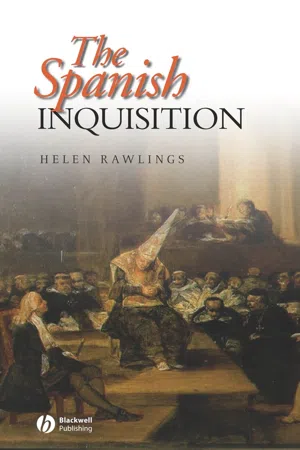 eBook - PDF
- Helen Rawlings(Author)
- 2008(Publication Date)
- Wiley-Blackwell(Publisher)
46 The Inquisition as an Institution 3 The Inquisition and the Converso The Spanish Inquisition was originally established to deal with a specific group of individuals known as conversos – Jews who had voluntarily converted to Christianity and were commonly regarded as being insincere in their new faith and secretly revert-ing to their former one. At the beginning of the reign of Ferdi-nand and Isabella, backsliding Jews were considered to be a potential threat to the stability of the new Catholic state, recently emerged from the long years of struggle against Moorish occu-pation and eager to assert its dominance as both a political and a religious force. Such was the monarchs’ concern, that a special institution – the Holy Office of the Inquisition – was established to root out the incidence of heresy within converso society. The Inquisition became universally synonymous with the intolerance and brutality directed at the crypto-Jewish community of urban Spain. This reputation was to dominate the tribunal’s whole history, although it represented only a small percentage of its overall activity. Anti-semitic Tensions in Spanish Society The Jewish community, persecuted in and then expelled from most other parts of western Europe between the late thirteenth and mid-fourteenth centuries, remained tolerated and highly valued in Spain. Although barred from holding public office and forced to live in segregated zones (known as aljamas ), the Jews made a valuable professional and cultural contribution to Spanish society. Some established reputations as doctors, tax collectors and financiers, others worked as artisans and traders. Social and economic factors, rather than religious or racial ones, were initially responsible for a change in public attitude towards them.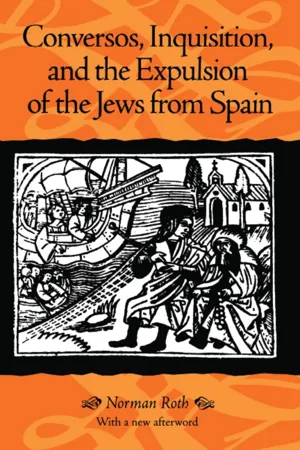
- Norman Roth(Author)
- 2002(Publication Date)
- University of Wisconsin Press(Publisher)
7 The Inquisition The general impression that the Inquisition in Spain was a product of the reign of the Catholic Monarchs is erroneous. The reason for this error is not hard to discover; the majority of the books dealing with the Spanish Inqui- sition begin with the fifteenth century, as though it emerged at that time without any antecedents. In fact, there were two Inquisitions in Spain, the earlier one centered in Aragon-Catalonia, and the fifteenth-century "Spanish" Inquisition. Yet an- other misconception shared by many, including not a few scholars, is that the Inquisition was established and run by "the Church." Thus, a recent translator of Eimeric's Manual for Inquisitors asked, but did not attempt to answer, "Why did the Roman Inquisition [his emphasis] last longer in Spain than elsewhere?" 1 The question reveals several erroneous assumptions: (1) that there was a "Spanish Inquisition," (2) that it was "Roman," i.e., directed from and controlled by the Church in Rome, an opus romanum, as he calls it; and (3) that the Inquisition lasted longer in medieval Spain than elsewhere (ignoring, for example, Italy). Even the Spanish Inquisition of the fifteenth century, as we shall see, can scarcely be called "Roman," for it soon achieved a complete independence of the Church and even a defiance of the papacy. Origins of the Inquisition The original Inquisition was established by a bull of Alexander III at HI Lateran, the ecumenical Church council, in 1179, attended by the bishops of Tarragona, Gerona, Barcelona, Vic, Tortosa, Lerida, and Seu d'Urgell, from the kingdom of Aragon-Catalonia. The purpose of the Inquisition was solely to act against Christian heretics who were deemed to be corrupting the faith from within. 204 The Inquisition In Spain, the first secular act (initiated not by Church authorities) was a document of Alfonso II (1194) of Aragon-Catalonia against the Waldensian heretics.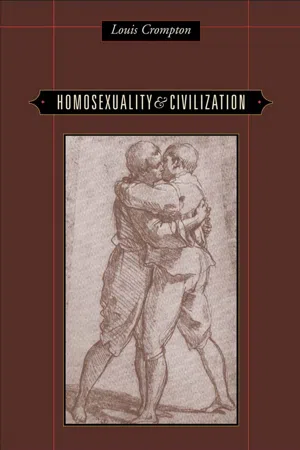 eBook - ePub
- Louis Crompton(Author)
- 2006(Publication Date)
- Belknap Press(Publisher)
Ferdinand and Isabella had in 1478 obtained papal sanction to set up a Spanish Inquisition whose primary aim was to enforce religious conformity among the Jews in Spain who had accepted Christianity. As a result of this campaign, thousands of Conversos, whose baptism had been coerced by force or fear, were burned on charges of having continued to secretly observe Jewish practices. Then, in January 1505, Ferdinand also issued a decree granting his new Castilian Inquisition authority to try sodomites. 13 A year later there was a spate of arrests in Seville; many men fled, but eventually twelve were convicted and burned by sentence of the local tribunal. 14 In 1509, however, the Supreme Council of the Inquisition in Madrid—commonly known as the Suprema—ruled that the organization should not be diverted from its primary task of hunting down heretics and Judaizers. Thereafter, the Inquisition in Castile left the prosecution of sodomites to the secular courts, whose own fervent piety and prejudice could be counted on to mete out a comparable severity. In Aragon, by a “fateful accident,” things took a different turn. William Monter, in his Frontiers of Heresy, has told the story in rich detail. What made the Spanish Inquisition unique was Ferdinand’s determination to use it as an instrument of state power and national unity. Since the Inquisition had its headquarters in the Castilian city of Madrid, it was resisted by the provinces that made up the Crown of Aragon because they feared it would infringe on their local laws and liberties. (The Crown of Aragon consisted of the ancient kingdom of Aragon, Catalonia, the kingdom of Valencia on the east coat of Spain, the islands of Majorca, Sardinia, and Sicily, and the much-contested kingdom of Naples.) The Valencian and Aragonese opposition to Ferdinand had came from nobles who wished to protect their Converso and Moorish subjects eBook - ePub
Judge Thy Neighbor
Denunciations in the Spanish Inquisition, Romanov Russia, and Nazi Germany
- Patrick Bergemann(Author)
- 2019(Publication Date)
- Columbia University Press(Publisher)
6 One of their most effective methods was the Spanish Inquisition.The Inquisition was dedicated to the enactment of social control over the religious lives of its subjects. In particular, the early Inquisition targeted conversos, seeking to identify those who were not fulfilling their duties as devout Christians and particularly those who were secretly following Jewish precepts.7 In practice, however, it took an interest in a wide variety of transgressions, including blasphemous statements, indications of skepticism or doubt about Christianity or the Inquisition, and the following of Jewish traditions that were cultural rather than religious in nature. By identifying transgressors, the Inquisition punished heretics, removed their perceived negative influence from society, and deterred others from betraying the faith.The Inquisition also served as a broader form of control that accomplished other political ends of the monarchy. This can be seen in the placement of the early tribunals. The Inquisition started in the frontier region bordering Granada, where the crown had the least political control and a strong interest in maintaining security. The monarchy then targeted other “trouble” areas, such as Ciudad Real, which had been at the center of a 1474 uprising.These political goals are also evident in the Inquisition’s expansion into Aragon in 1484. At the time, Aragon already had a functioning inquisition established by the pope, though it operated on a very small scale. Instead of expanding this, Ferdinand worked actively against those inquisitors until the pope conceded. In 1486, Pope Sixtus IV removed all papal inquisitors from Aragon, leaving the crown entirely in control of inquisitorial activities within its borders. The Spanish Inquisition was the only inquisition in history in which local monarchs successfully wrested inquisitorial power from the pope; this unified the Castilian and Aragonese tribunals and created the first legal and institutional link between the two kingdoms, thereby furthering the monarchs’ goal of political consolidation.8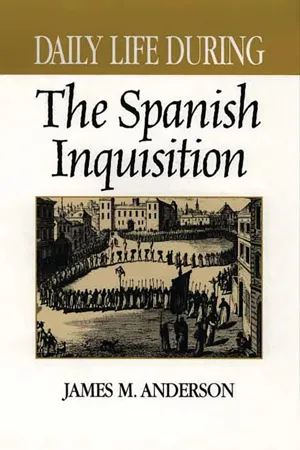 eBook - PDF
- James M. Anderson(Author)
- 2002(Publication Date)
- Greenwood(Publisher)
5 The Inquisition In the view of the Roman Catholic Church it was dangerous for a Chris- tian to look for direct communication with God or to hold views and opinions contrary to established doctrines. Nonconformity undermined the authority and power of the church. Such activity amounted to heresy, and efforts by the church to eliminate this gravest of sins was a driving force in Early Modern Spain. Dissenters had for centuries been beheaded or burned at the stake for antichurch views, but such cases, generally left up to bishops and their ecclesiastical courts, were nonsystematic and sporadic. To deal with ever larger groups of heretics, more effective measures were deemed neces- sary. An official judicial tribunal was needed by the church to inquire into such matters and punish the guilty. In short, an Inquisition—a body of ecclesiastics charged with ferreting out heretics, exacting a confession of their sins, and making them atone so that, according to the church, their souls would be saved. THE MEDIEVAL OR PAPAL INQUISITION An inquisitorial tribunal was established on 20 April 1233 when Pope Gregory IX issued a bull that conferred on the Dominican order of friars the task of eradicating heresy. Anyone once baptized in the Roman Cath- olic Church and hence ipso facto a member of the Catholic faith, or ad- herents to dissident sects that had broken away from it, fell under the Inquisition's jurisdiction. Followers of non-Christian faiths such as Ju- 62 Daily Life During the Spanish Inquisition daism or Islam did not fall into the category of heretic, and they could not be officially persecuted for their religious beliefs. Dominicans were chosen for the task because their founder, Saint Dominic, had been a leading figure in combating the Cathars (Albigen- ses) in southern France, against whom a holy crusade had already been launched by Innocent III in 1208.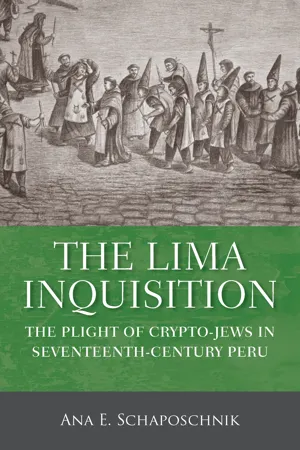 eBook - PDF
The Lima Inquisition
The Plight of Crypto-Jews in Seventeenth-Century Peru
- Ana E. Schaposchnik, Ana Schaposchnik(Authors)
- 2015(Publication Date)
- University of Wisconsin Press(Publisher)
About 1493, the Inquisition tallied a total of twenty-three tribu- nals in Spain—the largest number in all its history. 32 The establishment of an institution so peculiar and complex as the Inqui- sition was not a linear process, nor did it go uncontested. From the judicial point of view, the principles of the Inquisition conflicted with Aragon’s laws and institutions. Although it is true that the papal Inquisition had been active in Aragon during medieval times, it was then itinerant and occasional, meeting only at specific junctures. At the end of the fifteenth century, however, Tomás de Torquemada was determined to establish permanent tribunals in this terri- tory, and there he encountered opposition in Aragon, with two main objec- tions against the establishment of the Inquisition. The first was technical: the methodology of Inquisition trials and the potential penalty of property confisca- tion contradicted the laws of the region. The second was political: the inquisitors were from Castile and therefore foreigners in Aragon, which also contradicted regional laws. In response to these objections, King Ferdinand pointed out that heresy could not be allowed to fall back on the protection of local institutions. He also remarked that the establishment of the Inquisition in Spain stemmed from a papal decision, one that the local courts of Aragon could not choose to defy and at the same time protect their region from heresy. 33 Llorente also Heresy and Inquisition in the Iberian World 37 mentions lack of support from the local population in Castile. 34 In spite of local objections and resistance, tribunals of the Inquisition were established and active in both Castile and Aragon at the end of the fifteenth and the beginning of the sixteenth century. 35 After its first twenty years of activity, in the early 1500s, the Inquisition under- went some adjustment and reorganization.
- Kayoko Takeda, Jesús Baigorri-Jalón(Authors)
- 2016(Publication Date)
- John Benjamins Publishing Company(Publisher)
Initially, the Inquisition basically persecuted heresy, i.e. errors in matters of faith. But by the early 16th century, based on the premise that any erroneous idea in religion was tantamount to heresy, the Inquisition had managed to obtain juris-diction in almost all crimes. So in addition to the initial errors of Judaism and Mohammedanism, bigamy, blasphemy, usury, sodomy, mysticism, solicitation in the confessional, witchcraf, sorcery, magic, superstition and idolatry, among others, which naturally included Protestantism, were also considered. Te long lists of facts, rites and ceremonies that identifed the diferent heresies for which people could be denounced were stipulated in the edicts (cf. Llorente 1835–1836, 1: 240–249; 2: 250–255; 3: 46–52, 112–115; Lea 1906–1907, 3: 231–476; 4: 1–335; Kamen 1968: 197–213). We should mention that the Inquisition only pursued Christians, as heresy could only be committed by those who had been duly chris-tened. Consequently, only those Jews, Moors, Indian 2 or African slaves who had converted to Christianity were pursued. Protestants (such as Lutherans, Calvinists, Anglicans, Huguenots and Anabaptists) were assumed to have been baptized. As this work is a frst approach to this subject, secondary sources have been given more weight than primary ones (archives). Said secondary sources include 2. Te term “Indian,” used in this chapter, is taken directly from the sources. It applies to vari-ous native peoples in the Spanish colonial Empire who were identifed by the frst explorers as people from India, the intended destination of the early voyages. 50 Marcos Sarmiento-Pérez those that deal with the Inquisition as a whole, deemed relevant for an under-standing of the essence of the institution, and those that study a district tribu-nal or a particular sphere of the Inquisition’s activities. eBook - ePub
- Henry Charles Lea(Author)
- 2013(Publication Date)
- Perlego(Publisher)
He uses it to hold in check his subjects and to punish them with the secrecy and severity of its procedure, when he cannot do so with the ordinary secular authority of the Royal Council. The Inquisition and the Royal Council mutually help each other in matters of state for the king’s service. [553] This was a not unnatural conclusion to draw from a case of this nature, but the royal power, by this time, was too securely intrenched to require such aid. It was only the peculiar features of the Aragonese fueros that called for the invention of a charge of heresy in a political matter. The Inquisition, as a rule, considered it no part of its duties to uphold the royal power for, in 1604, we find it sentencing Bartolomé Pérez to a severe reprimand, a fine of ten thousand maravedís and a year’s exile for saying that obedience to the king came before that due to the pope and to the Church. [554] Thus the mere denial of the superiority of the spiritual power over the temporal was a crime. Sporadic cases occurred in which special considerations called for the aid of the Inquisition, but they were not numerous and were apt to be directed against ecclesiastics, whose privilege exempted them from the secular courts. Such was that of the Jesuit, Juan de Mariana, distinguished in many ways, but especially by his classical History of Spain. He had served the Inquisition well as a censor of books, but in his Tractatus septem, published anonymously at Cologne, in 1609, in an essay on the debased Spanish coinage, the freedom with which he reprobated its evils and spoke of the malfeasance of officials gave great offence to the royal favorite Lerma and his creatures. Had Mariana been a layman there would have been no trouble in punishing him severely, but to reach the Jesuit Philip invoked the papal nuncio Caraffa and the Toledo tribunal took a hand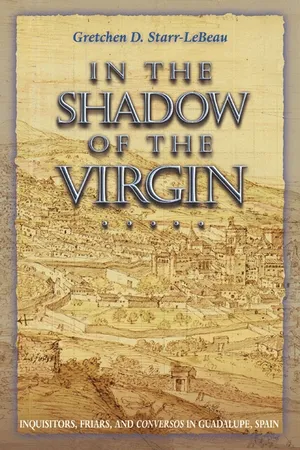 eBook - PDF
In the Shadow of the Virgin
Inquisitors, Friars, and Conversos in Guadalupe, Spain
- Gretchen D. Starr-LeBeau(Author)
- 2018(Publication Date)
- Princeton University Press(Publisher)
Indeed, the challenges to local authority— which came primarily from Old Christian artisans in Guadalupe—were not atypical of towns throughout western Europe in this period. In the two decades before the arrival of the inquisitors, we can see the contin-gent, conditional nature of community identity and individual allegiances. As the century wore on, though, this typical urban unrest was increas-ingly supplanted by this conjunction of religious and secular grievances. Furthermore, analysis of the friars' attempts to control the townspeople before the arrival of the royal Inquisition suggests a complicated mix-ture of religious and secular motivations behind their actions as well. The decades that preceded the establishment of the Inquisition in Gua-dalupe were important in securing the Virgin of Guadalupe's place as the preeminent devotion of fifteenth-century Castile. But even more importantly, those years reveal the religious and secular motivations that would affect the presence and actions of the inquisitors as well as contribute to the creation of Isabel and Fernando's image of Spain as a sacralized state. Thus, to understand events in Guadalupe in 1484 and beyond, it is important to go back for a moment to the first efforts to establish an inquisitorial court in the Virgin's town. T H E JERONYMITES A N D T H E ESTABLISHMENT OF T H E Spanish Inquisition While the royal Inquisition established by Isabel and Fernando officially heralded the beginning of the modern Spanish Inquisition, the idea of an ecclesiastical Inquisition had been known to Iberians since bishops and friars had sought out heretics in the thirteenth century. 1 Regionally 1 These courts are best known for their trials of the Cathars of southern France, but ecclesiastical Inquisitions tried a variety of cases throughout the late medieval period. The literature on these medieval inquisitorial courts is immense. Some good starting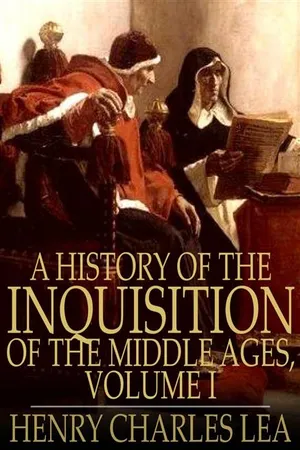
- (Author)
- 2012(Publication Date)
- The Floating Press(Publisher)
There is no business, he added, of greater importance to the Church than the destruction of heresy, and no way to win his favor more efficacious than by aiding the Inquisition. It had been organized for the purpose of relieving bishops of a portion of their cares, and any interference with it would be visited with his displeasure. In the present case, for the sake of concord, the inquisitor would revoke the grievances complained of, and the pope pronounced all suits against him quashed and extinguished. Evidently in any contest the odds were too great against the episcopate, and the danger of systematic opposition too real, to render any organized antagonism feasible. How completely the papacy regarded the Inquisition as an instrumentality for furthering its schemes of aggrandizement is seen when, on the outbreak of the Great Schism, inquisitors were required to take a formal feudal oath of fidelity to the pope appointing him and to his successors. [311] 371 * With so little to check and so much to stimulate, the spread of the Inquisition was rapid throughout most of the lands of Christendom. I shall have occasion hereafter to trace its vicissitudes in the principal centres of its activity, and need here only indicate the limits of its extension. The northern nations were too far removed from the focus of heresy to be exposed to aberrations from the faith at the time when papal supremacy found its most useful instruments in the Mendicant inquisitors. Consequently the papal Inquisition cannot be said to have had an existence in the British Islands, Denmark, or Scandinavia.
Index pages curate the most relevant extracts from our library of academic textbooks. They’ve been created using an in-house natural language model (NLM), each adding context and meaning to key research topics.

