History

Conquistadors
Conquistadors were Spanish soldiers, explorers, and adventurers who sought to conquer and colonize the Americas during the Age of Discovery in the 15th and 16th centuries. Led by figures such as Hernán Cortés and Francisco Pizarro, they played a significant role in the Spanish colonization of the Americas, often using military force to subjugate indigenous peoples and establish Spanish control over vast territories.
Written by Perlego with AI-assistance
Related key terms
1 of 5
9 Key excerpts on "Conquistadors"
 eBook - PDF
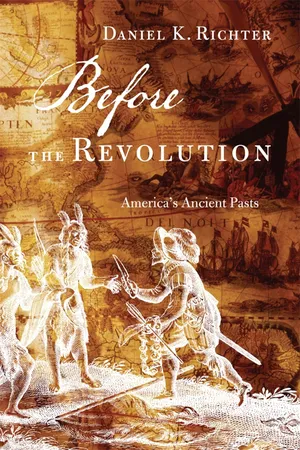
Before the Revolution
America's Ancient Pasts
- Daniel K. Richter(Author)
- 2011(Publication Date)
- Belknap Press(Publisher)
5 Conquistadores To co´nquer . v.a. [ conquérir, Fr. conquirere, Latin]. 1. To gain by conquest; to over-run; to win. Co´nqueror . n.s. [from conquer ]. 1. A man that has obtained a victory; a victor . . . 2. One that subdues and ruins countries. —Samuel Johnson, A Dictionary of the English Language (London, 1755) T H R E E 5 Crusades of the Christ-Bearers to the Americas EXOTIC ITEMS ACQUIRED from afar are often said to be a preoccupation of fifteenth-century Europeans. Yet the idea that explorers sailed off into uncharted oceans on a mad quest to find rare spices from the Far East fits neither with the nature of the new monarchies of Western Europe nor with the character of those who set out to conquer the globe on their be-half. It is revealing that the identity that Christopher Columbus fashioned for himself and his mission made no reference to spices, or axes, or any of the mercantile pursuits that the European elite derided as unworthy of true nobility. The introduction to the surviving version of the official diary Columbus presented to Queen Isabel and King Fernando ignores such things: This present year of 1492, after Your Highnesses had brought to an end the war with the Moors, . . . because of the report that I had given to Your Highnesses about the lands of India and about a prince who is called “Grand Kahn,” which means in our Spanish language “King of Kings”; how, many times, he and his predecessors had sent to Rome to ask for men learned in our Holy Faith in order that they might instruct him in it and how the Holy Father had never provided them; and thus so many peoples were lost, falling into idolatry and accepting false and harmful religions; and Your Highnesses, as Catholic Christians and Princes, lovers and pro-moters of the Holy Christian Faith, and enemies of the false doctrine of Mahomet and of all idolatries and heresies, you thought of sending me, Cristóbal Colón, . . . to see how their conversion to the Holy Faith might 67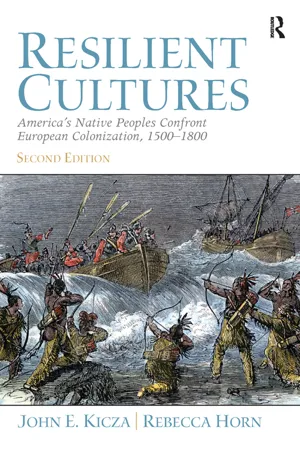 eBook - ePub
Resilient Cultures
America's Native Peoples Confront European Colonialization 1500-1800
- John E Kicza, Rebecca Horn, John Kicza(Authors)
- 2016(Publication Date)
- Routledge(Publisher)
Spaniards also encountered hunters and gatherers who lived in the deserts, plains, and jungles of the Americas. In general, Spaniards quickly withdrew from these areas once they ascertained the lack of exploitable resources and the character of the inhabitants. Hence, they did not become significant zones of colonization until centuries later. These regions were not conducive to agriculture, and the indigenous population was small in number, resilient in warfare, and resistant to forced labor service. Sixteenth-century Spanish expeditions journeyed across the North American plains, the Amazon drainage basin, and the South American pampas, but withdrew because of their lack of appeal. Only the lure of silver mines might attract Spaniards to such regions, as in the Mexican north. Spanish colonists congregated in Mesoamerica and the Andean region for their exploitable resources and numerous laborers.ConclusionThe conquistadores who defeated the great empires of the Aztecs and Incas should not be distinguished from the other early colonists in Spanish America. They had the same backgrounds, abilities, motives, and assets. The “conquerors” just found themselves in situations where extended combat (or combat readiness) was required. Once they had prevailed, they became in most respects indistinguishable from the other settlers who arrived early on but had avoided combat.Although the expeditions against the Aztecs and Incas captured the emperor and ruled through him for some time, in both cases the Spaniards, with the aid of their indigenous allies, ultimately had to defeat the imperial center led by members of the ruling family in grueling combat. Only when thoroughly defeated in warfare did the imperial dynasties acknowledge the permanent subordination of themselves and their peoples.The native societies invariably viewed the Europeans through their traditional cultural lenses. They did not consider them as gods, or even as particularly alien beings who could not be understood and should be held in awe. Instead, they commonly understood them to be quite similar to themselves in their goals, expectations, and values. Indigenous rulers were quick to negotiate with the strangers and to seek to make use of them for their own ends. Overall, the Indians did not regard the Europeans as especially “other,” nor did they become passive and slow to respond to the new, unexpected situation. Native leaders commonly proposed alliances and strategies with Spanish expeditions, contributing in this way to the collapse of indigenous empires. At times, they clearly manipulated the intruders for their own ends without the Spanish commanders understanding how they were being used. eBook - PDF
- Juana Vázquez-Gómez, Juana Vazquez-Gomez(Authors)
- 1997(Publication Date)
- Greenwood(Publisher)
THE CONQUEST: AN INTERPRETATION The conquest was a time of violence. The cities, temples, gods, and beliefs of the indigenous tribes were destroyed. Their land was taken, and a new government, a new religion, and a new system of values was imposed on them. The conquest was accomplished through a well-organized mix of vio- lence, strength, ambition, and greed. Military discipline lingered in the air, and everyday life was regimented in a military fashion. The new cities were planned from a military perspective and strategically placed. The central plaza was built with defense in mind, with a gallows pole, a church, and 14 DICTIONARY OF MEXICAN RULERS, 1325–1997 a cross in the plaza. The conquest was also the result of expeditions in search of wealth. There is much speculation as to how a handful of Spaniards (roughly 500) were able to conquer Tenochtitlan, which had a population of at least 200,000 inhabitants. There is no definitive explanation of this, but there are many theories. It is a fact that the entire territory of what is now Mexico was made up of many different tribes, all of which held a tremen- dous resentment against the Aztecs. They believed the Aztecs ruled with a cruel hand. Thus, when the Spanish came, they aligned themselves with them, the unknown, against those they knew too well, the Aztecs. Their alliance was critical to the Spanish success. Don ˜a Marina (a k a La Malinche) played an important role in the con- quest. Near Tabasco, as part of a peace offering, she came in contact with Herna ´n Corte ´s. She was a woman of exceptional intelligence. She assisted Corte ´s in matters of indigenous culture, mentality, and language, and turned herself into an invaluable resource in dealing with the tribes Corte ´s met. She served as the link between two cultures. In time, she also became Corte ´s’ lover and gave him a son, in addition to her advice and guidance.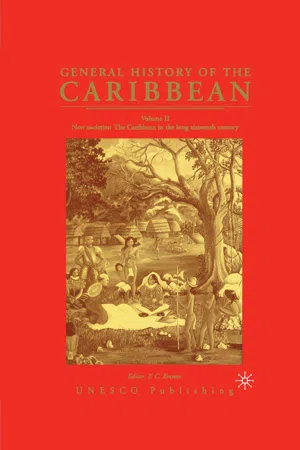 eBook - PDF
General History of the Caribbean UNESCO Vol 2
New Societies: The Caribbean in the Long Sixteenth Century
- NA NA(Author)
- 2019(Publication Date)
- Palgrave Macmillan(Publisher)
They were also well equipped for campaigns but, for the most part, had no interest whatever in permanent settlement overseas, let alone in setting to work there with their own hands. However, there was also an entrepreneurial class which had learnt in the Reconquista wars to turn war to economic advantage in order to secure long-term income and social status. Many of the leaders of the voyages of discovery and conquest came from that group. They were certainly willing to settle permanently in the newly- acquired lands, provided that they could acquire lordships, offices and pri- vileges which could be handed down by inheritance. Out of this complex situation there very soon developed, on Columbus' own model, the institu- tional system which was to underpin the entire Spanish expansion in America. Entrepreneurs of this kind sought from the King the right to take possession of a particular territory, generally inadequately defined because of the vague knowledge of geography, for the Crown of Castile. In return, he demanded supreme military command over the expedition, together with the main civilian and military offices in the conquered region and various econ- omic privileges for himself and his descendants. In legally-binding docu- ments, known as Capitulations, the Crown granted the entrepreneur an order to pursue the conquest and vested in him the desired offices and privileges as inheritable possessions. In addition, it fixed general rules which the person concerned was supposed to apply in his various official duties after the conquest and during the colonization of the country. In turn, the entre- preneur gave an undertaking to fit out the expedition at his own expense. On receipt of this document the person enjoying the privilege had to organize the venture. That was increasingly done from the soil of existing Spanish territories in America.
- Michael V. Wilcox(Author)
- 2009(Publication Date)
- University of California Press(Publisher)
Military conquests, often depicted by colonial historians as demonstrations of European dominance, frequently imply a transformative significance within colonial narratives, but they do not account for more pervasive and effective tactics of Indigenous resistance. The often heavily val-orized accounts of victories by Pizarro, Cortés, and Coronado serve as evocative symbolic events for Europeans, but they generate a com-pletely different meaning and signification among Indigenous peoples. In fact, these acts of violence, coupled with the common postevent experiences of discrimination, segregation, and persecution, often help generate collective responses by subordinate groups. Etched in the memories of subject peoples, these actions serve as potent and endur-ing vehicles for the development and implementation of more subtle and powerful forms of opposition. The Revolt of 1680 may represent the culmination of one such resistance movement, but it is part of a much larger process of negotiation, defiance, and organized conflict by Indigenous peoples. Creating Indian and Spaniard as Social Categories In colonial Spain, contact between the Pueblos and the Spaniards coin-cided with the development of Spanish national-ethnic identity and the advent of a capitalist world economy. As contact with the known world expanded to include previously unknown geographic regions and peo-ples, the social categories that defined and divided Europe were pro-jected on the Americas. The Indian came to symbolize a new kind of person singularly defined by geographic isolation from Europe and Christianity (Williams 1990 : 13 – 48 ). For many Europeans, the presence of peoples outside the historical religious and philosophical traditions of Europe had deep symbolic significance. By virtue of his isolation, the 82 THE MYTHOLOGIES OF CONQUEST Indian was conceived of as a being who demanded transformation in order to be included within the realm of other humans.
- Miles L. Wortman(Author)
- 2019(Publication Date)
- Columbia University Press(Publisher)
CHAPTER ONE The Conquest and the Settlement TWO ALIEN WORLDS met, the European and the Amerindian, with a violence surpassed only by the clash of the region's substrata plates and the resultant earthquakes and volcanic explosions. Thousands of Indians were slaughtered in battle. Hundreds of thousands died of disease. Of those who survived, many were enslaved. Most were re-settled. Their leadership was removed, their religions suppressed. The land was altered. Virgin forests were felled and European animals introduced. The soil eroded. Out of this violence, out of this joining of Europe and America, emerged a new American social order, a settled and relatively peaceful colony comprised of Amerindians, castes, and Creoles under a Haps-burg monarchy and a Spanish, Christian god. In the early, violent days, conquerors sought wealth greedily. After the initial shock, a more rational economic and political life emerged. Law was estab-lished, boundaries created, and elites formed. It is this process of normalization, the establishment of the co-lonial social structure, that concerns us. The rules and traditions, the hierarchies and beliefs, and the bases and suppositions for social order formed in the first century of the colony continued through the co-lonial period and exist, to some degree, today. Christopher Columbus came first. He sailed along the Caribbean coastline and named the cape at Gracias a Dios and the land of Costa Rica. His explorations and those of other Spaniards for the next ten years were tentative, seemingly unimportant. They may have given rise to stories and fables among Mesoamerican peoples. More impor-tant, they probably transmitted a destructive and unseen invader, European disease, for we now know that before Hernán Cortés and 4 El Reino de Guatemala Pedro Alvarado conquered the region, an epidemic occurred that, by one estimate, killed a fourth of the dense population of the Guate-malan highlands. eBook - PDF
American Catholic Experience
A History from Colonial Times to the Present
- Jay P. Dolan, Jay Dolan(Authors)
- 2020(Publication Date)
- University of Notre Dame Press(Publisher)
Catholics and Protestants were not terribly different in their motivation to explore and conquer the New World. To acquire wealth was an obvious prior-ity, but to establish a New Israel and extend the boundaries of the kingdom of God on earth was also a major impulse that propel led both the Spanish conquistador and the English Pilgr im across the ocean to America. Seen in this manner, the Spanish conquest of the sixteenth century, which inaugu-rates the history of Catholicism in the United States, evidences a strik ing resemblance to the Puritan colonizat ion of the seventeenth century and the beginnings of American Protestantism. American Catholicism, like American Protestantism, was inaugurated with a millenn ial enthusiasm. It first surfaced on an island in the Bahamas, appropriately renamed San Salvador, and spread across Central and South America, eventual ly reaching Florida, Texas, Arizona, New Mexico, and California. There is no denying that the Spanish were greedy; that they robbed, pil-laged, and eventually annih ilated mill ions of Indians in South and North America. They were Conquistadors, crusaders armed with Toledo steel and mounted on Spanish horses. Theirs was a crusade, made all the more just, precisely because it was conducted on behalf of the Church. Indeed, the Spanish conquest was the last great crusade to abolish paganism and estab-lish a city of God in the Promised Land, where the Christ ianity of the Old World could reach its perfection. Such holy wars are the worst possible kind. But it was the sixteenth century, and conquest and conversi on in the name of God and king was the way the Spanish set out to Christ ian ize and civilize the pe ople of the New World. The marriage between conquest and conversion was not unusual in Euro pe during the fi fteen th and sixteenth centuries. Most people were stil l view ing life throug h a medieval prism, pos se s sing a worldview that knew no separa- eBook - ePub
Sky Determines
An Interpretation of the Southwest
- Ross Calvin(Author)
- 2016(Publication Date)
- Sunstone Press(Publisher)
CHAPTER VII CONQUISTADORESTHE single errand which brought the Conquistadores into New Mexico was the search for precious metals. And yet they were motivated by no more than ordinary cupidity, for in a land so worthless, according to their view, it was gold or nothing. And thus Sky determined the object of their quest, and consequently, the uneconomic nature of their general policy. By a momentous chance, the Sky Powers laid out for them a trail beside the waters down in the canyon instead of over the mesa and along the mountains. So they passed the gold and silver only a few leagues distant—and they never knew. The epic in its first canto bent away to the left, so to speak, and the flame-colored banners of Spain conducted the mailed cavalcade and the brown-robed priests down the other path to obscurity, while the treasure waited in the earth for men of a different breed.The three hundred years of Spanish history in New Mexico were enacted, with the exception of sundry incidents along the Zuni-Albuquerque trail, in the narrow theater which the Sky Powers prepared and designated for the purpose—the north-and-south trending valley of the Rio Grande. The Conquistadores kept close to the waters, and that fact was fraught with the most striking consequences. Along with the history which we accept as authentic, there could be written a far more dramatic history of might-have-beens, but historians, occupied with actualities, have never lifted up their eyes to see how close to the surface runs a substratum of almost fact.Yet history came within an ace of being splendidly blazoned in golden characters, for the missed road led to opportunities that really were stupendous. Suppose, for instance, that Oñate, who was a practical miner, had come marching up the Gila instead of the Rio Grande, and had founded his settlement not at Santa Fe but at Silver City. The names tell the tale. At the edge of Silver City lies a thread of valley in the hills which back in the ’seventies yielded white metal—as fast, they say, as it could be taken from the ground—to the amount of five million dollars. What would it not have done for the perpetually bankrupt little colony at Santa Fe! It was precisely the kind of bonanza that the Conquerors sought. The total wealth of their colony through its whole history could not hold a candle to it and the others discovered near-by. Instead of poverty, isolation and peonage, there would have been wealth, progress, growth, and the flowering of a native culture. It is all a simple equation in economics. For instead of some scrubby sheep and longhorn steers, the only export of a people whom a hostile balance of trade left to grow perennially poorer, a few mule-loads of silver from Chloride Flat and some of the gold from Pinos Altos, would have set up a balance in their favor and given them in rich measure the commodities of civilization—tools, clothing, furniture, equipment. Precious metals could have saved the day—and they alone.
- I. Jaksic(Author)
- 2012(Publication Date)
- Palgrave Macmillan(Publisher)
(68–69) Fanaticism, bigotry, and greed, are listed in the History among the dismal legacies of the Spaniards. “We may well doubt,” wrote Prescott, “which has the strongest claims to civilization, the victor, or the vanquished” (80). Initially, one of the early explorers, Francisco Hernández de Córdoba, was astonished to witness indications of “a civilization far superior to any thing he had before witnessed in the New World” (165), but other Spaniards gradually came to the conclusion, or found it convenient to believe, that this was a civilization so antithetical to the principal pillars of Christianity that it must be subjugated. Prescott implied that Hernán Cortés, more than a clever and opportunistic conquistador, was “the instrument selected by Providence to scatter terror among the barbarian monarchs of the Western World, and lay their empires in the dust” (190). He proceeded with a series of deliberate steps: “The first object of Cortés was to reclaim the natives from their gross idolatry and to substitute a purer form of worship.” Perhaps echoing Washington Irving’s Conquest of Granada (1829), the Boston historian stated that to Cortés the Mexican campaign “was a holy war . He was in arms against the infi- del” (196). The conquistador determined that, either through persuasion or force, Indians should “embrace a better faith” (197). Addressing the cacique of Cempoala, for instance, Cortés announced that “he had come to the Aztec shores, to abolish the inhuman worship which prevailed there, and to introduce the knowledge of the true God” (247). Stepping away from Cortés at one point in the narrative, Prescott reflected that “the light of civilization would be poured on their land. But it would be the light of a consuming fire, before which [the Aztec’s] barbaric glory, their institutions, their very existence and name as a nation, would wither and become extinct! Their doom was sealed, when the white man had set his foot on their soil” (252).
Index pages curate the most relevant extracts from our library of academic textbooks. They’ve been created using an in-house natural language model (NLM), each adding context and meaning to key research topics.

