History

European Explorers
European explorers were individuals from Europe who embarked on voyages of discovery and exploration during the Age of Discovery from the 15th to 17th centuries. They sought new trade routes, resources, and territories, leading to the expansion of European influence around the world. Notable explorers include Christopher Columbus, Vasco da Gama, Ferdinand Magellan, and Hernán Cortés.
Written by Perlego with AI-assistance
Related key terms
1 of 5
7 Key excerpts on "European Explorers"
 eBook - PDF
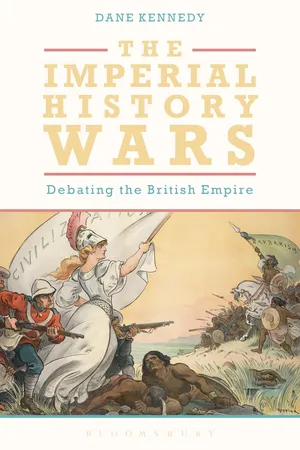
The Imperial History Wars
Debating the British Empire
- Dane Kennedy(Author)
- 2018(Publication Date)
- Bloomsbury Academic(Publisher)
4 Exploration and Empire Exploration was frequently the founding undertaking of empire, yet it attracted surprisingly little attention from imperial historians for decades after decolonization. When I began research for what would become my book The Last Blank Spaces: Exploring Africa and Australia (2013), I found that the richest, most illuminat-ing scholarship on exploration came from historical geographers, historians of science, and literary scholars. The original version of this essay, which appeared in History Compass in 2007, sought to synthesize this multidisciplinary scholarship and identify themes that seemed especially relevant to my own foray into the subject. The revised version that appears here acknowledges the renewed attention the history of exploration has received in recent years. Exploration, as it is commonly understood, is a product of a particular historical legacy. According to the Oxford English Dictionary, “exploration” first came to refer to arduous journeys to strange lands in the mid- to late eighteenth century, while the word “explorer” was coined in the early nineteenth century. Felipe Fernández-Armesto and others have pointed out that most societies in the past have engaged in what can be broadly construed as exploration. 1 Even so, the practice assumed a particular set of cultural, social, and political valences for Europeans as they extended their reach around the globe. Exploration came to connote a combination of scientific and technological achievement, state power, and national prestige—connotations that persist to the present day, perhaps most notably in space exploration. Expeditions to the far corners of the earth helped to bolster Europeans’ sense of exceptionalism. Explorers served to embody the enterprise, tenacity, and thirst for knowledge that Europeans saw as some of the key characteristics that set them apart from other peoples. 2 eBook - PDF
By the Sword and the Cross
The Historical Evolution of the Catholic World Monarchy in Spain and the New World, 1492-1825
- Charles A. Truxillo(Author)
- 2001(Publication Date)
- Praeger(Publisher)
Chapter 3 The Age of Discovery, Exploration, and Conquest, 1492-1556 SETTING THE STAGE At the end of the fifteenth century, European peoples living along the Atlantic coast began their great era of seaborne imperialism. The Age of Discovery and Explora- tion occurred at the same time as the Italian Renaissance. And though the two movements were not related, the intellectual expansiveness of the Renaissance made it easier for Europeans to assimilate aspects of the New World. By exploring and conquering the Americas, western Europeans were also able to increase the relative weight of their civilization in world affairs. Eventually the resources pro- vided by the New World tipped the age-old balance of Eurasian civilizations in favor of Europe. In this sense, the age of exploration was a turning point in world history (McNeill 1963). Since the retreat of Hellenism in the seventh century (A.D.) and the failure of the Crusades in the thirteenth century, Europeans had been con- fined to the western end of the Afro-Eurasian world island. When Columbus and Vasco de Gama sailed on their epic voyages at the end of the fifteenth century, it still seemed likely that the Ottoman Turks would overrun the whole of Christen- dom. A century later, the entire planet was beginning to feel the impact of the Euro- peans and their sailing gun ships, for the Atlantic maritime tradition facilitated European nations sailing with impunity throughout the world's oceans. Heavy-ship construction, necessary in the stormy waters of the North Atlantic, was combined, in the fifteenth century, with elements of Mediterranean naval technology, such as the lanteen sail, the compass, and portolan charts (Scammell 1989). The Portuguese were pioneers in the synthesis of maritime traditions. The vessels they built sailed throughout the world's oceans; moreover, they proved nearly invincible when armed with cannon.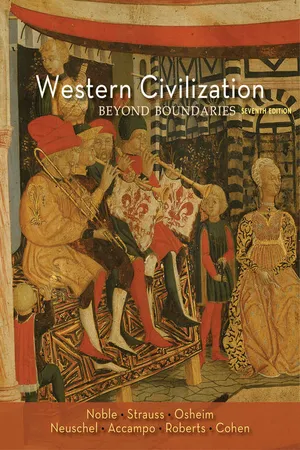 eBook - PDF
Western Civilization
Beyond Boundaries
- Thomas F. X. Noble, Barry Strauss, Duane Osheim, Kristen Neuschel(Authors)
- 2013(Publication Date)
- Cengage Learning EMEA(Publisher)
Cengage Learning reserves the right to remove additional content at any time if subsequent rights restrictions require it. 360 Chapter 13 European Overseas Expansion to 1600 the descendants of the native peoples who greeted the newly arriving Europeans—the Amerindians and the Aborigines, Maori, and Polynesians of the Pacific islands—remind us that the outsiders invaded another world. Their arrival brought modern warfare and epidemic diseases that virtually destroyed indigenous cultures. Spain sent its explorers west because the Portuguese already controlled the eastern routes to Asia around the African coast and because certain technological innovations made long open-sea voyages possible. Thus, the story includes national competition, the development of navigational techniques, and strategic choices. Finally, the Europeans overthrew the great empires of the Aztecs and the Inca, but the transfer of European culture was never as complete as the Europeans thought or expected. As our image suggests, the language and customs of the conquered peoples, blanketed by European language and law, survived, though the lands colonized by the Europeans would never again be as they had been before their encounter with the Old World. The European Background, 1250–1492 What did Europeans know about the wider world in the Middle Ages? By 1400, Europeans already had a long history of connections with Africa and Asia. They regularly traded with Arabs in North Africa, traveled through the Muslim lands on the east- ern edge of the Mediterranean, and eventually reached India, China, and beyond. After 1400, however, Europeans developed the desire and the ability to travel overseas to distant lands in Africa and Asia. Three critical factors behind the exploratory voyages of the fifteenth and early sixteenth centuries were technology, curiosity and interest, and geographic knowledge.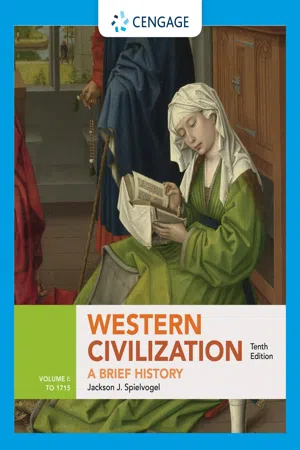 eBook - PDF
Western Civilization
A Brief History, Volume I: to 1715
- Jackson Spielvogel(Author)
- 2019(Publication Date)
- Cengage Learning EMEA(Publisher)
At the beginning of the sixteenth century, European adventurers like Magellan had begun launching small fleets into the vast reaches of the Atlantic Ocean. They were hardly aware that they were beginning a new era, not only for Europe, but for the peoples of Asia, Africa, and the Americas as well. Nevertheless, the voyages of these Europeans marked the beginning of a process that led to radical changes in the political, economic, and cultural life of the entire world. Between 1500 and 1800, European power engulfed the globe. In the Americas, Europeans established colonies that spread their laws, religions, and cultures. In the island regions of Southeast Asia, Europeans firmly implanted their rule. In other parts of Asia and in Africa, their activities ranged from trading goods to trafficking in humans, permanently altering the lives of the local peoples. In all regions touched by European expansion, the indigenous peoples faced exposure to new diseases, alteration of their religions and customs, and the imposition of new laws. Experience an interactive version of this period in 14-1 On the Brink of a New World ■ 315 half of the fifteenth century, European monarchies had increased both their authority and their resources and were in a position to turn their energies beyond their borders. At the same time, by the end of the fifteenth century, European states had achieved a level of wealth and technology that enabled them to make a regular series of voyages beyond Europe. They now had remarkably seaworthy ships and reliable navigational aids, such as the compass and astrolabe (an instrument used to determine the position of heavenly bodies). One of the most important world maps available to Europeans at the end of the fifteenth century was that of Ptolemy, an astronomer of the second century c.e.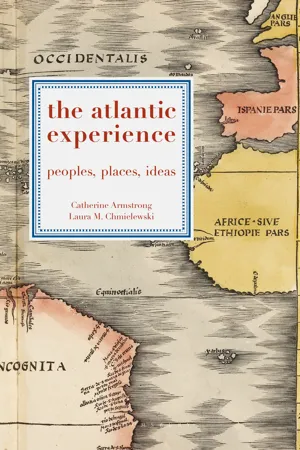 eBook - PDF
The Atlantic Experience
Peoples, Places, Ideas
- Catherine Armstrong, Laura M. Chmielewski(Authors)
- 2013(Publication Date)
- Red Globe Press(Publisher)
1 Navigation and Empire Origins of Empire The desire to explore the wider world and to establish settlements and empires in newly discovered territories was not new in 1500. There is a long and important pre-history to this desire. Although Europeans considered themselves at the centre of the known universe, Africans and Americans were also early exponents of using conquest to dominate their neighbours and develop new systems of governance, albeit with significant local variations. The language we use to discuss these new journeys and imaginings is significant. In talking about the European ‘discovery’ of America we are telling a particularly Eurocentric story, assuming that all innovation and progress was driven from and by Europe. The next chapter explores in more depth what happened when the peoples of the Atlantic world encountered each other for the first time. However, while it is important to acknowledge that Atlantic development repre-sents a departure from previous cultural patterns, this development can also be seen as a continuation and this chapter will explore how ancient and medieval models of empire and earlier technological advances and modes of exploration drove this inno-vation. Historian Charles Verlinden argues that this continuity can be traced from the fifth century onwards. While, prior to 1500, most Africans had not encountered a European in person, the ‘discovery’ of Europe by Africans had certainly begun before that date. Africans soon became aware of the benefits of contact with Europeans and in doing so had redefined themselves and their own identity. Ambassadors and delegations were sent to Europe from 1300 onwards as the European interest in African gold and slaves developed. The Barbary ports on the North African coasts were cosmopolitan places where Europeans of all nations mixed with Africans. The organization of West African society was hugely varied and constantly changing. eBook - PDF
Nations Out of Empires
European Nationalism and the Transformation of Asia
- H. Gelber(Author)
- 2001(Publication Date)
- Palgrave Macmillan(Publisher)
19 2 Explorers, Soldiers, Priests and Traders Until the start of the sixteenth century Europeans knew almost nothing about the Asian-Pacific area or its peoples and empires. Contacts were erratic and sparse. Some Europeans, their numbers much diminished during the fourteenth century, 1 were eager to import Eastern spices, Chinese silks and even bureaucratic principles, not to mention technologies including gunpowder and the magnetic compass. 2 But even educated folk were only dimly aware, through news by caravan or occasional travellers like Marco Polo, of the civil- izations and riches of the fabulous East. Late mediaeval Latin Christendom was a turbulent and dynamic region. Its rulers and peoples were enterprising and energetic, filled with religious zeal and accustomed to war, with one another or against the constant threats to Christendom’s very existence. From the East came Magyars, not settling but raiding deep into Christian Europe year after year. Until the tenth century there was the scourge of the Northmen. These lethal marine bandits could attack coasts or take their light boats up rivers to strike inland for plunder or the simple fun of rape and killing. They roamed Europe’s western coasts and further, to Sicily and Italy. Other Viking groups went east to the land of the Rus (Russia), some bands travelling as far as Constantinople. Different raiders came from the south. Saracens, North African Moors, sailed across the Mediterranean, setting up bases from the French coast to remote alpine mountain fastnesses to prey on trading routes. Above all, there was the general threat of Islam, whose armies swept with fire and sword through the Middle East, North Africa and Iberia, determined to kill or convert the infidel wherever they could get at him. Back in AD 732 Charles Martel, the grandfather of Charlemagne, had led an army of armoured knights to victory against them. Near Tours he H.G. Gelber, Nations Out of Empires © Harry G. Gelber 2001 eBook - PDF
- David Kennedy, Lizabeth Cohen(Authors)
- 2019(Publication Date)
- Cengage Learning EMEA(Publisher)
Due to electronic rights, some third party content may be suppressed from the eBook and/or eChapter(s). Editorial review has deemed that any suppressed content does not materially affect the overall learning experience. Cengage Learning reserves the right to remove additional content at any time if subsequent rights restrictions require it. European Trade and Expansion ● 11 • 1-4 Indirect Discoverers of the New World Europeans, for their part, were equally unaware of the existence of the Americas. Blond-bearded Norse seafarers from Scandinavia had chanced upon the northeastern shoulder of North America about 1000 C . E . They landed at a place near L’Anse aux Meadows in present-day Newfoundland that abounded in wild grapes, which led them to name the spot Vinland. But no strong nation-state, yearning to expand, supported these venturesome voyagers. Their flimsy settlements consequently were soon abandoned, and their discovery was forgotten, except in Scandinavian saga and song. For several centuries thereafter, other restless Europeans, with the growing power of ambitious gov-ernments behind them, sought contact with a wider world, whether for conquest or trade. They thus set in motion the chain of events that led to a drive toward Asia, the penetration of Africa, and the completely accidental discovery of the New World. Christian crusaders must rank high among Amer-ica’s indirect discoverers. Clad in shining armor, tens of thousands of these European warriors tried from the eleventh to the fourteenth centuries to wrest their Holy Land from Muslim control. Foiled in their military assaults, the crusaders nevertheless acquired a taste for the exotic delights of Asia. Goods once unknown in Europe were now craved—silk for clothing, drugs for aching flesh, perfumes for unbathed bodies, colorful draperies for gloomy castles, and spices (especially sugar, a rare luxury in Europe before the crusades) for preserv-ing and flavoring food.
Index pages curate the most relevant extracts from our library of academic textbooks. They’ve been created using an in-house natural language model (NLM), each adding context and meaning to key research topics.

