History

Anglo Spanish War
The Anglo-Spanish War was a series of conflicts between England and Spain that occurred from 1585 to 1604. The war was primarily fought over control of the seas and trade routes, as well as religious differences between Protestant England and Catholic Spain. The most famous event of the war was the Spanish Armada's failed invasion of England in 1588.
Written by Perlego with AI-assistance
Related key terms
1 of 5
3 Key excerpts on "Anglo Spanish War"
 eBook - ePub
Anglo-Hispania beyond the Black Legend
British Campaigns, Travellers and Attitudes towards Spain since 1489
- Mark Lawrence(Author)
- 2023(Publication Date)
- Bloomsbury Academic(Publisher)
38 At the same time, the costs of war created crises of indebtedness for Spain. Defaults entailed the transfer of burdens onto bankers and meant a compulsory rescheduling of debt.The revolution and civil war which rocked the British Isles after 1642 did not much alter imperial rivalry with Spain. The War of the Three Kingdoms and subsequent Cromwellian Republic (1642–60) were accompanied by redoubled rivalry with the Spanish empire beyond Europe. The period 1638–60, according to one recent study, witnessed British commerce and power projection into the Spanish sphere of global influence, beginning the Anglo rise in Atlantic history and ushering in Spain’s slow imperial decline.39 During this period, the Anglo-Hispanic colonization of the Americas shared a Christian world view and sense of mission, which contrasted with the stark differentiation of the religious cold war in Europe. British Protestants and Spanish Catholics resorted to similar biblical justifications for holy violence and conversion during their dual conquest of the New World. Unlike Asiatic powers, neither Spaniards nor Britons had to worry about invasions from rival empires on their borders: only the ‘savages’ of the New World who would be converted, civilized and settled into European life.40 The presence of Anglo-Hispanic colonizers, whether malign or benign in temperament, served as a model for the ideal colonized subject and an aid for Old World dominance. The shared view of the native was repaid in kind by the attitudes of the Indians, the vast majority of whom remained outside of the colonial power networks and dealt with the Old World only fleetingly. William Dampier, the English pirate and circumnavigator, recalled an incident at the Panamanian isthmus in the winter of 1684–5 when some Indians were taking a share of loot from a seized Lima galleon: ‘Here an Indian Canoa came aboard with three Men in her. These Men could not speak Spanish, neither could they distinguish us from Spaniards; the wild Indians usually thinking all white Men to be Spaniards .’41 eBook - PDF
The Emergence of a National Market in Spain, 1650-1800
Trade Networks, Foreign Powers and the State
- Guillermo Perez Sarrion(Author)
- 2016(Publication Date)
- Bloomsbury Academic(Publisher)
3 England, France and the Struggle for Spain, 1650–1715 The rivalry between Great Britain and France over the Spanish market was a drawn- out affair, played out over decades as the English and French states grew stronger, and Spain’s power waned. Like other seventeenth-century rivalries, it was rooted in religious and political differences, compounded by the accretion of commercial interests. In its origin, it sprang from the religious conflict caused by the Protestant Reformation. At the end of the sixteenth century, the English had definitively broken with Rome; his ‘Catholic Majesty’ the king of Spain was the champion of the Counter-Reformation; and his ‘Most Christian Majesty’ the king of France, whose lands were hemmed in on all sides by Spanish domains, had already endured long years of religious strife and now disputed the leadership of the Catholic world with Spain, though as yet without success. The emerging modern states were to a great extent shaped by the Thirty Years’ War, which devastated Germany and Central Europe in the first half of the seventeenth century. The interests of princes, dressed up as reasons of state, also played an important role in structuring a world in which the old medieval monarchies now asserted their divine right to rule, although their power soon became self-justifying. On the pretext of protecting the faith of their subjects, kings sought to rise above the supposed limitations imposed by the ancient institutions of courts and Parliaments, and to create instruments of government to channel the absolute will of the monarch. The logic of direct government by the monarch, which had become the raison d’etat , resulted in a complex international diplomacy based on dynastic marriages and wars fought on religious and political grounds, which eventually reshaped the absolutist states after the Peace of Westphalia (1648) and the Treaty of the Pyrenees (1659).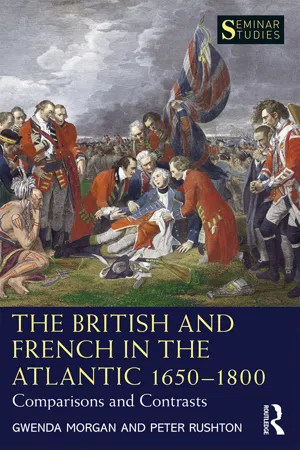 eBook - ePub
The British and French in the Atlantic 1650-1800
Comparisons and Contrasts
- Gwenda Morgan, Peter Rushton(Authors)
- 2019(Publication Date)
- Routledge(Publisher)
4 Wars across the Atlantic- 4.1 The Second Anglo-Dutch War (1665–1667)
- 4.2 King William’s War (1688–1697) or the Nine Years’ War
- 4.3 Queen Anne’s War/the War of the Spanish Succession (1702–1713)
- 4.4 The War of Jenkins’ Ear/War of the Austrian Succession (King George’s War) (1739–1748)
- 4.5 The Seven Years’ War/French and Indian War (1754–1763)
From the 1660s to the early nineteenth century the sequence of wars between the French and the British, ending in the defeat of Napoleon at Waterloo in 1815, shaped the history of the two nations and the fates of their American colonies. In addition they affected the way the identities of the two nations and their offshoots developed. Both French Canada under British rule and the independent United States of America were born of war, of victories and defeats. Some historians have argued that a developing patriotism – the sense of being British or French – was both the cause and the consequence of more than a century of wars between Britain and France. The two national identities were forged in opposition to one another (Colley, 1992). The encounter with the Americas, though, left both nations transformed. In one way, the more that European forces were sent to the Atlantic colonies the more it became clear that warfare on the two continents could be utterly different. Moreover, the scope of the Franco-British wars extended almost globally after 1700, and, indeed, the Duke of Newcastle in the late 1750s in the middle of the Seven Years’ War argued that ‘Ministers in this country where every part of the world affects us in some way or other, should consider the whole Globe’. This was following a comment directed against William Pitt (the Elder, secretary of state in charge of foreign affairs and military strategy) that he had concentrated on the needs of his own department – he ‘looks too much to his own part of the world only
Index pages curate the most relevant extracts from our library of academic textbooks. They’ve been created using an in-house natural language model (NLM), each adding context and meaning to key research topics.

