History

Spanish-American War
The Spanish-American War was a conflict between the United States and Spain in 1898. It was sparked by the sinking of the USS Maine in Havana harbor and resulted in the U.S. gaining control of territories such as Puerto Rico, Guam, and the Philippines. The war marked the emergence of the U.S. as a global power and had significant implications for its foreign policy.
Written by Perlego with AI-assistance
Related key terms
1 of 5
11 Key excerpts on "Spanish-American War"
 eBook - PDF
Guide to U.S. Foreign Policy
A Diplomatic History
- Robert J. McMahon, Thomas W. Zeiler, Robert J. McMahon, Thomas W. Zeiler(Authors)
- 2012(Publication Date)
- CQ Press(Publisher)
★ b y J a s o n C o l b y c h a p t e r 6 The Spanish-American War and Imperialism T he Spanish-American War (1898) trans-formed the United States from a continental power to a world empire with colonial posses-sions in the Caribbean and Pacific. Although the conflict was precipitated by the threat to U.S. interests posed by the Cuban revolution, the United States’ decision to launch an expansive war for empire stemmed primarily from domestic concerns. Among the most prominent of these was the belief voiced by political and business elites that the nation’s economic system needed greater access to international markets, particularly in Asia, in order to survive. Equally important was rising nationalist sentiment, as large num-bers of Americans demanded their country prove its mili-tary mettle against Spain and assume its destiny as a world power. Together, these concerns spurred the United States to combine intervention in Cuba with the annexation of Puerto Rico, Hawaii, Guam, and the Philippines. Drawing upon its new position as a colonial power in Asia, the United States sought to protect its growing inter-ests on the mainland. In 1899 and 1900, U.S. leaders in Washington promulgated the “Open Door Notes,” which called upon the other imperial powers to refrain from divid-ing China into closed spheres of influence, and they joined with those powers to put down the Boxer Rebellion. Yet overseas expansion raised troubling questions for Ameri-cans about the morality and domestic costs of imperialism. Chastened by the bloody Philippine-American War, in par-ticular, the United States explored more informal means of imperial control. This shift was typified by the 1901 Platt Amendment, which enabled the United States to end its military occupation of Cuba while protecting U.S. business and strategic interests. NATION AT THE CROSSROADS By the 1890s, the United States was a continental power reaching for global influence. eBook - PDF
War and American Popular Culture
A Historical Encyclopedia
- M. Paul Holsinger(Author)
- 1999(Publication Date)
- Greenwood(Publisher)
8 The Spanish-American War and the Philippine Insurrection Long before 1898, many Americans contemplated the annexation of Cuba. As early as the mid-1850s, plans were made by a number of pro-slavery U.S. dip- lomats in Europe to add Cuba to the nation's territorial possessions with the thought of being able to expand the "peculiar institution" of slavery into an- other congenial climate. That power grab failed, but in the 1860s and again in the 1870s, others were on the verge of advocating an attack on the Spanish-held colony and taking it by brute force. Even though, once again, nothing came of such plans, thousands of Americans began to show increasing interest in Cuba, Puerto Rico, and other Caribbean possessions of the Kingdom of Spain. In 1868, a bloody war for Cuban independence broke out. It took the Spanish ten years to crush the revolt, and over the next few years, the oppression of the Cuban peoples grew steadily. When another revolution, which looked toward the ultimate independence of the island, erupted in 1895, the people of the United States were, in many cases, overwhelmingly supportive of the underdog Cubans and, conversely, antagonistic to anything Spanish. That attitude was encouraged continually by a number of U.S. newspapers, especially two large New York competitors, William Randolph Hearst's Journal and Joseph Pulit- zer's World. These two men, often called the fathers of yellow journalism, frequently filled their pages with lurid stories of real and supposed Spanish horrors. By early 1898, both the Journal and the World had their readers worked up to a fever pitch of hatred against the Spanish Army. With the United States just beginning to come out of a four-year-long national economic depression, many readers found excitement and welcome diversion in the power struggle in Cuba.
- Christopher Bigsby(Author)
- 2006(Publication Date)
- Cambridge University Press(Publisher)
12 K E N N E T H P. O ’ B R I E N The United States, war, and the twentieth century No major advanced industrial nation has suffered less or profited more from its twentieth-century wars than the United States. Nor has any nation dis- patched its troops to as many places across the globe in the late twentieth century to defend and extend its national interest. At the end of the nineteenth century, the United States possessed one of the smallest armies in the indus- trial world; a century later its armed forces spanned the globe, bristling with deadly hardware and sophisticated technology, a military power without peer. To a large extent, this remarkable transformation had resulted from participation in two European wars, which had necessitated a reorganization of society and the establishment of new controls over its citizens. The Spanish-American and Philippine-American Wars By the 1890s, many influential Americans believed their economy required access to foreign markets to avoid future depressions. Incorporating this notion into a broader ideological framework, influential policymakers sought to establish an indirect control of large areas of the Caribbean and the Pacific. These ideas, informed by notions of racial hierarchy and articulated through a gendered vocabulary, provided the larger context for the war of 1898, as two presidents faced a growing Cuban insurrection against Spanish rule. 1 Between 1895 and 1897, American diplomats had pressured Spain to resolve the crisis on the island, with little result, and by late 1897 many Americans believed Spanish rule in the Caribbean must end. In February 1898 two events – the de Lome letter and an explosion aboard the battleship Maine while in Havana that killed 266 US sailors – triggered the final movement toward war. To President McKinley’s rambling war message the Congress attached the Teller Amendment, specifically denying US terri- torial interests in Cuba.
- Jerald A Combs(Author)
- 2015(Publication Date)
- Routledge(Publisher)
The forces inclining the United States toward overseas expansion and intervention had developed rapidly in the post-Civil War period. Most important of these was America’s growing power. The nation’s population increased from 39 million in 1870 to 63 million in 1890. By the 1890s, America surpassed all nations in the production of coal, oil, and steel, the sinews of modern power until the atomic age. Popular writers and politicians made clear to the American people the strategic and economic benefits of acquiring Caribbean naval bases, an isthmian canal, and Hawaii. They helped translate hazy inclinations into systematic thought patterns.The Spanish-American War supplied the catalyst to create a new national majority ready to intrude into the realm of great power politics and accept an overseas empire. The original rationale of the Spanish-American War, intervention to free Cuba from Spain, did not stretch the old diplomacy too much, especially when Congress declared its intention not to annex Cuba. But the thrill of military combat and victory broke down many of the barriers to overseas intervention and annexation. The United States took Puerto Rico, the Philippines, Guam, and Wake Island, completed the annexation of Hawaii, and asserted a protectorate over Cuba. It then acquired the Panama Canal route, undertook wholesale military interventions in Central America and the Caribbean, and increased its diplomatic activity in Asia.Even in this imperial aftermath of the Spanish-American War, Americans remained wary of European entanglement. They defended their Latin American interventions as necessary to ward off European expansion and consequent conflict with the interests of the United States. They offered the Open Door in Asia as an alternative to European attempts to carve China further into spheres of interest, a process that might entangle the United States in European balance of power politics. Finally, however, World War I dragged the United States into the European arena. Americans became thoroughly enmeshed in global politics. eBook - PDF
Selling War to America
From the Spanish American War to the Global War on Terror
- Eugene Secunda, Terence P. Moran(Authors)
- 2007(Publication Date)
- Praeger(Publisher)
The Spanish-American War was a relatively easy war to sell to a U.S. public clamoring for Ameri- can intervention. Selling the annexation of Puerto Rico and U.S. control of the Philippines was a bit harder, but appeals to patriotism undermined the naysayers and assuaged the concerns of the American people. What began as “Mr. Hearst’s War” ended up as “America’s War,” the war America The Splendid Little War—The Spanish-American War 25 wanted, perhaps needed, to continue its frontier heritage by wedding it to sea power, bringing enlightenment, peace, justice, and freedom to the less fortunate peoples of the world. The American Colossus no longer enlight- ened the world by example alone but with deeds as well. Destiny was now manifest. eBook - PDF
America in the World
A History in Documents since 1898, Revised and Updated
- Jeffrey A. Engel, Mark Atwood Lawrence, Andrew Preston, Jeffrey A. Engel, Mark Atwood Lawrence, Andrew Preston, Mark Atwood Lawrence, Mark Lawrence, Jeffrey A. Engel, Andrew Preston(Authors)
- 2023(Publication Date)
- Princeton University Press(Publisher)
2 Imperial America WAR WITH SPAIN AND THE PHILIPPINES U.S. power had expanded enormously by the time the United States went to war with Spain, but it was not yet clear what role the rising nation would play on the international stage. Policy makers and pundits charged Spain with mer- cilessly misruling Cuba—a country many American policy makers desired for their own sphere of influence—as Spanish leaders countered independence- minded rebels with force by the late 1890s. Unrest brought even more brutal tactics, while instability contributed to economic woes for the island, whose lu- crative trade with the United States sufered. The death of a hard-line national- ist prime minister in Madrid in 1897 cleared the way for the promise of Cuban independence by the start of 1898. Peace would not come easily, however. Ongo- ing instability on the island prompted further Spanish crackdowns, drawing even greater concern from the United States. In February 1898, President Wil- liam McKinley announced that American naval vessels would sail to Havana, ostensibly to ensure the safety of American citizens, though clearly also as a re- minder to Spanish officials that their actions would not go unnoticed. As the documentary record now makes clear, McKinley also longed to ensure that any Cuban state, devoid of Spanish rule, would remain under American influence if not direct American control. Leading the American flotilla was the battleship USS Maine, which moved to Cuba at the same time American strategists positioned additional naval forces near other Spanish outposts in Europe, Asia, and throughout the Pacific. Cuba was the spark, but planners were ready for a far wider conflagration. The first unexpected explosion sunk the Maine, which caught fire during the night of February 15 in the middle of Havana’s harbor. American politicians and a wild-eyed press corps demanded revenge, even if little evidence existed at the time that Cuban or Span- ish forces were at fault. eBook - ePub
Amateur Armies
Militias and Volunteers in War and Peace, 1797–1961
- Stephen M. Cullen(Author)
- 2020(Publication Date)
- Pen & Sword Military(Publisher)
Chapter 5The Spanish-American War, Cuba 1898
The USA, the Americas, and Spain
From the founding of the United States an important element in its foreign policy was to establish and maintain US pre-eminence on the American continent. The defeat of Britain in the American Revolution opened the way to the beginnings of trans-continental US expansion, and in the War of 1812 an attempt to incorporate British North America into the young American republic. Although the US’s strategic aims regarding British North America were foiled by its failure in that war, it did not in any way end the desire for US dominance throughout the continent. By the 1840s the concept of the United States’ ‘manifest destiny’ to occupy and dominate as much of the North American land mass as possible was a commonplace. This sense of a God-ordained future later came to encompass South America, a destiny that first required the expulsion of European powers from the region. By the late 1880s, the Indian Wars within the territory of the US were drawing to a close, and US interests were expanding in the Caribbean, where Spain, France and Britain held numerous territories.US strategic interests in the region were focused on the long-term plan of cutting a sea canal through the Panamanian isthmus. The initial French attempt to do this had come to grief due largely to the appalling death rate of workers, and construction had been abandoned in 1889. But the idea was key for advocates of US naval power. A canal would link both seaboards of the US, allowing naval ships to be quickly transferred between the Atlantic and the Pacific rather than enduring the long and dangerous route via Cape Horn. Among the enthusiasts for a crossing through the isthmus was Theodore ‘Teddy’ Roosevelt, who was appointed to the post of Assistant Secretary of the Navy in the spring of 1897 by the new President, McKinley. Roosevelt would become nationally famous thanks to his part in the Spanish-American War, leading a volunteer unit subsequently lionised in the US press. Teddy Roosevelt was a supporter of the naval theories of Captain Alfred Thayer Mahan, a lecturer at the US Naval War College and an advocate of naval power. An Anglophile, he took British naval surpremacy as a model, arguing that a combination of Britain’s geography, commitment to the sea and outward-looking governments had brought trading success and global power, protected by a strong navy, all of which could be emulated by the USA. Mahan made the idea of naval power a fundamental concern, and ‘it is no exaggeration to say that Mahan’s writings had a worldwide impact that changed the shape of armaments for a generation, and thinking about strategy for much longer than that’.1 In his The Naval War of 1812 , Mahan argued that the US needed a great fleet, and that in order ‘to support the great fleet he envisioned, Mahan called for bases in the Caribbean and the Far East and for a canal across Central America’.2 eBook - PDF
Borders and Bridges
A History of U.S.-Latin American Relations
- Stewart Brewer(Author)
- 2006(Publication Date)
- Praeger(Publisher)
5 Nineteenth-Century U.S. Imperialism and the Spanish American War Unless a man believes that there is something great for him to do, he can do nothing great. Hence so many of the captains and reformers of the world have relied on fate and the stars. A great idea springs up in a man’s soul; it agitates his whole being, transports him from the ignorant present and makes him feel the future in a moment. It is natural for a man so possessed to conceive that he is a special agent for working out into practice the thought that has been revealed to him. Why should such a revelation be made to him, why should he be enabled to perceive what is hidden to others—if not that he should carry it into practice? – William Walker During the year preceding the outbreak of the Spanish War I was Assistant Secretary of the Navy. While my party was in opposition, I had preached, with all the fervor and zeal I possessed, our duty to intervene in Cuba, and to take this opportunity of driving the Spaniard from the Western World. Now that my party had come to power, I felt it incumbent on me, by word and deed, to do all I could to secure the carrying out of the policy in which I so heartily believed; and from the beginning I had determined that, if a war came, somehow or other, I was going to the front. – Theodore Roosevelt Following the end of the Mexican War, the United States emerged as the major power in the western hemisphere. The United States had demonstrated that it had the ability—militarily and economically—to wage and win a war within the hemisphere. And although at first the United States was quick to defend its actions as retaliatory in nature against Mexican aggression, Latin 60 Borders and Bridges America’s worst fears were confirmed in 1848 when the Treaty of Guadalupe Hidalgo was ratified. The United States was aggressive and expansionistic, and Latin America was in its sights. eBook - PDF
- Mark Peceny(Author)
- 1999(Publication Date)
- Penn State University Press(Publisher)
3 The Spanish-American War and the Foundations of the Pro-Democratic Compromise The Spanish-American War heralded America's emergence as a great power in the international system. The United States had already become the world's most prosperous state by 1898, but its army numbered only 25,000 and its isolationist tendencies led to its exclusion from European great power politics during most of the nineteenth century. Then the United States delivered a crushing blow to decadent Spain, acquired the remnants of its colonial empire, and was finally recognized by Europe as an important force in the global balance of power. What kind of great power would the United States be? How would it use its newfound power and influence in the world? How would it exercise its authority over its new possessions? President William McKinley pursued similar nonliberalization policies in Cuba and the Philippines in the immediate aftermath of the Spanish- American War of 1898. He initiated long-term U.S. military occupations to pacify each nation to prevent political instability or the emergence to power of revolutionary forces antagonistic to U.s. interests. Thus, realist concerns about the potential negative consequences of the promotion of democracy 50 Democracy at the Point of Bayonets led McKinley to ignore the opportunities for the pursuit of liberal goals afforded by an unthreatening global balance of power. By mid-1899, however, the McKinley administration was pursuing very different policies in the two countries. On the one hand, the United States adopted proliberalization policies in Cuba, leading to a grant of formal independence to an elected Cuban government in 1902. In the Philippines, on the other hand, the United States engaged in a brutal counterinsurgency war against Filipino nationalists and erected the framework for long-term colonial rule. eBook - PDF
Beneath the United States
A History of U.S. Policy toward Latin America
- Lars Schoultz(Author)
- 2009(Publication Date)
- Harvard University Press(Publisher)
The armistice that was signed in Washington on August 12 required 140 Cuba and the War with Spain Spain to relinquish its sovereignty over Cuba (without specifying to whom), cede Puerto Rico and Guam to the United States, and permit the U.S. occupation of Manila pending negotiation of a treaty of peace, which would determine control of the Philippines. A peace conference began in Paris on October 1, and a treaty was signed on December 10. It declared that Cuba “is, upon evacuation by Spain, to be occupied by the United States,” confirmed the cession of the other islands mentioned in the armi-stice, and transferred sovereignty over the Philippines to the United States in exchange for $20 million. 51 Excluded from all the negotiations, Cubans now had a hazy status. Until this time, Henry Cabot Lodge had favored permitting the Cubans to take over from the Spanish, noting in 1896 that “the officers of the provisional government are Cubans, white men, and of good family and position. Among the principal military officers there are only three of negro blood.” 52 In general, Cubans had received wide praise in the United States for their tenacious three-year struggle against the Spanish, yet once the U.S. forces landed, there was only one early attempt at military cooperation, when the U.S. Army sent Lieutenant Andrew Rowan to meet with General Calixto García in Bayamo. García agreed to provide covering fire if needed during the U.S. landing east of Santiago, but beyond that there was no joint activity. The U.S. participants never reported that their victory was made immeasurably less difficult because the rebels had pinned down nearly all of the 200,000 Spanish troops on the island. With the fighting over, the Army commander in Santiago, William Shaf-ter, reported that the Cuban rebels now wanted to assume control of the country.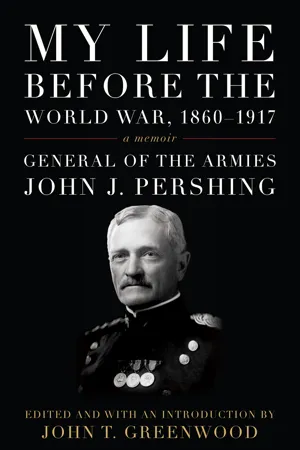 eBook - ePub
- John J. Pershing, John T. Greenwood(Authors)
- 2013(Publication Date)
- The University Press of Kentucky(Publisher)
8The Spanish-American War—Victory in Cuba and Its Consequences
1 July–20 August 1898The Battle for the San Juan Heights, 1–3 July 1898
The morning of July 1 was ideal, the sky cloudless, the air soft and balmy. As the first rays of the sun tipped the stately palms that towered here and there above the jungle, all nature still lay in quiet repose. Our cavalry division had bivouacked near El Pozo, about two miles east of San Juan Hill. The camp was stirring at daybreak and our men were eager to enter what for most of them was to be their first battle. They stood about in small groups opposite their places in column, impatient for the order to advance. From the low ridge near the trail we could see the lines of the enemy’s entrenchments and the blockhouses of the heights of San Juan. Beyond could be seen the successive lines of defense, and behind them arose the spires and towers of the city we were preparing to invest. To the northeast, overlooking all approaches, the stone fort and the smaller blockhouses of the enemy outpost at El Caney were outlined against the sky.The plan was for us not to advance on San Juan Hill, probably the strongest point in the Spanish defenses on our front, until El Caney had been taken. At 6:30 the battery, which we knew was [Captain Allyn] Capron’s, supporting Lawton’s division at El Caney, began firing. It was said that Lawton hoped to capture the hill within an hour or two. But as the time passed it was evident that he was meeting greater resistance than expected. About eight o’clock [Captain George S.] Grimes’ battery at El Pozo opened fire, its position being clearly indicated by the smoke from the black powder they used. The Spanish batteries promptly replied. The artillery duel had been going on for some time when the cavalry division was directed to go forward along the El Pozo–Santiago road, cross the Aguadores River, and deploy to the right. The road was narrow and tortuous and was flanked by heavy jungle. The sun, now high in the sky, had become scorching. Our progress was slow and men soon began to drop out of ranks from the heat. An occasional bullet nipped a leaf above our heads, and our closed ranks began to suffer casualties. For some reason, there was delay ahead of us, and we halted for what seemed an hour. [Brigadier General Jacob Ford or J. Ford] Kent’s division, which was immediately behind us, had orders to cross the San Juan River and deploy to the left. The leading regiment came up abreast of us in column of fours, although the road in places was hardly wide enough for one column.
Index pages curate the most relevant extracts from our library of academic textbooks. They’ve been created using an in-house natural language model (NLM), each adding context and meaning to key research topics.

