History

War of the Spanish Succession
The War of the Spanish Succession was a major European conflict from 1701 to 1714, triggered by the death of the Spanish king without a direct heir. It was fought between the Grand Alliance, led by England, Austria, and the Dutch Republic, and the Bourbon alliance, led by France and Spain. The war resulted in the Treaty of Utrecht, which reshaped the balance of power in Europe.
Written by Perlego with AI-assistance
Related key terms
1 of 5
12 Key excerpts on "War of the Spanish Succession"
 eBook - PDF
Empire of the North Atlantic
The Maritime Struggle for North America, Second Edition
- Gerald S. Graham(Author)
- 2019(Publication Date)
- University of Toronto Press(Publisher)
The War of the Spanish Succession APART from leaving most of the factories on Hudson Bay in the hands of the French, the Treaty of Ryswick (1697), which concluded the War of the League of Augsburg, effected no changes of European sovereignty in North America. In contrast, the War of the Spanish Succession, which followed four years later, was to produce a major rearrangement of colonial boundaries. Essentially the war was an attempt to defeat the dynastic ambitions of Louis XIV and restore the European balance of power. In an effort to prevent France from gaining the full inheritance of the Spanish Empire, England, Holland, and Austria came together in 1701 in a Grand Alliance. This alliance had positive objectives, however, beyond the limits of national se-curity. It was designed to prevent France from monopolizing the Spanish Indies and consequently Spanish sea power, and to regain, for England especially, the commercial privileges which had been enjoyed within the old Spanish empire. For Louis had not only put his grandson on the throne of Spain and thereby upset the delicate European equilibrium; he had immediately taken over the rich asiento, and his navy (which the English Admiralty was inclined to over-estimate) had been ordered to protect all trade between the Spanish colonies and the French kingdom. It was this excess of colonial power and wealth which weighed so heavily in the minds of commercially minded Whig statesmen. Both Dutch and English would probably have consented, with reluctance, to see a Bourbon at Madrid; but even had the barrier fortresses never been seized or Holland's sovereignty never threatened, it is doubtful if England would in the long run have allowed France to take over the monopoly of Spanish trade in the New World. Indeed, Article VIII of the agreement which produced the Grand Alliance 83 V 84 EMPIRE OF THE NORTH ATLANTIC stipulated that France should never be allowed to enjoy the ex-clusive commerce of the West Indian colonies. eBook - ePub
- Howard S Levie(Author)
- 2019(Publication Date)
- Routledge(Publisher)
2 The War of the Spanish Succession (1702–1713)1. The Second Grand Alliance
During the final quarter of the seventeenth century one of the major problems which beset Europe was the maintenance of a balance of power between the French Bourbons and the Austrian Hapsburgs; and the Spanish Succession became the core of this problem. Charles II had ascended to the Spanish throne in 1665 upon the death of his father, Philip IV. Epileptic and in poor health generally, childless and likely to remain so, the question of his successor was a continuing problem almost from the day of his ascension to the throne and had a major effect upon events in Europe for many years. Both the late Louis XIII of France and the late Ferdinand III of Austria had married daughters of Philip III of Spain. Both Louis XIV, the reigning Bourbon in France, and Leopold I, the reigning Hapsburg in Austria and the Holy Roman Emperor, had married daughters of Philip IV of Spain. Although the Spanish Infantas who married the French Bourbons had renounced their claims to the Spanish throne, those who married Austrian Hapsburgs had not. Louis XIV declared that his wife's renunciation was invalid. Leopold's wife died leaving only one daughter and Leopold (who twice remarried and had two sons by his third wife) had that daughter renounce her claim to the Spanish throne in his favor and then concentrated on his claim through his mother with the intention of naming his second son, the Archduke Charles, to that throne. (In 1703 both he and his elder son, Joseph, renounced their claims to the Spanish throne in Charles' favor.)On 12 May 1689 Leopold and the Dutch entered into the Treaty of Vienna, an alliance against France, with whom they were both already in conflict. England, Spain, and a number of the German principalities adhered to this Treaty during the subsequent months. This was the creation which came to be known as "The Grand Alliance,"1 the members of which were at war with France until the Treaties of Rijswijk were signed on 20 September 1697.2 when those Treaties became effective Europe was at long last more or less at peace--but it was still faced with the unresolved problem of the succession to Charles II of Spain. His father, Philip IV, had designated the Elector of Bavaria as Charles' successor should the latter die without direct descendants; but Charles could undo this. Louis XIV of France hoped to be able to place the Dauphin of France on the Spanish throne and thus eventually to unite the two countries, France and Spain, under a Bourbon king, a possibility which most of the rest of Europe could only view with alarm. Shortly after Rijswijk, Louis and William III of Great Britain began negotiations aimed at solving the problem of the Spanish Succession. In October 1698 they arrived at an agreement (the "First Partition Agreement") under which the Elector of Bavaria would become the King of Spain upon the death of Charles II; but a few months later, on 6 February 1699, the Elector died and it was all to do over again. A new agreement (the "Second Partition Agreement") was reached in March 1699 under which the Archduke Charles of Austria was named as the successor to Charles II on the Spanish throne.3 eBook - PDF
The Irish Brigade, 1670–1745
The Wild Geese in French Service
- D. P. Graham(Author)
- 2019(Publication Date)
- Pen and Sword Military(Publisher)
Chapter 17 Return to the Fight – The War of the Spanish Succession T he War of the Spanish Succession has been suggested as the main reason that France had wanted to wind down the previous war as expeditiously as possible, at least from 1695 onwards. The Treaty of Ryswick had done much to dampen Louis’s ardour for the fight, certainly in terms of finally ensuring that he realised the cost, and implications, of that elusive concept known as Gloire . He was no longer a young man, and had even started to believe that France’s victories meaning so little on a strategic scale during the previous war had been some form of divine justice at work. He had worked towards finding a peaceful way of finding a solution to the Spanish land question that would come with the death of Carlos II. However, only further war would decide the question when Carlos died, having left his kingdom to Philip of Anjou and a France that had already fought a war over dominance of Europe. In this instance, Marlborough and Eugene would gain years of victories over Louis’s less able commanders, after the war in which the once mighty Luxembourg and Boufflers had been so dominant. Yet the Dutch Provinces and England had remained strong in the face of Louis’s might, just as France would remain despite the pending string of allied victories. In the end he would win the throne of Spain for his grandson, retain his territory and, despite damage done to French military authority, retain some of his prowess. Carlos II’s childless end was inevitable by the turn of the century, with the French having a strong claim to the Spanish throne. This, and the potential uniting of European power blocs with a Catholic hegemony, was enough to set the rest of Europe, and the remnants of the Grand Alliance, on edge. Both Marie Thérèse, mother to the dauphin, and his grandmother had been Spanish princesses and, being eldest daughters, Spanish tradition allowed them to inherit the throne in the absence of sons. eBook - ePub
- Jean Berenger, C.A. Simpson(Authors)
- 2014(Publication Date)
- Routledge(Publisher)
CHAPTER ONE The War of the Spanish Succession (1665–1713)Charles II of Spain, on 2 October 1700, a month before he died and already in a much weakened state, named his successor in his will and so achieved the most significant act of his thirty-five-year reign. The king had yielded to pressure from cardinal Portocarrero and the Castilian national party and by disinheriting his uncle, the emperor Leopold I, he had barred the cadet branch of the Habsburg family from what it saw as its rightful inheritance and distanced himself from the House of Habsburg. The Spanish nation wanted to preserve the Spanish monarchy of Charles V and Philip II and would not countenance any division of Spanish territories. The Council of Spain knew that the Austrian monarchy, for all its recent victories in Hungary, was incapable of successfully defending its Madrid ally in the war which then seemed inevitable.The great powers had completed the final stages of their plans directed against the Habsburgs. Louis XIV of France and William of Orange, as king of England, elaborated a compromise solution which found no favour with the Castilian patriots. They proposed that Leopold I should receive the Spanish crown and compensate his Bourbon cousins, the descendants of Maria Theresa, the Spanish infanta and wife of Louis XIV, by giving them the House of Austria’s entire Italian patrimony. Since Philip IV’s death, the Madrid government had been firmly opposed to any division of Charles II’s possessions and had advocated the alternative plan of making the heir the duke of Anjou, Louis XIV and Maria Theresa’s grandson, on sole condition that he guaranteed the integrity of the Spanish monarchy. Charles II’s decision in his will was surprising and marked the subordination of the dynastic principle to the idea of the nation. It had a decisive effect on how the Habsburgs in the future maintained the balance of power in Europe. The interests involved were so great and so conflicting that to find a peaceful settlement was a great challenge, even though the question of a successor to Charles II had exercised the chancelleries of Europe since the signing of the Peace of the Pyrenees in 1659. Why this was the case becomes clearer when all the negotiations relating to the Spanish succession are examined.1 eBook - ePub
- John A. Lynn(Author)
- 2013(Publication Date)
- Routledge(Publisher)
7 THE FINAL CONTEST: THE War of the Spanish SuccessionThe Treaty of Ryswick chastened the ageing monarch, who interpreted the disappointment and suffering that the Nine Years War had inflicted on him, his state, and his people as an act of divine will, as caution or even condemnation. In addition, Louis was no longer a young man driven by the need to establish his glory through warfare, and could be more confident in his frontiers, having buttressed them through numerous annexations. Thus, he now worked to find a peaceful way to distribute the lands of Carlos II, as that Spanish king came to the end of his life. However, fate overcame the best efforts of princes and diplomats when Carlos II died leaving all this domain to Philippe of Anjou, the grandson of the Sun King. Unfortunately, and perhaps unavoidably, war overcame Europe again over this matter of the Spanish succession. Already weakened by the huge costs of the Nine Years War, France could ill afford another great war so soon after the conclusion of the last. French arms, virtually invincible for so long, were anything but in the new conflict, and the duke of Marlborough and prince Eugene of Savoy gained years of victories over Louis's less talented commanders. Still, France did not collapse, any more than had its foes in the Nine Years War, when Louis's armies had seemed so dominant. Instead, France suffered and survived until Marshal Villars led French armies to victory during the last years of the war. It would be foolish to call the War of the Spanish Succession a triumph for Louis, but neither did it end in defeat, for he finally won the Spanish throne for his grandson, retained the territorial gains he had gained in earlier wars, and reasserted French military prowess.THE ONSET OF AN UNWANTED WAR, 1698–1701
After Ryswick, Louis's primary concern, and that of other European leaders, was the Spanish succession. Carlos II had already lived longer than anyone had expected he would, but European statesmen now believed that the end was fairly near, and they knew he would die childless. Hopeful pretenders for the soon-to-be-vacant throne had powerful backers. The dynastic marriage game dealt several contenders strong hands, with the progeny of Louis XIV and Leopold I holding the best cards. The dauphin had the strongest trump to play, because both his mother, Marie Thérèse, and his grandmother were Spanish princesses; in fact, both were eldest daughters, and Spanish practice allowed daughters to inherit the throne in the absence of sons. Louis had earlier made claims to Spanish lands in the name of his wife; now he could in the name of his son. But Louis was not the only ruler who wanted his descendants to rule Spain; Leopold I, the Habsburg Holy Roman Emperor, was also the grandson of King Philip III of Spain. Leopold defended the claim of his son, Archduke Charles. Luckily another youth, Joseph Ferdinand, electoral prince of Bavaria, also stood in line and might serve as a reasonable compromise candidate to avert a clash between France and Austria. eBook - PDF
The Primacy of Foreign Policy in British History, 1660–2000
How Strategic Concerns Shaped Modern Britain
- William Mulligan, Brendan Simms(Authors)
- 2010(Publication Date)
- Palgrave Macmillan(Publisher)
4 Anglo-Scottish Union and the War of the Spanish Succession Allan I. Macinnes At first reading, there is a clear diplomatic symmetry between the Anglo- Scottish Union of 1707 and the War of the Spanish Succession. Initial talks for Union under Queen Anne commenced after her accession and the out- break of the War in 1702. The Union was accomplished in the midst of the War. Scottish peers and MPs commenced proceedings in the British Parlia- ment to terminate the Union as peace was being negotiated at Utrecht in 1713. The War of the Spanish Succession, just as its predecessor the Nine Years’ War of 1688–1697, placed England in direct opposition to France under Louis XIV. Scotland yet again appeared to offer a backdoor for a French invasion of England, especially as Louis XIV favoured the restoration of the exiled house of Stuart. James VII and II had been relieved of the common monarchy of Scotland, England, and Ireland at the Revolution of 1688– 1691 for his professed Roman Catholicism and his authoritarian reliance on the prerogative powers of the crown rather than working with or through parliaments. His son-in-law, William of Orange and his daughter Mary had succeeded him. On his death in 1701, his son James VIII and III was recog- nised by Louis XIV as the legitimate Jacobite claimant to the three kingdoms. However, the English Parliament had that same year already determined uni- laterally on the succession. On the death of William’s designated heir, his sister-in-law Anne, the common monarchy would be settled on the German house of Hanover as her nearest Protestant heirs. Accordingly, there was a real prospect that the War of the Spanish Succession could turn into the War of the British Succession. Yet this prospect had been apparent in 1703 when England was content to break off negotiations for Union with Scotland and to refuse overtures for Union from Ireland. eBook - PDF
I Am Not Master of Events
The Speculations of John Law and Lord Londonderry in the Mississippi and South Sea Bubbles
- Erik Levi(Author)
- 2009(Publication Date)
- Yale University Press(Publisher)
During that conflict both sides mobilized armies on land and navies at sea on a scale that was unprecedented in European history. By this time, belligerents realized that the military revolution under way since the fourteenth century in Europe meant that success in war depended on deploy-ing the largest and best equipped force in every battle, whether at land or sea. Equipping large armies with a full range of firearms, supplying them in the field for extended periods of time, and ultimately launching large quantities of ordnance in battle burdened governments with expenses that required ever more daring financial experiments during the War of the Spanish Succession. At the conclusion of that war, with its unsatisfactory results for all concerned, the refinancing of the accumulated stock of debts in order to resume military action induced even more monetary and financial experiments. When Lon-donderry met with him in Paris in August 1719, Law was putting in place the last elements of his system to revive the finances of France, a bold experiment that would soon be imitated in England. By that time, both men had been shaped by their experiences during the War of the Spanish Succession. The proximate cause of the war was the death in 1700 of the childless and ineffectual Charles II, the last Habsburg king of Spain. His will specified that his successor should be Philip Bourbon, the Duke of Anjou and the second grandson of Louis XIV, king of France, on condition that Philip waive any claim he or his descendants might have for the throne of France. Even so, Philip’s accession to the throne of Spain, with control of Spain’s possessions in America and northern Italy, and his filial friendship with the monarch of France, threatened both Britain and Austria as well as the Netherlands and Portugal. Britain was concerned about maintaining its Mediterranean trade while expanding its Atlantic trade by holding on to the Caribbean islands it had recently acquired.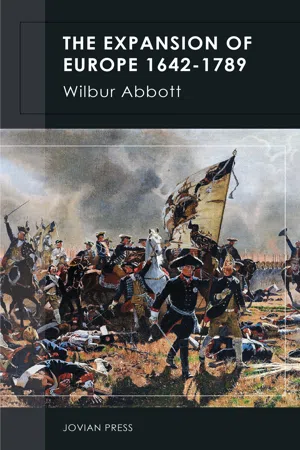 eBook - ePub
- Wilbur Abbott(Author)
- 2017(Publication Date)
- Jovian Press(Publisher)
But even the great war which filled the first two decades, of the history of western Europe by no means exhausted the importance of that period in the political development of the continent. The years which saw the collapse of Louis XIV’s ambitions had witnessed a series of minor changes among his allies and his enemies, which, like his own great adventure, bore within them seeds of a new order and of new conflicts. Almost at the moment he left the scene of his activities the death of Anne brought to the English throne the Elector of Hanover as George I; and the failure of the rebellion which the Stuart pretender, James III so-called, essayed against his rival ensured not merely the triumph of the Hanoverian house but parliamentary and Protestant supremacy, with the dominance of its champions, the Whigs. This was the more significant in that, during the crisis of the great war just past, England and Scotland, after a century of personal union under the crown, had finally achieved a legislative union under Parliament. Moreover, England had crowned her long connection with Portugal by the great Methuen treaty of commerce — and so, among other results, replaced Burgundy with port on British dinner tables. The Act of Union which took effect at the moment of the allies’ triumph over the French was designed to compose the antagonisms aroused by the revolution, and the bitterness produced by the failure of the Scotch Darien Company. Thenceforth England was relieved in large measure from the danger which had long threatened her from her sister kingdom, and Scotland exchanged her partial autonomy for substantial share in England’s wealth and power. The Elector of Saxony had long since become king of Poland, and this circumstance, with Hanoverian kingship in England, the elevation of Savoy and Brandenburg to like rank, altered the titular situation of the continent.But the effect was deeper far than that. Thenceforth Prussian ambition tended to translate its title into fact, and to extend this new-won dignity over increasing territory to the further disturbance of European peace. The personal union of Poland with Saxony and of England with Hanover tended to involve those extra-German states in the ambitions of the Hohenzollerns. Thus, among the remoter results of the War of the Spanish Succession, these dynastic changes were to bear fruit in another no less far-reaching conflict, on whose event the fortunes of the European world during the next generation were to depend.Meanwhile, however, another series of events divided with the War of the Spanish Succession the interests and the energies of European peoples. These centered in the so-called Northern War. During the years that England and Holland, Spain, Austria, France, Savoy, and German states, made their half of Europe a battlefield, the circumstances of the east were of no less importance and of even greater dramatic interest, while they were intensified by a personal rivalry which succeeded the long duel between William III and Louis XIV. This was the struggle between Charles XII of Sweden and his enemies, of whom the chief was Peter the Great of Russia. And what the eastern conflict lacked in dynastic importance it more than made up in a spectacular quality which far exceeded the subtler antagonism of Bourbon and Orange, and in a tragic intensity strengthened by its romantic adventures and its savage background. eBook - PDF
The Emergence of a National Market in Spain, 1650-1800
Trade Networks, Foreign Powers and the State
- Guillermo Perez Sarrion(Author)
- 2016(Publication Date)
- Bloomsbury Academic(Publisher)
3 England, France and the Struggle for Spain, 1650–1715 The rivalry between Great Britain and France over the Spanish market was a drawn- out affair, played out over decades as the English and French states grew stronger, and Spain’s power waned. Like other seventeenth-century rivalries, it was rooted in religious and political differences, compounded by the accretion of commercial interests. In its origin, it sprang from the religious conflict caused by the Protestant Reformation. At the end of the sixteenth century, the English had definitively broken with Rome; his ‘Catholic Majesty’ the king of Spain was the champion of the Counter-Reformation; and his ‘Most Christian Majesty’ the king of France, whose lands were hemmed in on all sides by Spanish domains, had already endured long years of religious strife and now disputed the leadership of the Catholic world with Spain, though as yet without success. The emerging modern states were to a great extent shaped by the Thirty Years’ War, which devastated Germany and Central Europe in the first half of the seventeenth century. The interests of princes, dressed up as reasons of state, also played an important role in structuring a world in which the old medieval monarchies now asserted their divine right to rule, although their power soon became self-justifying. On the pretext of protecting the faith of their subjects, kings sought to rise above the supposed limitations imposed by the ancient institutions of courts and Parliaments, and to create instruments of government to channel the absolute will of the monarch. The logic of direct government by the monarch, which had become the raison d’etat , resulted in a complex international diplomacy based on dynastic marriages and wars fought on religious and political grounds, which eventually reshaped the absolutist states after the Peace of Westphalia (1648) and the Treaty of the Pyrenees (1659).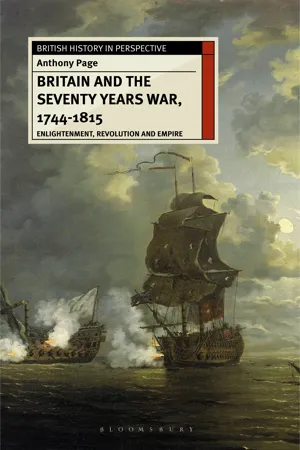 eBook - PDF
Britain and the Seventy Years War, 1744-1815
Enlightenment, Revolution and Empire
- Anthony Page(Author)
- 2017(Publication Date)
- Red Globe Press(Publisher)
12 Historians have long thought in terms of an eighteenth-century Anglo-French ‘Second Hundred Years War’ running between 1689 and 1815. 1 Yet there are problems with talking of a Second Hundred Years War that stretches over 125 years. And the conflicts of this period can be better seen in two groups. The Glorious Revolution sparked the Nine Years War/War of English Succession (1689 – 1697) that was soon followed by the War of Spanish Succession (1702 – 1713). Britain during these two decades of war with Louis XIV’s France continues to attract much scholarly attention. 2 The death of France’s Sun King in 1715 was followed by three decades of Anglo-French peace. They were formally allies from 1716 to 1731 – a period in which ‘France’s navy was practically non-existent’. 3 Indeed, as Jonathan Dull has observed, ‘never had Europe seen a period of peace as wide-ranging and long-lasting as that which endured from late 1721 to late 1733’. 4 Thus, in The Wealth of Nations, Adam Smith observed that early eighteenth-century ‘England had enjoyed a profound peace for about eight-and-twenty years’. 5 Historians sometimes date one of the periods of warfare ‘with France, and allies of France’ as 1739 – 1748, which began with Britain’s War of Jenkins’ Ear against Spain and merged with the War of the Austrian Succession. 6 Yet direct war between Britain and France was not declared until March 1744. Though the end of the War of the Austrian Succession brought ‘a few years of uneasy peace in Europe’, in Stephen Conway’s words, ‘Anglo-French hostilities continued almost unabated elsewhere’ until war was again officially declared in 1756. 7 The years following the end of the Seven Years War (1756 – 1763) saw ongoing rivalry in the Caribbean, India and exploration of the Pacific. Rebellion in Britain’s 13 North American Colonies provided France with an opportunity for Chapter 1: The Seventy Years War THE SEVENTY YEARS WAR 13 revenge by providing military assistance to the insurgents. No longer available |Learn more
- (Author)
- 2014(Publication Date)
- University Publications(Publisher)
This conflict lasted seven years from 1756 to 1763. In the United States, however, the North American portion of the war, which started in 1754, is popularly known as the French and Indian War. Many scholars and professional historians in America, such as Fred Anderson, however, follow the example of their colleagues in other countries and refer to the conflict as the Seven Years' War, regardless of the theatre. In Quebec, the conflict is also referred to as La Guerre de la Conquête , meaning The War of Conquest . The conflict in India is termed the Third Carnatic War while the fighting between Prussia and Austria is called the Third Silesian War . ________________________ WORLD TECHNOLOGIES ________________________ The war was also described by Winston Churchill as the first world war, as it was the first conflict in human history to be fought around the globe, although most of the combatants were either European nations or their overseas colonies. As a partially Anglo-French conflict involving developing empires, the war was one of the most significant phases of the 18th century Second Hundred Years' War. Background This war is often said to be a continuation of the War of the Austrian Succession that had lasted between 1740 and 1748, in which King Frederick II of Prussia, known as Frederick the Great, had gained the rich province of Silesia from Austria. Empress Maria Theresa of Austria had signed the Treaty of Aix-la-Chapelle only in order to gain time to rebuild her military forces and to forge new alliances, which she did with remarkable success. The political map of Europe had been redrawn in a few years as Austria abandoned its twenty-five year alliance with Britain. During the so-called Diplomatic Revolution of 1756, the centuries-old enemies of France, Austria, and Russia formed a single alliance against Prussia. ________________________ WORLD TECHNOLOGIES ________________________ All the participants of the Seven Years' War. eBook - PDF
- Frank W. Thackeray, John E. Findling, Frank W. Thackeray, John E. Findling(Authors)
- 2002(Publication Date)
- Greenwood(Publisher)
2 The Seven Years' War, 1756-1763 INTRODUCTION The immediate origins of the Seven Years' War extend back to at least 1740. In that year the Habsburg ruler Charles VI died without a male heir. Charles had spent much of his reign promoting the Pragmatic Sanction, an exception to tradition that would allow his lands to pass in their entirety to his daughter, Maria Theresa, upon his death. However, the new Prussian king, Frederick II—later "the Great"—stymied Charles's plans when he seized Austria's rich Habsburg province of Silesia in eastern central Europe from Maria Theresa in December 1740. Frederick's aggressive act brought about the War of the Austrian Succession, which lasted until 1748. The war soon escalated into a major conflict involving the most impor- tant European countries. Great Britain, although it had no direct interest in the struggle, entered the fray in 1742 in order to counter its traditional rival France, who had entered the war on Prussia's side. During the course of the war, a British expeditionary force to the Continent found little success. In 1745 French sponsorship of a Stuart restoration in Britain failed ignomini- ously, permanently ending the Stuart threat to the Hanoverian dynasty. In India France made gains at British expense, while in North America Britain eventually captured the important French post of Louisbourg. However, these respective gains were undone by the 1748 Treaty of Aix-la-Chapelle The French and Indians defeated General Edward Braddock. Braddock was killed in battle near present-day Pittsburgh during the North American phase of the Seven Years' War. Reproduced from the Collections of the Library of Congress. The Seven Years' War 21 that—except for Silesia— largely restored the status quo ante bellum, or the prewar state of affairs.
Index pages curate the most relevant extracts from our library of academic textbooks. They’ve been created using an in-house natural language model (NLM), each adding context and meaning to key research topics.

