History

Plantagenet Dynasty
The Plantagenet Dynasty was a royal house that ruled England from the 12th to the 15th centuries. It is known for producing influential monarchs such as Richard the Lionheart and King John, as well as for its role in the Hundred Years' War. The dynasty's reign was marked by significant political and military developments, shaping the course of English history.
Written by Perlego with AI-assistance
Related key terms
1 of 5
7 Key excerpts on "Plantagenet Dynasty"
 eBook - ePub
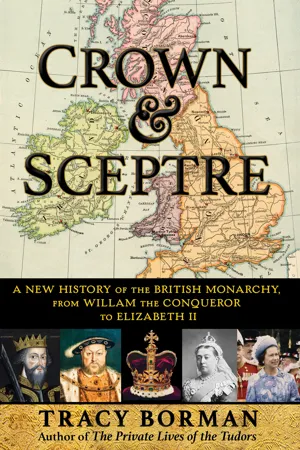
Crown & Sceptre
A New History of the British Monarchy, from William the Conqueror to Elizabeth II
- Tracy Borman(Author)
- 2022(Publication Date)
- Atlantic Monthly Press(Publisher)
Part 2 The Plantagenets (1154–1399)‘From the Devil they came and to the Devil they will return’The name Plantagenet applies to the three related ruling dynasties of Anjou, Lancaster and York: fourteen monarchs in total, their reigns spanning more than three hundred years.1 The most dynamic and energetic dynasty in British royal history, they fostered the legend that they were descended from Melusine, the daughter of Satan, who married an early Count of Anjou, then vanished in a puff of smoke when he forced her to attend Mass. The yellow broom flower that inspired their sobriquet was later embodied in the family arms. Henry II was the first and is generally agreed to be the greatest of the Plantagenet kings. His vast empire stretched from the Scottish border almost to the Mediterranean, and from the Somme in the north of France to the Pyrenees in the south. For much of the period, England waged costly wars with France and Scotland, with mighty warrior kings such as Edward I and III and Henry V achieving celebrated victories. Among the greatest contributions of the Plantagenets was the development of English law and their magnificent architectural legacy. The monarchy also evolved to become much more closely aligned with the interests of the people, while the rise of Parliament prescribed new limits on royal power. Passage contains an image
Henry II (1154–89)
‘A human chariot dragging all after him’WITH THE PEACEFUL accession of Henry II to the English throne in October 1154, the dynastic ambitions of his grandfather and namesake were not merely realised, but spectacularly superseded. England’s new king reunited Henry I’s Anglo-Norman inheritance, but also brought the lands and riches of Anjou and Aquitaine with him. He was compared to ‘a cornerstone joining the two peoples’ and, rather less accurately, as ‘a king of the English race’.1Like his great-grandfather, William the Conqueror, Henry II had already been chiselled into a fearsome warrior by the time he took the throne. Years of campaigning to protect his Duchy of Normandy had given him vital skills of diplomacy, too. Above all, he had youth on his side. He was twenty-one years old when he became King of England, and his restless energy and exuberance seemed boundless. The twelfth-century scholar Herbert of Bosham compared him to a ‘human chariot dragging all after him’.2 eBook - ePub
- W M Ormrod, The British Library(Authors)
- 2011(Publication Date)
- The History Press(Publisher)
- 4 -
The House of Plantagenet 1272-1399
W.M. Ormrod
I t was the Angevin symbol of the sprig of broom, planta genista, that gave the House of Plantagenet its name; but while in origin the title might be supposed to date back to Henry II’s assumption of the throne in 1154, it was not in fact used by the English royal family until the fifteenth century. To call the kings of England from 1272 to 1399 ‘Plantagenets’ is therefore something of a fiction. There is, however, some justification for treating the rulers from Edward I to Richard II as a distinct group. First, although most of these kings attempted, in one way or another, to regain the French territories lost under King John and Henry III, they also gave much attention to the British Isles: this was the period in which the English monarchy not only clung tenaciously to its claims to the lordship of Ireland but also conquered Wales and attempted (and failed) to subdue the independent kingdom of Scots.It was during the late thirteenth and fourteenth centuries that the English monarchy therefore gave its first indications of a coherent ambition for the unification of the British Isles. Secondly, the loss of the overseas territories meant that, to pursue their wars, rulers were dependent on the resources of the kingdom of England, and had to enter into tax negotiations with their subjects through the newly evolving institution of Parliament. Finally, this was a period during which two kings – Edward II and Richard II – were forced to give up their thrones through their incompetence and tyranny. The latter of these depositions brought to an end the direct line of descent of the English crown and heralded the arrival of a new dynasty, the House of Lancaster.EDWARD I (1272-1307)
The first king since the Norman Conquest to bear the Old English name of Edward was born on 17 June 1239, the first child of Henry III and Queen Eleanor of Provence. Edward and his younger brother, Edmund ‘Crouchback’, were both named in honour of Anglo-Saxon royal saints: Henry III’s devotion to Edward the Confessor is well known, but he also had a strong attachment to the cult of St Edmund of East Anglia, centred at Bury St Edmunds. Edward was trained in the school of hard knocks: his emergence to manhood and public life coincided with Henry III’s quarrel with the English barons, and Edward early earned himself a reputation not merely for the vigour and ruthlessness that would be a hallmark of his kingship but also for a tendency to shift his loyalties: he moved from being a supporter of Simon de Montfort’s reform programme to being his bitterest enemy; and after the Battle of Evesham, in which the prince decisively defeated the opponents of the Crown, he was commemorated in verse as one who changed his allegiance in the same way that the leopard was then believed to change its spots. eBook - ePub
Kings & Queens of England
A royal history from Egbert to Elizabeth II
- Nigel Cawthorne(Author)
- 2009(Publication Date)
- Arcturus(Publisher)
CHAPTER THREE
III
THE PLANTAGENETS
THE PLANTAGENETS Henry II (1154–89)Richard I ‘the Lionheart’ (1189–99)John I (1199–1216)Henry III (1216–72)Edward I (1272–1307)Edward II (1307–27)Edward III (1327–77)Richard II (1377–99)Dates show reign of monarch The head of the Welsh prince Llywelyn ap Gruffydd was paraded through the streets of London on a pike after he died in battle in 1282.The First Plantagenet King
Henry II (r.1154–89) was born at Le Mans in 1133. The son of Matilda, daughter of Henry I and Geoffrey Plantagenet, count of Anjou, Maine and Touraine, he was educated partly in England. In 1150 he became duke of Normandy and when his father died in the following year he assumed the title of count of Anjou. He further advanced himself by marrying Eleanor of Aquitaine, who had recently divorced Louis VII of France (r.1131–80). Louis then tried unsuccessfully to crush Henry, who in just two years had moved from being a landless wanderer to the most powerful man in western France. But his acquisitions did not stop there.Henry II ruled England and much of France, but he is remembered for the murder of Thomas à Becket.In January 1153, Henry invaded England in pursuance of his mother’s claim to the throne. There were a number of clashes. King Stephen found his support ebbing away, but fought on in the hope of securing the succession for his son Eustace. When Eustace died in August of that year Stephen lost heart and signed a treaty with Henry. This allowed Stephen to continue as monarch, but named Henry as his heir.Henry II came to the English throne in 1154 – he was the first in a line of fourteen Plantagenet kings. The dynasty would last for more than 300 years. He was short and stocky with legs slightly bowed from endless days on horseback and his hair was reddish, although he kept his head closely shaved. But his blue-grey eyes were his most distinctive feature. They were said to be ‘dove-like when he was at peace’ but ‘gleaming like fire when his temper was aroused’. eBook - PDF
- John F. Le Patourel(Author)
- 1984(Publication Date)
- Hambledon Continuum(Publisher)
VIII THE PLANTAGENET DOMINIONS THE TITLE of this lecture 1 has been a matter of some difficulty, and it might be well to begin by saying what is meant by it. I am using the term 'Plantagenet' as a conventional name for the family of the counts of Anjou. There is not much contemporary justification for this. Tlantegenet' was only one of the soubriquets given to Geoffrey, the father of King Henry II, and itwas not treated as an hereditary surname until the fifteenth century.* From that time, however, it has been wished on to the family retrospectively; historians have used it in this sense and it is convenient. The word 'dominion' is used in the general sense in which it appeared until lately in the royal style,* that is, signifying political units, distinct in law and administration, ruled together by one monarch. In the twelfth century the word 'land' would generally have been used in this context; but 'dominium' was also used, certainly in the fourteenth century. It would have been possible to call this lecture simply 'The Angevin Empire'; and I shall often have occasion to use the word 'empire' in the general sense of an assemblage of 'lands' or 'dominions' under one ruler. But 'The Angevin Empire' as a title could have been misleading; though it is part of the present argument that the term has a much wider significance than is generally given to it. The subject of this lecture, then, is the government of all those lands which in one way or another, and at one time or another, came into the possession or in some way under the authority of this family—Anjou, Touraine, Maine; Normandy, Aquitaine, England; Brittany, Ponthieu, Calais; the Celtic countries of the British Isles. The government of these countries in the Middle Ages has been the subject of an enormous volume of historical writing; but that they formed a governmental unit, or a unit of any kind over a considerable length of time, has not often been suggested. eBook - ePub
The Royal Demesne in English History
The Crown Estate in the Governance of the Realm From the Conquest to 1509
- B.P. Wolffe(Author)
- 2019(Publication Date)
- Routledge(Publisher)
IIA NEW ROYAL PATRIMONY THE PLANTAGENET FAMILY ESTATE, 1227–1399
1. FAMILY ENDOWMENTSThe primary significance of the role of English kings as landowners from the reign of Henry III to the usurpation of Henry IV lay in their development of a new English royal family estate. Historians have tended to look askance at this policy, or to doubt that it ever existed, because of the apparent folly of the consequent, inevitable creation of apanages for younger sons. This has been seen as the surest way of breeding over-mighty subjects and of alienating those royal resources which would best have helped the king to live of his own. It has even been asserted that its principal architect, Edward III, was aware of a traditional unpopularity attached to such a policy and therefore strove to spare the crown lands and to achieve the same results through politic marriages for his offspring.1Contemporaries viewed the matter far differently. By 1399 conventions were firmly established that the principal function of the crown estate was to provide adequate endowment for all members of the royal family. When Henry IV was consolidating his usurpation he was able to rely on the support of petitions from the Commons in Parliament that his queen, his heir and all his sons should receive prompt landed endowment on the ample scales which had become customary by that date. During the later middle ages their duties as head of a royal family towards their queens, their heir, their younger sons and daughters, younger brothers and nephews generated and maintained a very powerful interest in English kings. A well-endowed royal family was an essential attribute of effective kingship. This royal family interest led to very substantial family acquisitions from time to time; certain conventions developed governing the circumstances in which alienations were permissible, and accidents of politics, or failure of family trees, often brought these lands back yet again into the hands of the kings themselves. In such instances, and especially when a dearth of royal children afflicted certain kings, public attention was undoubtedly focused on the employment of this newly augmented and consolidated royal demesne: on its disposal and on its permissible use or misuse outside the circle of the royal family.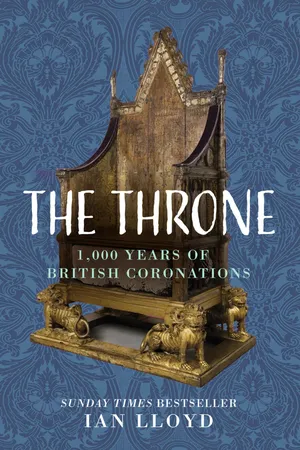 eBook - ePub
The Throne
1,000 Years of British Coronations
- Ian Lloyd(Author)
- 2023(Publication Date)
- The History Press(Publisher)
THE PLANTAGENETS 1154–1399HENRY II 1154–1189
Henry II expanded his Anglo-French domains and strengthened the royal administration in England. He is remembered for his quarrels with his erstwhile friend Thomas Becket, whom he made Archbishop of Canterbury. His reign was also dogged by family conflicts between Henry, his consort Eleanor of Aquitaine and his sons, ‘Young Henry’, Richard the Lionheart and John Lackland.Coronation of Henry II, 19 December 1154
Henry Plantagenet continued the efforts of his mother Matilda, daughter of Henry I, to claim the English throne, which had been occupied by Stephen of Blois since 1135. A fifteen-year civil war, known as the Anarchy, was fought by supporters loyal to either Matilda or Stephen, with neither side achieving victory.Henry invaded England in 1153 and, after the second siege of Wallingford in July, met Stephen to discuss peace terms. The agreement, known as the Treaty of Wallingford, named Henry as Stephen’s heir, although the latter had two sons. Conveniently for Henry, the elder son, Eustace, died the following month and his brother William showed little inclination to fight for his inheritance. The death of Eustace affected Stephen badly and he was again ready to negotiate rather than fight, and at Christmas Stephen issued a charter ‘to all his liegemen of England’ confirming Duke Henry as his ‘son and heir’.Stephen died on 25 October 1154, but it would be another six weeks before Henry landed in England. Having quickly taken oaths of allegiance from the barons, he prepared for his coronation alongside his wife, Eleanor of Aquitaine, on 19 December.On the Feast of St Basil, 14 June 1170, the king’s eldest surviving son, also called Henry – or ‘Young Henry’ – was crowned king during his father’s lifetime. This was the practice of the French Capetian rulers, and it ensured the seamless inheritance of the throne from one monarch to the next. This was the only time this occurred in British history, though Stephen had tried but failed to win papal support for crowning his own son Eustace. eBook - PDF
England and her Neighbours, 1066-1453
Essays in Honour of Pierre Chaplais
- Michael Jones(Author)
- 1989(Publication Date)
- Hambledon Continuum(Publisher)
The new Plantagenet empire, so envisaged, would be immeasurably more powerful than that of old. It would dominate both eastern and western Christendom, and the Capetians, to return to the old rivalry, would be totally overshadowed. If Matthew Paris can be credited, Henry even regarded the establishment of this new polity as a means to the restoration of the former Plantagenet greatness in France. He reports, sub anno 1255, that Henry considered that his French lands could be regained, by force if necessary, 'because between Apulia and England, France would be crushed as if between two millstones'. 106 Henry's crusading vow was taken at the point when the question of the fate of the Hohenstaufen inheritance was emerging as the central issue in the power politics of Christendom, both east and west. It may even be that the matter of the crusade was an unwelcome distraction in 1250, partly forced upon the king by his compulsion to match Louis IX. In the course of the next few years, that vow, and Henry's projected crusade, took on a very different complexion, emerging as just one element of an elaborate foreign policy, itself intended both to secure the prize of the Hohenstaufen inheritance and to turn the tables on the Capetians. The feud between John and Philip Augustus over the fate of the Plantagenet inheritance in France, continued under Henry III and Louis IX, did not simply die out in the 1250s, as is sometimes suggested. On the contrary, the stakes were 106 CM, v.516. King Henry HI, the Crusade and the Mediterranean 119 raised and the frame of reference extended as Henry, or his advisers, conceived a much more ambitious strategy to curb the apparently inexorable growth in Capetian influence, both within and beyond the French kingdom, whilst seeking to secure for the Plantagenets a place in the sun. With regard to these wider schemes Henry found support and encouragement from Pope Alexander IV.
Index pages curate the most relevant extracts from our library of academic textbooks. They’ve been created using an in-house natural language model (NLM), each adding context and meaning to key research topics.

