History

House of Medici
The House of Medici was a powerful Italian family that rose to prominence in the 15th century, becoming one of the most influential and wealthy dynasties in Europe. They were known for their patronage of the arts, banking prowess, and political maneuvering, playing a significant role in the cultural and political landscape of Renaissance Florence.
Written by Perlego with AI-assistance
Related key terms
1 of 5
4 Key excerpts on "House of Medici"
 eBook - PDF
Forgotten Healers
Women and the Pursuit of Health in Late Renaissance Italy
- Sharon T. Strocchia(Author)
- 2019(Publication Date)
- Harvard University Press(Publisher)
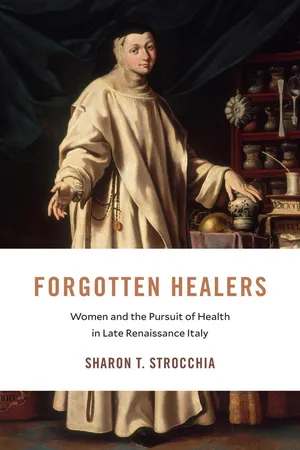
The early Medici court in mid-sixteenth-century Tuscany offers a rich point of entry into these questions for several reasons. Its very new-ness as a political structure showcases the evolution of a distinctive med-ical court culture. In 1532, the centuries-old Florentine republic was replaced by a dynastic principate, led by Duke Alessandro de’ Medici. Al-though Florence quickly became one of the principal courts of Renais-sance Europe, the Medici were still newcomers to the dynastic stage when seventeen-year-old Cosimo I de’ Medici (1519–1574) assumed the ducal throne following the assassination of his predecessor in 1537. Cosimo’s immediate hire of Andrea Pasquali as court physician showed his ability to build a regime that was both separate from the republican past yet 16 T H E P O L I T I C S O F H E A L T H A T T H E E A R L Y M E D I C I C O U R T continuous with it. The doctor’s long service at the Florentine civic hos-pital of Santa Maria Nuova gave him strong republican credentials, while his more recent attendance on the murdered duke indicated his open-ness to new political loyalties. 7 Regular medical staff remained limited throughout most of Cosimo’s reign, especially by comparison with more established Italian courts. 8 Facilitating this fraught political transition were two Medici women: Cosimo’s mother, Maria Salviati (1499–1543), and his Spanish-born wife, Eleonora of Toledo (1522–1562). Much has been written about them as political figures and cultural patrons, but their medical agency has barely been explored. Both women exercised enormous influence over daily care routines and critical decision-making processes, which brought them into frequent interaction with court physicians and other practitioners. Yet their personalities were a study in contrasts. Granddaughter of Lo-renzo the Magnificent, Salviati was renowned for her piety, modesty, and sharp political instincts. eBook - PDF
The Rare Art Traditions
The History of Art Collecting and Its Linked Phenomena
- Joseph Alsop(Author)
- 2023(Publication Date)
- Princeton University Press(Publisher)
And to the contemporary works of art Cosimo and his sons commissioned, one must add their quantities of gold and silver plate, their rich stuffs, the amazing array of jewels one finds in Piero de' Medici's last inventory (including thousands of loose pearls),- 212 the rarities like Piero's unicorn horn,- 213 and above all, the ever-increasing classical art collection and the large and constantly augmented library of superb books, mostly classical texts. 214 With their new palazzo, in sum, the Medici largely set an example of a new way of living. Splendor there had been before in the surroundings of the rich and powerful, and in most parts of Europe that had experienced prosperity and a measure of good order from the fall of the Western Roman Empire until the Palazzo Medici first opened its doors. But in the first place, there was nothing in the least medieval in the splendor of the fifteenth-century Medici from Cosimo's time onward. Gilding was every- where in Cosimo's new house, but guards and armed retainers were no- where to be seen. 215 Nor was there any high table for the Medici and [ 368 ] THE RARE ART TRADITIONS their equals, with lesser persons eating ''below the salt." The fifteenth- century Medici were famously hospitable; but even in the days of Lorenzo the Magnificent, when Medici rule in Florence was already regarded as hereditary, there was no precedence except on days when state guests were being entertained. 216 Indeed, the teen-age Michelangelo, if he came to the meal promptly, might find himself receiving the Magnificent's in- structions about connoisseurship of antique coins and carved gems, which Condivi recorded, 217 while older guests, far more important than any youth, simply took their places as they entered. As for the palazzo itself, it is not easy to picture in its heyday. The great windows generously poured in light on rich surfaces of every kind.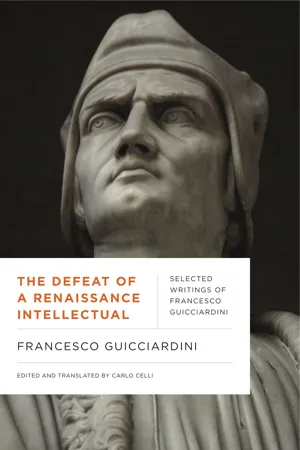 eBook - PDF
The Defeat of a Renaissance Intellectual
Selected Writings of Francesco Guicciardini
- Francesco Guicciardini, Carlo Celli(Authors)
- 2019(Publication Date)
- Penn State University Press(Publisher)
How to Ensure the State for the House of the Medici The return to Florence of the Medici brought momentous changes for the entire city. Except for a desperate and ruined few who desired their return out of dire need since they had no other path to prosperity. Their return pains not only their enemies, but the entire population, which would have willingly remained with the popular government. Even their friends who had been satisfied with the state before 1494 were not overjoyed. From their decreased status, they would now be forced to travail for the city, incurring ruinous burdens for themselves and for others. Then came the miraculous elevation of Cardinal Medici into Pope Leo X, which imme- diately changed everyone’s hopes and plans. 1 The general opinion is that this pontificate removed the Medici from a state of neediness or suspicion and put our affairs into an advantageous position. Those who were hostile were reassured they would be able to live in a reasonable manner. Those who were supporters threw themselves into service of the state with heated vitality. The people hoped for the sweetness of peace without the burden of taxes. There was the expectation of the reform of public revenue and bonds under the assurance that everything would be administered properly, and the grandeur of such a young and powerful pontiff would improve conditions. However, now that we are already at the end of three years of the pontificate, there have not been results supporting these expectations. The partisans are not content; in fact, they are distant and detached. The people are even more discontented, laden with jealousy and suspicion. At 1. Giovanni di Lorenzo de’ Medici (born in 1475) ruled the Papal States as Pope Leo X from 1513 to his death in 1521. eBook - PDF
- E. B Fryde(Author)
- 1984(Publication Date)
- Hambledon Continuum(Publisher)
The interest of the Medici in this district went back to Cosimo's time, but Lorenzo had expanded this group of estates. Land was plentiful in the region of Pisa and relatively cheap. This complex of estates, which included extensive pastures, much arable land and a cheese factory at Vico Pisano, was valued at some 40.000 florins 62 . Here and at Poggio a Caiano, where Lorenzo possessed another profitable farm, he kept highly re-puted herds of cattle, a specially fine breed of pigs imported from Calabria and sheep with particularly long tails immorta-lised in one of Piero di Cosimo's pictures. Poggio boasted of its plantations of mulberry trees on which were reared large num-bers of silkworms and the place was overrun with golden pheasants specially imported from Sicily 63 . Raymond de Roover discusses the possibility that Florentine banking and commerce were less profitable in the last quarter of the fifteenth century than they had been earlier on. Lorenzo's preference for expanding his estates could be interpreted as a conscious reaction to this. But one must not exaggerate the 58 CASATI, «Document! sul Palazzo chiamato ' II Banco Mediceo'», Archivio Storico Lombardo, anno 12 (ser. 2, vol. 2), 1885, p. 582. 59 Ed. cit. (1953), p. 194. Guicciardini mistakenly places the sale in 1484. 60 R. RIDOLFI, L'Archivio della Famiglia Guicciardini (Firenze, 1931), p. 35 and n. 2. 61 Ed. cit. (1953), p. 194. 62 M. MALLET, 'Pisa and Florence in the fifteenth century', in N. RU-BINSTEIN (ed.), Florentine Studies. Politics and Society in Renaissance Florence (London, 1968), pp. 433-35. 63 E. L. S. HORSBURGH, Lorenzo the Magnificent (London, 1908), p. 462 and E. ARMSTRONG, in the Proceedings of the British Academy, 10 (1923), p. 198. Lorenzo de' Medici's Finances and Patronage 155 extent of the general Florentine business crisis and De Roover rightly recognizes that the decline of the Medici bank was due above all to the lack of efficient management under Lorenzo 64 .
Index pages curate the most relevant extracts from our library of academic textbooks. They’ve been created using an in-house natural language model (NLM), each adding context and meaning to key research topics.

