History

Catherine de' Medici
Catherine de' Medici was an influential figure in 16th century France, serving as queen consort and later regent. Known for her political acumen and involvement in the Wars of Religion, she wielded significant power and navigated complex religious and political tensions. Catherine's legacy is marked by her efforts to maintain stability and control during a tumultuous period in French history.
Written by Perlego with AI-assistance
Related key terms
1 of 5
6 Key excerpts on "Catherine de' Medici"
 eBook - ePub
On Power
Psychoanalytic Inquiry, 6.1
- Melvin Bornstein(Author)
- 2014(Publication Date)
- Routledge(Publisher)
In December of 1560, after 26 years of obscurity, Catherine dé Medici at the age of 41 unexpectedly took upon herself the government of France as active Regent for her second son, Charles IX. Thus began a lengthy reign during the Wars of Religion in which this Italian woman dominated French politics despite great unpopularity. There were, in fact, many who might have described her as “infamous” for her complicated but central role in the St. Bartholomew’s Day massacre of the Huguenots. Many enigmas surround this unpredictable woman. How did so seemingly unpromising a person, at age 41, survive so well in a dangerous era while wielding great power against strong opposition inside and outside France? An alternative question is, given her skill in political maneuvering, what accounts for the long period of obscurity preceeding 1560? Perhaps a review of what is known of her youth will provide clues to help us understand the unique personality of this woman. The principal sources of our historical data for Catherine are Heretier (1963), Mahoney (1975), Sichel (1969), and Sutherland (1973).When Catherine dé Medici was born in Florence in 1519 the economic glory of the Medici family was literally spent. She was the last of the legitimate line, and that she was female was regarded as a disaster. Both her mother and father (to whom Machiavelli had dedicated The Prince) died within days of her birth. Her guardians were men, primarily her granduncle, Giulio dé Medici, who later became Pope Clement VII, and the then current Pope, Leo X, also a Medici. While she was sporadically cared for by her aunt Clarice Strozzi and her grandmother, it is probably crucial to her development and processes of identification that in the main her female caretakers were servants and her principal models were male. Her removal from Florence to Rome when she was seven months old separated her from her aunt; her grandmother died when Catherine was a year old.She lived in Rome until she was six years old. Fragile from birth, she was several times thought to be on the brink of death. Before the age of three, she suffered three serious object losses, either by death or separation: her parents, her grandmother, and her first guardian, Clarice Strozzi.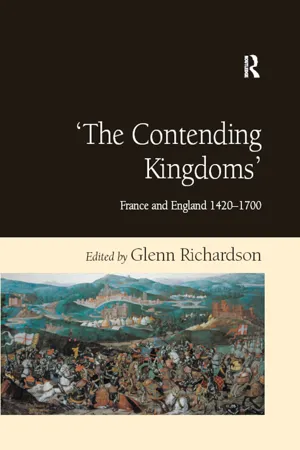 eBook - ePub
'The Contending Kingdoms'
France and England 1420–1700
- Glenn Richardson(Author)
- 2017(Publication Date)
- Routledge(Publisher)
Chapter 7 Elizabeth I and Catherine de’ Medici Susan DoranAn examination of the relationship between Elizabeth I and Catherine de’ Medici might seem an odd, or even inappropriate, topic for a collection of essays on Anglo-French relations inspired by the centenary of the Entente-Cordiale. An objection might be raised that Catherine cannot legitimately be treated as a representative of France as she was neither born nor acted as queen regnant there. Yet, although a native of Florence, Catherine was more French than anything else. She had moved away from Italy in 1533 when she was a young girl of 13; she wrote and spoke French fluently and was imbued with the culture of the Valois court. Furthermore, while never a queen regnant, from the time of her husband’s death in July 1559 until her own in January 1589, Catherine as la reine-mére played a significant role in French political life, influencing both French domestic affairs and international relations. Her voluminous correspondence is testimony to her close involvement in public affairs. The English State Papers, moreover, make clear that Queen Elizabeth and her ambassadors took Catherine very seriously indeed as a major political player, especially during the reigns of her younger sons, Charles IX and Henry III.It is true that during the 17 months when her eldest son, Francis II, was on the throne Catherine’s influence was thought to be limited compared with that of the Guise family, especially Francis, Duke of Guise, and Charles, the cardinal of Lorraine who were the uncles of the new king’s wife, Mary Queen of Scots. Thus, on 11 July 1559, Sir Nicholas Throckmorton, the English ambassador, reported gloomily that ‘the house of Guise is like to govern all about the King, who is much affected towards them’, and two days later he pronounced: ‘The House of Guise ruleth’. Nonetheless, even during this period, Catherine’s importance was acknowledged. By the end of July, Throckmorton was reporting that the dowager queen had been given the new title of la reine mère and ‘hath thoughe not in name, yet in dede and in effect th’authorite of the Regent to the French King’.1 At the death of Francis II, Catherine did indeed become regent to her second son, Charles, and from then on, well beyond her three years as regent, she was recognised as a significant force within the realm.2 In their dispatches to England, Elizabeth’s envoys reported time and again on Catherine’s informal power at court, and especially her influence over her sons. In late 1560 Throckmorton described Catherine as ‘tutrix’ to the young Charles IX, and a little later Francis Russell, Earl of Bedford, reported that ‘the Quene Mother dothe most thinges here’.3 In January 1569, Sir Henry Norris recounted a particular incident when Catherine would not allow the king, then aged 20, to sign some letters of importance,4 and a few years later, Sir Francis Walsingham reported that Catherine’s power was paramount and ‘the governement rests wholie in her hands’.5 Throughout the reign of the adult Henry III, the king was generally believed to be dominated by his mother. ‘[The] Queen Mother commandeth very much’, wrote Sir Henry Cobham in November 1579.6 Even after she had become debilitated through age and illness, she was thought to be the king’s trusted adviser: ‘the king’, wrote Sir Edward Stafford in May 1587, ‘[is] ever used in all things of weight to acquaint his mother with it’. The following year Stafford commented that the queen mother ‘could bring him [the king] to do whatever she likes’.7 eBook - ePub
- Honoré de Balzac(Author)
- 2020(Publication Date)
- Spartacus Books(Publisher)
The new Duchesse d’Orleans soon found herself a nullity at the court of Francois I. Her young husband was in love with Diane de Poitiers, who certainly, in the matter of birth, could rival Catherine, and was far more of a great lady than the little Florentine. The daughter of the Medici was also outdone by Queen Eleonore, sister of Charles V., and by Madame d’Etampes, whose marriage with the head of the house of Brosse made her one of the most powerful and best titled women in France. Catherine’s aunt the Duchess of Albany, the Queen of Navarre, the Duchesse de Guise, the Duchesse de Vendome, Madame la Connetable de Montmorency, and other women of like importance, eclipsed by birth and by their rights, as well as by their power at the most sumptuous court of France (not excepting that of Louis XIV.), the daughter of the Florentine grocers, who was richer and more illustrious through the house of the Tour de Boulogne than by her own family of Medici.The position of his niece was so bad and difficult that the republican Filippo Strozzi, wholly incapable of guiding her in the midst of such conflicting interests, left her after the first year, being recalled to Italy by the death of Clement VII. Catherine’s conduct, when we remember that she was scarcely fifteen years old, was a model of prudence. She attached herself closely to the king, her father-in-law; she left him as little as she could, following him on horseback both in hunting and in war. Her idolatry for Francois I. saved the house of the Medici from all suspicion when the dauphin was poisoned. Catherine was then, and so was her husband, at the headquarters of the king in Provence; for Charles V. had speedily invaded France and the late scene of the marriage festivities had become the theatre of a cruel war.At the moment when Charles V. was put to flight, leaving the bones of his army in Provence, the dauphin was returning to Lyon by the Rhone. He stopped to sleep at Tournon, and, by way of pastime, practised some violent physical exercises,—which were nearly all the education his brother and he, in consequence of their detention as hostages, had ever received. The prince had the imprudence—it being the month of August, and the weather very hot—to ask for a glass of water, which Montecuculi, as his cup-bearer, gave to him, with ice in it. The dauphin died almost immediately. Francois I. adored his son. The dauphin was, according to all accounts, a charming young man. His father, in despair, gave the utmost publicity to the proceedings against Montecuculi, which he placed in the hands of the most able magistrates of that day. The count, after heroically enduring the first tortures without confessing anything, finally made admissions by which he implicated Charles V. and his two generals, Antonio di Leyva and Ferdinando di Gonzago. No affair was ever more solemnly debated. Here is what the king did, in the words of an ocular witness:— eBook - ePub
Ceremonial Entries in Early Modern Europe
The Iconography of Power
- J.R. Mulryne, Maria Ines Aliverti, Anna Maria Testaverde(Authors)
- 2016(Publication Date)
- Routledge(Publisher)
30 It is extraordinary that Catherine should be included in this illustrious company. Both François Ier and Henri II were highly regarded monarchs, and the verses on the arch asserted that Charles was destined to be remembered as a ‘victorious and powerful king’. To place Catherine alongside these men was to affirm that she was more than simply a wife and a mother. Her power was equal to that of a French king.It is now widely accepted by historians that Catherine de Médicis wielded unparalleled influence over her son, Charles IX, in his early years.31 Charles himself, at the sessions of justice in 1571, paid homage to his mother, saying:After God, the Queen, my mother, is the one to whom I have the greatest number of obligations; her tenderness towards me and my people, her industry, zeal, and prudence have so well conducted the affairs of this State at a time when my age did not permit me to apply myself to them, that all the tempests of civil war were unable to damage my kingdom.32Charles had clearly allowed Catherine to take the principal rôle in the administration of his kingdom, and as such he had invested his authority as sovereign in her. Shared authority became a necessity based on the political divisions that existed at court and the youth of the king. As shown above, fears over his ability to maintain peace at the time were evident in the repeated references to child kings in his entries. Both the grandees of France and the ambassadors at court were aware of how power was distributed. In a memoire to the King and Queen Mother in 1564, the Baron de Biron wrote that in the course of his duties in Provence, he did ‘ce qui est necessaire pour le service de Leurs Majestez, conservation de leur autorité et administration de la justice ’ (‘that which is necessary for the service of Their Majesties, the conservation of their authority and the administration of justice’).33 eBook - PDF
Unexpected Heirs in Early Modern Europe
Potential Kings and Queens
- Valerie Schutte(Author)
- 2017(Publication Date)
- Palgrave Macmillan(Publisher)
2017a. “Counsel as Performative Practice of Power in Catherine de Medici’s Early Regencies.” In Queenship and Counsel in the Early Modern World, ed. Helen Graham-Matheson, and Joanne Paul. Basingstoke: Palgrave Macmillan. Broomhall, Susan (ed.). 2017b. Women and Power at the French Renaissance Court. Amsterdam: Amsterdam University Press. Broomhall, Susan, and Jacqueline Van Gent. 2016. Gender, Power and Identity in the Early Modern House of Orange-Nassau. London: Routledge. Judith, Butler. 1996. “Gender as Performance.” In A Critical Sense: Interviews with Intellectuals, ed. P. Osborne, 109–125. London: Routledge. Butler, Judith. 1999. Gender Trouble: Feminism and the Subversion of Identity. London: Routledge. Canestrini, Giuseppe, and Abel Desjardins (eds.). 1865. Négociations diploma- tiques de la France avec la Toscane, vol. 3. Paris: Imprimerie Imperiale. 110 S. BROOMHALL Catherine de Medici. 1880, 1885, and 1909. Lettres, Vols. 1 and 2, ed. Hector de la Ferrière; Vol. 10, ed. Gustave Baguenault de Puchesse. Paris: Imprimerie nationale. Catherine de Medicis and Others. 2014. Portraits of the Queen Mother: Polemics, Panegyrics, Letters, ed. Leah L. Chang and Katherine Kong. Toronto: Iter. Chalus, Elaine. 2000. “Elite Women, Social Politics, and the Political World of Late Eighteenth-Century England.” Historical Journal 43: 669–697. Cimber, L. (ed.). 1834. Archives curieuses de l’Histoire de France, 1ère series, Vol. 1 [part 3]. Paris: Beauvais. Cloulas, Ivan. 1978. Catherine de Medicis. Paris: Fayard. Cloulas, Ivan. 1997. Diane de Poitiers. Paris: Fayard. Couchman, Jane, and Ann Crabb (eds.). 2005. Women’s Letters Across Europe, 1400–1700: Form and Persuasion. Aldershot: Ashgate. Crawford, Katherine. 2000. “Catherine de Medicis and the Performance of Political Motherhood.” Sixteenth Century Journal 31 (3): 643–673. Crawford, Katherine. 2004. Perilous Performances: Gender and Regency in Early Modern France. Cambridge, MA: Harvard University Press. Crouzet, Denis. eBook - PDF
A Monarchy of Letters
Royal Correspondence and English Diplomacy in the Reign of Elizabeth I
- Rayne Allinson(Author)
- 2012(Publication Date)
- Palgrave Macmillan(Publisher)
C HAPTER 6 MARRIAGE AND MOTHERHOOD: CATHERINE DE’ MÉDICI, QUEEN MOTHER OF FRANCE, 1559–1588 Madame, If the extremity of my unhappiness had not equaled my grief for his sake and had not rendered me inadequate to touch with pen the wound that my heart suffers, it would not be possible that I would have so forgotten myself as not to have visited you in the company that I make with you in sorrow . . . —Elizabeth to Catherine, c. July 1584 1 C atherine de’ Médici produced over six thousand letters (both holographs and autographs) during her lifetime, making her one of the most prolific female letter-writers of her day. 2 Such an impressive epistolary output partly reflects the indirect nature of Catherine’s power during her fifty-six years as con- sort and queen mother, for under the French Salic law she was unable to make full use of the formal channels of government available to her male relatives. The breadth of her correspondence also indicates an awareness of both the affective and effective nature of royal corre- spondence; as recent feminist studies of early modern politics have shown, women used letters not only as a means of exerting personal influence and drawing in alliances with disparate groups, but as a medium through which to carry out political action itself. 3 Catherine defined her authority rhetorically through letters and proclamations by assuming a series of dependent relationships—daughter, wife, and mother—and in doing so was able to arrogate more power to herself than any other French queen had before. Catherine’s correspondence with Elizabeth textualized another kind of relationship, namely that of sister queen. Although Catherine was never coronated and her regency powers during the reigns of her
Index pages curate the most relevant extracts from our library of academic textbooks. They’ve been created using an in-house natural language model (NLM), each adding context and meaning to key research topics.

