History

Medici Family
The Medici family was a powerful and influential Italian dynasty that rose to prominence during the Renaissance period. They were known for their patronage of the arts, support of scholars, and significant contributions to the cultural and political landscape of Florence. The family produced several influential leaders, including popes and rulers, and played a key role in shaping the history of Italy.
Written by Perlego with AI-assistance
Related key terms
1 of 5
8 Key excerpts on "Medici Family"
 eBook - PDF
Forgotten Healers
Women and the Pursuit of Health in Late Renaissance Italy
- Sharon T. Strocchia(Author)
- 2019(Publication Date)
- Harvard University Press(Publisher)
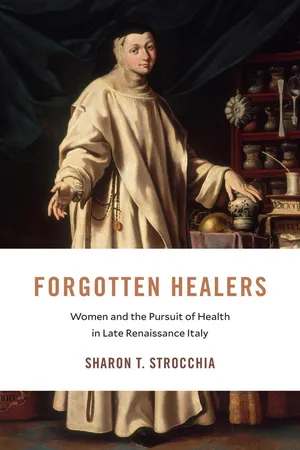
The early Medici court in mid-sixteenth-century Tuscany offers a rich point of entry into these questions for several reasons. Its very new-ness as a political structure showcases the evolution of a distinctive med-ical court culture. In 1532, the centuries-old Florentine republic was replaced by a dynastic principate, led by Duke Alessandro de’ Medici. Al-though Florence quickly became one of the principal courts of Renais-sance Europe, the Medici were still newcomers to the dynastic stage when seventeen-year-old Cosimo I de’ Medici (1519–1574) assumed the ducal throne following the assassination of his predecessor in 1537. Cosimo’s immediate hire of Andrea Pasquali as court physician showed his ability to build a regime that was both separate from the republican past yet 16 T H E P O L I T I C S O F H E A L T H A T T H E E A R L Y M E D I C I C O U R T continuous with it. The doctor’s long service at the Florentine civic hos-pital of Santa Maria Nuova gave him strong republican credentials, while his more recent attendance on the murdered duke indicated his open-ness to new political loyalties. 7 Regular medical staff remained limited throughout most of Cosimo’s reign, especially by comparison with more established Italian courts. 8 Facilitating this fraught political transition were two Medici women: Cosimo’s mother, Maria Salviati (1499–1543), and his Spanish-born wife, Eleonora of Toledo (1522–1562). Much has been written about them as political figures and cultural patrons, but their medical agency has barely been explored. Both women exercised enormous influence over daily care routines and critical decision-making processes, which brought them into frequent interaction with court physicians and other practitioners. Yet their personalities were a study in contrasts. Granddaughter of Lo-renzo the Magnificent, Salviati was renowned for her piety, modesty, and sharp political instincts.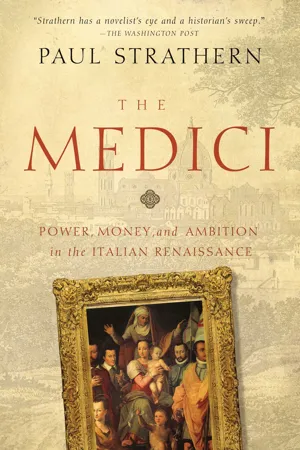 eBook - ePub
- Paul Strathern(Author)
- 2016(Publication Date)
- Pegasus Books(Publisher)
It is difficult to tell whether the political modesty of these two early Medici was instinctive, feigned, or simply a matter of clan loyalty, or even clan policy. Self-consciousness in the late fourteenth century was still firmly rooted in medieval mores: people tended to regard themselves as members of a family, rather than as individuals. According to such a way of thinking, these early Medici would naturally have sunk their individual political ambitions in the long-term ambitions of the family as a whole, accepting that political power would only be achieved by the family in more propitious times; meanwhile it was best to lay the foundations, firmly establishing the family and its wealth to an ever greater degree, in preparation. However, such foresight would appear to display an extremely well-developed sense of political ambition. Did the Medici harbour secret long-term ambitions for political power, or was their early accumulation of wealth merely an ambition in itself? From such a distance it is impossible to tell the secret machinations and plans of the Medici Family at this stage. Being a member of the Medici Family certainly helped Giovanni di Bicci, for shortly after the ciompi revolt the new head of the family business, his uncle Vieri de’ Medici despatched Giovanni to Rome where he was apprenticed to the local branch of Vieri’s bank. Familial ties always played their part in businesses, especially in banking where trust was so essential. Even so, Giovanni evidently had an aptitude for the business, because within a few years he was made a junior partner, and three years later he became manager of the Rome branch
- Brian Jeffrey Maxson(Author)
- 2023(Publication Date)
- I.B. Tauris(Publisher)
4 The Medici Consolidated, 1466–92In the 1500s Francesco Guicciardini argued that Italy had enjoyed a golden age under the leadership of Lorenzo de’ Medici, called Lorenzo the Magnificent. Lorenzo, Guicciardini claimed, had used the Peace of Lodi from 1454 to create decades of peace and stability for Florence and for all of Italy. During Lorenzo’s golden age, warfare vanished, culture boomed, states prospered, and transalpine powers left Italy alone. Some centuries later, Voltaire showered similar praises upon Lorenzo and his Florence. But Voltaire went even further. He claimed that the second half of the fifteenth century marked one of the four great apices in European history.1Even today Lorenzo often appears in fictional and nonfictional historical accounts as a benevolent patron of the arts motivated by nothing else than the good of all and the beautification of his city. In those tales, his enemies were greedy men, too wicked to appreciate the age in which they lived.The history of Florence between the deaths of Cosimo de’ Medici in 1464 and that of his grandson Lorenzo in 1492 reveals a much more complicated story. Internal politics sped faster around the Medici center point. The Italian League continued to restrict external politics to regional affairs. Some Florentines continued or created new alliances with the Medici faction. Others resisted their approach to both internal and external affairs. Most Florentines did neither. They lived their lives as best they could within the changing systems in their city. For all of them, different visual and literary cultures offered tools to make claims to piety, status, and power. Even as the Italian League meant regional politics, Florentine culture spoke transcontinental languages. Florence seemed to be becoming synonymous with the Medici Family. It also was an important source for cultural trends far beyond the Arno River. eBook - ePub
A Great and Wretched City
Promise and Failure in Machiavelli’s Florentine Political Thought
- Mark Jurdjevic(Author)
- 2014(Publication Date)
- Harvard University Press(Publisher)
But just as Machiavelli’s analysis of the Albizzi in the Histories looked further back than Maso’s regime in 1393, the moment at which the Discourse ’s analysis begins, the Histories also considered the early, pre-Cosimean Medici and the benefits of their relationship with the people. The Histories then went on to offer a complex history of the early Medici Family’s connections to the city’s guild and laboring communities that revealed that the people’s support for the Medici, however beneficial to Cosimo, was more of an inheritance than a product of his own creation. In the pages of the Histories, the fourteenth-century Medici—particularly Salvestro, Veri, and Cosimo’s father Giovanni—were consistently linked to the Florentine people. 81 The foregoing analysis of Machiavelli’s account of the Medici suggests that in the 1520s he had not yet definitively determined how to interpret their long-term historical impact on the history and future of Florence. He hinted at this in a lengthy speech midway through the Histories that elliptically raised the same question. In 3.5, a group of anonymous citizens, “moved by love for their country,” assembled before the priors to urge them to repress the escalating conflict between the Albizzi and the Ricci. Toward the end of a speech on the grave and imminent peril faced by the city, an anonymous orator warned that Florentine problems were compounded by a providential certainty that “in all republics, there are fatal families, born for their ruin.” 82 Whereas many republics have one or only a few such fatal families, the orator explained that Florence was cursed with an abundance of them, invoking the struggles between the Buondelmonti and Uberti, the Donati and the Cerchi, and the Ricci and the Albizzi
- Konrad Eisenbichler(Author)
- 2017(Publication Date)
- Routledge(Publisher)
26 Vasari is the only sixteenth-century source for the contents and appearance of the Palazzo Medici in the fifteenth century. Even though Vasari lived for a period in the 1530s in the Palazzo Medici, we would err if we take his references interspersed within individual artist’s biographies as identical to Cosimo’s own knowledge of, and interest in, that same structure from his period of residence between 1537 and 1540. Cosimo, as the principal resident of the Palazzo Medici at that time, likely possessed an understanding of the palazzo that was more comprehensive and spatially contextual as it was also augmented by his accumulated knowledge of the history of that same structure. It is also worth recalling that Cosimo came to political power in a city and within a culture in which the process of falling into political disfavour, namely exile, was at times accompanied by the destruction or confiscation of physical property. Raised as he certainly was to an understanding of the ebb and flow of his family’s political fortune in Florence, Cosimo was unquestionably aware of the link between those periods of political difficulty for his family and the repercussions of those periods for the interior appointments of the Palazzo Medici. My final question then goes to the issue of why Cosimo as a receiving patron might have had some interest in understanding something of the Palazzo Medici as a totality.It seems that Cosimo, the whole extended Medici Family of the fifteenth and sixteenth centuries, and Florentine patricians in general were raised to embrace the notion of the edifying value of environments defined by art. More often we think of the Medici and their contemporaries as patrons in the active sense, but we also have evidence of their education as patrons and their behaviour as receivers of artistic influence. In Poggio Bracciolini’s fifteenth-century De nobilitate, Cosimo the Elder’s brother, Lorenzo ‘il Popolano,’ is part of a group that regards ownership of ancient sculpture as a contributing factor to personal nobility.27 Much later, in the next century, Vasari in his Ragionamenti of 1558-60 gives Cosimo’s son Francesco a tour of the decorations in the Palazzo della Signoria as a lesson in the visual aspects of Medici rule.28 In the fifteenth century Giovanni Rucellai proclaimed in his Zibaldone that a man’s first obligation is to procreate, the second to build.29 The Medici, I suspect, would add a third, and that is to learn or receive from your buildings. Accordingly, I would suggest that as ‘mentor,’ the Palazzo Medici was part of the education of Cosimo as a receiving patron just as the Palazzo della Signoria would later be for Francesco his son.Even if, as is certain, Cosimo was unable to reconstruct in full the Palazzo Medici to its fifteenth-century appearance, his acquired knowledge of that building was inevitably an education in how his ancestors had employed works of art such as Donatello’s David or his Judith and Holofernes, and Pollaiuolo’s Labours of Hercules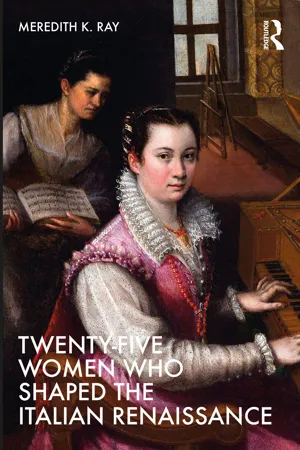
- Meredith K. Ray(Author)
- 2023(Publication Date)
- Routledge(Publisher)
Though Piero lacked Cosimo’s political charisma, he too supported Florence’s burgeoning humanist culture. Soon, with the innovative vision of Lorenzo – and the help of Lucrezia, on whose judgment Lorenzo depended – Florence would turn into a magnet for the most imaginative and gifted artists, philosophers, writers, and architects of the era. From Sandro Botticelli – who depicted Lucrezia’s sons in his Adoration of the Magi, commissioned for a chapel in the Dominican church of Santa Maria Novella – to the Neoplatonist Marsilio Ficino and the multi-talented Leonardo da Vinci, the Tuscan city became synonymous with the flowering of Renaissance culture (see Figure 1.2). Lucrezia brought status and a substantial, though not extravagant, dowry of 1200 florins to her match with Piero. Both were equally important to the Medici, who did not come from nobility and relied on the accumulation of new wealth. Piero and Lucrezia lived with Cosimo and his wife Contessina de’ Bardi (1390–1473) in the then still-unfinished Palazzo Medici in Via Larga (today Via Cavour) (see Figure 1.3). Laid out by the architect Michelozzo, the imposing building – one of the finest of the Renaissance – reflected the essence of the Medici public image: the exterior somber and rather plain, designed to avoid stirring up envy among the people; the interior richly adorned with frescoes by Filippo Lippi and Paolo Uccello. During the years of the palace’s construction, the Medici supported numerous artistic commissions, from Benozzo Gozzoli’s vivid frescoes for the Chapel of the Magi, portraying members of the family (see Figure 1.4), to Donatello’s bronze Judith and Holofernes (which may have inspired Lucrezia’s later poetic account of the Old Testament heroine)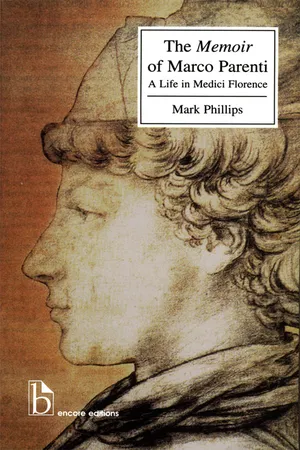 eBook - PDF
The Memoir of Marco Parenti
A Life of Medici Florence
- Mark Phillips(Author)
- 2019(Publication Date)
- University of Toronto Press(Publisher)
CHAPTER I I A CRITIQUE OF MEDICI POLITICS: MARCO PARENTI'S VIEWS ON PIERO AND COSIMO L O R E N C E has been made famous by a long line of men, stretching from Dante, Compagni, and Villani to Ma-chiavelli, Guicciardini, andGiannotti, who confronted political change with self-conscious articulateness. Within this succes-sion, Marco Parenti has a modest but significant place as a sensitive witness to the growth of Medici power and its impact on the traditions of Florentine citizenship in the second half of his century. Before examining his critique of Medici pol-itics, it may be useful to be reminded of the kind of witness he was and how his circumstances contributed to his sensi-tivity. The broadest pattern of Marco Parenti's career is his slow ascendancy into the patriciate. His inherited wealth, his ed-ucation, and his acquaintanceship brought him into the upper reaches of society, and the achievement was sealed by a certain degree of success in public office. His marriage, though risky politically, was socially advantageous for a man who began as a relative outsider; and after the repatriation of his in-laws, this marriage became an unambiguous asset. Marco's acceptance into the upper stratum is important, because in his generation to be outside the patriciate was es-sentially to be excluded from any real observation of politics— or, to put it more accurately, the only alternate post of ob-[ 2 2 2 ] F A C R I T I Q U E OF M E D I C I POLITICS 223 servation was from within the circle of functionaries and lit-erati that the Medici government relied upon. But for all his success, Marco Parenti remained a figure on the edge of pa-trician life, and this too is part of his value as a witness. A man who was better placed would not have had to wait three hours to get Luca Pitti's attention or felt so acutely conspic-uous in the antechambers of the Neapolitan prince.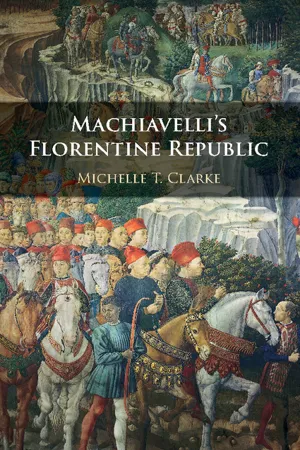 eBook - PDF
- Michelle T. Clarke(Author)
- 2018(Publication Date)
- Cambridge University Press(Publisher)
He is also praised, among other things, for having supported the development of its artis- tic and literary culture by patronizing writers like Poliziano, Demetrius Chalcondyles, and Pico della Mirandola (FH 8.36). Humanist writers of the fifteenth century had lauded the Medici fam- ily in precisely these terms, as Alison Brown and others have capa- bly demonstrated. Leonardo Bruni and Poggio Bracciolini, Machiavelli’s 96 The Questionable Virtues of the Medici historiographical rivals, had led the way in this regard. Bruni, for example, had used the prefaces to his Latin translations of pseudo-Aristotle’s Oeco- nomicus (1420) and Plato’s Letters (1427) to exalt Cosimo for using his wealth to practice the virtues of generosity, moderation, honesty, benevo- lence, and justice. 2 Similarly, Poggio had commended Cosimo’s devotion to Florence in his Letter of Consolation (1433) and Letter of Congrat- ulation (1434), written to Cosimo during and after his exile from the city. According to Poggio, Cosimo’s willingness to defend the public good even at great personal cost recalled the unflinching patriotism of classical heroes like Aristides, Camillus, Scipio Africanus, and Cicero. 3 This effort to analogize Cosimo and the greatest statesmen of antiquity continued in the many translations of Plutarch’s Lives produced during this century, including Lapo da Castiglionchio’s Life of Themistocles (c. 1434–1436) and Antonio Pacini’s Life of Timoleon (c. 1434) and Life of Camillus (c. 1436). 4 Later, John Argyropoulos would praise Cosimo’s wisdom and learning in the prefaces to his widely acclaimed translations of Aristotle of the 1460s and other humanist writers like Niccolò Tignosi, Donato Acciaiuoli, Alammano Runuccini, Bartolomeo Scala, and Marsilio Ficino would reiterate this emphasis on Cosimo’s intellectual virtues, apparently inspired by Argyropoulos’s lectures at the University of Florence.
Index pages curate the most relevant extracts from our library of academic textbooks. They’ve been created using an in-house natural language model (NLM), each adding context and meaning to key research topics.

