History

Ming Dynasty
The Ming Dynasty was a ruling dynasty in China from 1368 to 1644, known for its cultural and artistic achievements, as well as its maritime exploration. It was a time of economic prosperity, technological advancements, and the construction of the Great Wall of China. The dynasty also saw the establishment of the Forbidden City in Beijing as the imperial palace.
Written by Perlego with AI-assistance
Related key terms
1 of 5
6 Key excerpts on "Ming Dynasty"
 eBook - PDF
The Limits of Universal Rule
Eurasian Empires Compared
- Yuri Pines, Michal Biran, Jörg Rüpke(Authors)
- 2021(Publication Date)
- Cambridge University Press(Publisher)
8 Delimiting the Realm Under the Ming Dynasty David M. Robinson 8.1 Introduction The Ming Dynasty (1368–1644) emerged out the crumbling Mongol Empire and fell during another moment of rapidly expanding global horizons, the early days of West Europe’ s imperial age and its expansion into Africa, South Asia, East Asia, and the New World. In its formative stages, the fledgling Ming court wrestled with many of the questions that we examined in this volume: Where were borders to be drawn and how were they to be defended? Which peoples were to be incorporated into the realm and how? How were differences among an ethnically diverse population to be articu- lated and adjudicated? How were relations among the imperial center, the border, and peoples and polities beyond to be conceived and managed? In an age when the memory, institutions, and personnel of the Mongol Empire stood as a legacy to be rejected or embraced, the early Ming court defined itself in relation to the empire of Chinggis Khan and his descendants. At the same time, the Ming emperor and his chief advisers drew selectively on a rich repository of rhetoric, policy, and perspectives developed by previous dynas- ties (including “classical” polities headed by Chinese elites and later regimes topped by Chinese, Turkic, Kitan, and Jurchen elites) to envision and admin- ister the realm. The second global moment of the 16th and early 17th centuries posed another set of challenges. Portuguese, Spanish, and Dutch colonial agents (both military and economic) appeared in East Asia. They brought advanced military and navigational technologies. They introduced alien notions of state sovereignty, trade, and foreign relations. Their cartography, social relations, ethics, and religion implicitly raised questions about borders and the realm, the articulation and accommodation of difference, and the basis of rulership and authority. eBook - ePub
Broadening the Horizons of Chinese History
Discourses, Syntheses and Comparisons
- Ray Huang(Author)
- 2016(Publication Date)
- Routledge(Publisher)
The History of the Ming Dynasty and Today’s WorldAfter several decades of hard and intense work by scholars in and out of China, the history of the Ming Dynasty is no longer an immature field. This situation I have not hesitated to take advantage of. Benefiting from the wide circulation of reprinted source material and the appearance of a large number of monographs and articles on the period, my small book, 1587, A Year of No Significance, tries to present a profile of the dynasty in its late stage. The compilation is made possible by the voluminous data on hand, which would not have been so readily available even a short time ago.True, there is no limit to the depth of factual details that historians may endeavor to unearth. At this point, however, we can at least claim that a general picture of Chinese society in the late sixteenth century is within our power to present.With a slight touch of crudeness, we can even assert that the society in description is a submarine sandwich. The long piece of bread on the top is the literary bureaucracy and the long piece of bread on the bottom is the peasantry, both enormous and undifferentiated. Simplicity and uniformity being its structural features, this traditional organization is fostered by a legal code that gives deference to the imperial patentee over the commoner, the male over the female, and the aged over the young. The link between the top and the bottom, provided by the civil service examinations, affirms those principles. While successful in warding off all the possible complexities, such a social order from today’s viewpoint can never escape the criticism of being obsolete and uninspiring. eBook - ePub
Chinese Lives
The People who Made a Civilization
- Victor H. Mair, Sanping Chen(Authors)
- 2013(Publication Date)
- Thames and Hudson Ltd(Publisher)
THE Ming Dynasty TO THE PEOPLE’S REPUBLIC OF CHINA 1368–PRESENTThe Mongol Yuan dynasty lost control of China to a series of peasant uprisings, finally headed by the charismatic first emperor of the Ming, born into a desperately poor peasant family. The Ming was a consciously ‘Chinese’ dynasty, harking back to the glories of the Tang in a bid to remove all trace of Mongol rule. However, the peoples to the north remained a threat, and the Ming, too, gradually declined, with an emperor lacking interest in the administration and failing to control corruption, culminating in peasant uprisings. The Ming was overthrown by a Chinese peasant rebellion, but this was swept aside by the superior Manchu armies who rode into Beijing in 1644 and established the last imperial dynasty, the Qing.Though the Qing flourished at first, the 19th century, in particular, saw the familiar cycle of natural disasters and local uprisings, complicated by the encroachment of Westerners with gunboats. At the fall of the Qing, the Republic of China was established, but central rule was non-existent as the country was divided once again between different warlords, and the Kuomintang and the Chinese Communist Party struggled for supremacy as Japan invaded in 1937. In 1949, the Kuomintang retreated to Taiwan and the People’s Republic of China was proclaimed in Beijing.Ming 1368–1644Qing 1644–1911Republic of China 1911–People’s Republic of China 1949–China from the Ming Dynasty to the People’s Republic.65. THE HONGWU EMPEROR (1328–98)First emperor of the MingZhu Yuanzhang was born in 1328 to a poverty-stricken tenant farmer family in Anhui province in the Yangtze valley. As the youngest son, he grew up tending cattle for the family’s landlord. In 1344, while northern China was hit by devastating floods, southern China experienced a rare drought. Epidemics spread, and, within a month, Zhu Yuanzhang lost both his parents and his eldest brother to the plague. Unable to afford coffins, he and his surviving brother had to beg for a small plot of ground in which to bury their dead. eBook - PDF
Chinese Martial Arts
From Antiquity to the Twenty-First Century
- Peter A. Lorge(Author)
- 2011(Publication Date)
- Cambridge University Press(Publisher)
The new Ming ruler, the Yongle emperor (1360–1424), moved the capital to Beijing and had the short reign of his nephew deleted from the records. In spite of the founding emperor’s vision, Ming society changed in many dynamic ways over nearly three centuries of the dynasty’s rule. Commerce and trade expanded rapidly, for example, directly undercutting the notion of a static empire of disconnected farmers living in their villages. Trade with the outside world also increased, and Christian missionaries made their first attempts to enter China. The ranks of the educated elite increased as well, though the size of government did not, leaving larger and larger numbers of qualified men unable to pass the civil service exams and serve as officials. Even those who passed the exams had difficulty getting posts. This was a problem that had begun to appear as early as the eleventh century, leading Confucian thinkers, originally wedded to the idea that men studied in order to serve in government, to rethink the purpose of education. The Neo-Confucians argued that self-cultivation was the pri- mary goal of study, offering some consolation to the tens of thousands of men whose family means and position in society required that they study, but recognized how slim their odds were of passing the exams. An 158 The Ming Dynasty increasing number of men competed for a more or less fixed number of slots, thus lowering everyone’s chances of passing almost to the level of random chance. The presence of this educated, elite audience of readers created a demand for books on every subject and in every genre, from fiction to history. Far more books on military affairs, for example, were written during the Ming Dynasty than in any earlier period. New and sometimes recycled ideas were introduced, explained, and expanded upon. Some argued that Confucianism, Daoism, and Buddhism were three aspects of the same underlying ideas.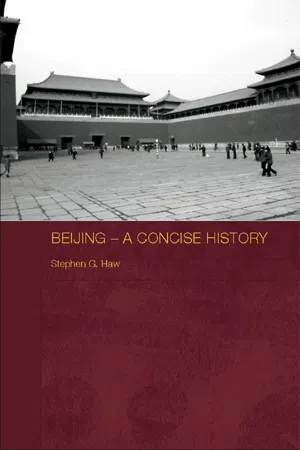 eBook - ePub
- Stephen G. Haw(Author)
- 2006(Publication Date)
- Routledge(Publisher)
5 Chinese capital: The Ming Dynasty, 1368 to 1644
Shortly before his armies took Dadu, Zhu Yuanzhang had declared himself the first emperor of a new dynasty, the Ming. He is usually known as the Hongwu Emperor, although in fact ‘Hongwu’ is not a name, but the title of a reign-period. Reign-periods had been in use in China for many centuries for dating the years. Thus, a particular year might be ‘the fifth year of the Yuanfeng period’. The Western calendar dating years from the birth of Christ was of course not used in China until recent times. During previous dynasties, reign-periods were often changed during the reign of one emperor, but during the Ming Dynasty and the Qing dynasty that followed it, only one reign-period was used throughout the whole of the reign of each emperor. It has become common practice to refer to emperors of these dynasties by the title of their reign-period, as if it were their name.Dadu becomes Beiping
The Hongwu Emperor had established himself in Nanjing, then called Yingtian, in 1356. Twelve years later, in the same year that he proclaimed his new dynasty, he renamed it Nanjing, meaning ‘Southern Capital’. Kaifeng, the old capital of the Song dynasty, became his Northern Capital, Beijing. The former Mongol capital of Dadu was given the name Beiping. The founder of the Ming Dynasty, it would seem, never had any intention of using the old Mongol capital of Dadu as even a subsidiary capital of his new, Chinese dynasty. There was really no reason why he should have wished to do so. Dadu or Beiping was in the far north-east of his empire, a long way from its centre. The water supply for the city was barely sufficient and it could only be supplied with enough food by transporting grain over long distances. During the last twenty years or so of the Yuan dynasty, disorder in the Yangtze valley region had stopped the movement of grain northwards to Dadu. There had been famine in the city as a result. The Mongol Grand Canal had fallen into disuse and disrepair. Parts of it had been severely damaged by flooding and changes of course of the Yellow River. To make the city viable as a capital again would require the renovation of the Grand Canal, a major undertaking. Nanjing was a practical site for the principal capital of the empire, for it lay on the Yangtze River, in the area that had by this time become the chief grain-producing region of China. There was no shortage of water, either. Communications with the rest of the empire were relatively easy from Nanjing. The Yangtze River and its major tributaries allowed direct water-borne communication with a large part of China. Nanjing was also a long way from the northern borders, where the Mongols continued to pose a threat. As it lay on the south bank, any invaders from the north would have to cross the wide Yangtze River to attack it. The Hongwu Emperor made a good choice of capital. It seemed that Beiping was destined to revert to being an important regional centre, but nothing more.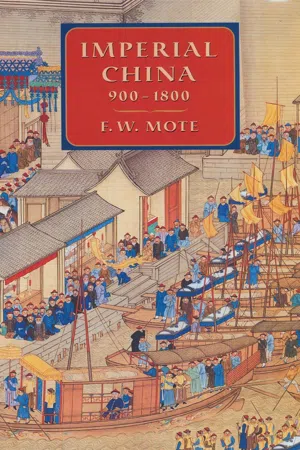 eBook - ePub
- F. W. Mote(Author)
- 2003(Publication Date)
- Harvard University Press(Publisher)
Beyond the adjacent regions in which China might on occasion be militarily active was a more distant world of less direct contacts. Admiral Zheng He’s extraordinary exploits in the first third of the fifteenth century brought China into expanded diplomatic contacts with many states and statelets from the coasts of Southeast Asia to India, the Persian Gulf, and Africa. Whatever potential that kind of state-sponsored maritime activity might have had for broadening China’s international horizons, after the 1430s the government abandoned those great maritime expeditions, although it continued to send envoys to the nearer states, often by sea. In the sixteenth century the sea lanes Zheng He had explored a century earlier now began to bring Europeans into South and East Asia and to China; more important, goods and products and ideas from distant places came to affect the lives of the Chinese in new ways. Modern China’s dramatically changing place in the world can be dated from this century. Ming China had to make the first adjustments to that larger world without knowing, or having a way to know, that the world around it would never be the same again. Two centuries later the Qianlong emperor, who reigned 1736–1795, began to sense the full significance of that changing world, but he remained uncertain how to deal with it and ineffectual in his attempts.Here Ming China’s land frontiers on three sides will first be surveyed. Then the maritime frontier on the east will complete this tour of Ming China’s horizons.II . TENSION AND PERIL ON THE NORTHERN BORDERSRelations with the Mongols dominated Ming China’s northern frontiers throughout the dynasty until its last thirty years; then the Jurchens, only slowly recognized as a more immediate source of danger, superseded the threat long associated exclusively with the Mongols. In 1635 the Jurchen khan officially changed his people’s name to Manchu. With much Mongol assistance, a group of newly united Manchu tribes then subjugated both the Mongols and the Chinese to create a vast empire of Inner Asian and Chinese extent; we know it as the Qing dynasty. As will become clear in subsequent chapters, groups of Jurchens and certain Mongol tribes had lived side by side in the Northeast (which we usually call Manchuria) and in adjoining portions of Mongolia throughout the Ming period; both participated in the tribute system pattern of Chinese foreign relations, were deeply involved with China, and were eager for the trade and other benefits which that system made possible. Until the early seventeenth century, however, we can discuss the northern border problems exclusively as a Mongol-Chinese problem.To understand Ming-Mongol relations it is necessary to look at the problems from the quite different points of view of all the participants. That is consistent with the attempt I have made throughout this book when discussing non-Chinese peoples who have played important roles in Chinese history; the other side of such problems, seldom given much consideration by Chinese of the time, and often quite distorted by present-day Chinese and other historians, must be brought within our awareness. It is nowhere more important than in the history of Ming relations with the Mongols.
Index pages curate the most relevant extracts from our library of academic textbooks. They’ve been created using an in-house natural language model (NLM), each adding context and meaning to key research topics.

