History

War of the Roses
The War of the Roses was a series of civil wars fought in England between the Houses of Lancaster and York from 1455 to 1485. The conflict was primarily a struggle for the English throne, and it resulted in significant political instability and bloodshed. The war ultimately ended with the establishment of the Tudor dynasty under Henry VII.
Written by Perlego with AI-assistance
Related key terms
1 of 5
10 Key excerpts on "War of the Roses"
- Philip Edwards(Author)
- 2017(Publication Date)
- Red Globe Press(Publisher)
1 The Wars of the Roses The term `Wars of the Roses' is the traditional title given to a complex and protracted, but not continuous, conflict among the political elite in England in the second half of the fifteenth cen-tury. The Crown changed hands violently five times between 1461 and 1485. The ruling Plantagenets became divided into Yorkist and Lancastrian parties striving for the throne. Finally after the elimination of most claimants the Plantagenets found themselves swept from power with the arrival of a new dynasty in the person of Henry Tudor, victor of the battle of Bosworth 22 August 1485). Henry Tudor had only the flimsiest claim to the Crown of England, and his success was due solely to the events of a single day: the very future of England hung on the outcome of a battle, just as it had back in 1066. There was nothing inevitable about the accession of the Tudors: far from it, their advent was one of the flukes of a very confused period of English history; and it is more true to say that Richard III, the last of the Yorkist branch of the Plantagenets, lost Bosworth than that Henry Tudor positively won it. The crucial point is that so much in the history of this period depended on personalities and accidents. And the final victors who were to emphasise their very Englishness in the sixteenth century were in reality descend-ants of an obscure Welsh family who had been involved in the great Welsh rebellion against Henry IV in the early fifteenth century. Such were the most unexpected results of this amazingly dramatic age. The normal dating of the Wars of the Roses is from 1455 with the first battle at St Albans) to 1485 and the battle of Bosworth). However, both the significance and the duration of the wars became subjects of dispute among historians in the twentieth century. eBook - ePub
The Roots and Consequences of Civil Wars and Revolutions
Conflicts That Changed World History
- Spencer C. Tucker(Author)
- 2017(Publication Date)
- ABC-CLIO(Publisher)
Wars of the Roses (1455–1485) CausesThe Wars of the Roses were a series of dynastic struggles fought during the period 1455–1485 for the throne of England. They were waged between the rival houses of Lancaster and York, both of which had claimants descended from the Plantagenets and King Edward III (r. 1327–1377). The name of the wars, although not used at the time, is taken from the badges of the two rival houses: a red rose of the House of Lancaster and a white rose of the House of York.There had been no major conflict regarding the succession to the throne since the so-called Anarchy following the death of King Henry I in 1135. The House of Lancaster had held the English throne since 1399, when Henry of Bolingbroke deposed his cousin Richard II and became king as Henry IV. Henry was in turn succeeded by his son, Henry V (r. 1413–1422). Henry V was campaigning in France and confident of becoming king of France when he died suddenly at the Chateau of Vincennes, apparently of dysentery contracted during the siege of Meaux. At the time of his death Henry was only 35 years old, and his son was only 9 months old. Before his death, Henry had named his brother, John of Lancaster, first duke of Bedford, regent in the name of his son Henry VI. The Lancastrian claim to the throne rested on John of Gaunt (1340–1399), first duke of Lancaster and the third surviving son of Edward III.Wars of the Roses in England (1455–1485)Approximate Strength of Opposing Forces, Battle of St. Albans (May 22, 1455)Yorkish ForcesLancastrian Forces3,000–7,000 men 2,000 men Casualties, Battle of St. Albans (May 22, 1455)Yorkish ForcesLancastrian Forces60 100 Approximate Casualties, Battle of Blore Heath (September 23, 1459)Yorkish ForcesLancastrian Forces1,000 2,000 Approximate Casualties, Battle of Barnet (April 14, 1471)Yorkish ForcesLancastrian Forces500 1,000 Sources: Philip A. Haigh, The Military Campaigns of the Wars of the Roses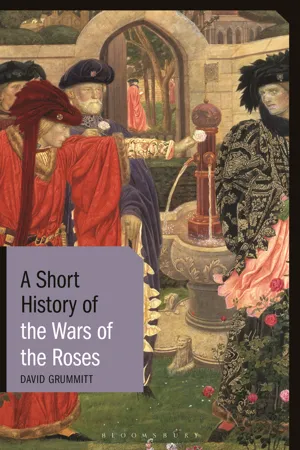 No longer available |Learn more
- David Grummitt(Author)
- 2014(Publication Date)
- I.B. Tauris(Publisher)
Introduction
THE WARS IN HISTORY WHY THE ‘WARS OF THE ROSES’?The phrase ‘the Wars of the Roses’ is what the philosopher of history, W.H. Walsh, dubbed a ‘colligatory term’. That is to say, like the ‘Industrial Revolution’, ‘the Scientific Revolution’ or even ‘the Cold War’, it is a term invented by historians to make sense of and order an otherwise confused and chaotic series of events. ‘The Wars of the Roses’ therefore provides a context for episodes such as Cade’s Rebellion in 1450 or the usurpation of Richard III in 1483. It gives both historians and students a framework within which they can order their narratives, write their essays, and seek to understand the past.1 In an age of professional historical scepticism, the term and its ‘usefulness’ can be dissected, the beginning and end of the Wars endlessly debated, new examples found to challenge academic orthodoxies, and even the very existence of the Wars themselves called into question. The Wars of the Roses, we are told, was a concept ‘invented’ by Sir Walter Scott in his 1829 novel Anne of Geierstein and was a phrase unknown to fifteenth-century minds. Indeed, such was the limited nature of conflict in the mid-fifteenth century that most Englishmen and women were not even aware that they were living through a civil war.2Nevertheless, we should not despair of the ‘Wars of the Roses’. As Margaret Aston pointed out over forty years ago, the term does have a near contemporary relevance. In simple terms, the White Rose was one of the many badges or devices adopted by the House of York (from the Mortimer earls of March). Equally, the Red Rose was one of an even larger collection of badges used by the dukes and later by the royal House of Lancaster. Elizabeth of York, daughter of Edward IV, appears to have adopted the White Rose as her personal badge before 1485 and Henry Tudor seized upon the opportunities presented by the Red Rose immediately following his victory at Bosworth. Contemporaries were certainly aware of this imagery and the symbolism of the roses as badges of ancient royal lines. The chronicler of the Lincolnshire abbey of Crowland, one of the most astute commentators of the time, wrote shortly after the Battle of Bosworth that in Tudor’s victory ‘the tusks of the boar (Richard III) were blunted and the red rose (Tudor), the avenger of the white (the murdered sons of Edward IV), shines upon us’.3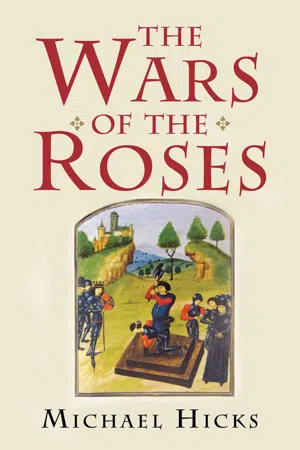 No longer available |Learn more
- Michael Hicks(Author)
- 2020(Publication Date)
- Yale University Press(Publisher)
5 The label has caught on and is familiar and indeed useful to historians and non-historians today. Cricket matches between Lancashire and Yorkshire have been called Roses Matches for over a century and the Amazon website catalogue records the Wars of the Roses as the title for 120 different books.DYNASTIC CONFLICT
The rival Roses and the Tudor Union of the Roses made the Wars into a dynastic conflict between rival Lancastrian and Yorkist claimants to the Crown. The theme makes sense only after the Tudor victory at Bosworth and the marriage of Henry VII and Elizabeth of York on 18 January 1486. What came before also mattered. Whatever Richard, Duke of York, may privately have thought, it was not until 1460 that he overtly challenged the Lancastrian right to rule and claimed the throne for his own line. It had been quite different issues that had raised tensions and triggered the conflict that produced the dynastic trial of strength of 1460–1. It was Yorkist propaganda from 1460 that transformed disagreements about governance into dynastic rivalry. Thereafter, the Yorkists traced the Wars back to the deposition in 1399 of King Richard II, a legitimate king, and his wrongful replacement by Henry IV who ‘unrightfully entered upon the same’. Hence the tribulations of the following 62 years. Edward IV asserted that back in 1399 the new king should have been Edmund Mortimer, the grandson of Edward III's second son Lionel, Duke of Clarence (d. 1368), to whom the Crown ‘by law and conscience belonged’, and from whom it should have passed to the house of York. Arbitrating on York's claim in 1460, the House of Lords had ruled that ‘the title of the said duke could not be defeated’.6 The usurpation of Henry IV was punished in 1461 when his grandson Henry VI was overthrown by the rightful Edward IV. ‘These three harrys’, so Edward IV's Brief Treatise observed, ‘have occupied and kept the said Crown of England from the rightful heir this 62 years’. ‘Ill-gotten gains cannot last’, the chronicler Waurin remarked.7 No longer available |Learn more
They Never Reigned
Heirs to the British Throne Who Never Became the Monarch
- Blair Hoffman(Author)
- 2023(Publication Date)
- Austin Macauley Publishers(Publisher)
Chapter 7The Wars of the Roses, Part I: Richard, Duke of York and Edward of Lancaster
The death of Edward, the Black Prince, set in motion the series of events that led to the convulsions in the second half of the fifteenth century called the Wars of the Roses. As is well known, the wars pitted two branches of the Plantagenet family—Lancaster and York. The name given to the wars refers to the emblems of the respective branches—the red rose of Lancaster and the white rose of York. The early stages of the wars resulted in two heirs to the throne becoming heirs who never reigned, one on each side. One was King Henry VI’s only son, Edward, known as Edward of Westminster, after his birthplace, or Edward of Lancaster, after his lineage. The other was Richard, the third Duke of York, who was descended from King Edward III through both his father and his mother.When King Edward III died in 1377, he was succeeded by his grandson (the Black Prince’s son), who became King Richard II. But in 1399, Richard’s cousin, John of Gaunt’s son, Henry, the Duke of Lancaster, overthrew him and became King Henry IV, the first Lancastrian king. Henry’s prevailing over Richard set the precedent that the strength of dynastic claim alone was not always enough to become or remain king. Richard, not Henry, had the valid dynastic claim, but his misrule gave Henry his chance to obtain the crown. This proved that, at least with the consent of Parliament, someone with a lesser claim, but more ability, might become king.Henry IV was succeeded by his son, Henry V, a strong and popular king and the victor of the 1415 Battle of Agincourt, the last great English victory in the Hundred Years’ War. But Henry V died prematurely of dysentery in 1422 at the age of 35, leaving behind an infant son, who became King Henry VI, the third King of the Lancastrian branch. Due to his father’s victories that led to the 1420 Treaty of Troyes, Henry also became—for a while—the King of France as an infant, when the French King Charles VI died shortly after Henry V’s death. Henry was the only Englishman to be King of both countries. A long and difficult regency ensued until Henry came of age. During these years, partly due to the inspired leadership of Joan of Arc, England slowly lost its grip on France. Ultimately, although it won the major battles (Crecy, Poitiers and Agincourt), it lost the war. The war ended in 1453 with the port city of Calais remaining as the only English possession in France. Calais was all the English had to show for over 100 years of fighting. eBook - ePub
Stoke Field
The Last Battle of the Wars of the Roses
- David Baldwin(Author)
- 2006(Publication Date)
- Pen & Sword Military(Publisher)
Chapter 1Prelude to Conflict: The Wars of the RosesThe battle of Stoke was the culmination of a series of conflicts which convulsed England in the latter half of the fifteenth century and which Sir Walter Scott called the ‘Wars of the Roses’.1 There were three distinct phases: from 1452 to 1464, from 1469 to 1471, and from 1483 to 1487, all related and interconnected, but also separate in that particular factors were responsible for each new outbreak. They differed from modern wars inasmuch as they were seldom continuous, and their effects varied considerably. It has been estimated that there were only some sixty-one weeks of domestic campaigning (in total) between 1455 and 1485,2 and that most ordinary people were unaffected unless they happened to live near to a route taken by one of the armies. But four kings, Henry VI, Edward IV, Edward V and Richard III, were deposed (at least one, and possibly three, of them also died violently), and the leading noble families were decimated through two, or as many as three, generations. Overall, they claimed the lives of a larger proportion of the population of England than any conflict before the First World War.The origins of the Wars of the Roses lay in the Hundred Years’ War fought between England and France in the fourteenth and early fifteenth centuries. Henry V won glory at Agincourt and, ultimately, an empire which included large areas of France north of the River Loire: but he bequeathed an impossible legacy to his infant son and successor when he died prematurely in 1422. Henry VI was neither a warrior nor a statesman; and although the late King’s brother, John, Duke of Bedford, secured and even extended the English position in the short term, he could do nothing to prevent the tide turning after Joan of Arc rallied the demoralised Dauphin and his armies in 1429. By the 1440s there was already conflict between a section of the English nobility who had profited from the war and who wanted to defend all the hero-king’s conquests, and others who favoured rapprochement and the ceding of territory in return for a truce, or treaty, which would leave England with at least some possessions on the French side of the Channel. Both were unrealistic. The ‘war’ party failed to appreciate that the French, with their vastly greater resources, were bound to drive the English out eventually; and the ‘doves’ were mistaken if they thought that the French would rest until they had regained all the lands lost earlier in the century. It was the latter group which dominated the Council, however, and in 1445 they arranged for Henry VI to marry the French princess Margaret of Anjou in return for a truce of two years duration and the dim prospect of a permanent peace. The accord was extended when Henry and his ministers agreed to surrender Maine three years later; but a rash attack on the city of Fougères in March 1449 gave the French an excuse to break the agreement and the English armies were driven from Normandy within the year. eBook - ePub
From Robber Barons to Courtiers
The Changing World of the Lovells of Titchmarsh
- Monika Simon, Monika E Simon(Authors)
- 2021(Publication Date)
- Pen and Sword History(Publisher)
Chapter 8 The Wars of the Roses T he first Battle of St Albans on 22 May 1455 is usually seen as the point when the political conflict between different factions at court turned into the war we know as the Wars of the Roses. However, at the time no one could have foreseen that it was the start of a series of different but interdependent conflicts that lasted for more than thirty years. The Wars of the Roses had a profound impact on the lives of Alice Deincourt, her two sons John Lovell IX and William Lovell, Lord Morley, and her grandson Francis Lovell. As governess of the young Prince Edward, Alice Deincourt spent the last years of the 1450s mostly at court and close to Henry VI and Margaret of Anjou. Both her sons, John Lovell IX and William Lovell, as well as her second husband Ralph Butler were firm supporters of the king and queen. John Lovell IX was also married to Joan Beaumont whose father John, Viscount Beaumont, was regarded by the Yorkist side as one of their principle ‘mortal and extreme’ enemies by 1460. 1 John Lovell IX and his wife Joan had three children, one son and two daughters. In a surprising break from family tradition, their son was named Francis. Why they choose this unusual name is unclear. Possibly, he was named after his godfather, which was often the case and could explain the introduction of the name. 2 However, Francis was an extremely unusual name at the time. It also was not used either by the Beaumont or by the Deincourt family. It was more popular in France, where several dukes of Brittany were called Francis and it became increasingly popular in England in the sixteenth century with Francis Drake and Francis Bacon just the most famous men bearing this name. Joan Beaumont and her husband were most likely simply preferring unusual names for their children eBook - PDF
England in the Fifteenth Century
Collected Essays
- K. B. McFarlane(Author)
- 1981(Publication Date)
- Hambledon Continuum(Publisher)
XII. THE WARS OF THE ROSES THE broken sequence of battles, murders, executions, and armed clashes between neighbours which we have chosen to miscall the Wars of the Roses has long made the second half of the fifteenth century in England repulsive to all but the strongest-stomached. Had it not been for the early discovery of some two or three collections of private letters, the whole period might have fallen with some show of justice under the reproach of utter inhumanity. As it is, the homely details preserved in the familiar correspondence of Pastons, Stonors, and their like may have been allowed to excuse too much. For they have suggested the consoling but possibly mistaken notion that while great lords were busy exterminating one another, lesser men, though enduring much at the hands of their betters, stood to some extent outside and below the conflict so that, unlike their betters, they were able to survive. And what is more deserved to survive, however humble their merits, because at least they were not monsters. It might have been otherwise had we the private letters of but one ducal, comital, or even mere baronial family, what its members wrote to one another and to their friends. The magnates certainly sent and received letters in vast quantities, as their accounts prove. They may have been too wary to open their hearts often on paper where matters of state were at issue, but there were many other subjects on which circumspection was unnecessary. The letters which passed between Richard Nevill, Earl of Warwick, and his countess during their frequent separations are unlikely to have been less revealing than the correspondence of John and Margaret Paston. eBook - PDF
- John A. Wagner(Author)
- 2001(Publication Date)
- ABC-CLIO(Publisher)
Because of their political leadership and social dominance, the peerage could not remain neutral in any struggle for control of the government or the Crown. Because the noble families of England controlled the military resources of the realm (see Bastard Feudalism), almost every magnate family was com Page 198 pelled to commit itself to one side or the other at some time during the conflict. The rewards of being on the winning side could be substantial—lands, offices, and local and national influence; however, the penalties for losing could be equally harsh—execution for the head of the family and disinheritance through Attainder for heirs. Some families suffered severely. No less than three Courtenay earls of Devon, three Beaufort dukes of Somerset, and two Percy earls of Northumberland were executed or slain in battle during the Wars of the Roses. The war also extinguished the male lines of the houses of Lancaster and York, the male line of the Beaufort family, and most of the male descendants of the Neville family, thereby transmitting the wealth and influence of all four to Henry VII, an inheritance that greatly strengthened the position of the house of Tudor. Nonetheless, as modern research has shown, the rate of extinction of noble families during the civil war generations was no higher than it had been through the natural failure of heirs in previous generations. This outcome was in part because many nobles submitted to Edward IV after the Battle of Towton in 1461 and especially after the Battles of Barnet and Tewkesbury in 1471; the wastage of war was relatively brief and contained. Edward often extended favor to even his most ardent opponents, and many Lancastrians of the 1460s became loyal Yorkists in the 1470s. Almost twothirds of the 397 acts of attainder passed in the last half of the fifteenth century were eventually reversed. eBook - ePub
Staging Power in Tudor and Stuart English History Plays
History, Political Thought, and the Redefinition of Sovereignty
- Kristin M.S. Bezio(Author)
- 2016(Publication Date)
- Routledge(Publisher)
Chapter 1 The White Rose and the Red: The Wars of the Roses and the Rise of Absolutism in England (1400–1558) The single most important shift in the English ideological conception of sovereignty and government came with the dissolution of feudalism following the Wars of the Roses. The fifteenth century marked the English transition from a fully participatory government to one that, while clinging steadfastly to Parliamentary regulation, espoused the continental doctrine of monarchical absolutism. This was also, perhaps ironically, the era during which Parliament confirmed its legislative power, cementing the need for its consent to ratify all legislation. 1 Compounding the intellectual struggle of rearticulating the power-dynamic between Parliament and the crown was a deterioration of the feudal hierarchy. With Henry VI incapable of mediating between Parliament, the peerage, and his own royal authority, national stability crumbled, and the increasing ideological division between the nobility and the commons produced a rejection of the feudal framework, dismantled feudalism altogether, and gave rise to absolutist doctrine. The late fourteenth and fifteenth centuries saw serfs and villeins replaced by waged liveried retainers whose new role indicated the almost complete dissolution of the feudal system of unpaid laborers. 2 This change in the social hierarchy in England known as “bastard feudalism” altered the relationship between lord and vassal such that the vassal came to personally rely upon (and therefore exhibit loyalty toward) his immediate superior (and employer) over his loyalty to community or nation. 3 The lord gained manpower and prestige, and the retainer received wealth, status, and legal protection. 4 In one sense, the development of such retainers was simply a natural product of a system which already included a mutually beneficial implied contract between lords and vassals
Index pages curate the most relevant extracts from our library of academic textbooks. They’ve been created using an in-house natural language model (NLM), each adding context and meaning to key research topics.

