History

The English Civil War
The English Civil War was a series of armed conflicts and political machinations between Parliamentarians and Royalists in the 17th century. It resulted in the execution of King Charles I and the establishment of the Commonwealth under Oliver Cromwell. The war had a profound impact on the development of the English constitution and the shift of power from the monarchy to Parliament.
Written by Perlego with AI-assistance
Related key terms
1 of 5
10 Key excerpts on "The English Civil War"
 No longer available |Learn more
- (Author)
- 2014(Publication Date)
- University Publications(Publisher)
________________________ WORLD TECHNOLOGIES ________________________ Chapter- 2 English Civil War The English Civil War (1642–1651) was a series of armed conflicts and political machinations between Parliamentarians and Royalists. The first (1642–46) and second (1648–49) civil wars pitted the supporters of King Charles I against the supporters of the Long Parliament, while the third war (1649–51) saw fighting between supporters of King Charles II and supporters of the Rump Parliament. The Civil War ended with the Parliamentary victory at the Battle of Worcester on 3 September 1651. The Civil War led to the trial and execution of Charles I, the exile of his son, Charles II, and replacement of English monarchy with first, the Commonwealth of England (1649– 53), and then with a Protectorate (1653–59), under Oliver Cromwell's personal rule. The monopoly of the Church of England on Christian worship in England ended with the ________________________ WORLD TECHNOLOGIES ________________________ victors consolidating the established Protestant Ascendancy in Ireland. Constitutionally, the wars established the precedent that an English monarch cannot govern without Parliament's consent, although this concept was legally established only with the Glorious Revolution later in the century. Terminology The term English Civil War appears most commonly in the singular form, although historians often divide the conflict into two or three separate wars. Although the term describes events as impinging on England, from the outset the conflicts involved wars with and civil wars within both Scotland and Ireland. Unlike other civil wars in England, which focused on who ruled, this war also concerned itself with the manner of governing Britain and Ireland. Historians sometimes refer to The English Civil War as the English Revolution and works such as the 1911 Encyclopædia Britannica call it the Great Rebellion .
- Philip Edwards(Author)
- 2017(Publication Date)
- Red Globe Press(Publisher)
10 The British Civil Wars, 1642±51 `This war without an enemy' The traditional title of `The English Civil War' has lost favour among historians of late because it suggests a homogeneous conflict within one kingdom, whereas it is clear that more than one civil war was fought, more than one country was involved and that events unfolded in a quite startling and unforeseen way, with the various players competing for completely different prizes. The belated recognition by English historians of the cru-cial role played by both Scotland and Ireland has led to a general preference for the term `British Civil Wars' or `Wars of the Three Kingdoms'. While one certainly must bear in mind the different course and impact of the fighting in each of the three kingdoms, the crucial point is that it was their fusing together that ignited the flames of protracted warfare. The Scottish crisis of 1637 was the opening page of the drama, whose later scenes turned heavily on the preparedness of the Scots to help either Parliament or the king. As for Ireland, its role was surely necessary to buttress the notion of a great Catholic conspiracy which so obsessed men like Pym; the rebellion there in October 1641 lit the spark that flamed up into civil war in England less than a year later. The very idea of civil war was anathema to English people of the seventeenth century, and the devastation in Europe occa-sioned by the Thirty Years War was a salutary reminder of what might happen at home. Nevertheless the common perception was that both sides simply drifted into war. `It is strange to note', Bulstrode Whitelocke commented, how we have insensibly slid into this beginning of a civil war, by one unexpected incident after another as waves of the sea. . . On a rainy 22 August at Nottingham, in the very centre of England, the king unfurled his banner, calling his subjects to 332 render him assistance `against the late rebellion of the Earl of Essex'. eBook - PDF
Tudor and Stuart Britain
1485-1714
- Roger Lockyer, Peter Gaunt(Authors)
- 2018(Publication Date)
- Routledge(Publisher)
C H A P T E R 1 5 The Civil War The English Civil War in perspective A lthough the raising of the King’s standard in Nottingham on 22 August 1642 might be taken to mark the formal start of The English Civil War, in reality fighting began slowly and rather patchily. There had been con-frontations and some armed encounters, resulting in injury and a small number of deaths, earlier in the summer, as royalist commissioners of array and parliamentarian militia commissioners clashed when they tried to win over and call out the militias of the same counties and to recruit further volunteers in the same localities. Moreover, the King’s attempt to seize Hull in April had been vigorously rebuffed, in July the royalist heir to the earldom of Derby had similarly attempted to take control of Manchester only to be outmanoeuvred and forced off, at the beginning of August local members of the elite and recruiting agents had skirmished in the hill country of north Somerset and during the first half of August George Goring had sought to hold Portsmouth in the King’s name but had been driven out by a parlia-mentarian counter-attack. Equally, widespread fighting did not begin immediately after the raising of the King’s standard, not least because both sides were still in the process of recruiting and assembling their main field armies. Active military campaigning in late summer and autumn 1642 was quite limited, not until the latter half of October did the two sides clash in a substantial field engagement, at Edgehill in Warwickshire, in what turned out to be an indecisive and drawn fight as well as the only major battle of 1642, and many parts of England and Wales avoided becoming fully militarized and drawn directly into the war until the following year. However, between its outbreak in 1642 and summer 1646, when Parlia-ment secured a complete military victory, England and Wales were drawn into and divided by a major, lengthy, often intensive and quite highly eBook - PDF
- Robert C. Evans, Eric J. Sterling, Robert C. Evans, Eric J. Sterling(Authors)
- 2009(Publication Date)
- Continuum(Publisher)
Historical Contexts 3 Richard Harp Chapter Overview Introduction 43 The Sixteenth-Century Background to the Civil War 44 The Road to Civil War: Philosophy and Political Thought 44 The Road to Civil War: Church and State in the Reign of James I 46 The Road to Civil War: Church and State in the Reign of Charles I 48 The Road to Civil War: Arts and Popular Culture 49 The Civil War 50 The Era of Oliver Cromwell 51 Church and State, 1660–1888 53 London 55 London as Trade Center 55 Science 56 Introduction The watershed national event of the seventeenth century in England was the Civil War fought between the years 1642–1649. Among its consequences was the legal trial and execution of the King of England by some of his own countrymen and the firm establishment of Parliament as the most important governing body in the country. The reasons for this conflict were numerous and they had their origins at least as far back as the sixteenth century. Con-tributing factors included the religious quarrel between Protestants and Catholics and the rise of the gentry and the middle class as economically powerful elements in society. In addition, by the seventeenth century English social life was no longer limited to the three traditional divisions of nobility, clergy, and commoners. As a result, the monarch had great difficulty holding the country’s various political factions together. 43 The Sixteenth-Century Background to the Civil War The Protestant Reformation began in England when Parliament, in 1534, declared King Henry VIII, not the Roman Catholic Pope, the supreme head of the Church in the country. Henry desired this authority not out of any fundamental theological disagreement with Rome but because he wished to have his marriage to Catherine of Aragon annulled, as he had not been able to father with her a male heir to the throne of England. eBook - PDF
The Military Revolution and Political Change
Origins of Democracy and Autocracy in Early Modern Europe
- Brian Downing(Author)
- 2020(Publication Date)
- Princeton University Press(Publisher)
The crisis and breakdown of government (1640-1642) led to open warfare between king and Parliament, and, perversely, to central-izing intrusions on the part of the Whig heroes, the Long Parliament, a turn of events that facilitated the Stuart Restoration in 1660. A final con-flict with the Stuarts led to the Glorious Revolution, after which state constitutional government returned. England was only tangentially involved in the Thirty Years' War (1618-1648). The king's relations in the Palatinate were endangered by the ar-mies of the Counter-Reformation, and a Parliamentary consensus sup-ported a small effort for the Protestant cause. The disbanding of Eliza-s' See G. R. Elton, A High Road to Civil War? in his Studies in Tudor and Stuart Politics and Government (Cambridge: Cambridge University Press, 1974). 38 Conrad Russell, Parliaments and English Politics 1621-1629 (Oxford: Clarendon Press, 1983), pp. 1-84; J.C.D. Clark, Revolution and Rebellion: State and Society in England in the Seventeenth and Eighteenth Centuries (Cambridge: Cambridge University Press, 1986), pp. 1-91. England • 169 beth's expeditionary forces, however, left England with no troops, save for guard units and small garrisons; the only operative militia act dated back to the time of Edward I, though Parliament allowed militias and trained bands to drill under expired Elizabethan acts. Charles was able to deploy a few thousand soldiers and raid a few coastal towns, including, in the finest traditions of the English navy, a raid on Cadiz. Unlike Drake's raid a generation earlier, however, this one was unsuccessful. Other efforts were dismal failures, and by 1625 war weariness had set in and alloyed with tensions over constitutionally ambiguous taxation. Ship money, benevolences, a forced loan, the quartering of unruly troops, and imprisonment of opponents made many feel that fundamental issues were at stake.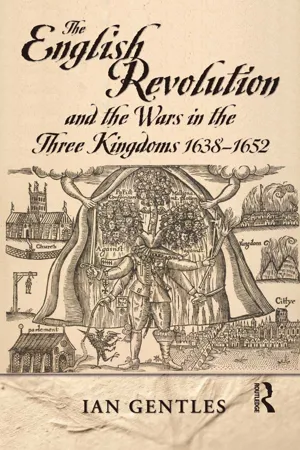
- I.J. Gentles(Author)
- 2014(Publication Date)
- Routledge(Publisher)
Yet even as late as the beginning of 1642 civil war was not inevitable. Had things gone a little bit differently Charles might well have defeated the Scots in the first Bishops’ War, thereby obviating the need to summon parliament in the autumn of 1640. 19 When parliament met, the king made huge political, financial and religious concessions to his critics. Most people who backed either the king or parliament, as well as the great majority of the population, who were interested mainly in local issues, had no desire for armed conflict. 20 Almost from the beginning the revisionist account of the reasons for England’s civil war came in for searching and sustained criticism. Revisionists were accused of doing a better job of explaining why a civil war did not happen rather than why it did. They were charged with exaggerating the extent of intellectual consensus in early Stuart England, while overlooking the substantive ideological differences between the king and his political opponents. Far from caring only about local, county matters, many people outside London had a lively interest in national issues, and were avid readers of political news from the capital, as well as the continent. The provinces were just as deeply divided over politics and religion – popery in particular – as was the metropolis. Not only was most of the country gripped by a terrible fear of international Catholicism, there was great resentment against the absolutist pretensions of the Stuart monarchy. Arbitrary arrest and imprisonment, unparliamentary taxation, and the king’s claim to be above the law were all deeply divisive issues in the decades leading up to the outbreak of civil war. Ann Hughes, Norah Carlin and others have argued that the civil war was also the product of broad social and cultural conflict. It is therefore unsatisfactory to explain the outbreak of civil war merely through a detailed narrative of high politics No longer available |Learn more
- (Author)
- 2014(Publication Date)
- White Word Publications(Publisher)
Religious conflicts permeated Charles's reign. His failure to successfully aid Protestant forces during the Thirty Years' War, coupled with such actions as marrying a Catholic princess, generated deep mistrust concerning the king's dogma. Charles further allied himself with controversial religious figures, such as the ecclesiastic Richard Montagu, and William Laud, whom Charles appointed Archbishop of Canterbury. Many of Charles' subjects felt this brought the Church of England too close to the Catholic Church. Charles' later attempts to force religious reforms upon Scotland led to the Bishops' Wars, strengthened the position of the English and Scottish Parliaments and helped precipitate the king's downfall. Charles' last years were marked by The English Civil War, in which he fought the forces of the English and Scottish Parliaments, which challenged the king's attempts to overrule and negate Parliamentary authority, whilst simultaneously using his position as head of the English Church to pursue religious policies which generated the antipathy of reformed groups such as the Puritans. Charles was defeated in the First Civil War (1642– 45), after which Parliament expected him to accept its demands for a constitutional monarchy. He instead remained defiant by attempting to forge an alliance with Scotland and escaping to the Isle of Wight. This provoked the Second Civil War (1648–49) and a ________________________ WORLD TECHNOLOGIES ________________________ second defeat for Charles, who was subsequently captured, tried, convicted, and executed for high treason. The monarchy was then abolished and a republic called the Commonwealth of England, also referred to as the Cromwellian Interregnum, was declared. Charles' son, Charles II, though he became king at the death of his father, did not take up the reins of government until the restoration of the monarchy in 1660. eBook - PDF
- D.E. Kennedy(Author)
- 2017(Publication Date)
- Red Globe Press(Publisher)
12 This royal nightmare of revolution was matched in Parliamentarians by a premonition of apocalyptic catastrophe. ‘In the way we are’, Sir Benjamin Rudyard told the Commons in early July, ‘we have gone as far as words can carry Us: We have voted our own Rights and the King’s Duty’, while The War for King and Parliament, 1642–6 15 16 The English Revolution, 1642–1649 the Kingdom stands amazed ‘in fearful Expectation of dismal Calamities to fall upon it’. 13 The anxieties and confusions of the summer of 1642 are paradoxical. The civil war in prospect was being widely denounced in our modern sense of being ‘condemned’, while simultaneously being denounced in the seventeenth-century sense of being promulgated. The Essex clergyman and Parliamentary supporter, Ralph Josselin, nar-rates that in midsummer of 1642, before any official declaration of war, ‘we began to raise private arms . . . and the King was beginning to raise an army’. Having ‘encouraged others to go forth’, he was disconcerted when ‘poor people in tumults arose and plundered divers houses, papists’ and others, and threatened to go farther’, whereupon he endeavoured to suppress their zeal ‘by private and public means’. 14 Like his King, he had no desire to see the common people ‘set up for themselves’. Similarly, Thomas May – Parliament’s official chronicler of these events – reports with dismay the first sparks of civil unrest. He writes of the Militia Ordinance and the Commissions of Array ‘justling together almost in every County’: . . . the greatest of the English Nobility on both sides appearing personally, to seize upon those places which were deputed to them either by the King or by the Parliament. No Ordinances from the One, or Proclamations from the Other, could now give any further stop to this general and spreading Mischief. God was not pleased that one Chimney should contain this Civil fire; but small sparks of it were daily kindling in every part of the Land.
- Ben Dew(Author)
- 2020(Publication Date)
- Manchester University Press(Publisher)
CHRONOLOGY AND COMMERCE 81 Part II 82 COMMERCE, FINANCE AND STATECRAFT CHRONOLOGY AND COMMERCE 83 4 Te English Civil War and the politics of economic statecraft Te relationship between historical writing and the political and religious conficts of the 1640s was a complex one. 1 Historians of the period generally emphasised that their loyalty was to the ‘truth’ rather than to any particular faction or party. Hamon L’Estrange, for example, used the frontispiece to his Te Reign of King Charles (1655) to claim that this was a work ‘Faithfully and Impartially delivered’. 2 Similarly, in the preface to his Observations (1656), a detailed critique of L’Estrange’s History , Peter Heylyn claimed to be writing ‘with a minde free from love, or hatred, or any of those other afections, which pre-ingagements in a party doe possesse men with’. 3 Tomas Fuller, meanwhile, defended his Church-History of Britain (1655) by observing that the work ‘was so far from prostituting her Self to Mercenary Embraces , She did not at all Espouse any Particular Interest , but kept her self a Virgin ’. 4 In making such comments, authors were emphasising their adherence to a series of well-established ideas about the importance of impartiality in historical writing. Indeed, before stating his own commitment to ‘Truth’, the parliamentarian historian Tomas May noted that ‘the use of History, and the just Rules for composure of it [had] been so well and fully described heretofore’ that it was ‘lost labour and a needlesse extention of the present work’ to discuss them further. 5 Authors were also aware, however, that writing in a time of confict presented certain challenges. Civil wars served not only to divide people, but also historical source material and, as May observed, his own position in Parliament meant that his knowledge of Parliamentarian ‘Councels’ was better than that of Royalist ones. Moreover, May acknowledged that the nature of the subject he was eBook - PDF
- Conrad Russell(Author)
- 1990(Publication Date)
- Hambledon Continuum(Publisher)
For the first few months of 1641, Charles's terms for settlement, the preservation of episcopacy and the life of S traf f ord, were precisely those which would have the effect of separating the English Parliamentarians from their Scottish allies. From March 1641 onwards, he pursued the same objective by another method, and aimed, by Scottish concessions, to remove the Scots from English politics. In the autumn of 1641, when he exacted promises of non-intervention in English affairs from Argyll and Loudoun as part of his Scottish settlement, he appeared to have succeeded. 83 It was at this point that the Irish Rebellion drove Charles back onto the mercy of his English Parliament. The Irish Rebellion, like the Bishops' Wars, is regularly discussed as if it were a random intervention of an outside factor, like a stroke of lightning. In fact, it was not. It was the very measures taken to draw England and Scotland together which had forced England and Ireland apart. 84 It was demonstrated that one of the most 79 Hamilton MSS 327.1. 80 C. Burges, The First Sermon, Ep.Ded. 81 Cal SP Dom 1639, Vol ccccxvii, nos. 85, 92. 82 Bodleian Ms Rawlinson D.1099, f. 22b. 83 Hamilton MSS 1585, 1586. 84 See my article, The British Background to the Irish Rebellion', below, ch. 15, pp. 263-80. The British Problem and The English Civil War 251 Athanasian characteristics of the British problem was the way in which avoidance of one error led straight to the perpetration of another. For the second time, it was failure to handle the British problem successfully which led Charles to failure in England. Perhaps the point on which we should really be pondering is that it took five years of continuous British crisis to drive the English body politic to the point of Civil War. This might perhaps suggest that, in spite of all the strains to which it had been subjected, the English social fabric of 1637 was still very tough indeed.
Index pages curate the most relevant extracts from our library of academic textbooks. They’ve been created using an in-house natural language model (NLM), each adding context and meaning to key research topics.

