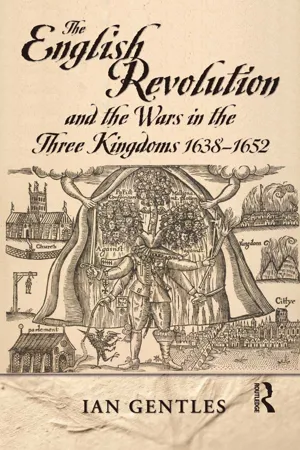
Ian Gentles provides a riveting, in-depth analysis of the battles and sieges, as well as the political and religious struggles that underpinned them. Based on extensive archival and secondary research he undertakes the first sustained attempt to arrive at global estimates of the human and economic cost of the wars. The many actors in the drama are appraised with subtlety. Charles I, while partly the author of his own misfortune, is shown to have been at moments an inspirational leader.
The English Revolution and the Wars in the Three Kingdoms is a sophisticated, comprehensive, exciting account of the sixteen years that were the hinge of British and Irish history. It encompasses politics and war, personalities and ideas, embedding them all in a coherent and absorbing narrative.
- 544 pages
- English
- ePUB (mobile friendly)
- Available on iOS & Android
eBook - ePub
The English Revolution and the Wars in the Three Kingdoms, 1638-1652
About this book
CHAPTER 1
Rebellion in the north
Who knows but this great work which is begun in Scotland now when it is going into England, and it has taken some footing there, but the Lord He will make it to go over the sea? Who knows but the Lord will make Scotland, who is a worm indeed in comparison of other nations, to be a sharp threshing instrument, to thresh the mountains and to beat the hills to pieces? Who knows but He will make them a sharp threshing instrument to beat Rome and the Pope and Antichrist to pieces …?1
Scotland was where Charles I’s troubles began. His father James VI had occupied the throne of that kingdom until 1603, when he inherited the English crown, thereby uniting the kingdoms of Britain. Scots had initially welcomed this union, believing it would enable them to share in the greater wealth of England, not least by plucking some ripe plums of patronage for themselves. And indeed, Scots were very much in evidence at the English court during the early years of James I. Disillusionment soon set in, however. In the first place parliament threw cold water on the king’s cherished scheme to join the two kingdoms into one. Secondly, after a decade in England James began showing more and more favour to his English courtiers. Basking in the greater opulence, flattery and formality of the southern court, the first Stuart king gradually lost interest in Scotland, revisiting his bleak northern capital only once (in 1617) during his twenty-two-year reign.
It did not take long for religion to emerge as a further cause of strain between the king and his Scottish subjects. In the middle of the sixteenth century Scotland had undergone a Calvinist revolution. Led by John Knox, the nobility had risen up against the French-dominated Mary Stuart and overturned her Catholic regime, substituting a Protestant regency until the infant James grew to manhood. Calvinism’s three distinctive tenets were: original sin, or the universal depravity of the human race consequent upon the fall of the first man, Adam; the irresistibility of God’s grace to those whom He had selected for salvation; and, the predestination of every human being to salvation or everlasting damnation. There was little room for free will.
The Scottish version of Calvinism, called Presbyterianism, entailed a new form of Church government. Lay elders, selected by their congregations, combined with ministers as delegates to presbyteries, which were groupings of parishes. (There were just over 1,000 parishes divided among 66 presbyteries in early seventeenth-century Scotland). The presbyteries in turn elected delegates to the general assembly, which governed the Kirk, as the Scottish Church was known.
James insisted on grafting bishops onto this structure, mainly to act as agents of royal power. He enhanced their authority by giving them courts of High Commission through which to enforce their judgements. The king’s insistence on a state-dominated Church rather than a Church-dominated state as the Presbyterians would have desired, prompted the latter to band together locally in covenants. From the 1590s they developed the concept of people uniting themselves under a sacred oath as a way of concretizing the spiritual bond between God and his elect people. The political potential of covenants remained latent until after Charles had come to the throne.
The potency of the Scottish Kirk was grounded not only in its militant Calvinist theology, but in the self-confidence of its educated clergy who were also well paid in comparison with their English counterparts. The religious assurance of these men and their congregations was distilled in the words of the Confession of Faith: ‘the church of Scotland through the abundant grace of our god is one of the most pure churches under heaven this day, both in respect of truth and doctrine and purities of worship’.2 The adherents of this perfect Church did battle with James over the bishops, and they resisted his attempts to move in the direction of Arminianism – a Dutch brand of Protestantism that asserted free will against Calvinist predestination.
Royal promotion of a Crown- and bishop-dominated Church espousing a diluted version of Calvinism could never have been stopped by the clergy alone. The country’s dominant socio-economic classes had to be enlisted in the struggle as well. Fortunately for the Presbyterian clergy, the nobility, the lairds (as the untitled landowners were called), and the merchants of the burghs all had their reasons for being unhappy with Scotland’s absentee monarchy. At the end of the sixteenth century the nobility had undergone a severe cultural and economic crisis, though a few had profited from new patronage opportunities when James VI ascended the English throne. Prolonged inflation, whose effects were accentuated by the practice of granting perpetual leases at fixed rents, was made still worse by disastrous weather and crop failures in the 1590s. When partial recovery occurred after 1610, the nobles found themselves beset by ever-increasing taxes and predatory lawyers. The doubling of the size of the nobility from 50 to about 100 within half a century, and the intellectual attacks on the honour culture added to their anxiety. As if all this were not enough, in 1625 they were confronted by Charles I’s Revocation. The young king announced his determination to recover all royal land alienated since an unspecified date in the past. While his aim was the disinterested one of strengthening church revenues, the landed classes saw the very basis of their property under threat. More than a decade later the king finally thought better of his attempted land-grab, but after their hair-raising experience nobles and lairds would never trust him again.
What supplied the combustible element to convert smouldering resentment into flaming rebellion was religion. The nobility long bore a grudge against the bishops, whose power James I had persistently tried to increase. The bishops were partly blamed for the religious ‘Perth’ Articles of 1621, which required Scots to bend their stubborn knees while receiving communion. To many, kneeling was a sign of creeping Anglicisation, if not outright popery. By the time Charles I visited Edinburgh in 1633 for his coronation, word had got around about his plans for a more centralized, authoritarian and Arminian Church. His heavy-handed manipulation of the Scottish parliament, and his efforts to intimidate opponents by personally taking notes of their speeches, were deeply worrying. When a group of lords led by the Earl of Loudoun, Lord Balmerino, implored the king not to force religious changes on the Scottish people, he brushed them aside, and went ahead with his plans for a new prayerbook and canons. No representative body was consulted: the new canons were simply published in 1636, while the reform of the prayerbook was announced in a royal proclamation issued by the Scottish privy council at the end of that year. The canons, which were the laws governing the clergy, banned extemporaneous prayer, because it offended Charles’s desire for order and decency in worship. The new prayerbook was devised by Scottish bishops according to Charles’s specifications. It stipulated that ministers were to be strictly subordinated to bishops and bishops to the king. The communion table was to be removed out of the body of the church into the chancel. Key words were excised from the formula spoken by the minister as he distributed the bread and wine at communion, so that it no longer implied that the service was simply a memorial of Christ’s Last Supper. One minister said of the new book, which had been submitted to no representative ecclesiastical body whatsoever, that it was more popish than the English prayerbook. Even though its use was not to become compulsory until the summer of 1637, discontented people, among them Balmerino, and a knot of militant Presbyterian ministers, began organizing meetings around the country months ahead of time. Women, from the rank of maidservant to matron in the mercantile community, were in the forefront of the public protest in Edinburgh. They were there of their own volition, as ‘holy and religious women’, not because they had been put up to it by men, as sometimes happened in other riots.3
On a fateful Sunday in July 1637 several members of the Scottish privy council, nine or ten bishops, and the lords of the session (Church leaders) assembled in St Giles Cathedral, Edinburgh with a large congregation. As soon as the dean began to read from the new prayerbook there were cries of ‘the mass is entered among us’ and women began to shout insults, ‘calling them traitors, belly-gods, and deceivers’.4 Rising to their feet, they hurled their folding stools, one of them just missing the bishop for whom it was intended, and striking the dean on the head. The women then stormed out of the cathedral to continue their rioting in the street. When the Bishop of Edinburgh emerged after the service they chased him with stones and insults.
Now that the breadth of the opposition to the new liturgy had been shown the nobility moved to take charge of the movement. Under their inspiration a Supplication was framed attacking not only the prayerbook and canons, but also the bishops. What amounted to a counter-government was set up. Going under the name of the Tables, it consisted of four committees, the first comprising the nobility, the other three the representatives of the clergy, the gentry and the boroughs. The Fifth Table was an executive committee made up of the nobles’ Table, and four representatives from each of the other three. Their mandate was to concert resistance to the new order of service. Charles for his part made negotiations awkward by insisting that he and not the bishops was responsible for the new prayerbook.
The National Covenant
This fresh evidence of Charles’s recalcitrance and political ineptness impelled the Tables to commission ‘a band of mutual association’ for the Scottish people. They appointed a respected Presbyterian minister, Alexander Henderson, and a young firebrand lawyer, Archibald Johnston of Wariston, to draw it up. Published as the National Covenant in February 1638, it was, in Allan Macinnes’s words, ‘a nationalist manifesto asserting the independence of a sovereign people under God’.5 Signatories swore to defend ‘the true reformed religion’ and abstain from all innovations not approved by the Kirk assemblies or parliament. Only a ‘covenanted king’ who agreed to defend ‘the true reformed religion’ (meaning Presbyterianism), and to rule according to the laws of the realm as defined by parliament would be obeyed by his subjects. If the king failed to uphold Presbyterianism or to govern according to the law, the people were morally required to resist him. This was nothing less than a revolutionary attack on the powers of kingship. Yet the Covenant’s promoters recruited many thousands of signatories within the space of a few months. Many adherents, we are told, ‘subscribed with tears on their cheeks, and … some did draw their own blood, and used it in place of ink to underscribe their names’.6 In Edinburgh thousands wept as they assembled in Greyfriars churchyard to sign the document inscribed on parchment. Expressing the general mood of exaltation, Wariston proclaimed ‘the glorious marriage day of the kingdom with God’, while Samuel Rutherford identified ‘little Scotland’ as the bride of Christ.7 Anyone who held back was ostracized as a papist.
Why did the covenant evoke such powerful emotion among the Scottish people? It was because of the heightened sense of national destiny that it imparted to those who swore their allegiance to it. It was not just a contract between individuals and their God. It was a collective act in which all the signatories were bound to one another as well as to God. Not only did many Scots sincerely believe that their brand of Protestantism was purer than any other; with the covenant they became only the second people in the world – after the ancient Israelites – to make a pact with God. They accordingly regarded themselves, like the Jews, as a chosen people. Their special role in carrying out God’s providential design was to assist in the overthrow of popery and the establishment of Christ’s reign on earth. Some Scots went further, extending this apocalyptic vision to all three British kingdoms, and even to all of Christendom.8
The political significance of the covenant was that it embraced the whole people, whereas before only the leaders of society had been involved in the political process. Equally momentous, the insistence on contractual obligation, derived directly from Calvinist federal theology, made resistance to monarchical authority possible.9 There were dissenters of course. Less than half the Scottish nobility were actively pro-Covenant, and most of the population of the Highlands were opposed to it. Aberdeen was a particularly strong centre of loyalty to the king, although the fact that the region’s most powerful nobleman, the Marquess of Huntly, was a Catholic weakened the royalist cause.
Seeing that his northern kingdom was out of control, Charles decided to backtrack. Again he was too late. His offer to surrender the prayerbook if Scotland would surrender the covenant got him nowhere. He told Hamilton that if he had to live under the covenant he would have no more power than a doge of Venice. All of Hamilton’s suggestions for compromise he rejected. ‘I will rather die than yield to these impertinent and damnabl...
Table of contents
- Cover
- Half Title
- Modern Wars in Perspective
- Title Page
- Copyright Page
- Dedication
- Table of Contents
- List of maps
- Acknowledgements
- Preface
- Prologue
- 1 Rebellion in the north
- 2 The Irish insurgency, 1641-42
- 3 The outbreak of civil war in England, 1640-42
- 4 Building and fuelling the machinery of war: recruitment, finance, logistics
- 5 Popular allegiance in the English Civil War
- 6 War in England: the first year, 1642-43
- 7 The hinge year, 1643-44
- 8 Hope revived: royalists counterattack, roundheads regroup, September 1644-May 1645
- 9 The king vanquished, 1645-46
- 10 The wars carried on by other means: the political struggles of 1646-48
- 11 The War of the Engagement - 1648
- 12 Regicide and republic
- 13 Ormond, Cromwell, the Levellers and Ireland
- 14 War between Scotland and England, 1650-51
- 15 Audit of war: the human and material cost
- Epilogue
- Abbreviations
- Bibliography
- Index
Trusted by 375,005 students
Access to over 1.5 million titles for a fair monthly price.
Study more efficiently using our study tools.
Frequently asked questions
Yes, you can cancel anytime from the Subscription tab in your account settings on the Perlego website. Your subscription will stay active until the end of your current billing period. Learn how to cancel your subscription
No, books cannot be downloaded as external files, such as PDFs, for use outside of Perlego. However, you can download books within the Perlego app for offline reading on mobile or tablet. Learn how to download books offline
Perlego offers two plans: Essential and Complete
- Essential is ideal for learners and professionals who enjoy exploring a wide range of subjects. Access the Essential Library with 800,000+ trusted titles and best-sellers across business, personal growth, and the humanities. Includes unlimited reading time and Standard Read Aloud voice.
- Complete: Perfect for advanced learners and researchers needing full, unrestricted access. Unlock 1.5M+ books across hundreds of subjects, including academic and specialized titles. The Complete Plan also includes advanced features like Premium Read Aloud and Research Assistant.
We are an online textbook subscription service, where you can get access to an entire online library for less than the price of a single book per month. With over 1.5 million books across 990+ topics, we’ve got you covered! Learn about our mission
Look out for the read-aloud symbol on your next book to see if you can listen to it. The read-aloud tool reads text aloud for you, highlighting the text as it is being read. You can pause it, speed it up and slow it down. Learn more about Read Aloud
Yes! You can use the Perlego app on both iOS and Android devices to read anytime, anywhere — even offline. Perfect for commutes or when you’re on the go.
Please note we cannot support devices running on iOS 13 and Android 7 or earlier. Learn more about using the app
Please note we cannot support devices running on iOS 13 and Android 7 or earlier. Learn more about using the app
Yes, you can access The English Revolution and the Wars in the Three Kingdoms, 1638-1652 by I.J. Gentles in PDF and/or ePUB format, as well as other popular books in History & British History. We have over 1.5 million books available in our catalogue for you to explore.