Literature

Restoration Comedy
Restoration Comedy refers to a style of drama that was popular in England during the late 17th century. It is characterized by its witty dialogue, satirical portrayal of social manners, and often risqué themes. The plays typically featured complex plots, mistaken identities, and a focus on the foibles of the upper class. Notable playwrights of this genre include William Wycherley, William Congreve, and George Etherege.
Written by Perlego with AI-assistance
Related key terms
1 of 5
6 Key excerpts on "Restoration Comedy"
 eBook - PDF
Tricksters and Estates
On the Ideology of Restoration Comedy
- J. Douglas Canfield(Author)
- 2014(Publication Date)
- The University Press of Kentucky(Publisher)
Unlike social and even subversive comedy, then, Restoration comical satires end in no real restoration: nei-ther of the estate nor of England itself. They may, at their most conserva-tive, end in poetical justice or warn against the destruction of the old order from its own internal threats. But they may also, at their most radi-cal, playfully portray that order as empty rhetoric. A THEORETICAL WORD ABOUT GENERIC DISTINCTIONS Why bother with generic mapping at all in this age of deconstructive slip-page? Generic criticism seems to me nevertheless an ineluctable modality of our professional practice. However much we may want to have moved beyond genre, at least as a system of ontological categories, we continue to attempt to map out the territory, to bring it under manageable control. And if we have less faith in the structuralist enterprise to define genres in synchronic fashion, thanks to recent books like Thomas Beebee's The Ide-ology of Genre and, more appropriate to my purposes here, Brian Corman's Genre and Generic Change in English Comedy, 1660-1710, we seem to un-derstand at least the diachronic importance of genres, especially as they become institutionalized and as both authors and critics negotiate the bur-den of the past. First, authors: Restoration dramatists were conscious of a received generic tradition that included such broad categories as tragedy and comedy, categories its period attempted to rigidify in its neoclassicism. Yet it is a commonplace of criticism that authors were notoriously sloppy about generic categories; moreover, they consciously mixed and matched, creating hybrids like the many variations on the already existing Renais-sance hybrid, tragicomedy, or like the dramas they simply called plays. eBook - PDF
- Joseph Wood Krutch(Author)
- 2019(Publication Date)
- Columbia University Press(Publisher)
If the success or failure of a play had depended upon any but people of fashion, it is not likely that they would have risked their reputation before an audience. Briefly then, the Restora-tion stage was a fashionable entertainment where the most reckless of the upper class saw their follies and vices wittily and realistically presented. From this it is evident that certain of the characteristics of the Restoration drama were inevitable. In the first place, since the drama's laws the drama's patrons give, any dramatist who had written idealistically would have been neglected for some one who knew better how to meet the taste of the audience. In the second place, any comedy of manners which depicted the actual life of the upper class of the times had to be in one sense corrupt if it was to be true. It could not picture the times and be pure. It is not strange that under the circumstances people of the times should not have been shocked by this drama as its modern readers have been shocked, because the people for whom it was written were familiar with open corrup-tion in a way that most modern readers are not. Dorimant and Mirabel may seem to some mere creatures of fancy, but the audience at the Restoration theater not only knew that they existed but had come into personal contact with them. This audience was not likely to resent on the stage what it knew to exist openly. Nor is there anything in this which need damn the dramatists as men. They had no 40 COMEDY AND CONSCIENCE deliberate intention of encouraging vice, which, being men of sense, they no doubt hated. The material, then, of Restoration Comedy was inevita-ble; but there remains the question of the dramatists' attitude toward it. Those who attacked the stage came, as will be seen later, to object to the representation of impurity in any way, but it was also charged that the dramatists not only represented the corruption of the time but sympathized with it and encouraged it. eBook - ePub
- Martin Coyle, Peter Garside, Malcolm Kelsall, John Peck(Authors)
- 2002(Publication Date)
- Routledge(Publisher)
Although studies of Restoration drama based on very partial reading of the available evidence continue to appear, the growing tendency for serious scholars to base their work on total coverage of the period means that in the last two decades virtually all the received commonplaces about the subject have been discredited or questioned. The form that we know as the ‘Comedy of Manners’ was not the sole or even the dominant type of comedy. Nor is it true that Restoration Comedy habitually glamorizes successful rakes: comedy which cheerfully portrays and endorses extra-marital sex does not appear until the early 1670s, and although such plays then continue to appear until the mid-1690s, the real boom in sex comedy was located in the years 1672–82. Even here harsh criticism of the predatory rake can easily be found (e.g. in Otway’s Friendship in Fashion, 1678, Nathaniel Lee’s The Princess of Cleve, ?1680, and some of Durfey’s plays). Although Aphra Behn champions adultery as the refuge of the oppressed wife, she naturally condemns the predatory and domineering instincts of the male, which darken even many of her most sympathetically portrayed liaisons. Etherege’s Dorimant and Wycherley’s Horner are exceptional, not typical, creations. It is also untrue that the audience of Restoration drama was predominantly a court coterie audience. The Duke’s Company seems from the outset, even in the location of its theatres, to have sought the patronage of city audiences, and Harold Love (1980) has offered the rough guess that ten to fifteen percent of the available public (that is, excluding children, pregnant women, shopkeepers, etc.) may have attended the theatre in any year eBook - PDF
- William Congreve, Malcolm Kelsall(Authors)
- 2014(Publication Date)
- Methuen Drama(Publisher)
1, xxxn FURTHER READING Restoration Drama, 1660-1700, Cambridge, Cambridge University Press, 4th edn., 1952 Powell, Jocelyn, Restoration Theatre Production, London, Routledge & Kegan Paul, 1984 Southern, Richard, Changeable Scenery, London, Faber and Faber, 1952 Styan, J. L., Restoration Comedy in Performance, Cambridge, Cambridge University Press, 1986 Summers, Montague, The Restoration Theatre, London, Kegan Paul, 1934 The Playhouse of Pepys, London, Kegan Paul, 1935 A Chronology of Criticism Lindsay, A., and Erskine-Hill, H. (eds.), William Congreve: The Critical Heritage, London, Routledge, 1989 Dobree, Bonamy, Restoration Comedy, 1660-1700, London, Oxford University Press, 1924 Krutch, T. W., Comedy and Conscience after the Restoration, New York, Columbia University Press, 1961 (first published 1924) Knights, L. C., 'Restoration Comedy', in Explorations, London, Chatto and Windus, 1946, pp. 131-49 (first published 1937) Fujimura, Thomas H., The Restoration Comedy of Wit, Princeton, Princeton University Press, 1952 Holland, Norman N., The First Modern Comedies, Cambridge, Mass., Harvard University Press, 1959 Van Voris, W. H., The Cultivated Stance: The Designs of Congreve's Plays, Dublin, The Dolmen Press, 1965 Loftis, John (ed.), Restoration Drama: Modern Essays in Criticism, New York, Oxford University Press, 1966 Birdsall, Virginia Ogden, Wild Civility: The English Comic Spirit on the Restoration Stage, Bloomington, Indiana University Press, 1970 Donaldson, Ian, The World Upside Down: Comedy from Jonson to Fielding, Oxford, Clarendon Press, 1970 Novak, Maximillian E., William Congreve, New York, Twayne, 1971 Hawkins, Harriet H., Likeness of Truth in Elizabethan and Restoration Drama, Oxford, Clarendon Press, 1972 Morris, Brian (ed.), William Congreve, London, Ernest Benn, 1972 Love, Harold, Congreve, Oxford, Basil Blackwell, 1974 Hoffman, Arthur W., 'Allusions and Definitions of Themes in Congreve's Love for Love', in The Author in his Work, ed.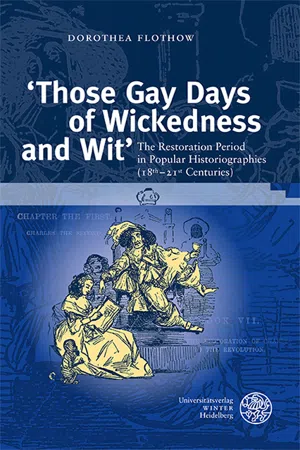 No longer available |Learn more
'Those Gay Days of Wickedness and Wit'
The Restoration Period in Popular Historiographies (18th–21st Centuries)
- Dorothea Flothow(Author)
- 2021(Publication Date)
- Universitätsverlag Winter(Publisher)
47 Theatre censorship was abolished in the UK in 1968. 48 For the following cf. Canton (2011: 11-13); Kramer (2000); Kelly (2010); Wandor (2000). 49 Postcolonial and gay / lesbian re-writings of history have also been offered. See Berninger (2006: 152). 50 See Palmer (1998: ch 7); Broich (1993); Zimmermann (2006). T HE R ESTORATION P ERIOD – THE T WENTIETH AND T WENTY -F IRST C ENTURIES 261 metatheatre (see Feldman 2013). Inspired by postmodernist theory (see ch 1.2), these plays call the possibilities of historical knowledge into question. A prominent example is Tom Stoppard's Travesties (1974), 51 a 'memory play' (see Brunkhorst 1980). The action takes place entirely in the narrator's mind and is strongly distorted by his aged memory (see Pearce 1979: 1148). His view of historical events – the First World War and the Russian Revolution – contradicts accepted interpretations (see Zapkin 2016: 314). This playfully calls into question the reliability of historical eyewitnesses, the key source of historical accounts. A similarly sophisticated play with fact and fiction occurs in plays of Brian Friel and Michael Frayn, which have likewise helped to revise concepts of the history play (see Berninger 2006). Obviously, the historiographic form 'history play' has come a long way. Since the nineteenth century, it has not only become more openly political, wider in its scope, but also – due to its economic and institutional set-up and its strong aim for innovation – more elevated within the hierarchy of popular historiographical genres. This last development has repercussions for the way history is written in the genre. 5.2.2 Romantic Comedies and the Restoration In the early twentieth century, the Restoration period continued to attract primarily dramatists of the romantic comedy mode. With Paul Kester's internationally successful Sweet Nell of Old Drury (1900), 52 Anthony Hope's English Nell (1900), 53 George C. eBook - ePub
Memory and Enlightenment
Cultural Afterlives of the Long Eighteenth Century
- James Ward(Author)
- 2018(Publication Date)
- Palgrave Macmillan(Publisher)
as discussed in the following chapter, is a concern to present crime, punishment and their relation to social class in ways that refute the representation of these issues in the extant canon of fiction and drama. Lady Are comments on her securing a pardon that Bob ‘shall be reprieved at the tree […] [a]s in the old romances’ (259) and adds that the whole episode has ‘made an old lady merry with a farce’. A living link to the historic Restoration, this character is aware that she inhabits a dramatic ‘situation’ as well as an historical one, and recognizes that both are shaped and bounded by generic conventions. Her efforts to manipulate them, like her son’s manipulation of the corpse of his wife, present an allegory of the limits of historical memory and the power of determinants in shaping the past in the present.Victory and Restoration use the immediate and extended aftermath of monarchy’s return to interrogate and ironize the concept of restoration . In compact, episodic, narratives they present the political cataclysm of the seventeenth century as an analogue for the early 1980s, an apparently novel political dispensation which in a longer view resembles history repeating itself as both tragedy and farce. Each play also reawakens memories of the post-revolutionary period in order to destabilize a familiar and prevailing cultural memory of the post-1660 era as a proto-modern moment of tolerance, interclass harmony, and sexual enlightenment . Neither play, however, offers the revolutionary period as a positive countermemory. Victory depicts a Restoration which merely continues the brutality and carnage of the revolution while in Restoration , despite being only a generation old, the revolution is absent from characters’ memory. Genuinely revolutionary change is instigated under the guise of continuity through the alliance of aristocracy with finance capitalism, embodied in Victory though Charles II and Hambro and in Restoration through Hardache’s deal with Lord Are. This union replaces the marriage of lead characters central to the comic drama with which the period is associated, and provides a memory-equivalent to the new right’s marriage of fiscal radicalism and social conservatism in the 1980s. In spite of their differences both plays establish this alliance as a primary object of memory through which the represented past conditions the present. Beginning a shift away from the politics of nation and class and towards ‘notions of identity, gender and the limits of permissible social behaviour’, which as Ingo Berensmeyer asserts, became a major concern of Restoration memory texts in the 1990s, Restoration and Sexing the Cherry mark a transitional point in Restoration memory.42
Index pages curate the most relevant extracts from our library of academic textbooks. They’ve been created using an in-house natural language model (NLM), each adding context and meaning to key research topics.

