Literature

Sentimental Comedy
Sentimental comedy is a genre of drama that emerged in the 18th century, characterized by its emphasis on emotions, moral values, and the portrayal of everyday life. It often features themes of love, virtue, and the triumph of good over evil, and typically includes elements of humor and sentimentality. This genre aimed to evoke empathy and moral reflection in its audience.
Written by Perlego with AI-assistance
Related key terms
1 of 5
11 Key excerpts on "Sentimental Comedy"
 eBook - PDF
- Joseph Wood Krutch(Author)
- 2019(Publication Date)
- Columbia University Press(Publisher)
CHAPTER Vili THE DEVELOPMENT OF Sentimental Comedy EIGHTEENTH-CENTURY comedy is by no means merely Restoration comedy purified. True, to the moralist it is much less objectionable, and his protest helped its develop-ment, but it is not merely the old comedy expurgated. It is a different species. It embodies the reforms that were demanded, for in its fully developed form the language is pure, the moral not only good but obvious, and the hero always intended to be ultimately admired. But in addi-tion to this, it adds the element called Sentimentalism, which I take to be merely facile and, usually, shallow, illogical emotion. The best of the old writers of comedy were largely intel-lectual. They observed a hard and unfeeling society and they pictured it with delight, taking a cynical and purely intellectual pleasure in contemplating its follies and its vices. To this cold picture, the inferior dramatist added a large amount and the better ones a small amount of the purely luscious to tickle the imagination of the ground-lings. But the emotions, except sometimes the misan-thropic, were usually absent. With the coming of the sentimental drama, comedy began to take on some of the functions of tragedy. The audience is expected now not only to laugh at the characters, but to share their joys and sorrows. It is no longer to look on with an Olympian detachment, but to suffer with distressed virtue and rejoice when the dark clouds reveal their silver lining. Moreover, all of this is to be connected with a sentimental (i.e., not THE DEVELOPMENT OF Sentimental Comedy 1 9 3 necessarily genuine or deep rooted) admiration of virtue. The spectator is to be always on the side of the angels, and not only to believe that virtue always triumphs but also to feel a personal exultation when it does. Benevo-lence takes the place of esprit as the most admirable human characteristic, and the reform of some vicious person be-comes a favorite theme.
- Albert J. Rivero(Author)
- 2019(Publication Date)
- Cambridge University Press(Publisher)
27 At the same time other kinds of works were also marketed in titles as ‘sentimental’, including an acting manual, poems, a magazine, a songster, literary anthologies, a pedagogical work for young- sters, familiar essays, several stage comedies, and travel journals and narra- tives. These indicate that the sentimental was now a familiar and Anglicized if shifting, contested and in some quarters controversial cultural-political category. In the late 1770s and 1780s, as disparagement of certain kinds of senti- mental novel increased and probably taste for these kinds decreased, producers of the sentimental novel responded successfully to political events and their market by variegating, diversifying and developing the form. In the public sphere the American crisis increased doubts of the ruling order’s ability to modernize effectively, boosting existing reform movements, prompting new ones, expanding public political literature and inspiring representation in the belles-lettres as crisis in subjective identity, pure relationships and chronotopes of power. The ‘sentimental citizen’ was being formulated in literature and political activism as basis of, and necessary identity for, participation in a modernized political nation, while unmodern politics were supposed to exclude sentimental modern subjects from citizenship and require and produce people of damaged, corrupted or no sensibility, as illustrated particularly in ‘philosophical romances’ such as John Moore’s Zeluco (1789). 28 Sentimental novels were often gynocentric in form to sharpen political import, centring on a conventional figure of disempowerment, but now that import was heightened by devices of gothic fiction in representing contested legiti- macy, inheritance and property as analogues to the national and imperial crisis.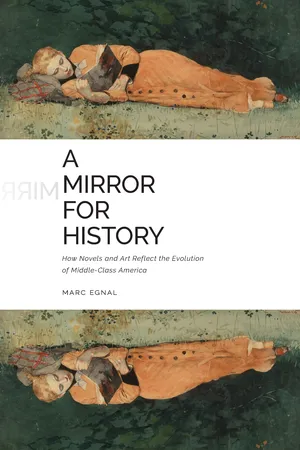 eBook - PDF
A Mirror for History
How Novels and Art Reflect the Evolution of Middle-Class America
- Marc Egnal(Author)
- 2024(Publication Date)
- Univ Tennessee Press(Publisher)
3 These families, and particularly the wives and daughters, relished the widening flood of novels. Much of this fiction, such as the works of James Fenimore Cooper and Harriet Beecher Stowe, had a rural setting. In the towns, the “middling folk” who visited galleries and exhibits enjoyed the work of landscape painters, including Thomas Cole, Frederic Church, and Albert Bierstadt. Any exploration of the period must look more closely into two questions: What exactly was sentimentality? And what dates demarcate the era? Observers agree that sentimental literature involves heightened emotions, often including a flood of tears. “Characters in sentimental novels,” notes Cindy Weinstein, “cry for all sorts of reasons: they have lost a child or a parent, seen a loved one fall from spiritual grace, endured cruel treatment. . . . There is indeed a contagion of weeping, but the targeted weeper is, of course, the reader.” 4 One indication of the high-water mark and gradual ebb of sentimentalism rests with the frequency of weep, which crested in the mid-1840s and declined in the following decades (fig. p1.1). Still, a full understanding of the era and of sentimental literature and art, must move beyond tears, and focus on “heightened emotions.” That broader definition encompasses the anguished protagonists of the early national period; the seekers and lofty heroes in novels by James Fenimore Cooper, Nathaniel Hawthorne, and Herman Melville; and the sentimentality that marked many of the books published after midcentury. Scholars underscore other aspects of this literature. Some critics pronounce this outlook (as David Reynolds notes) “socially conservative.” Jane Tompkins remarks, “the fiction we label as ‘sentimental’ . . . . blots out the uglier details of life,” while Laura Wexler observes, “The energies [sentimentalism] developed were intended as a tool for the control of others.” In this reading, tears dissolved cries for change and turned anger inward. eBook - PDF
- N. Rawlinson(Author)
- 2002(Publication Date)
- Palgrave Macmillan(Publisher)
37 However, they also shared a certain inability to articulate a vision of God behind the moral values they claimed to be promoting. It was but a short step from the sentimental to sentimentality, an insipid world where lack of moral certainty was made worse by an obsession with nature and a general air of melancholy. Sentimental Comedy, inviting its audience to weep as well as laugh, rap- idly became the art of smug self-congratulation, the expression of a 26 William Blake’s Comic Vision society content with itself and only supporting those who adopted its (largely middle-class) values. A correspondent identified only as ‘IWLB’ epitomizes this desire to see society reflect his own image when voicing a concern about the Sentimental Comedy, John Bull. In a letter to the Gentleman’s Magazine in September 1803, he remarks that ‘being, like the justly celebrated Sir Roger de Coverley, inclined to patronize and to enjoy innocent amusement’ he decided to take his family to see the new play ‘with the hope of having all our old English prejudices gratified, by see- ing the national character exhibited in a respectable point of view’ in a ‘good Church of England comedy’. However, the play disappoints him, largely due to a speech that tries to separate ‘Charity from the sterner virtues . . . Truth, Justice, Prudence and Chastity’. Throughout his work Blake questioned the value of such ‘virtues’: for example one of his Proverbs of Hell remarks that ‘Prudence is a rich ugly old maid courted by Incapacity’ (E35) and in Milton he asserts that it is one of the ‘four pillars of tyranny’ (E128). In his criticism of the heroine of the great Sentimental Comedy Clarissa, he complains that Sentimental Comedy represented human existence as nothing more than a set of ‘Historical combinations & Moral Sentiments’ (E633) and ‘Moral laws’ were part of the ‘cruel pun- ishments’ of ‘Jehovah’ (E103). eBook - PDF
- Jürgen Klein, Vanderbeke Dirk, Jürgen Klein, Vanderbeke Dirk(Authors)
- 2016(Publication Date)
- De Gruyter(Publisher)
6 Both genres were little noticed in the early 20th century, allowing thus for the inflationary use of the philosophical paradigm as a kind of substitute religion in the explanation of literary phenomena. For Arthur Sherbo sentimental drama is - even in 1957 - simply a debased literary genre, incapable of producing literature of any marked degree of excellence. 7 It is in the drama, however, for example in Nicholas Rowe's melancholy tale of private woes The Fair Penitent (1703), that sympathy, compassion and the type of the man of feeling are modelled long before Shaftesbury's essays became influential. 8 The hero Altamont exhibits „goodness innate in a most uncompromising form, is kind as the softest virgin of our sex, and frequently demonstrates his tender passions on the stage, so after a misunderstanding with his best friend Horatio: But, O, had I been wronged by thee, Horatio, There is a yielding softness in my heart Could ne'er have stood it out, but I had ran With streaming eyes and open arms upon thee. 9 Esteeming his heart more than common law or common sense, Altamont is even willing to forgive his dishonoured bride Calista, a most extreme form of compassion and of illegal sacrifice not to be found in later sentimental literature. Here we have anything but the possessive gaze of a more or less detached male observer often found in later sentimental literature and generally attacked as a stereotypical trait of the man of feeling. Here we have quite uncompromising self-abasement and an altruistic model of compassion which is centered upon the extended family unit (which includes friends 10 ) surrounding Sciolto and endangered by the rake Lothario. The revolution of dramatic production at the turn of the century requires, besides an intertextual explanation, the application of the socio-political paradigm, not only that of the history of ideas.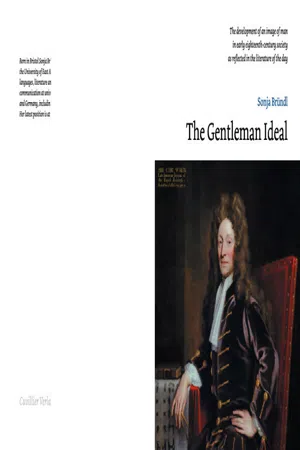 eBook - PDF
- (Author)
- 2003(Publication Date)
- Cuvillier Verlag(Publisher)
6.3 Sensibility and Sentimentalism The cult of feelings, what is now generally known as sensibility, grew up as a reaction to rationalism and the harsh conditions of everyday life. It was a craving for feelings neither prevalent in rationalism nor of importance in the survival of the poor. “The emphasis on passion and instinct, as opposed to reason, led, it is clear, to the emergence of sentimentality as a governing factor in the literature of the time.” 11 It once more reiterated the belief in the innate goodness of man and became unbelievably popular. 182 The sentimental novel, the dominant literary form of the late eighteenth century, was innovative as a form largely because it attached an unprecedented audience to literature. This readership was not only numerically larger than that previously attracted, it was also notable because it was made up of a new social alliance. The sentimental novel addressed women as much as men, and increasingly, those who belonged to the middle station of life, the social level between manual workers and the gentry that Dorothy Marshall characterised as ‘the Middling Sort’. 12 Consequently, it had much more influence on society than previ-ous forms of literature and as such played a decisive role in form-ing the acceptable manners of genteel society and portraying the gentleman ideal. There is often some confusion about the terms used in con-nection with sensibility: “Although closely related, sensibility and sentiment/ sentimental are in one respect easy to separate: sensibility is associated with the body, sentiment with the mind. The first is based on physical sensitivity and the processes of sensation; the second refers to a refinement of thought.” 13 However, the distinc-tions would seem to pale with frequent use: “In spite of the distinc-tions that can be identified, however, eighteenth-century writers and speakers were neither precise nor consistent.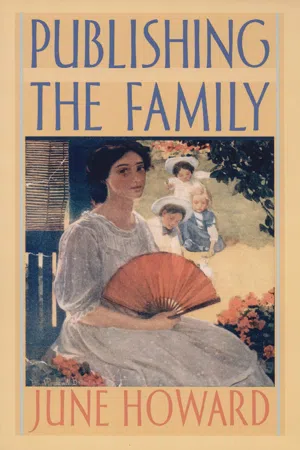 eBook - PDF
- June Howard, Donald E. Pease(Authors)
- 2001(Publication Date)
- Duke University Press Books(Publisher)
Sentimentality is such an elusive, provocative, indispensable category because it beckons us into these paradoxes. Celebrations and critiques occupy the same circuit, and we can end the relay between them only by historicizing the oppositions themselves. Feeling and Form How, then, on this broad terrain, are we to think about sentimentality in literature, and particularly in American literary history? I noted earlier that the deployment of sympathy in literature provoked some eighteenth-century writers to critique emotionalism in literature. Its embedding in the practice of domestic reading similarly produced an antisentimental reaction. Nina Baym has shown that the protagonists of the best-known American women’s novels of the mid-nineteenth century, such as The Wide, Wide World and The Lamplighter, try to ex-tricate themselves from human connectedness in order to pursue indi-What Is Sentimentality? 241 vidual self-development. In postbellum America, literature itself was often defined against sentimentality and the domestic culture of let-ters. 19 Prestigious writing gradually and unevenly became less openly emotional and more ambitiously intellectual, less directly didactic and more conspicuously masculine. Antisentimentalism is an important part of this story, especially for literary studies. Forty years before he criticized Edith Wyatt’s contribution to The Whole Family, Henry James was an articulate spokesman for the re-action against sentiment. He writes in an 1867 review, for example, that Rebecca Harding Davis has made herself ‘‘the poet of poor people,’’ but her material cannot justify her manner: She drenches the whole field beforehand with a flood of lachrymose sen-timentalism, and riots in the murky vapors which rise in consequence of the act . eBook - ePub
- John Richetti(Author)
- 2003(Publication Date)
- Routledge(Publisher)
The sentimental novel presents in their place a consoling myth encompassing varieties of extravagant heroism and moral community, private rather than public achievements. In turning away from the attempt to know the modern world in its spectacular and transforming historical dimension and in offering instead a comically private epistemology (which is in fact a literary joke, a parody of intellectual seriousness) and a rhetorically produced and totally personalized sentimentality, Sterne’s fiction appears at first glance to be the definitive rejection of the social and historical world by eighteenth-century British narrative. It offers the proposition that the eccentrically personal and whimsical, the economically privileged and disengaged individual, devoid of communal function or membership or occupation, pleasing himself and ignoring or disparaging conventional knowledge of the external social and political world, possesses generalized significance. And yet such a representation might be seen as a profound allegory of modern life in its new material abundance, so that, as Joyce Appleby sums it up, the “cumulative gains in material culture which became manifest by the eighteenth century…made it evident that human beings were the makers of their world.” 36 Sterne’s odd genius is to render this claim in a very complex fashion by dramatizing both the absurdity and the truthful inevitability of such solipsism in a world of privileged and materially secure individualism. 37 NOTES 1 Richard Steele, The Spectator, No. 294, February 6, 1712, ed. Donald F. Bond (Oxford, Clarendon Press, 1965), Vol. III, pp. 47–48. 2 John Mullan, Sentiment and Sociability: The Language of Feeling in the Eighteenth Century (Oxford, Clarendon Press, 1988), p. 14. 3 Mullan, Sentiment and Sociability, p. 25. 4 Mullan, Sentiment and Sociability, p. 24. 5 David Hume, A Treatise of Human Nature, ed. P.H.Nidditch (Oxford, Clarendon Press, 1978), Part II, Section V, pp
- Susan J. Matt(Author)
- 2020(Publication Date)
- Bloomsbury Academic(Publisher)
James Baldwin famously defines it as “the ostentatious parading of excessive and spurious emotion,” which he considers “the mark of dishonesty, the inability to feel” (Baldwin 1949: 579). By the late twentieth century, literary sentimentalism began to receive serious scholarly attention. In Virtue in Distress (1974), R.F. Brissenden traces sentimentalism’s “idealistic and freshly empirical and pragmatic approach to life” (Brissenden 1974: 55) from Samuel Richardson’s Clarissa (1748) to the Marquis de Sade’s La philosophie dans le boudoir (1795) and Jane Austen’s Northanger Abbey (1818). He sees in sentimentalism “the basis for a liberal and a revolutionary political ideology—humanist, anti-authoritarian and compassionate” (55). While his focus on “virtue in distress” as the central theme may seem narrow now, this examination of the literature of tears and its ties to humanitarianism, philosophy, and a range of English, French, and German texts, initiated a reevaluation of literary sentimentalisms, leading to a later explosion of scholarly work on emotion in literature. Later critics would build on Brissenden’s emphasis on tears and suffering to demonstrate sentimental literature’s interest in a broad array of affects. For example, in his study of French sentimental writers, from once popular novelists such as Baculard d’Arnauld to Madame de Staël, David Denby expands our understanding of sentimentalism beyond tears. He sees it “as a narrative structure, in which the happiness and misfortune of the represented subject are the primary focus.” Yet sentimentality is also always about others, observers, and their emotional responses: “As well as representing a reality, the sentimental text represents the reaction to that reality of an observing subject” (Denby 1994: 4)
- M. Bell(Author)
- 2000(Publication Date)
- Palgrave Macmillan(Publisher)
5 Victorian Sentimentality: the Dialectic of Sentiment and Truth of Feeling If the eighteenth century is remembered as the age of sentiment and sensibility, the Victorian period is usually considered the peak, or trough, of sentimentality. Victorian sentimentality is a byword for indulgent and lachrymose excess, and the reaction against it, as encapsulated in Oscar Wilde's remark that it would take a heart of stone to read the death of Little Nell without laughing, was crucial to many writers of the modernist generation. It may be that literary criticism is not the best mode for considering the signi®cance of this cultural phenomenon. A popular culture of tears may serve an intuitively therapeutic purpose requiring simple triggers rather than artistically complex occasions. Nonetheless, literary texts, and contemporary ways of understanding them, are an especially signi®cant part of the Victorian culture of feeling and in recent years Victorian sentiment has been seen with greater sympathy, and internal discrimination, while the modernist response now seems an overreaction. But this critical turn in favour of sentiment still largely misses the process of transformation. Victorian sentimentalism grappled, creatively and self-critically, with the inherited problems of ethical sentiment and its great achievements are just as sentimentalist in their deeper derivation as the moments of excess. The implicit criterion of true feeling which developed within the tradition of sentiment cannot be fully disentangled from sentimentality in the pejorative sense. In the realm of feeling, the true and the false de®ne each other in a process of constant discrimination; true and false feeling have a dialectical relation. The recent sympathetic interest in nineteenth-century sentimental literature, therefore, requires some further discrimination. eBook - PDF
- Pierre Dubois(Author)
- 2015(Publication Date)
- Cambridge University Press(Publisher)
part ii Sentiment and sensibility 6 The perimeter of the sentimental mode In the preceding chapter, we saw that in the first part of the Georgian period, music was the locus of intense ideological conflicts, and that, quite naturally, the novels written in that period reflected those tensions: the moral import of music was central to its fictional representation. Although the allegorical use of music as a means to reflect the moral excellence or depravity of a given character was to remain a constant feature in fiction throughout the eighteenth century, other, more complex issues became prominent in the second half of the period. I shall argue that this corre- sponded to a deep evolution in the way music tended to be conceived, as is manifest in the theoretical discourse on music aesthetics that developed after 1750. A close look at the work of Laurence Sterne (1713–68), the author of The Life and Opinions of Tristram Shandy, Gentleman (1760–7) and A Sentimental Journey through France and Italy (1768), will show that his approach to music was different from that of his predecessors and that it implied a new conception of music. Before focusing on his work in detail, it may not be inappropriate to attempt to frame (albeit superficially) the so- called sentimental novel, to which Sterne himself gave its name with the title of his second novel. The eighteenth century has often been dubbed – somewhat simplisti- cally – “the Age of Reason” (after the title of Thomas Pain’s influential pamphlet, published in three parts between 1794 and 1807). There were, it is true, signs of this quest for rationality. In Britain, following the founda- tion of the Royal Society of London for Improving Natural Knowledge (known as the Royal Society) in 1660, all departments of knowledge were submitted to systematic scientific investigation through the observa- tion of natural laws.
Index pages curate the most relevant extracts from our library of academic textbooks. They’ve been created using an in-house natural language model (NLM), each adding context and meaning to key research topics.

