Literature

Farce
Farce is a comedic genre characterized by exaggerated, improbable situations, physical humor, and absurd plot twists. It often involves mistaken identities, misunderstandings, and chaotic events. Farce aims to entertain and amuse through its exaggerated and often ridiculous portrayal of characters and events, creating a sense of lightheartedness and laughter for the audience.
Written by Perlego with AI-assistance
Related key terms
1 of 5
7 Key excerpts on "Farce"
 1 What is Farce?“I have not yet seen any Definition of Farce, and dare not to be the first that ventures to define it. I know not by what Fate it happens (in common Notion) to be the most contemptible sort of the Drama.”—Nahum Tate, preface to A Duke and No Duke, 1684, edition of 1693When the newly created Poet Laureate, Nahum Tate, set out to defend Farce in 1693, his literary colleagues were accustomed to employ the word as a term of contempt. Thomas Rhymer, for example, savagely damned Shakespeare’s Othello as ‘a Bloody Farce, without salt or savour.” For many people today Farce is still a pejorative term, implying that something is “as ridiculous as a theatrical Farce;...a hollow pretense, a mockery” (O.E.D. , s.v. Farce , 2). But in the language of criticism, the word is now generally used in a more constructive sense to identify a particular form of comedy. This the O.E.D. succinctly defines as “A dramatic work (usually short) which has for its sole object to excite laughter” (s.v. Farce , 1). It is this genre with which this study is concerned: broad, physical, visual comedy, whose effects are pre-eminently theatrical and intended solely to entertain; comedy which is slapstick, if you like, in a more or less coherently funny narrative; or, as Eric Bentley puts it “practical joking turned theatrical” (The Life of the Drama , N.Y., 1964, p.234).Farce came late to the canon of dramatic terminology. Unlike the terms comedy, tragedy, and even satire, its usage was not sanctioned by classical authority. In fact, both the Greek and Roman stages seem to have distinguished between various forms of comedy according to their subject-matter, rather than their appropriate comic styles. Thus, Old Comedy was equated with ridicule of individuals,
 eBook - PDF
Theatre
A Way of Seeing
- Milly Barranger(Author)
- 2014(Publication Date)
- Cengage Learning EMEA(Publisher)
In general, Farce’s characters are broad outlines of the ludicrous in human behavior. They are monuments to human stupidity and mischievousness— reminders that fools and impostors are part of the human condition along with the sensible, virtuous, and noble. T HE “P SYCHOLOGY ” OF F ARCE The “psychology” of Farce, as Eric Bentley calls it, is that special opportunity for the vicarious fulfillment of our unmentionable wishes without having to take respon-sibility for our actions or suffer guilt for our transgressions. 6 As a popular dramatic form, Farce gives us a fantasy world of violence (without harm), adultery (without consequences), brutality (without reprisal), and aggression (without risk). Unlike comedy’s concerns for social values, the fast-paced, topsy-turvy world of Farce trips over social proprieties. It entertains with escapades that appeal to our secret thoughts and innermost fantasies. In Michael Frayn’s Noises Off , a character sum-marizes the improbable confusions of Farce: “That’s what it’s all about. Doors and sardines. Getting on—getting off. Getting the sardines on—getting the sardines off. That’s Farce. That’s the theatre. That’s life.” Today, we enjoy Farce in the films of Charlie Chaplin, W. C. Fields, the Marx Brothers, Woody Allen, Steve Martin, Eddie Murphy, Queen Latifah, and the Coen Brothers; in the plays of Georges Feydeau, Neil Simon, Elaine May, Alan Ayckbourn, Michael Frayn, David Ives, and Steve Martin; and in the performances of The Flying Karamazov Brothers, Blue Man Group, Penn & Teller, Bill Irwin, and Robin Williams. CHAPTER FIVE THEATRICAL WRITING : PERSPECTIVES AND FORMS 117 Copyright 201 Cengage Learning. All Rights Reserved. May not be copied, scanned, or duplicated, in whole or in part. Due to electronic rights, some third party content may be suppressed from the eBook and/or eChapter(s). Editorial review has deemed that any suppressed content does not materially affect the overall learning experience.
- Penny Gay(Author)
- 2008(Publication Date)
- Cambridge University Press(Publisher)
Chapter 2 Farce The Comedy of Errors 18 The Taming of the Shrew 23 The Merry Wives of Windsor 30 When we use the theatrical term ‘Farce’ today we usually understand it to mean ‘French Farce’, or ‘sex comedy’: plays set in bedrooms or drawing-rooms with lots of doors and hiding spaces for adults attempting to engage in illicit sex. This type of drama works via a frenetic pace and split-second comic timing. The Oxford Dictionary of English (2nd edn, 2005) defines Farce as ‘a comic dramatic work using buffoonery and horseplay and typically including crude character- isation and ludicrously improbable situations’. From the French cooking term, farcir, to stuff, in the early sixteenth century the word ‘became used metaphor- ically for comic interludes “stuffed” into the texts of religious plays . . . “suche as writte farcis and contrefait [counterfeit] the vulgare speche”’ (as translator Jehan Palsgrave wrote in 1530). If there is sexual activity, that is, it’s not neces- sarily the most important driver of the play, and it certainly doesn’t represent the behaviour of upper-class people. Horseplay, buffoonery, vulgarity (including really crude sex jokes, often visual, involving oversize phalluses) – all are important defining aspects of comedy pre-Shakespeare. Words are often less important than actions, and because of this physicality there’s always a possibility of violence in this type of theatre. It’s intriguing to speculate why this is so: might there be a clue in that early concept of Farce? If the reality of life in this world is, as Thomas Hobbes said in 1651, ‘poor, nasty, brutish, and short’, and we live in ‘continual fear and danger of violent death’ (Hobbes, Leviathan, ch. 13), the church-going members of the medieval community might have welcomed the ‘stuffing’ of this perception into a pious religious play that exhorts us to behave ourselves and look to our heavenly reward – or punishment. eBook - PDF
Theatrical Event-Machines
Encounters between Theatre and Theory in British Farce from the 1960s to the 1980s
- Kerstin Howaldt(Author)
- 2023(Publication Date)
- Königshausen & Neumann(Publisher)
Vera Gottlieb states that “two very different philosophies of ‘Farce’ may be opposed. First, the conventional one which has it that Farce does not deny that human aspirations exist; it merely regards them as a joke’ – the philosophical ‘common ground’ between conventional Farce and much ‘absurdist’ work. The second, virtually an oppositional reading, is that Farce (and comedy) is […] about ‘the struggle between human will and the lack of will power’. By the first definition, situation or circumstance dictate character and action – and render characters impotent or like ‘blind and inflexible machines’; by the second, action and circumstance arise largely from character: there is a potential for change, albeit often unrealized on stage. The first philosophy or definition of Farce is largely ‘dehumanizing’: the second, essentially humanist and […] ironic” (224-225, emphasis in original). 28 help of which she seeks to explore exemplary topics and plot structures of Farce. Although only mentioned in passing, she assumes that the analysis of Farce might be connected to its staging of eventfulness. She claims that the plays’ accumulation of events leads to a more condensed experience of time for characters who are intrinsically superficial and surmises that a slower sequence of events unveils the emptiness of Dasein. Although Drechsler’s study goes beyond the commonplace of (physical) humour, it continues the taxonomic and classificatory tendencies established by early Farce criticism. Moreover, her thoughts on sense-making rather focus on the plays’ subject matter and neglect their formal aspects. Finally, her study discusses plays which in my understanding cannot even be considered farcical insofar as they deploy an entirely different modality (for example Beckett’s Waiting for Godot or Ionesco’s La Cantatrice Chauve).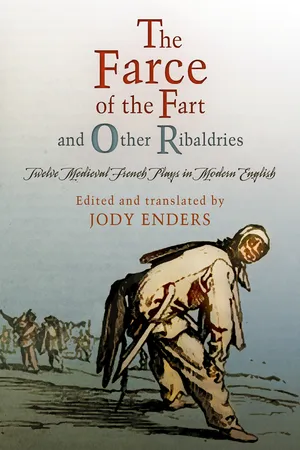 eBook - ePub
"The Farce of the Fart" and Other Ribaldries
Twelve Medieval French Plays in Modern English
- Jody Enders(Author)
- 2011(Publication Date)
- University of Pennsylvania Press(Publisher)
Are you sick of the lechery of your parish priest? No worries! Devise a drama that will show his true colors and provide his come-uppance (Monk-ey Business). Is your wife fooling around on you? Try catching her in the act; but, when you cast the scene of her entrapment, better make sure that everyone is only acting (Getting Off on the Wrong Foot). What about that dolt of a husband who’s always locking you up inside the house? Typecast your priest as the Devil so that, next time your hubby shouts, “The Devil take you!” the priest can step right up in a Devil suit. Could it be … Satan ? (Cooch E. Whippet). And, finally, what do you do when schooling turns a young man into such a jargon-spouting, Latin-speaking fool that he forgets how to speak his native French? Get him back on the farm for some homespun homeschooling (Birdbrain). That’s what. While it would be customary to start out with a working definition of what Farce is, I prefer to end where others might begin. (Any farcical resemblance to my doing things “ass-backwards” is purely coincidental.) It is only at the close of this Introduction that you will see a tentative sketch of the Farce as literary genre; and that is because performance is paramount to all the usual, prefatory categories or heuristics. Performance (as exemplified here by space, mime, gesture, and costume) makes it difficult to treat independently such crucial access points as genre, history, authors, actors, and audience. Performance inflects all the questions that I propose to ask and answer in a version of the journalistic canon of Who? What? Where? When? Why? 3 As we shall see, who the performers of Farce were had a lot to do with what came to define the genre over time. To put it another way, my questions are these: Where does Farce come from? (I am tempted to respond, paraphrasing Dr. Seuss: “I can’t say eBook - PDF
Fools and Jesters in Literature, Art, and History
A Bio-Bibliographical Sourcebook
- Vicki K. Janik(Author)
- 1998(Publication Date)
- Greenwood(Publisher)
Much of the debate revolves around the character of the fool and his presence in a given comedy. Eugenie Droz, in her collection, maintains that there is no difference between sotties and Farces other than a style of acting. Emile Picot's edition separates the two forms, as do studies by Jean-Claude Aubailly and Barbara Bowen, who subsequently distinguishes some 150 Farces. Alan Knight, on the other hand, follows the practice of the late Middle Ages and groups all the comedies as Farces, proposing to classify what the contemporary authors and printers alternatively entitled sot- ties or Farces moralisees as a subgenre of the typical Farce. In so doing, he respects their differences while he preserves the notion that they all belong to the same "folly-ridden world." As an initial, general distinction, the typical Farces, with the exception, that 412 Fools and Jesters in Literature, Art, and History is, of the well-known Farce de maitre Pierre Pathelin (c. 1460), are short com- edies of approximately four hundred lines in octosyllabic verse with characters from real life. Their plots, usually ending in the "trickster tricked," depend on stock situations: husbands and wives fight, merchants and customers cheat each other, stupid students study Latin, soldiers brag, priests seduce, women lie, and old men are duped. On the other hand, the sotties and Farces moralisees, of virtually the same length as the Farces, display a greater variety of versification. Also, the characters are anonymous (Premier Sot, Deuxieme Sot) or allegorical, personifying abstract ideas (Vertu, Malice, Grosse Despense), institutions (Honneur Spirituel, Mar- chandise), or social types (Les Gens Nouveaulx, Le Monde). Along with these can come a whole following of fools with thoroughly carnivalesque names (Croulecul, Platebourse, Baillevant). eBook - ePub
English Literature
A Student Guide
- Martin Stephen(Author)
- 2013(Publication Date)
- Routledge(Publisher)
EXISTENTIALISM: in existentialist philosophy, existence is the only thing we are certain of; man’s life begins and ends in nothingness, and life is inexplicable, meaningless, and dangerous. The nature of our existence is decided by the choices we make to determine its nature. There are many variations of this philosophy, including even a Christian one, but its main appearance in literature is in the THEATRE OF THE ABSURD.EYE RHYME: rhyme based on words which look similar but which are pronounced differently, as in ‘how/bow’ where ‘bow’ is pronounced as in ‘bow and arrow’.FABLE: a short tale or story conveying a clear moral lesson, as in the sixth-century Aesop’s Fables .FABLIAU: a short satirical or comic tale with a strong bawdy element; Chaucer’s The Miller’s Tale is one of the best-known examples.Farce: a play intended to provoke non-censorious laughter by presenting absurd and ridiculous characters and actions. Complicated plots, mistaken ideas, and marital infidelity are the stuff of Farce. FEMININE ENDING: a line of verse ending on a weak or unstressed syllable.FEMINIST CRITICISM: the literary and critical theory that explores the bias in favour of the male gender in literature, and which re-examines all literature from a feminist viewpoint. See Chapter 25 .FLAT AND ROUNDED CHARACTERS: a FLAT character is one who is one-dimensional, often characterised through one feature or mannerism. He or she is a type, a CARICATURE, or someone who behaves with little depth and complexity. A ROUNDED character is more complex, can surprise the reader with his or her actions, and can change or grow over the course of a book or play. In general, flat characters are simple, and rounded characters are complex. Thus in Great Expectations
Index pages curate the most relevant extracts from our library of academic textbooks. They’ve been created using an in-house natural language model (NLM), each adding context and meaning to key research topics.

