Literature

Satire
Satire is a literary technique that uses humor, irony, or ridicule to criticize and expose the flaws of individuals, institutions, or society. It often employs exaggeration and parody to highlight the absurdities and vices of its targets. Through wit and sarcasm, satire aims to provoke reflection and change by challenging prevailing attitudes and behaviors.
Written by Perlego with AI-assistance
Related key terms
1 of 5
11 Key excerpts on "Satire"
 eBook - ePub
Comedy and Social Science
Towards a Methodology of Funny
- Cate Watson(Author)
- 2015(Publication Date)
- Routledge(Publisher)
4 Satire DOI: 10.4324/9781315731407-4INTRODUCTION
Satire has been defined as ‘a literary manner which blends a critical attitude with humour and wit to the end that human institutions or humanity may be improved’ (Holman, 1980 , p. 398). Holman continues, ‘True satirists are conscious of the frailty of institutions of human devising and attempt through laughter not so much to tear them down as to inspire a remodeling’. While irony, as a rhetorical trope which exerts its effects through juxtaposition and the creation of incongruity, constitutes a potential analytical tool in the social sciences, Satire may be considered a genre, mode of writing, or narrative form, a means for and of representation. In overly simplistic terms, then, irony contributes to the development of theory whereas Satire functions as a form of critique, achieving its ends through challenging our assumptions by making them appear ridiculous (Bronowski and Mazlish, 1960 ).Satire is undoubtedly dangerous stuff. Ancient beliefs in the magical powers of Satire for good and ill were once widespread (Elliott, 1954 ). Satire could literally be hurled as invective against one’s enemies or used to expel evil. That satirists could ‘rhyme rats to death’ (Todd and Curry, 1850 ) was apparently a commonplace belief in ancient and medieval times, referred to by Shakespeare and others and the possible source of the legend of the Pied Piper of Hamelin.While satirists may no longer be feared for their terrible power, ruthlessly exercised—rats may sleep easy in their nests—the metaphor of Satire as weapon persists. It is perhaps Satire’s conceit to present this as having moral purpose, ‘prompting men of genius and virtue, to mend the World, as far as they are able’ (Swift, 1730 , p. 21). Such an aim would accord with a critical research tradition. However, this claim to moral purpose gives rise to a number of problems for the satirically inclined social scientist. First, as Veatch (1998 eBook - ePub
Diversity and Satire
Laughing at Processes of Marginalization
- Charisse L'Pree Corsbie-Massay(Author)
- 2022(Publication Date)
- Wiley-Blackwell(Publisher)
1 Defining Satire“Satire is a wrapping of exaggeration around a core of reality”.–Barbara W. TuchmanWe live in a satirical age unlike any other. There is an abundance of social absurdities to critique as well as a host of outlets through which to speak out. In the twenty-first century, Satire is mainstream and avant-garde. Long-running network shows, like Saturday Night Live (1975–present) and The Simpsons (1989–present), cable television offerings like Comedy Central’s The Daily Show (1996–present) and Cartoon Network’s Adult Swim, and popular and critically acclaimed independent films like Get Out (2017) and Parasite (2019) keep satirical content at the center of today’s entertainment industry. At the same time, social media has led to an explosion of user-generated Satire that can be tailored to niche and intersectional audiences, especially those whose voices have not traditionally been embraced by and in mainstream media.Regrettably, this flood of satirical content has exacerbated a long-standing issue for American audiences: The ability to distinguish and appreciate Satire. This confusion is particularly troubling for Satire that addresses issues related to marginalization, diversity, and inclusion. Even though discussions of social justice are prevalent in the public sphere, content that satirizes these processes is increasingly difficult to create and understand. This chapter will define Satire as well as a set of satirical strategies before describing how Satire serves to disrupt marginalization processes and the difficulties that satirists face in ensuring that their audiences understand their messages.What Is Satire?
Satire eBook - ePub
Irony, Satire, Parody and the Grotesque in the Music of Shostakovich
A Theory of Musical Incongruities
- Esti Sheinberg(Author)
- 2017(Publication Date)
- Routledge(Publisher)
The vertical axis is the axis of criticism, with progression from Reality to Fiction, and it is designed to include the characteristic which distinguishes satirical literature from other types of literature on the one hand, and from non-literature on the other. Satire is the meeting point of criticism and humor in a literary work. This meeting point is already expressed in the concept of ridicule, but ridicule does not always equal Satire. Finally, Satire is also situated somewhere between literature proper (Fiction), where the literary text does not necessarily enter into referential relationship with the world, and non-literature (Reality), where, as in everyday speech, there is a clear referential relationship. An ideal Satire should be situated closer to, rather than farther from the intersection of the two axes (Petro, 1982: 128) As in the case of irony, most writers on Satire use various and sometimes overlapping terms to describe its specific ramifications: burlesque, irony, the grotesque, parody and even tragedy are constantly interchanged with Satire. Within all this variety, however, there is one general agreement: Satire relies on a given set of norms, and uses ridicule, often in an aggressive manner, to indicate actual instances of failure to match their standards (Pollard, 1970: 3; Nichols, 1971: 14, 18; Fletcher, 1987: ix). The norms of Satire are characteristically (though not necessarily!) related to ethical and social values (Pollard, 1970: 7). Thus Satire bears a historical, reality-related character, and is therefore never totally fictional (Petro, 1982: 128). The simplest case of Satire would then be a phenomenon that, being incongruous with an accepted norm, is ridiculed eBook - ePub
- Joel Schechter, Simon Shepherd(Authors)
- 2021(Publication Date)
- Methuen Drama(Publisher)
Stripped of scenery, lighting, comic actors and audience after a performance ends, accomplishments of this ephemeral form are harder to assess than satiric novels, poems or mock-travelogues such as Gulliver’s Travels which can be read (and need not be heard) at any time. Texts that offer Satire without actors get most of the attention from critics of the art. M.H. Abrams, for example, defines ‘Satire’ as ‘the literary art of diminishing or derogating a subject by making it ridiculous and evoking toward it attitudes of amusement, contempt, scorn or indignation… Comedy evokes laughter mainly as an end in itself, while Satire “derides”; that is, it uses laughter as a weapon’ (1985: 187). Abrams’s references to derogation, weaponized laughter and ridicule are fine; he even tacitly admits the need for a respondent in his reference to laughter. But the thought that Satire can be more than a ‘literary art’ and take shape on stage appears only briefly toward the end of his three-page gloss. To allow the form its due as theatre, a critic would have to consider the contributions of actors and directors abetted by designers, stagehands, financial backers, musicians and spectators, all of whom contribute to a performance that ‘laughs Men out of their Follies and Vices’. Even in literary Satires such as Gulliver’s Travels, though no actors are needed to read the book, different voices speak. Some readers and critics mistake the voice of Lemuel Gulliver or the projector in Swift’s pamphlet A Modest Proposal for that of the satirist himself; but there is a distance between the author and his creations comparable to that between a playwright and stage characters eBook - ePub
Satire
Origins and Principles
- Matthew Hodgart(Author)
- 2017(Publication Date)
- Routledge(Publisher)
5 Forms of SatireIf Satire is marked by its predilection for certain subjects, and by its special approach to these subjects, it is not limited to any special forms. Almost any literary form will serve, provided that it permits the characteristic combination of aggressive attack and fantastic travesty, and gives the satirist freedom to use some or all of the essential techniques that I have described. Most if not all of the existing literary genres have in fact been taken over for satiric purposes by means of parody, and, as we shall see, Satire may be inserted to make self-contained episodes in plays and novels. Nevertheless there are certain forms that have been favoured by the satirists over many centuries, sometimes merely because of the conservativeness of literary tradition (such as formal Satire), and sometimes because they offer particularly good possibilities for imaginative invention (such as Utopian and anti-utopian story). What follows is not meant to be an exhaustive list of the possible forms, but it will show some of the commoner and more interesting formal structures that have supported the satirist's vision.Formal Satire: the classical tradition
Formal Satire is a miscellany in verse: in a loosely constructed monologue the poet denounces various kinds of vice and folly, and puts up against them his moral ideals. The subject matter is daily life, not heroic life, and this is treated realistically. The style is 'low', using not the elevated diction of epic and tragedy, but words and phrases from ordinary speech; and the tone tends to be conversational, rather than declamatory. Vice and folly are delineated in 'characters' which may be individual (as in the primitive lampoon) or representative; and the poet himself sometimes appears as a character, describing some event autobiographically or speaking through a mask or 'persona' which he assumes for the occasion. 'All the doings of mankind, their vows, their fears, their angers, their lusts, their pleasures, and their goings to and fro, these shall form the motley subject of my page' is Juvenal's description of his own work (I, 85-6). The Romans claimed to have invented this genre: 'Satura tota nostra est' (Satire is all our own) said Quintilian; the word has etymologically nothing to do with 'Satyr', a hairy god with goat feet20 ; although as we shall see it was often confused with this by classical and modern writers. It comes instead from the root satur meaning 'full' (as in 'saturated' and connected with satis, 'enough'). A satura lanx No longer available |Learn more
The Language of Persuasion in Politics
An Introduction
- Alan Partington, Charlotte Taylor(Authors)
- 2017(Publication Date)
- Routledge(Publisher)
Taylor (2016) notes that sarcasm is not always judged to be a bad thing. She observed how participants in online forums sometimes referred to their own behaviour as ‘sarcastic’ and portrayed it as a justifiable response to some other person’s aggressive verbal behaviour towards them. Politicians too may pride themselves on their ability to display aggression in a way that is considered both acceptable and entertaining.It may also be viewed as entertaining by those who are not the target, as in the following instance from the UK House of Lords:I have to thank the noble Lord, Lord Carlile of Berriew, for his colourful combination of irony and sarcasm, which I so often enjoyed listening to when he was a Member in another place.(House of Lords 2003)9.3 Definitions of SatireHumour in politics is often associated with Satire: Satire is a work ‘in which wickedness or folly is censured’ (Johnson 1755). It is a written or spoken form ‘in which human or individual vices, follies, abuses, or shortcomings are held up to censure by means of ridicule, derision, burlesque, irony or other methods’ (Encyclopedia Britannica, www.britannica.com/art/satire ). Various mock satirical ‘newspapers’ or news TV are available online; for example, The Onion satirises current affairs from a US perspective, The Daily Mash and NewsThump from a UK angle.In the terms adopted in this book, Satire is also a means of persuasion. A person, behaviour or state of affairs is criticised (evaluated unfavourably) in the hope of persuading an audience that something has to change.Moreover:• In political Satire, individuals or groups who possess power, authority or at least influence eBook - ePub
- Massih Zekavat, Tabea Scheel(Authors)
- 2023(Publication Date)
- Routledge(Publisher)
This is frequently achieved through the use of different rhetorical devices in literature. Moreover, Satire usually presumes a standard moral system as a norm in comparison to which deviations and (moral) failures are detected and exposed. As a result, Satire has been frequently conceptualized at the juncture between moral philosophy and rhetoric. Nonetheless, it has never been restricted to the traditional medium of rhetoric, namely language. Not only has it resurfaced in many genres like the novel, but it has also permeated over other media including pictorial arts and motion pictures. Among other things, its use in personal attacks also shows that it has not always strictly adhered to the moral and ethical codes it aims to uphold (for more on Satire, see Baumgarten & Morris, 2008 ; Bloom & Bloom, 1979 ; Condren, 2002, 2012, 2017; Condren et al., 2008 ; Connery & Combe, 1995 ; Davis, 2016, 2017; Declercq, 2018 ; Elliott, 1954, 1960 ; Feinberg, 1967 ; Frye, 1973 ; Greenberg, 2011, 2019 ; Griffin, 1994 ; Guilhamet, 1987 ; Highet, 1960, 1962 ; Hodgart, 2017 ; Hume, 2007 ; Jav ā d ī, 2005; Kernan, 1959, 1965 ; Knight, 2004 ; LaMarre et al., 2014 ; Marshall, 2013 ; McCausland et al., 2008 ; Meijer Drees & De Leeuw, 2015 ; Paulson,. 1967 ; Phiddian, 2013, 2019; Quintero, 2007 ; Simpson, 2003 ; Sloterdijk, 2001 ; Sutherland, 1962 ; Test, 1991 ; Twark, 2007 ; Zekavat, 2014, 2017, 2019a, 2019b). In literary and cultural studies, several critics have acknowledged the disciplinary, parrhesiastic, liberating, and revolutionary functions of Satire (Bakhtin, 1984 ; Brock, 2018 ; Colebrook, 2004 ; Eagleton, 2019 ; Hoffman & Young, 2011 ; Holm, 2017 ; Hutcheon, 2005 ; Kozintsev, 2010 ; McGraw & Warren, 2014; Nikulin, 2014 ; Phiddian, 2017 ; Rolfe, 2017 ; Sørensen, 2016 ; Takovski, 2019 ; Waterlow, 2015, 2018 ; Young, 2012, 2020 ; Zekavat, 2017 ; Zupan č i č, 2008). Chattoo (2019, p eBook - ePub
Satire
A Critical Reintroduction
- Dustin Griffin(Author)
- 2021(Publication Date)
- The University Press of Kentucky(Publisher)
In the late fourth century the grammarian Diomedes defined Satire as “a verse composition . . . defamatory and composed to carp at human vices” (maledicum et ad carpenda hominum vitia). 14 Furthermore, he has in mind only the tradition of Roman verse Satire as written by Lucilius, Horace, and Persius (whom he names), omitting the Varronian or Menippean tradition altogether. Though he acknowledges Satire’s complex etymology, from satyrs or the lanx satura or the lex satura, 15 Diomedes defines the form in wholly moral terms. He says nothing of wit, humor, playfulness, exaggeration or fantasy or paradox, iconoclasm or the carnival spirit. It is ultimately writers like Diomedes, reflecting what G.L. Hendrickson called the “moral obsession of literary criticism in later antiquity,” 16 who lead more or less directly to the emphasis on Satire’s moral function that dominates satiric theory from the Renaissance into the mid-twentieth century. Elizabethan Theory Sixteenth-century English writers on Satire inherited several different traditions: a broad medieval tradition of “complaint” 17 that ranged in English alone from Langland and Chaucer to Barclay and Skelton; Lucianic dialogues, once prized for their sophistication but by the Reformation increasingly associated with scoffing atheism; a line of epistolary Satire in Italy from Vingiguerra to Alamanni and Ariosto, based primarily on Horatian models. Oddly enough, with all this wealth of living tradition and despite the recovery of classical Roman formal Satire, the dominant theory of Satire among Renaissance writers was based on their notion of Greek satyr plays (of which they knew almost nothing), a theory that could account for very little of the Satire with which they were familiar eBook - ePub
Satire in the Elizabethan Era
An Activistic Art
- William Jones(Author)
- 2017(Publication Date)
- Routledge(Publisher)
2 For literary scholars, the end result of such dissimulation is a history of eminently useful formalist, Historicist, Reader Response, and many other approaches to satiric literature that are nonetheless plagued with manifold exceptions, uncomfortable generalities, and interpretive dead ends.Indeed, the chasm between theoretical approaches to Satire and the practice of Satire remains as broad and deep today as it has ever been, particularly with regard to satiric historicity, or the nature and degree of contact a particular form of Satire has with the various material conditions of its historical moment. On the academic side of the expanse, scholars of Satire have long acknowledged the need to account for the presence of historical forces in the interpretation of satiric literature, but more often than not, they have subsumed Satire’s overt historicity beneath the genre’s more legitimizing formal features. The ephemeral nature of Satire’s unapologetic interest in topicality, of representing “particular events,” and as a consequence, becoming “inescapably tied to those events but at an uneasy tension with them” (Knight 50), is certainly valuable to scholars. That engagement provides a tantalizing window into, or more precisely, a distorted mirror that reflects (a popular metaphor for the satirist’s art) contemporary realities, those “things that men do, their desires, their fears, their rage, their pleasures, their joys, their fumbling around” as Juvenal writes (85–86).3 However, as fascinating as topical referentiality is, it should come as no surprise that literary exegetes have tended to prefer the “universal” in Satire over “dated” representations because an excessive focus on topicality in satiric literature threatens to anchor the work in question too firmly, too materially, in a precise temporal moment whose political and cultural specifics are largely unrecoverable, not to mention risking the devaluation of the aesthetic complexity of the work. It is certainly important for literary scholars to admit, for example, that John Dryden’s Absalom and Achitophel represent, at one level, the Duke of Monmouth and the Earl of Shaftesbury, or that Jonathan Swift’s King of Lilliput is, again, at one level, a parody of King George I. However, in early-twentieth-century Historicist criticism, such analogical parallels only served to diminish the role of history in the interpretation of Satire by presenting such historical components as little more than an intriguing Roman-à-clef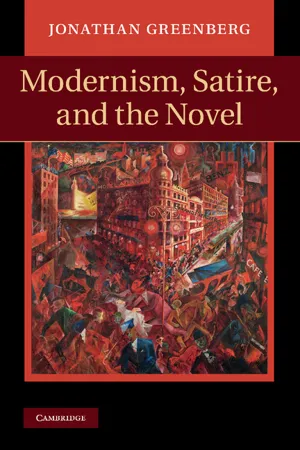 eBook - PDF
- Jonathan Greenberg(Author)
- 2011(Publication Date)
- Cambridge University Press(Publisher)
15 This moral element separates Satire from pure comedy; the objects of satiric laughter are experienced not as trivial but as “harmful or destructive.” 16 It also tends to make Satire a conservative mode, the argument runs, since Satire paints its target as deviating from a strong and stable set of communally held beliefs and at least implicitly urges reform. Such “conservatism,” suggesting both a certainty of authorial meaning and a promotion of social consensus, resembles what Wayne Booth has called “stable irony”; irony is stable, according to Booth, if “once a reconstruction of meaning has been made, the reader is not then invited to undermine it with further demolitions and reconstructions.” 17 This conservatism describes something different from a writer’s overt political views; while in a case such as Evelyn Waugh’s the writer’s outspoken traditionalism appears to reinforce his satiric ridicule of all that departs from age-old standards, a novelist on the left like Nathanael West has just as frequently been read as conservative in the sense that, in his biographer’s words, “his Satire was designed to return man to himself, to his ‘lawful callings’.” 18 Thus, while Satire is sometimes thought to trade in politics to the fault of being trivial – does anyone really care that the Treasurer of Lilliput was meant to represent Robert Walpole? – it is equally often felt to be redeemed by a metaphysical insight into that chimerical entity called human nature. 19 Yet even if in Satire the timely ultimately gives way to the timeless, political carping to moral vision, unadulterated moralism does not, according to the typologists, produce Satire, but leads instead to sermon, invective, or The double movement of Satire 3 polemic. To achieve its moral aims, Satire has been understood to deploy techniques that involve wit, play, and fantasy.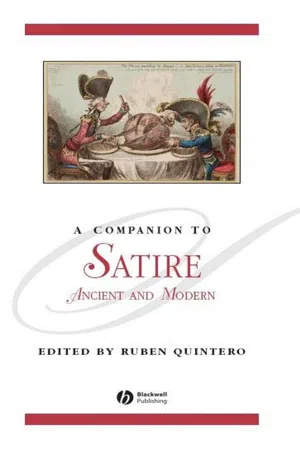 eBook - PDF
A Companion to Satire
Ancient and Modern
- Ruben Quintero(Author)
- 2008(Publication Date)
- Wiley-Blackwell(Publisher)
The satiric spirit emerges in a broader literature of cultural comment, social protest, and private disaffection. Rage and raillery are increasingly replaced by reflective anger, alienation, and even a satiric nostalgia that decries the loss of a simpler, more virtuous life. Some objects of this new, mixed Satire still appear in satiric portraits. However, the targets now include larger, more intractable, anony-mous forces: government policies and bureaucracies, a growing gap between the rich and poor, attitudes toward rural poverty, enclosures (the agribusiness of that age), abuses and crimes committed by the professional class, incipient industrialization that dehumanizes workers, the evils of globalization (economic exploitation and slavery), and the self-reinforcing hypocrisy of institutions that resist reforms because their first goal is to enlarge their own corporate power. If the Satire of this half-century seems diffuse, it is in part because no canonical writer, with the possible exception of Charles Churchill, represents it. It acts on a broadened stage of cultural and social uncertainty. It addresses a world recognizably modern. Imitation of classical models falls off. Fixation on court and crown does not disappear but does decrease. It is hard for formal Satire, a classical genre, to deal with accelerating change and volatility. For the first time in history, writers now employ that adjective to characterize the pace of change. During this time, England fought three major, protracted wars, ruthlessly sup-pressed a violent internal rebellion, lost thirteen North American colonies, estab-lished control by force of arms over much of the Indian subcontinent, experienced the rise of a powerful, new religious movement in Methodism, suffered anti-Catholic riots in the capital, debated the abolition of the slave trade and slavery, dealt with the
Index pages curate the most relevant extracts from our library of academic textbooks. They’ve been created using an in-house natural language model (NLM), each adding context and meaning to key research topics.

