Literature

Horatian Satire
Horatian satire, named after the Roman poet Horace, is a form of satire characterized by its gentle, witty, and lighthearted tone. It aims to gently ridicule human folly and vice, often using humor and irony to convey its message. Horatian satire is known for its more playful and good-natured approach compared to the harsher and more biting Juvenalian satire.
Written by Perlego with AI-assistance
Related key terms
1 of 5
11 Key excerpts on "Horatian Satire"
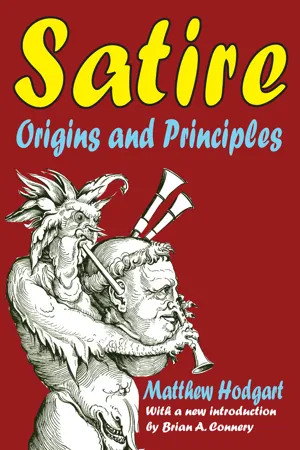 eBook - ePub
Satire
Origins and Principles
- Matthew Hodgart(Author)
- 2017(Publication Date)
- Routledge(Publisher)
satura lanx was a full dish, and in particular a dish filled with the first fruits of the harvest and offered to Ceres and Bacchus; a kind of cornucopia, it came to mean a medley, farrago or hotch-potch. The Romans believed their earliest satires to have been dramatic medleys in rude 'fescennine' verse, full of coarse raillery and ridicule. According to one Roman tradition, the early Roman poets, Ennius and Pacuvius, removed satire from its dramatic setting, and used the term to describe the more sophisticated verses they wrote on a variety of topics: 'satura', also spelt 'satira', now came to mean a poetical miscellany. Lucilius in the days of the Scipios (late second century BC), developed the form still further, turning it into a moral and political miscellany: his satires were open letters to the public, on matters of politics, morals and literary criticism. He was followed by Horace, who perforce abandoned politics, but kept the form of a moral miscellany. But in fact, Roman satire may be derived more directly from the parabasis or author's monologue of Aristophanic comedy, as Horace himself admits.With Horace we are beyond the hazy ground of conjecture, since his work has survived to stamp its mark on formal satire ever since. His earlier works in the genre are called 'satires', his later ones 'epistles', but there is not very much difference between them; both are also called 'sermones' or 'conversations'. That is the essential point about Horatian Satire: it is colloquial, dealing with a variety of not too serious moral, social and literary topics in the easy-going familiar style of a man talking to his intimate friends. The kind of topics he discusses are the folly of running to extremes, the defence of plain living and moderation in all things; the superiority of country to town life, and the simple pleasures of his Sabine farm (illustrated by the fable of the town mouse and the country mouse); another poem is centred on the Stoic maxim nil admirari:
- Lawrence Giangrande(Author)
- 2019(Publication Date)
- De Gruyter Mouton(Publisher)
It followed in the tradition of Panaetius who had objected (c/. Pavlovskis' citation above, p. 102) to the socially harmful moral coarseness of Cynic speech. Good-natured satire without censorious references of the Lucilian type shows Horace as a spectator who relates incidents ' Epistle 1.9.9. » Satire 1.10. 14-15. 4 Ibid., 16-17. ROMAN SATIRE 107 and scenes with no obvious ethical instruction in mind. But the lesson is there for the cautious reader. Although Horace assigns a certain virtue to Lucilius' vis comica, he adopts a theory of comedy more in accord with the restrained humor of New Comedy. Horace's irony, the trembling equipoise between jest and earnest, enables him to withhold decisions concerning human values. He manages to be sincere without becoming deadly serious. Observing and judging himself and his fellow-man through non-committal and good-natured irony, he maintains a tolerant, wise, humane, and middle-of-the-road approach to problems of living. Thus, for example, in Satires 2.3.326 and 2.1, 6 he directs satire even against himself in an ironical and humorous fashion. It would prove superfluous to analyze each of the Horatian Satires in detail in order to signalize the numerous examples of earnest jest, bland humor, urbane irony, and good-natured satire. The field has been too often covered by such scholars as Fiske, Fraenkel, Cartault, Rudd, Bennett, Rolfe, Kiessling, Heinze, Lejay,® and others. We can, therefore, only hope to parade before the reader's view a modest proportion of the wealth of material which the aforementioned subjects entail. Heterogeneous in subject matter, most of the Horatian Satires are replete with jokes jostling their judgments, although they do convey serious instructions. Social conscience and moderation, moral conviction and sober-minded abstinence from cloying self-5 Where the Horatian work is not mentioned, the Satires are meant. eBook - PDF
- Frederick Jones, David Taylor(Authors)
- 2007(Publication Date)
- Bristol Classical Press(Publisher)
The laughter is like that of the old comedians (1.123-5), ‘bold Cratinus’ ( audac i Cratino ), ‘angry Eupolis’, and the ‘grand old man’ (Aristophanes). As well as the way these three iconic figures are characterised, we are meant to remember Horace’s description of the same three (Hor. Sat. 1.4.1-5). Criticism may be expressed in laughter, but it has a moral aim. It is not mere abuse, and there is no place for easy targets like one-eyed men or geometricians (127-33). As in the Horatian programme style is an issue as well as criticism. In 14 Juvenal and the Satiric Genre this regard Persius makes a quite different claim from Horace. His satire is not like conversation (Hor. Sat . 1.4.42), but difficult and concentrated (125-7). If it is not actually unreadable, it is certainly as good as unread (2-3). Although the content is partly to blame for this, the contrast with the smoothness of other verse in the rest of this satire makes it clear that the stylistic issue is important. Indeed, the two are interwoven, since Persius treats style as symptomatic of moral state. In the fifth satire the comic element is again applied in a context of moral criticism: pallentis radere mores / doctus et ingenuo culpam defigere ludo (Pers. 5.16, ‘scraping pallid habits and nailing fault with unservile wit’). However, what is striking (and quite different from his model, Horace) in the introduction to this satire and in the first satire, is the extent to which Persius does not define what he does directly, nor by assimilating satire to another literary form. Rather, he does so in terms of a thorough-going critique of other literature. eBook - PDF
- Monica R. Gale, J. H. D. Scourfield(Authors)
- 2018(Publication Date)
- Cambridge University Press(Publisher)
Discipline and Punish Horatian Satire and the Formation of the Self Paul Allen Miller* Horace clearly states that the undisciplined Lucilian satire could have no place in the Augustan period. (Ramage, Sigsbee, and Fredericks b: ) Satire presents itself as a violent genre. Its descriptions in Lucilius, Horace, Persius, and Juvenal are filled with images of slashing, biting, rubbing salt in wounds. It is a discourse that, as Horace says in Satires ., is widely perceived as an assault and stands to earn an equally violent riposte from its victims (..–). Juvenal, therefore, will only write about the dead (.–). Persius will whisper his caustic truth in a hole dug in the ground (.–). The origin of this imagery can be traced to the genre’s founder, Lucilius. His satire not only ridiculed vice but also directly assaulted the political enemies of his patron, Scipio Aemilianus. Lucilian satire was a weapon in the political, ideological, and cultural warfare that sought to define what it meant to be a civis Romanus, a bonus, a nobilis. It was a discourse of positive exemplification in so far as the satirist demonstrated knowledge of social codes, cultural refinements, virtus, and urbanitas. But it was also a dis- course that sought to punish deviations from those perceived norms and did not shrink from naming names. Horatian Satire is different. It seldom attaches the names of prominent citizens to its objects of attack and protests that it does not seek to attack at all. It worries about the response of its victims (Sat. ., ., ., .), and is often the butt of its own jokes. In this chapter, I argue that * Many thanks to David Larmour, who read and commented on an early version of this chapter. The comments and criticisms of Monica Gale, David Scourfield, and the Cambridge University Press readers have made this a much better, more precise chapter. eBook - PDF
- Julian Wolfreys(Author)
- 2017(Publication Date)
- Red Globe Press(Publisher)
To know more would take us into the less conscious areas of writing and reading. Satiric models English literary satire has drawn upon several classical and Renaissance models. There were two principal Roman sources, much studied in grammar schools and universities for their stylistic distinctiveness: Horace and Juvenal. Quintus Horatius Flaccus, or Horace, wrote two books of Satires , in which he exploited aspects of his own life. His good fortune in attracting the notice of an enlightened patron, Maecenas, and one friendly with the emperor, Augus-tus, led to the award of a farm to him in Tibur in the Sabine hills. This independence (best exemplified by his second satire in Book 2), and the perspective of one not directly within the whirl (and compromises) of active political life, modulates in his work into a number of recurrent themes and styles: an urbanity that shows amusement at the lengths others will go to in order to gain high office; an easy, conversational style (he dubbed his satires sermones or chats) that apparently rambles through loosely connected topics, and a gradually unfolding preference for temperance and good humour. Pope’s identification with Horace in the 1730s is apt; he, too, a Roman Catholic and deformed from birth, suffered a similar exile, purchasing a property in Twick-enham, just outside (then) the western suburbs of London, equivalent to Horace’s Sabine farm. In his Horatian Epistles and Satires (1731–8), Pope found a means of amplifying his comments through other accents than his own, dignified by the passage of time as well as Horace’s own skill in apparently off-the-cuff and disengaged wit. In sharp contrast, there is Decimus Iunius Iuvenalis ( fl. late first to early second century), or Juvenal, whose firebrand vituperation in his 16 Satires is unrelenting and targeted at the commercial and pagan spirit that suffused Rome at the moment of its decline.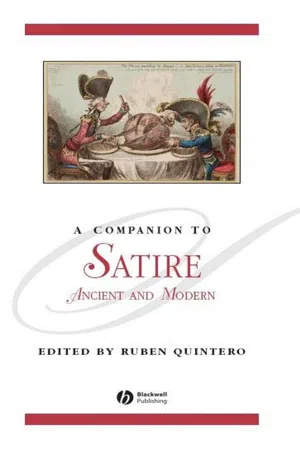 eBook - PDF
A Companion to Satire
Ancient and Modern
- Ruben Quintero(Author)
- 2008(Publication Date)
- Wiley-Blackwell(Publisher)
The satiric persona is fashioned from the conventions of drama, especially the predictable stock characters of comedy, and of rhetoric. The later Roman satirists had at their disposal a particularly Roman rhetorical mode: declamation, the art of constructing speeches for hypothetical contexts. By the early first century ce , declamatory exercises were a core part of Roman secondary education; students composed speeches offering advice to past political figures ( suasoriae ) and arguing the two sides of a legal conflict ( con-troversiae ). All educated Roman men thus knew the strategies for arguing a given 42 Catherine Keane viewpoint, conjuring emotions so as to be more persuasive, and constructing a persona appropriate to the occasion. Satirists put these techniques to work, contriving a variety of masks and rhetorical approaches. For the most part, the speaker in Horace’s Sermones is characterized by a mild and self-mocking pose. On the other end of the emotional spectrum, Juvenal’s early Satires are delivered by an angry persona, who communicates in frequent exclamations, rhetorical questions, and overgeneralizations about the degraded state of society. The satirists’ ancient readers would have recognized rhetorical techniques, but we are less sure about how that obvious artificiality affected the perception of satire’s aims. When it is clear that a satirist is appropriating rhetorical and poetic tools, his moral commentary begins to appear disingenuous, an observation that forms a refrain in Anderson’s (1982) influential essays on the satiric persona. It can sometimes seem as though satire’s rhetorical component overwhelms its moral content, making a mockery of moralistic discourse itself. But rhetoric is only the organizing structure of a complex performance. eBook - PDF
The Walking Muse
Horace on the Theory of Satire
- Kirk Freudenburg(Author)
- 2014(Publication Date)
- Princeton University Press(Publisher)
CHAPTER ONE Horatian Satire and the Conventions of Popular Drama INTRODUCTORY REMARKS: ANCIENT RHETORIC AND THE PERSONA THEORY "The poet's work may be a mask, a dramatized conventionalization, but it is frequently a conventionalization of his own experiences, his own life. If used with a sense of these distinctions, there is use in biographical study." 1 Since the days of the great "Personal Heresy" debate, which pitted C. S. Lewis of Oxford against E. M. Tillyard of Cambridge, critics of personal poetry have struggled to strike a bal- ance between the opposing claims of art and autobiography. 2 The concept of the poet's mask, the persona, while generally accepted in theory, still suffers from much neglect in the actual practice of criti- cism. It troubles us, for it leads to the ironic realization that all per- sonal poetry, such as satire, elegy, and lyric, is essentially impersonal, or at least personal only in a restricted sense, for the poet chooses to create and project a specific image of himself as speaker just as he would create any other character to play a role in his fictional poetic world. This remarkable irony is central to a proper understanding of Horatian and all Roman satire: the speaker who delivers his criticisms in the first person is not the poet himself but the poet in disguise. Like the modern stand-up comedian who claims, "a funny thing hap- pened to me on the way to the show," he invents a second life for himself, a conventionalized, often ridiculous existence, which may or may not bear any significant resemblance to his own life experience. In the end, Horace's satiric persona is no more the real Horace than 1 R. Wellek and A. Warren, Theory of Literature (New York: Harcourt, Brace, 1942), 72. 2 See E. M. Tillyard, The Personal Heresy: A Controversy by Ε. M. Tillyard and C. S. Lewis (London: Oxford University Press, 1965). eBook - PDF
- Daniel Hooley(Author)
- 2008(Publication Date)
- Wiley-Blackwell(Publisher)
Satire’s reiterated geneses, born again in Horace, Persius, and Juvenal, are inherently critical acts, reading-down forebears as they refashion something else in explicitly critical terms; criticism and creation fused. It further sets up a paradigm within which ‘‘what one creates’’ and ‘‘how one reads’’ are obverse facets of the same thing. Satire’s own poetry tells us that (this) literature is its reception; Lucilius can only be what his satiric readers, Horace, Persius, and Juvenal, say him to be, and that saying is part and parcel of their different formulations of their different sorts of satire. In all this are implications for our reading of satire: satiric poems invite us into a conceptual space where textuality turns all ways: to the real worlds of its topicality and ours, to itself, commenting on its own comment, to its auditors, dialogically anticipating – needing – response. That response is all yours. This book won’t script it for you. Read (satire) on. Further Reading Valuable general works on Roman satire include M. Coffey, Roman Satire , 2nd edition (London, 1989), a clearly written, reliable introduction; J. P. Sullivan, ed., Critical Essays on Roman Literature: Satire (London, 1963) still has valuable things to say in its essays by various hands; C. A. Van Rooy, Studies in Classical Satire and Related Literary Theory (Leiden, 1970) remains invaluable. You will also find very good things in C. Witke, Latin Satire (Leiden, 1970), N. Rudd, Themes in Roman Satire (London, 1986), ––––––––––––––––––– Introduction –––––––––––––––––– 11 and, for some seminally important work, W. S. Anderson, Essays on Roman Satire (Princeton, 1982). More recently, K. Freudenburg’s Satires of Rome (Cambridge, 2001) is an incisive, comprehensive modern study of the three major Roman satirists. Freudenburg has also edited The Cambridge Com-panion to Roman Satire (Cambridge, 2005); the many times its essays turn up in this book are an index of the Companion ’s importance.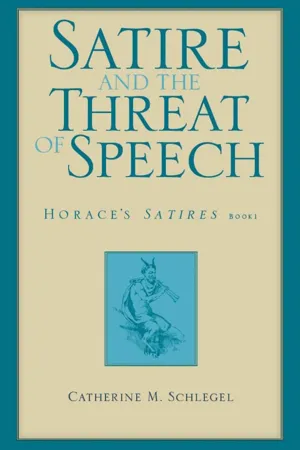 eBook - PDF
Satire and the Threat of Speech
Horace's Satires, Book 1
- Catherine M. Schlegel(Author)
- 2005(Publication Date)
- University of Wisconsin Press(Publisher)
The merging of poetic style and personal character produces a picture of the satiric genre that is identified with the poet himself; the poetry is the inevitable outcome of the man. When Horace asks whether his poetry is justifiably suspectum (..), he answers by telling us who he is; the poet is the answer to the question about the genre. Style and ethos are thus made indistinguishable. That art can be wholly identified with its human source is in some sense a radical view, but this view is congenial to Horace’s satire, which he fixes in the ordinariness of life and whose muse is, as Horace says later, pedestris. 2 As satire constantly finds its wisdom, parody, or bite in ordi- nary material reality, so Horace’s strategy of equating the poem with its material cause, i.e. the poet, is perfectly consistent with the genre’s orien- tation. It is a genre, after all, whose name can be derived from a food, the stuff of life. 3 If the portrait of Horace’s father is determined by its poetic context in ., as I suggest is the case with all the dramatis personae of these poems, the portrait of Lucilius is in turn determined not only by the poetic con- text but also by the portrait of Horace’s father. Lucilius enters Satires ., and the Satires as a whole, on the heels of the Old Comic poets Eupolis, Cratinus, and Aristophanes; Horace begins his discussion of his genre in the opening six lines of Satires . with a discussion of Lucilius’s lineage. The Greek comic poets, Horace says, “noted with great freedom” (“multa Satires . and . cum libertate notabant,” ..) the faults of any who deserved it (“quis erat dignus,” ). From these poets Lucilius is entirely descended; he follows them in all but metrical form (–). Satires . will demonstrate that ulti- mately Horace and Lucilius have separate genealogies. eBook - ePub
- J.A.K. Thomson(Author)
- 2023(Publication Date)
- Routledge(Publisher)
Chapter Ten SatireDOI: 10.4324/9781003462682-10T HE Romans liked to think that satire was a Roman invention. The claim cannot be allowed without some qualification, but it contains enough truth to make it natural and up to a point justifiable. For the kind of satire which has influenced the history of literature was the work of Roman poets. They may be named at once: Lucilius, Horace, Persius, Juvenal. No Greek will be mentioned in this chapter.Of Lucilius extremely little is known, his voluminous works having all but completely perished. It is evident from ancient testimony that he possessed vigour, learning and originality, with a sense of humour (perhaps rather hearty than fine) and a taste and talent for invective. He wrote the Latin of his time (the end of the second century before Christ) with idiomatic purity except where it was variegated with Greek words, their Latin equivalents not yet existing. Lucilius wrote on a wide variety of subjects, but much too rapidly, so that he was often prolix and careless. These were grievous defects in the eyes of Horace, who from the very beginning of his literary career was animated, like the youthful Pope, with a passion for what the latter called ‘correctness’. It meant not only the refusal of any licences in grammar or metre, but a love of artistic finish for its own sake. When Horace, for reasons that need not be considered at this time, decided to continue the Lucilian tradition, he could not radically alter it, because it was a genre, and every genre had its own style, that being one of the great principles of classical art. At the same time Horace thought it possible to retain much of the native force and savour of Lucilius’ verse while purifying it of its faults in expression and in metre. On the other hand it was not a possible course for a young man—Horace began his career as a satirist, not a lyric poet—and a young man without influential connexions and with a political past that had to be lived down—to attack public men with the libellous ferocity of Lucilius. Probably he felt little regret on that score, for he was never a good hater. And what he loved best in the old poet was not his invective but those parts of lois work in which he unconsciously revealed himself.
- Rolf P. Lessenich, Uwe Baumann, Marc Laureys, Winfried Schmitz, Uwe Baumann, Marc Laureys, Winfried Schmitz(Authors)
- 2012(Publication Date)
- V&R Unipress(Publisher)
The Neoclassical understanding of the rule of decorum, which constituted one of many seventeenth-century “dissociations” as identified by T.S. Eliot, 78 was often blatantly violated by the Augustan satirists from Dryden to Johnson, though with decreasing tendency from 1660 to 1780. Satire was ex- pected to improve mankind, in contrast to libel and lampoon, personal deni- grations which were denied the status of literary works as they were designed to merely irritate individuals and destroy their reputations. 79 Theorists of satire from Dryden to Johnson insisted on that distinction, convinced that it corre- sponded to the borderline between moral duty and immorality. 80 This corre- sponded to theorists of physical warfare, who insisted on a jus naturale which sharply distinguished legal from illegal actions in military combat. In the practice of both bellicose and intellectual warfare, however, hatred of the enemy and love of victory proved stronger than jus naturale. In Dryden’s satirical practice, as in the satirical practice of his Whig opponent Thomas Shadwell, the distinction between legal satire and illegal libel was blurred. Tradition suggested the destruction of a “wrong cause” by the destruction of the reputation its best advocates, an aim best achieved by making individuals lose faces. 81 Menippean satire, explicitly called “alterum saturate genus” by Quintilian, was the literary equivalent to caricature and especially prone to personal abuse with its bur- lesque transgression of the boundary of comic realism and probability, from Seneca’s Apocolocyntosis to Dryden’s Mac Flecknoe and Pope’s Dunciad. 82 Such invectives and pasquils still remained within a pre-war domain of quarrel, avoiding bodily harm to or assassination of the adversary, not least for the reason that the murder of his reputation was more effective and the loss of his honour irreparable. This motive may be paradoxically drawn from Dryden’s very argument against libel and lampoon: 77 Ibid.
Index pages curate the most relevant extracts from our library of academic textbooks. They’ve been created using an in-house natural language model (NLM), each adding context and meaning to key research topics.

