Literature

Parody
Parody in literature is a form of imitation that humorously exaggerates the style, tone, or content of a work to create a comedic effect. It often involves mimicking the original work while adding a satirical or mocking twist. Parody can be used to critique or comment on the original work, as well as to entertain and amuse audiences.
Written by Perlego with AI-assistance
Related key terms
1 of 5

7 Key excerpts on "Parody"
 eBook - ePub
Metafiction
The Theory and Practice of Self-Conscious Fiction
- Patricia Waugh(Author)
- 2002(Publication Date)
- Routledge(Publisher)
Dr Faustus, p. 148)Parody fuses creation with critique to replace, as one observer has remarked, what had become ‘a matter of course’ with what now becomes a ‘matter of discourse’ (Stewart 1979, p. 19). The specific method of Parody, the actual process involved in this substitution, has been usefully explained as:a kind of literary mimicry which retains the form or stylistic character of the primary work, but substitutes alien subject matter or content. The parodist proceeds by imitating as closely as possible the formal conventions of the work being parodied in matters of style, diction, metre, rhythm, vocabulary.(Kiremidjian 1969, p. 232)In other words, Parody renews and maintains the relationship between form and what it can express, by upsetting a previous balance which has become so rigidified that the conventions of the form can express only a limited or even irrelevant content. The breaking of the frame of convention deliberately lays bare the process of automatization that occurs when a content totally appropriates a form, paralysing it with fixed associations which gradually remove it from the range of current viable artistic possibilities. The critical function of Parody thus discovers which forms can express which contents, and its creative function releases them for the expression of contemporary concerns. Parody has, of course, always performed these functions: Walter Shandy’s hovering foot, for example, in Tristram Shandy (1760), is on one level a direct critique of the mimetic fallacy of Richardson’s exhaustive attention to detail. On another level, however, it provides a more general insight into the very essence of narrative – its inescapable linearity, its necessary selectiveness as it translates the non-verbal into the verbal – and finally creates eBook - PDF
Job: An Introduction and Study Guide
Where Shall Wisdom Be Found?
- Katharine J. Dell(Author)
- 2017(Publication Date)
- T&T Clark(Publisher)
Parodies can be made using any genre. I would argue that the Parody genre usually ‘sends up’ the original in some way, not necessarily in comic mode; often a comic effect is associated with the definition of Parody but I have argued (Dell, 1991) that this is not key to its meaning. Dr. Johnson defined Parody as ‘a kind of writing in which the words of an author or his thoughts are taken and by a slight change adapted to some new purpose.’ In Job’s speeches that purpose seems to be to critique traditional positions held by the friends in mocking or sarcastic tone. But that need not be the case for all parodies in all cases. Kynes (2011) puts forward the idea that parodies can be positive rather than simply critical or ironic or with a negative purpose. In order for the reader to appreciate a Parody, that reader needs familiarity with the original that is being parodied, so that when it comes to the psalms for example, we can only fully appreciate a Parody of either the form or content by knowing the original in reference to a form-critical type in some cases or an actual psalm in others. Sometimes the Parody is very subtle and its irony can be lost on an audience. Furthermore, parodies can generate further parodies so that there can be a chain of parodies feeding off an original but also branching out into new thought domains. 3. Parody as a Technique of the Author of the Dialogue My own argument about Parody is about critique of known genres by the author of Job on a fairly detailed level, nearly always in the speeches of Job. I will give some salient examples in my key text section. The fact that gen-res from within wisdom but also those outside wisdom circles, in particular psalmic laments and genres from the law court, are featured indicates the broader interaction with the genres of Israelite life by our author. An impor-tant distinction needs to be made here between form, content and context. eBook - PDF
The Genius of Parody
Imitation and Originality in Seventeenth- and Eighteenth-Century English Literature
- R. Mack(Author)
- 2007(Publication Date)
- Palgrave Macmillan(Publisher)
It is among the earliest efforts to exclude the parodic impulse from the taxonomies of valued literary creation as extra-literary and parasitic. Subsequent to such usage, at least, one can say that even those occasions on which Parody is not being openly stigmatized as a literary plague, it is (as a literary mode) almost always derided as somehow low, foul, illegitimate, and base. Parody is at best an excrescence; it is at worst the premature and often abortive progeny of an immature literary mind. As we shall see, there may in fact have been a great deal more to Jonson’s understanding of Parody – to say nothing of the understandings of his contemporaries and those who followed in their footsteps – than is constituted by such a wave of contemptuous dismissal and distaste. We should not yet forget, after all, that a second possible connotation of a word such as ‘Parody’, should it have been encountered in its original Greek, might at the very Parody as Plague 65 least have brought to mind the parallel ‘path’ or ‘way’ alongside of which one travelled towards the truth of an oracle or presentment of some kind. As Chapter 2 made clear, critics for far too long sided against Parody in its supposed war against ‘legitimate’ or ‘creative’ writing. It was F. R. Leavis, again, who had commented earlier in the twentieth century that ‘people who are really interested in creative originality regard the parodist’s game with distrust and contempt’. 27 More recent writers on the subject have remained no less eager to remind us that Parody is nothing more than ‘the first phase of comic invention’; such critics tend likewise to stress that, as such, Parody is an embryonic ‘phase’ of creative development – the primary and distinctive feature of which is ‘destruc- tion and reductiveness’. Dickens’s parodic references here, marked with varying evaluative charges, are all allusions, not to any specific precursor text, but more to particular phraseologies, even to what can only be described as a tone of voice. The various languages that circulate around the court (that is, some of the dialects of working-class London), reappear here in mildly parodied form. Much of the paragraph is in ‘double-voiced discourse’, so that we can hear in the writing simultaneous traces both of the characters’ speech and the author’s attitude towards it. Thus we can hear in the extract the accents of Mrs. Perkins and Mrs. Piper (‘that excellent woman’), the jargon of semi-professional entertainment, the slang of the pieman, and the pomposity of the beadle (‘accepts the compliment of a glass of ale’). It is helpful to see, in the pervasiveness of Parody in a characteristically Dickensian paragraph such as this, an indication of the author’s multitudinous recycling of the diverse languages of mid-nineteenth-century English. Writing of this kind marks one limit of what might count as Parody, making scarcely hostile allusions to what are little more than the slightly inflected phrases of contemporary speech. The passage nevertheless indicates the potential scope of Parody, if it is understood as one form of the more general intertextual constitution of all writing.I am therefore moving towards a wide and inclusive account of Parody, rather than a narrowly formal one. The definition of Parody that I am about to offer is based, not on any specific formal or linguistic features, but on the intertextual stance that writing adopts. Accordingly, I conclude this section with this preliminary definition of Parody: ‘Parody includes any cultural practice which provides a relatively polemical allusive imitation of another cultural production or practice’.In order to capture the evaluative aspect of Parody, I include the word ‘polemical’ in the definition; this word is used to allude to the contentious or ‘attacking’ mode in which Parody can be written, though it is ‘relatively’ polemical because the ferocity of the attack can vary widely between different forms of Parody. And finally, in a distinction whose importance is about to become clearer, the direction of the attack can vary. So far I have been stressing the importance of Parody as rejoinder, or mocking response to the word of another. But many parodies draw on the authority of precursor texts to attack, satirise, or just playfully to refer to elements of the contemporary world. These parodies also need to be reckoned in to any definition, so the polemical direction of Parody can draw on the allusive imitation to attack, not the precursor text, but some new situation to which it can be made to allude. Such parodies, indeed, are the stock in trade of innumerable compilations of light and comic verse and of literary competitions, and their ‘polemical’ content is often very slight indeed.
DEFINITIONS
Given the often humorous and anti-academic nature of Parody, it is ironic that discussions of the topic have been bedevilled by academic disputes about definition. What exactly did the ancient Greeks mean by ‘parodia’? How can we distinguish, in a hard and fast way, between Parody, travesty, and pastiche? Does Parody necessarily have a polemical relationship to the parodied text? It is partly because of these disputes that I have drawn my definition of Parody in as wide-ranging a way as possible, and have based it upon linguistic interaction, both verbal and written. On this basis, some of the disputes about definition which we are about to review briefly will seem less significant, though they will point eventually to a large question about the cultural politics of Parody, namely whether it is to be thought of as an essentially conservative or essentially subversive mode—indeed, we shall have to ask whether it is possible to talk of Parody as ‘essentially’ anything at all.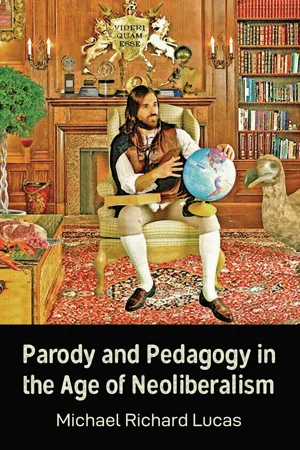
- Michael Lucas(Author)
- 2020(Publication Date)
- Peter Lang Group(Publisher)
In only focusing on highly abstract theories of irony provided by (mostly) serious philosophers, scholars (but not me) rely too heavily on specialized readings to disrupt peoples’ problematic assumptions. With Parody, the buy-in for our perceptions to be challenged is much less. We do not have to learn an overly-specialized academic language in order to participate in the philos- ophizing and self-reflection that Parody can provide—we only need a basic understanding of social norms and communicative practices in order to view humor within the performance and to be offered alternative viewpoints. As mentioned throughout this text, this is not merely a call to abandon spe- cialized audiences or rigorous scholarship and texts in favor of a generalized “dumbing down.” 9 Instead, it is an exploration into alternative approaches that can improve every aspect of our quests for knowledge, how we communi- cate our findings, and how we teach others about what we have found. Differentiating Parody from Other Comedic Forms Obviously there are more comedic rhetorical devices than Parody, satire, and irony, for example, the burlesque, ridicule, mock-epic, and travesty. However, these forms are problematic when they communicate an overly simplistic understanding of culture, power relations, and their target. These forms share similar aspects with Parody but fail to be as helpful, as each one lacks essential elements that make Parody more robust. This is one of the reasons why Rose distinguishes Parody from Bakhtin’s definitions of Parody that trap the term within the realm of folk humor, thereby placing too strong an emphasis on Parody’s ridiculing aspects (158). Here, it becomes necessary to distinguish Parody from these closely related forms because folk humor, burlesque, pure ridicule, mock-epic, and travesty often depend on overly-simplified treat- ments of power relations; i.e., a mere reversal of high and low culture (Rose 29).
- William M. Landes, Richard A. Posner, William M. LANDES(Authors)
- 2009(Publication Date)
- Belknap Press(Publisher)
The basis of the fair use privilege for parodies is their critical function. If a parodist had to get a copyright license to copy from the paro-died work, criticism would be impeded. If a license were granted, moreover, this would undermine the credibility of the Parody as criticism, just as in the parallel case of the licensed book review. The audience for the Parody would wonder whether the parodist had pulled his punches in order to obtain the li-cense at a lower fee. Parody has been called a limited form of criticism because of its focus on idiosyncrasy: 150 150 The Economic Structure of Intellectual Property Law 8. See Kiremidjian, note 3 above, at 234; Dentith, note 3 above, at 32–38. Parody naturally tends to be the watchdog of established forms, a cor-rection of literary extremes . . . [It thus] tends to confine itself to “writ-ers whose style and habit of thought, being more marked and peculiar, was more capable of exaggeration and distortion.” This tendency seri-ously restricts the scope of critical Parody because it seems to ignore the fact that the absence of any “marked and peculiar” style and habit of thought is a symptom of mediocrity rather than of talent. 9 This is overstated. There are plenty of parodies of mediocrity, as in Joyce’s Dubliners and the Gerty MacDowell episode in Ulysses, 10 among many other examples; mediocrity is often ridiculous. And parodies of the style of great writers, such as Shakespeare’s Parody in Hamlet of Marlowe 11 or Beerbohm’s parodies of James and Shakespeare 12 focus on criticizable (whether justly or not) features of the style of the writers parodied—in these examples, Elizabe-than bombast and Jamesian convolution. Another example is the Parody of the form, conventions—and pretensions—of the epic poem: Paradise Lost by Pope’s Rape of the Lock, for example. And Parody can be a method of political criticism, as in The Wind Done Gone. eBook - PDF
The Alchemy of Laughter
Comedy in English Fiction
- G. Cavaliero(Author)
- 1999(Publication Date)
- Palgrave Macmillan(Publisher)
Few, if any late twentieth-century English novels have been so ambitious in their scope as No Laughing Matter, for the temper of the post-war world does not encourage broad generalisations or magnilo- quence of outlook. But Wilson's use of Parody is an ironic way of forestalling the pre-emptive forces of traditional chronological expo- sition and its accompanying moral commentary. Moreover, both in Margaret Matthews's preoccupation with how, as a novelist, to combine sympathy with detachment, and in her brother Rupert's attempts to resolve the ambiguities of Malvolio's character in perfor- mance, one sees a quest for sincerity in a world which the corresponding extremes of social competitiveness and sentimentality have rendered both supercilious and wary. In the late twentieth century, Parody has come to perform the function less of critical dissection than of reconciliation, its mood approximating to burlesque in its affirmative ferocity. As both Fielding and Jane Austen had already demonstrated, Parody strips away the disguises of literary, behavioural and even religious models: it subverts the epistemology of monolithic attitudes by reflecting them in terms of caricature and disrespectful imitation. It also becomes increasingly critical, not only of its original material but also of the effects of the parodic act upon the parodists themselves. Even when Parody is largely celebratory (as it is with Beerbohm) it is also purposeful, its target the tyranny of the monolith, its aim to be liberating and remedial. Both the strength and the weakness of any literary artefact can be illuminated by a Parody, for here the primary elements of the comedic experiment are set out in what is the preliminary stage in the alchemical comedic process. 4 Ludic Comedy: the Dissolution of Elements Somehow there were very extraordinary noises over-head, which disturbed the dignity and repose of the tea party.
Index pages curate the most relevant extracts from our library of academic textbooks. They’ve been created using an in-house natural language model (NLM), each adding context and meaning to key research topics.

