Literature

Tragicomedy
Tragicomedy is a literary genre that combines elements of tragedy and comedy. It often features serious or dramatic themes alongside moments of humor or lightheartedness. Tragicomedy allows for a complex exploration of human experiences, blending the emotional depth of tragedy with the levity of comedy to create a nuanced and thought-provoking narrative.
Written by Perlego with AI-assistance
Related key terms
1 of 5
5 Key excerpts on "Tragicomedy"
 eBook - ePub
- Verna A. Foster(Author)
- 2017(Publication Date)
- Routledge(Publisher)
It remains important, however, to understand Tragicomedy as a genre transcending particular periods, because of the reforming power that has repeatedly been ascribed to it by its champions. In the sixteenth century Guarini sought to retain the most pleasurable aspects of tragedy and to rescue comedy from triviality by fusing the two, thereby producing Tragicomedy. In the midtwentieth century Friedrich Dürrenmatt has regarded comedy as the only possible vehicle for recovering tragedy from irrelevance. In contemporary drama, indeed, the finest effects of tragedy or comedy are generally produced in Tragicomedy. If Tragicomedy was once considered by its opponents a risqué defiance of classical authority or a writing down to the audience, the high regard in which the mixed genre is held today by both dramatists and critics (whether the latter acknowledge it as a genre or not) makes it almost inconceivable that any playwright who wishes to be taken seriously should utilize a dramaturgy that does not at least approximate the tragicomic.But though Tragicomedy has produced much of what is best in contemporary drama, the mix of laughter and tears is in some ways a facile one, an audience response that can be generated by any competent writer for the movie of the week. This being so, it is imperative that we should be able to evaluate our responses in terms of the dramaturgy that gives rise to them. The ability to make value judgments is, I believe, an important though currently not very fashionable aspect of literary criticism. More crucially, however, only by exploring the dramaturgy of Tragicomedy, the causes of our mixed emotional and intellectual responses, can we approach a genre that has no fixed form. I have chosen a comparative perspective for my examination of tragicomic dramaturgy because only by considering multiple states of a genre can one avoid partial representation, because a study of the relationship between dramaturgy and audience response becomes particularly interesting when the surface forms of dramatic techniques are dissimilar, and especially because both the name and nature of Tragicomedy have had such a chaotic history.1 Feeling and Form (New York: Charles Scribner's Sons, 1953), p. 363.2 eBook - PDF
The Uncensored Boris Godunov
The Case for Pushkin's Original Comedy
- Chester Dunning, Caryl Emerson, Sergei Fomichev, Lidiia Lotman, Antony Wood(Authors)
- 2006(Publication Date)
- University of Wisconsin Press(Publisher)
41 Tragicomedy (like Pushkin’s own transitional label, “Romantic tragedy”) encourages its audience to think in terms of the resilience of parts over the finality of ends, even when those parts are arranged in an orderly or symmetrical way. Like comedy proper, Tragicomedy strives to restore balance to the represented world, but – and here we speak to the core of Pushkin as an historian – it holds open the possibility that there are other routes to balance than strong, definitive closure, whether of grief or of joy. Thus Tragicomedy has a perpetually “modern” feel, some- thing we sense acutely when Pushkin’s treatment of history is measured against the later, and more conservative, playwrights in Russia’s Age of Kukolnik. “In its modern context it signals the final breakdown of the classical separation of high and low styles,” writes John Orr in his Tragicomedy and Contemporary Culture. It is “a drama which is short, frail, explosive and bewildering. It balances comic repetition against tragic downfall,” often calling into question “the conventions of the theatre itself.” 42 Beck- ett, Pinter, Genet, and Shepard all share with Pushkin this eclectic spirit of the tragicomedic genres, and all those modern playwrights have exer- cised influence on twentieth-century productions of Boris Godunov. But Tragicomedy alone is not enough. We now arrive at our final genre refinement. A Tragicomedy of history would seem to face further chal- lenges, especially when the playwright is concerned about how to regis- ter historical experience in an accurate, responsible way. This subgenre, a Tragicomedy of history, has received compelling treatment in recent decades by such accomplished critics as Paul Her- nadi. 43 He observes that dramatizations of history in the tragicomedic mode are especially abundant in the immediate aftermath of times of trouble (the post-World War One and Two worlds).
- J. E. Spingarn(Author)
- 2019(Publication Date)
- Columbia University Press(Publisher)
in.] THE THEOKY OF THE DRAMA 67 iv. The style and diction of tragedy are elevated and sublime; while those of comedy are humble and colloquial. v. The subjects of tragedy are generally histori-cal ; those of comedy are always invented by the poet. vi. Comedy deals largely with love and seduc-tion ; tragedy with exile and bloodshed. This, then, was the tradition that shaped the un-Aristotelian conception of the distinctions between comedy and tragedy, which persisted throughout and even beyond the Renaissance. Giraldi Cintio has followed most of these traditional distinctions, but he is in closer accord with Aristotle 1 when he asserts that the tragic as well as the comic plot may be purely imaginary and invented by the poet. 2 He explains the traditional conception that the tragic fable should be historical, on the ground that as tragedy deals with the deeds of kings and illustrious men, it would not be probable that re-markable actions of such great personages should be left unrecorded in history, whereas the private events treated in comedy could hardly be known to all. Giraldi, however, asserts that it does not matter whether the tragic poet invents his story or not, so long as it follows the law of probability. The poet should choose an action that is probable and dignified, that does not need the intervention of a god in the unravelling of the plot, that does not occupy much more than the space of a day, and that can be represented on the stage in three or 1 Poet. ix. 5-9. 2 Giraldi Cintio, ii. 14.
- Wayne Shumaker(Author)
- 2016(Publication Date)
- Hauraki Publishing(Publisher)
Streetcar Named Desire exhausts our response to the play. If we do not, as we watch and listen, feel a satisfaction analogous, if only at a distance, to that felt by the primitive Greek at the consummation of a blood sacrifice, some other deep-lying stratum of the psyche is invaded. At such points as this, the literary theorist can afford to display a generosity denied to the purely historical critic. It is one of his few sustaining comforts on a journey across treacherous ground.Archaic tendencies in comedy
In the remainder of the present chapter, I intend to suggest, more briefly, that what is true of tragedy is true also of comedy: that here, too, there is continuity with a transcended and forgotten past. The danger of error will be even greater, for, in proportion as the discussion is compact, data are certain to be excluded. Yet I can attempt to indicate, by a series of controlled hints, that an archaizing literary tendency appears also in the second major variety of drama.Recurrent comic elements: cheerfulness
Comedy includes at least three separable elements, not all of which need appear in any single play. The first is cheerfulness. If based on organic euphoria—a simple consciousness of vitality superior to inconvenience or temporary frustration—cheerfulness tends to express itself in sheer exuberance of language and incident, as in the comedies of Ben Jonson. Here the exposition of every idea or feeling explodes with the energy of fireworks, so that the vitality of language far exceeds that of the concept, and the generation of stratagem by stratagem bespeaks a fecundating principle in life itself. If based on cosmic optimism, the mood reveals itself, more soberly, in the manipulating of the plot toward a final gratification of desires. In either event, the total effect is that of fulfillment, hence cheerfulness. The life principle shows itself stronger than the death principle, and the spectator leaves the theater heartened for the resumption of his daily responsibilities.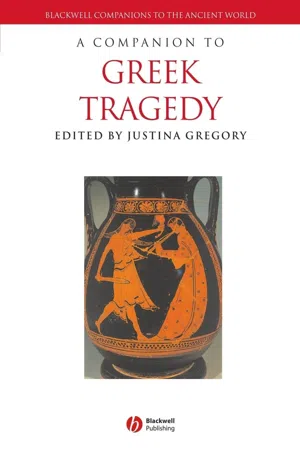 eBook - PDF
- Justina Gregory(Author)
- 2008(Publication Date)
- Wiley-Blackwell(Publisher)
Tragedy is a mime ˆsis ‘‘not of individual people but of action(s) and life’’ (1450a16–17), a selectively enlarged image of coherently conceivable events, revolving around major changes of fortune 402 Stephen Halliwell (1451a3–15) and raising issues of grave importance for human success or failure, happiness or unhappiness. Although tragedy, like all poetry, depicts ‘‘the kinds of things that might occur, according to necessity or probability’’ (1451a37–38), it is not straightforwardly realistic. Tragic characters, for one thing, should be ‘‘better than people of the present’’: not idealized prototypes of humanity but (mythically) magnified figures whose ‘‘great renown and prosperity’’ (1453a10) makes them especially vulnerable to acute shifts of fortune. Aristotle’s comparative reference to ‘‘people of the present’’ echoes passages such as Iliad 5.304 and 12.383 where the grandeur of the heroic past is contrasted with the human present. Yet his model of tragedy welds this sense of heroic elevation to a requirement that tragic characters should be sufficiently ‘‘like ourselves’’ (1453a4–6, cf. 1454a24–25), in psychological and ethical make-up, to engage fully our understanding and emotional sympathy: Aristotle’s position instructively seeks to hold a delicate balance between ideals akin to the ‘‘Aeschylean’’ and ‘‘Euripidean’’ types of tragedy caricatured in Frogs . More-over, its principles of characterization blend ethical and status-related considerations in a manner influenced by a person like the Oedipus of Oedipus the King . Oedipus has achieved outstanding things for his city, saving it from extinction by the Sphinx and becoming a father-figure beloved by his people; yet he is also, like all Greek heroes, an all-too-human character, capable of irrationality, irascibility, and even injustice. Such a figure, on Aristotle’s reading, can focus a heroically intensified image of life, while still allowing a vital bond of rapport between audience and character.
Index pages curate the most relevant extracts from our library of academic textbooks. They’ve been created using an in-house natural language model (NLM), each adding context and meaning to key research topics.

