Literature

Heroic Drama
Heroic Drama is a type of play that emerged in the 1660s in England. It typically features heroic characters engaged in conflicts that involve love, honor, and duty. The genre was popular during the Restoration period and is known for its grandiose language and spectacle.
Written by Perlego with AI-assistance
Related key terms
1 of 5
4 Key excerpts on "Heroic Drama"
 No longer available |Learn more
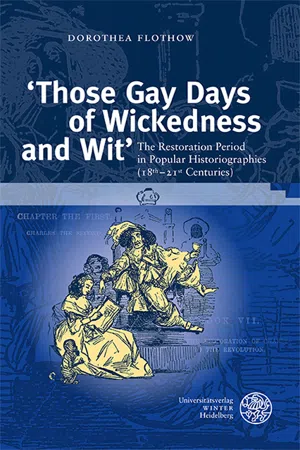
'Those Gay Days of Wickedness and Wit'
The Restoration Period in Popular Historiographies (18th–21st Centuries)
- Dorothea Flothow(Author)
- 2021(Publication Date)
- Universitätsverlag Winter(Publisher)
Thus, strategies of 'policing' (Woolf 2003: 9) the boundaries of the correct ways of speaking about the past, of establishing hierarchies which also imply reliability (see ch 1.3), are central to definitions of historical drama, historical novels, and other popular forms. 2.2 Defining Historical Drama Most studies of historical drama agree that this genre is particularly difficult to define. Indeed, Teresa Grant and Barbara Ravelhofer (2008a: 1) state: Critical attention will probably never result in a satisfactory agreed answer to the question 'What is a history play?' The most obvious reason seems that, unlike verse drama or tragedies, but like the historical novel, historical drama is not characterised by formal or structural aspects, but only very broadly by its content. 17 Any definition of the genre therefore has to deal with the difficult question what consti-tutes 'history', or more precisely, history in historical drama. A further problem is historical drama's fluidity to other genres. Most famously, this is apparent in Elizabethan history plays: The term 'history' was used promis-cuously in titles of plays during the period: quarto editions of Shakespeare's plays include The True Chronicle History of King Lear , The tragical history of Hamlet, and The Most Excellent History of the Merchant of Venice […]. 18 In later centuries, the ambiguities of this genre continued (see ch 4.2.1). A third problem is that most studies concentrate on a very narrow corpus of plays. Studies of the 17 Düsing (1998: 2; my translation). There have been attempts to define the genre through its structural openness. See Snyder (2001); Griffin (2001). For a detailed discussion of this approach see Kewes (2003: 176-82). 18 Chernaik (2007: 8). On Shakespeare's classification see Howard (1999); Chernaik (2007); Kastan (2001); Dutton / Howard (2003); Kewes (2003). eBook - PDF
Literature and Moral Feeling
A Cognitive Poetics of Ethics, Narrative, and Empathy
- Patrick Colm Hogan(Author)
- 2022(Publication Date)
- Cambridge University Press(Publisher)
separate treatment, with the isolation of a range of cases and an account of its emotional sources. I have already outlined the main features of these cross-cultural genres (excepting the tentatively added salvation or enlightenment genre). Even so, I will begin the following sections with a brief summary of the genre’s main features. I will also note, schematically, the characteristic emotions, interpersonal stance, social organization, and virtues commonly associ- ated with the genre. From there, I will give literary examples. I have chosen some examples from Shakespeare since his work is presumably most familiar and accessible to Anglophone readers. I have also included non-Western cases, despite their likely unfamiliarity for most readers, to give some degree of cross-cultural coverage. Depending on what seemed most helpful, I have sometimes treated one work in greater depth and at other times treated several cases more briefly. Heroic Narrative (Mahābhārata) Again, the heroic prototype has two parts: the usurpation–restoration sequence and the threat–defense sequence. In its full, comic version, the former treats the overthrow of the legitimate leadership of the in-group (frequently intensified by making the usurper an attachment object, such as a sibling), the exile of the legitimate leader (sometimes his or her death or association with death), and the restoration of the legitimate leader (or some heir or follower). The threat–defense sequence involves the defeat of the in-group by an enemy out-group (sometimes with the collaboration of the usurper), the subsequent revival of the in-group (commonly by the usurped leader), and the defeat of the enemy out-group (often resulting in an idealized society). The main heroic story is sometimes followed by an “epilogue of suffering.” War leads to much undeserved misery. eBook - ePub
- Marjorie Boulton(Author)
- 2014(Publication Date)
- Routledge(Publisher)
Riders to the Sea poor peasants have tragic dignity.The main types of drama may be listed for the use of the student, but with the warning that in all classes there are exceptions, overlaps and anomalies.1. Tragedy
A play with a sorrowful ending, usually at least one death; the action and thoughts are treated seriously and with a respect for human personality. The central character, according to Aristotle—and this still often holds—is a person of admirable character and important position who is ruined by some one flaw of character such as the impetuosity of Oedipus, the ambition of Macbeth or the credulity of Othello. It is usual for the diction to be dignified, but not necessarily poetic or even dignified in the sense of being correct English—the dignity comes from within and expresses the tragic importance of the human beings and their situations, as in the colloquial language of A Streetcar Named Desire, parts of Children in Uniform, or Arthur Miller's The Crucible and Death of a Salesman. An important feature of true tragedy is that we are left with a sense of the greatness of man as well as of the suffering involved in human life; these small but passionately individual creatures who struggle with their destiny are curiously important. In tragedy, after one of the crises, the human dilemma becomes insoluble; there is no going back and no easy answer or happy ending; the emotional conflicts are deep and almost unbearable; but the creatures suffering these agonies are worth our concern.2. Melodrama
This is the poor relation of tragedy. It may have a sad or a happy ending, though the sad ending—a pile of corpses or a screaming lunatic—is perhaps more completely melodramatic. It is distinguished from true tragedy by a portrayal of characters who are all more violently and improbably good or evil than is realistic; by a lack of real psychological insight; by a more far-fetched plot whose horrors and sensations may easily tumble over into the ludicrous; and by a continual pandering to the public desire for strong sensations and great excitement. Melodrama may also fall into sentimentality when an attempt is made to portray a tender or lofty emotion. Shakespeare's Titus Andronicus and The Jew of Malta of Marlowe are two early melodramas, and it does not take much insight to see that these are not plays on the tragic level of Othello or Edward II eBook - ePub
The Shape of Fantasy
Investigating the Structure of American Heroic Epic Fantasy
- Charul Palmer-Patel(Author)
- 2019(Publication Date)
- Routledge(Publisher)
For the purposes of this book, the narrative structure of Heroic Epic Fantasy is one where the hero realises a messianic duty via a journey (literal or metaphorical), one which results in a spiritual transcendence for the hero (the ascendance of the hero from human or superhuman to something closer to the divine) along with the salvation of the world by the act of healing or re-creating it, thereby fulfilling their destiny and the world’s destiny. This is the basic structure of the ‘Epic’ or ‘Heroic Epic’ found in Mythology as many formalists have identified. James Frazer (1890), Otto Rank (1909), Lord Raglan (1936), and Joseph Campbell (1949) have all offered a comparative study of religion and mythologies in order to identify the basic structure of the hero’s journey. Vladimir Propp’s (1928; 1958 English translation) formalist approach to Folktales is also an important study in which Propp identifies formal functions of the Folktale. Yet, there are obvious problems with reducing the Heroic Epic to a simple pattern. I do not mean to dismiss those works or narrative patterns that do not follow my model of the Heroic Epic. It is simply the focus of this book. Additionally, I hope not to be reductive and ignore the depth and complexity of each work. While the texts that I study share common structural similarities, I attempt to acknowledge and make references to the differences between these texts. Though I expose the basic structure of Heroic Epic texts, I also point to how repetitive devices add complexity, a resonance, to the stories under investigation.There are numerous and varied definitions of ‘hero’ which I discuss throughout this book, but as a starting point let us utilise the definition provided by Thomas Carlyle in On Heroes, Hero-Worship, & the Heroic in History (lectures 1835; published 1904): the hero is one (whether in fiction, mythologies, or the real world) who: “know[s] for certain, concerning [their] vital relations to this mysterious Universe and [their] duty and destiny there” (2–3). The hero is defined by the manner in which they come to identify their place in the universe and fulfil their destiny, taking on this duty of their own free will. Accordingly, the Epic is a journey which results in fulfilling a world destiny; the Heroic journey is one where the hero achieves spiritual transcendence; and the Heroic Epic is where the two meet.If there is no journey (literal or metaphorical) through which the hero achieves spiritual transcendence and fulfils a world destiny, then the book or series is not part of the Heroic Epic subgenre of Fantasy. The ‘journey’ of the hero does not indicate the hero’s life from birth to death, but the path through which they come to save the world. The Epic Hero is a messianic hero, one who saves the world through a sacrifice, usually associated with some literal or metaphorical connection to death as part of their journey. In The Epic Hero
Index pages curate the most relevant extracts from our library of academic textbooks. They’ve been created using an in-house natural language model (NLM), each adding context and meaning to key research topics.

