Literature

Melodrama
Melodrama is a genre characterized by exaggerated emotions, sensational plots, and moral polarization. It often features clear distinctions between good and evil characters and evokes strong emotional responses from the audience. Melodramatic works typically emphasize spectacle and sentimentality, and they have been popular in literature, theater, and film, particularly in the 19th century.
Written by Perlego with AI-assistance
Related key terms
1 of 5
11 Key excerpts on "Melodrama"
 eBook - PDF
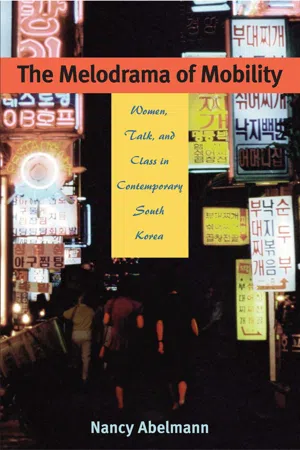
The Melodrama of Mobility
Women, Talk, and Class in Contemporary South Korea
- Nancy Abelmann(Author)
- 2003(Publication Date)
- University of Hawaii Press(Publisher)
I use “Melodrama” here to refer to a complex of theatrical, literary, and cinematic conventions characterized by excess — of a¬ect (the overdrawn, overmarked) and of plot (strange, almost unbelievable twists, coincidences, connections, and chance meetings). Thomas Elsaesser writes that the gen-eral use of “Melodramatic” describes the “exaggerated rise-and-fall pattern in human actions and emotional responses, a from-the-sublime-to-the-ridiculous movement, a foreshortening of lived time in favor of intensity — all of which produces a graph of much greater fluctuation, a quicker swing from one extreme to the other than is considered natural, realistic or in con-formity with literary standards of verisimilitude” ([1972] 1987, 52). Excess also characterizes Melodrama’s overdrawn characters — moral hero/ines and evil villain/esses (Brooks [1976] 1995, 11–12; Kaplan 1993, 10). “A par-ticular form of dramatic mise en scène, ” including decor, color, and music, has also been critical to the enactment of excess (Elsaesser [1972] 1987, 51). Some have argued that this is particularly pronounced for cinema (see Mulvey 1989). I argue here that a Melodramatic sensibility has been pervasive in con-temporary South Korea, as it has been in many times and places of rapid so-cial transformation (see also J. An n.d.). Indeed, many theorists of melo-drama assert that the genre rose with the social and class transformations of the rise of capitalism (Brooks [1976] 1995; Watt 1957). Peter Brooks, pre-mier Melodrama theorist, writes about Melodrama as both a “mode of ex-pression and representation” and a “means for interpreting and making sense of experience” ([1976] 1995, 205). In my use of “Melodramatic sensi-bility” I follow his convention, referring not only to the properties of a par-ticular field of texts (including personal narratives) but also to their dialogic context (that is, to the talk that so often surrounds them). eBook - PDF
Irritation of Life
The Subversive Melodrama of Michael Haneke, David Lynch and Lars von Trier
- Jörg Metelmann, Scott Loren(Authors)
- 2015(Publication Date)
- Schüren Verlag(Publisher)
Melodrama involves a dialectic of pathos and action – a give and take of ‹too late› and ‹in the nick of time.› Melodrama presents characters who embody primary psychic roles organized in Manichaean conflicts between good and evil.» 24 22 Küster, p. 176. 23 Cf. Schatz; Cook 1983; Gledhill; Modleski. 24 Cf. Williams 1998, pp. 65‒77. 34 3 Melodrama: A Vernacular Modernism Concomitantly, there has also been a great deal of consensus about the aesthetic dimensions of Melodrama, where hyperbolic visual and aural elements are central means of communication and, as Elsaesser put it in his seminal essay from 1972 that in many regards already said it all ( tout dire! ), «punctuation.» In «Tales of Sound and Fury: Observations on the Family Melodrama,» Elsaesser described melo-drama as a «system of punctuation, giving expressive color and chromatic contrast to the story-line, by orchestrating the emotional ups and downs of the intrigue. The advantage of this approach is that it formulates the problems of Melodrama as prob-lems of style and articulation.» In a way, Elsaesser’s notion of punctuation does what this chapter seeks to undo for the sake of categorical distinctions; namely, he fuses narrative content and aesthetic style in the marriage of function and theme. The aesthetic means of Melodrama—the orchestration of music and sound, color, space, dynamic movement, etc.—have a functional and thematic use, both evocatively marking emotional intensities in the manner of a musical crescendo (functional, or «of structural significance»), and formulating specific moods as content (thematic, or «belonging to the expressive content»).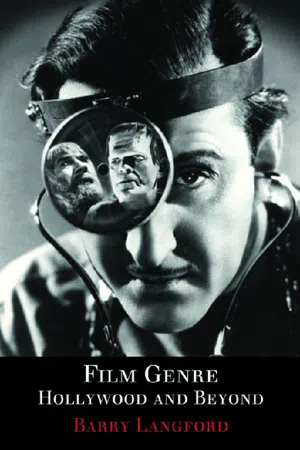 eBook - PDF
Film Genre
Hollywood and Beyond
- Barry Langford(Author)
- 2019(Publication Date)
- Edinburgh University Press(Publisher)
‘Melodrama’ seems generally (though by no means exclusively) to have denoted blood-and-thunder dramas of passion, crime, injustice and retribution – in fact the term was widely used to describe films across (in standard genre-critical terms) a wide variety of classical genres, from Westerns to crime thrillers and exotic adventure films. Richard Maltby (1995: 111) notes that of the six major categories used to classify pictures for the Production Code Administration in the 1940s, Melodrama was by far the largest, accounting : 31 for between a quarter and a third of all production. A growing body of scholarship, starting with Gledhill (1987, 1994), has argued for the centrality to Hollywood film in general of a Melodramatic mode that extends back to and derives directly from the popular nineteenth-century stage. While the theatrical inheritance is most clearly visible in silent film, the Melodramatic mode in this larger, even capacious conception extends well beyond the silent film-makers most readily associated with Melodrama such as D. W. Griffith, into not only studio-era film, but contemporary Hollywood too. Moreover, this Melodramatic ‘mode’ maps directly onto neither the earlier gender-based critical constructions of sound-era Melodrama (Sirk, Minnelli, the woman’s film, etc.) nor onto the ‘industry relay’ explored by Neale. As a set of narrative conventions, affective forms and ideological beliefs present across a wide variety of genres in different periods, Melodrama is at once before, beyond and embracing the system of genre in US cinema as a whole. Linda Williams offers perhaps the clearest, as well as the most ambitious and far-reaching recent statement of this reconception of Melodrama: Melodrama is the fundamental mode of popular American moving pictures.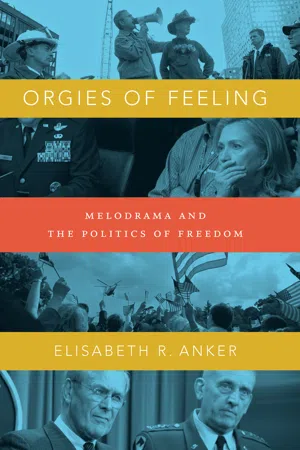 eBook - PDF
Orgies of Feeling
Melodrama and the Politics of Freedom
- Elisabeth R. Anker, Elisabeth Robin Anker(Authors)
- 2014(Publication Date)
- Duke University Press Books(Publisher)
1 Yet I argue that Melodrama is more than a film, literary, or cultural genre; it is also a po-litical genre, more precisely a genre of national political discourse. Melodra-matic genre conventions are found in political rhetoric, governing processes, citizenship practices, and formations of national identity. Melodrama shapes the legitimation strategies of national politics, and the very operations of state power. What I call Melodramatic political discourse casts politics, policies, and practices of citizenship within a moral economy that identifies the nation- state as a virtuous and innocent victim of villainous action. It locates good-ness in the suffering of the nation, evil in its antagonists, and heroism in sovereign acts of war and global control coded as expressions of virtue. By evoking intense visceral responses to wrenching injustices imposed upon the nation-state, Melodramatic discourse solicits affective states of aston-ishment, sorrow, and pathos through the scenes it shows of persecuted citizens. It suggests that the redemption of virtue obligates state power to exercise heroic retribution on the forces responsible for national injury. Melodrama depicts the United States as both the feminized, virginal victim Melodrama AND THE POLITICS OF FREEDOM | 3 and the aggressive, masculinized hero in the story of freedom, as the victim- hero of geopolitics. Its national injuries morally legitimate the violence, ex-tensions, and consolidations of state power that Melodrama posits as neces-sary both for healing the nation’s wound and for reestablishing the state’s sovereign freedom. Melodramatic political discourse provides the tableaux and the legitimacy for the late-modern expansion of state power.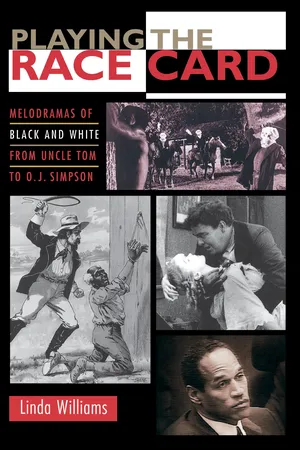 eBook - PDF
Playing the Race Card
Melodramas of Black and White from Uncle Tom to O. J. Simpson
- Linda Williams(Author)
- 2020(Publication Date)
- Princeton University Press(Publisher)
As Christine Gledhill writes, The suc-cess of Melodrama lies partly in its heterogeneity, arguably producing a greater variety of genres than its close modal neighbor, comedy, and able, moreover, to draw into its articulation the other dominating modes of contemporary popular culture: comedy, romance, realism (Gledhill 2000, 235). 25 The mainstream of Melodrama is often not acknowledged as such, however, since Melodrama consistently decks itself out in the latest trappings of realism in order to command recognition of the world it represents. We need to see, however, that Melodrama is the name of the cultural force that, beginning in the nineteenth century, supplied story materials about race, gender, and class already organized into visually compelling forms of pathos and action, already performable in pictures through a system of gesture and demeanor, and already given musical accompaniment on the stage. The Melodramatic mode of narrative in American popular culture is thus nothing less than the process whereby Melodrama sheds its old-fashioned values, acting styles, and ideologies to gain what Gledhill calls the imprimatur of 'realism' (Gledhill 1992, 137). 26 Suffering and Suffrage 27 Feminist critic Lauren Berlant has written insightfully about the role of pain and suffering in the construction of American citizenship. In the liberal, Con-stitutional model of citizenship, a citizen's value is secured through the notion of an abstract personhood protected equally under the law. But since this juridical notion of abstract personhood often fails to provide equal protection Chapter One to all citizens, a second model of citizenship has emerged around the visible emotions of suffering bodies that, in the very activity of suffering, demonstrate worth as citizens. No longer available |Learn more
Melodrama After the Tears
New Perspectives on the Politics of Victimhood
- Jörg Metelmann, Scott Loren, Jörg Metelmann, Scott Loren(Authors)
- 2016(Publication Date)
- Amsterdam University Press(Publisher)
Melodrama and War in Hollywood Genre Cinema Hermann Kappelhof f I. Looking back over the forty-year discussion about film Melodrama, we can now claim that certain fundamental theoretical approaches have become established. One of these is that hardly anyone would still make an attempt to def ine Melodrama as a specif ic genre to which we could then taxonomically assign a certain group of films. Rather, as Christine Gledhill writes, Melodrama designates a “culturally conditioned mode of perception and aesthetic circulation,” which has historically unfolded as a “genre-producing machine.” 1 The Melodramatic is a fundamental mode of entertainment cinema, even of entertainment culture, which can structure the widest variety of genre types. Indeed we can accept the thesis, if not without reservations, that Melodrama – as fits the historical usage of the word – ultimately designates all forms of sensation-oriented entertainment culture. 2 The idea of the Melodramatic mode 3 corresponds to a genre-theoretical concept in which genre cinema itself is understood as a system paradigmati-cally formulated in the interplay between various aesthetic modalities. 4 In this system, the Melodramatic mode is surely one of the base aesthetic modalities that can indeed be suf f ic iently dif ferentiated from others, them-selves perhaps just as fundamental: for instance, comedy, horror, action or the thriller. I myself, in reference to this (incomplete) list of the aesthetic modalities of genre cinema, have attempted to def ine the Melodramatic as sentimental enjoyment. The following is in no way meant as a recap of this discussion. Rather, I would like (a) to pursue a motif where the melodra-matic modus can clearly be set apart as a sentimental modality in relation to other modalities: namely, the motif of the victim. eBook - PDF
Global Melodrama
Nation, Body, and History in Contemporary Film
- Carla Marcantonio(Author)
- 2015(Publication Date)
- Palgrave Macmillan(Publisher)
8 In fact, a critique of classical Hollywood and its patriarchal ideology was in many ways inextricably linked to denouncing classical film narrative, beginning with the work of D. W. Griffith. The genealogy from Griffith’s Victorian novel-inspired innovations in cinematic form to the Freudian-inflected 6 GLOBAL Melodrama “women’s films” of the 1940s and 1950s is undeniable. 9 Yet, as work like Ben Singer’s on Melodrama and modernity has demonstrated, the term “Melodrama” has been used to describe, throughout the history of the medium, very different kinds of films. 10 Broadly speaking, the rubric has shifted from grouping films predicated on external action at the turn of the twentieth century (what Singer calls “sensational” Melodrama), to a genre associated with structures of interiority, be it the psyche or the home, as feature-length films turned away from these sensational narratives. Linda Williams has proposed that Melodrama be understood as the fundamental element through which American popular cinema has func- tioned, neither as genre nor a deviation from classical narrative, but, rather, as a mode that underpins both. 11 In this respect, I concur with the view that Melodrama is a mode that allows us to apprehend and rethink film history, not just within the bounds of American cinema but in the context of global cinema as well. Art cinema, for as much as it is an ideological alternative to Hollywood cinema, in both narrative and stylistic terms, also shares a symbiotic relationship to Hollywood. Art cinema reworks Hollywood Melodramatic convention in a way that still retains the former’s claim for universal legibility. eBook - PDF
The Performing Century
Nineteenth-Century Theatre's History
- T. Davis, P. Holland, T. Davis, P. Holland(Authors)
- 2015(Publication Date)
- Palgrave Macmillan(Publisher)
While the Melodrama may have been dismissed by some as merely theatrical, and while romantic tragic drama may have been set aside by others as unfit for the stage, at the time they both contended for the attention of that portion of the public that cared about the theatre and the drama. We should not collapse romantic drama into the Melodrama or celebrate the romantic drama as the hero of some self-defeating conflict between high literature and materialist theatre, but we do need to read the Melodrama and romantic drama together to see how, confronting a shared literary, cultural, social and political moment, they offered competing visions and drew on differing literary and theatrical tactics that are still usefully defined in relation to one another. We need, as Edward Ziter puts it, to adopt a phenomenological approach to the drama and theatre of the day to reveal the romantic drama and Melodrama as differing, even opposing responses to the same epistemological shift found in the era's theatrical representation and shaping of the experience of space and time. s In order to begin the mapping of the theatrical landscape to include both the Melodrama and the romantic drama, I will first outline the presence of the Melodrama in the patent theatres royal (where the romantic poets hoped to triumph), as it presented one key popular way to deal with the aesthetic, cultural, social and political tensions of the Napoleonic era; I will then suggest how we might understand the kind of realism offered by the Melodrama as 'sensationalist', before more briefly considering how the romantic drama offered competing forms and visions that create a 'virtual' rather than 'realistic' theatre. Patent house Melodrama in the era of Napoleon Any attempt to equate romantic drama and the Melodrama faces the opposition of the 'father' of the Melodrama, Charles Guilbert de Pixerecourt, and his great defender, Charles Nodier.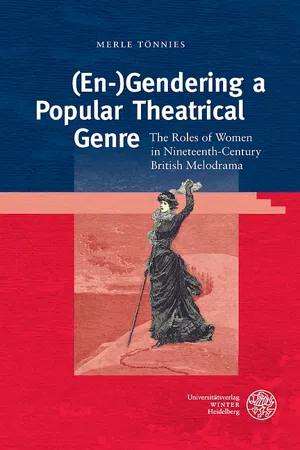 No longer available |Learn more
(En-)Gendering a Popular Theatrical Genre
The Roles of Women in Nineteenth-Century British Melodrama
- Merle Tönnies(Author)
- 2014(Publication Date)
- Universitätsverlag Winter(Publisher)
The prominence of ideological subversion in the later phase also means that although the plays continue to offer emotional benefits for male spectators, they are more specifically geared towards fulfilling women’s needs. As a ‘female’ genre in this 302 new and radical sense, Melodrama clearly fits in well with the established aims of popular culture, addressing the desires of those oppressed by the prevalent power structures. Since this purpose is served overtly rather than obliquely, however, it is even more surprising than before 1860 that both censors and reviewers only very rarely object to the plays on moral grounds. Still more importantly, these works at the same time find favour with ‘dominant’ audience groups in terms of class, thereby disproving all attempts in critical literature to confine the appeal of potentially transgressive Melodrama women to particular sections of the audience (see 1.). As the detailed analysis of the post-1860 roles has shown, the ruling circles of society indeed often desire more rather than less daring images. With regard to nineteenth-century Melodrama, the established cultural studies concept of the popular thus has to be modified not only concerning the ways in which the subversive impulses expresses themselves, but also in terms of the functions performed for the audience. Instead of reconciling subordinate groups to their lot by allowing some scope for their grievances within an overall ‘dominant’ framework, the plays give all social strata the chance to experiment with the forbidden as much as they dare to at any specific moment. It is possible to conclude that throughout the century, this orientation constitutes the central feature by which Melodrama distinguishes itself from its respective ‘literary’ opposite. The portraits of women in tragedy and in the New Drama are after all far more conventional even though they target the same higher-class audiences who enjoy Melodrama. eBook - PDF
- Alexander Lacey(Author)
- 2019(Publication Date)
- University of Toronto Press(Publisher)
Etna (in Le Be~veder), a flood (Charles-le-Teme-raire), a river over-flowing its banks (La Fille de l'Exile). Lengthy and exact descrip-tions of the mechanical means used to obtain these effects are given with the text of some of these plays. Music and dancing, tableaux, the firing of guns, the clash of swords occur in almost every play. It is well-nigh impossible to exhaust the fertility of Melodramatic invention in matters of mere spectacle. The second kind of sensational effect is that which depends on sudden and unexpected developments in the plot, by means of which the audience is kept in a constant state of excitement, never knowing what is coming next . Unexpected appearances, chance meetings of long-separated relatives, narrow escapes from death, providential accidents, revelation of important secrets, clever ruses, disguises, mystifications-these are a few of the many methods adopted to keep the nerves of the spectators always on edge. (V) Minor Characteristics (a) THE STOCK CHARACTERS OF Melodrama These are so well known that it is quite unnecessary to consider them at any great length here. One general feature characterizes each and all of them, viz., they exist not as life-like personages but as parts of a machine for carrying on the plot . No noticeable difference in character separates a Ccelina from an Eliza or a Floreska, there is only a difference in situation. The same is true of an Edwinski and a Vivaldi, of an Orsano and a Zamoski. Strictly speaking, there are no characters in Melodrama, there are only types, easily recognized and constantly recurring, such as the villain, the hero, the persecuted innocent and the clown or niais . There are also, besides these four principals, two other prevailing types, -20- the accomplice and the faithful friend. But these two are to be considered as mere understudies of their respective principals, the villain and the hero. eBook - PDF
- K. Newey, J. Richards(Authors)
- 2015(Publication Date)
- Palgrave Macmillan(Publisher)
2 Forty years ago, Michael Booth recognised the oppositional politics of this dramaturgy with his neat formulation that Melodrama offered ‘the world its audiences want but cannot get’. 3 Since Bentley and Booth, other literary and theatre historians have found in Melodrama an explanation for the intellec- tual and emotional ‘structures of feeling’ of the Victorian period, although most discussions of the ‘Melodramatic’ quickly move away from the stage practices of Melodrama as a performance genre. 4 However, neither popularity with audiences then nor interest in melo- drama as an intellectual trope now has guaranteed that the stage tradition of Melodrama has been seen as a positive and serious element in the formation of British (and specifically English) performance culture. Stage Melodramas, in all their messy fecundity, are still seen as symptomatic of the problems of mass culture in the nineteenth century, rather than centrally significant cultural products in their own right. Victorian Melodrama has achieved some ‘respectability’ in cultural studies circles, chiefly after Peter Brooks’ groundbreaking study, The Melodramatic Imagination, which read Melodrama via Freud and neo-Marxist notions of revolution. But, as Jacky Bratton has recently pointed out, Brooks is ‘ultimately writing about the novel, his approach is psychological and semiotic, and he dismisses all stage melo- drama after the 1820s as the form in decline’. 5 It was Brooks’ ability to place Melodrama at the forefront of a radical, revolutionary sensibility which is so useful and exciting in looking at Melodrama, particularly in working class theatres and for working class audiences in London and elsewhere. Cultural critics and historians, such as Elaine Hadley, took up this category of the ‘Melodramatic’, but such discussions moved quickly from the material practices and conditions of the theatre to apply the term more broadly to Victorian culture.
Index pages curate the most relevant extracts from our library of academic textbooks. They’ve been created using an in-house natural language model (NLM), each adding context and meaning to key research topics.

