Literature

Neo-Classical
Neo-Classical literature refers to a movement in literature that emerged in the 17th and 18th centuries, characterized by a revival of classical themes and forms. It emphasized reason, order, and restraint, drawing inspiration from ancient Greek and Roman literature. Neo-Classical writers sought to emulate the style and values of classical antiquity, often focusing on moral and didactic themes in their works.
Written by Perlego with AI-assistance
Related key terms
1 of 5

4 Key excerpts on "Neo-Classical"
 eBook - PDF
A History of Literary Criticism
From Plato to the Present
- M. A. R. Habib(Author)
- 2008(Publication Date)
- Wiley-Blackwell(Publisher)
On the one hand, the neoclassical concept of nature was informed by Newtonian physics, and the universe was acknowledged to be a vast machine, subject to fixed analyzable laws. On the other hand, the tenor of most neoclassical thought was retrospective and conservative. On the surface, it might seem that the neoclassical writers shared with Enlightenment thinkers a belief in the power of reason. The neoclassicists certainly saw literature as subject to a system of rules, and literary composition as a rational process, subject to the faculty of judgment (Pope uses the word “critic” in its original Greek sense of “judge”). But, while it is true that some neoclassical writers, especially in Germany, were influenced by Descartes and other rationalists, the “reason” to which the neoclassical writers appeal is in general not the individualistic and progressive reason of the Enlightenment (though, as will be seen in a later chapter, Enlightenment reason could from other perspectives be seen as a coercive and oppressive force); rather, it is the “reason” of the classical philosophers, a universal human faculty that provides access to general truths and which is aware of its own limitations. Alexander Pope and others emphasized the finitude of human reason, cautioning against its arrogant and unrestricted employment. Reason announced itself in neoclassical thought largely in Aristotelian and sometimes Horatian terms: an adherence to the requirements of probability and verisimilitude, as well as to the three unities, and the principle of decorum. But the verisimilitude or likeness to reality here sought after was different from nineteenth-century realism that sought to depict the typical elements and the universal truths about any given situation; it did not operate via an accumulation of empirical detail or a random recording of so-called reality.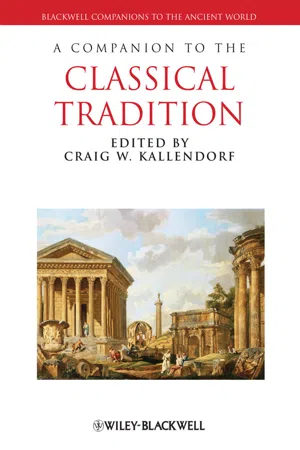 eBook - PDF
- Craig W. Kallendorf(Author)
- 2008(Publication Date)
- Wiley-Blackwell(Publisher)
And so it was that with an appeal to the classics, neoclassicism was brought down. FURTHER READING The indispensable work for understanding the historical development of neoclassical theory is Bray (1927). For the particular way these ideas developed in England, see Johnson (1967). For many years the period of English literature from 1660 to 1798 was called the ‘‘Augustan Age.’’ That terminology came under attack towards the end of the last century. Some background on the dispute as well as a defense of the term ‘‘Augustan’’ can be found in Kaminski (1996). Readers in need of a general intro-duction to French literature will find clear, readable surveys of the important authors and literary trends in Yarrow (1967) and Niklaus (1970). David Hopkins has provided an excellent, brief survey of classical translation and imitation during this period in Womersley (2000). Stack (1985) provides a detailed analysis of Pope’s imitations of Horace. Two important works (often in disagreement) survey the reputation of Augustus Caesar and his place in the political debates of the eighteenth century: Weinbrot (1978) and Erskine-Hill (1983). The disputes between the Ancients and the Moderns receive thorough coverage in Levine (1991). And finally, for a wide-ranging discussion of Enlightenment thought, including the influence of ancient philosophers, see Gay (1966). Neoclassicism 71 CHAPTER SIX Romanticism Bruce Graver 1 Introduction In the 1940s, when Gilbert Highet wrote his account of the classical tradition in the Romantic era, he avoided the word ‘‘Romantic.’’ For Highet, the late eighteenth and early nineteenth century in Europe ‘‘was a time of revolt, and it would be better called the Revolutionary than the Romantic era’’ (Highet 1949: 356).
- Rolf P. Lessenich, Uwe Baumann, Marc Laureys, Winfried Schmitz, Uwe Baumann, Marc Laureys, Winfried Schmitz(Authors)
- 2012(Publication Date)
- V&R Unipress(Publisher)
When, in the Restoration Period, the King and his Court returned from their long exile in France, they imported FranÅois de Malherbe’s French Neo- classicism, thus revitalizing England’s own early aristocratic and elitist Neo- classicism. This grew with Ben Jonson and his Cavalier poets as well as with Inigo Jones’s Palladian architecture in the first half of seventeenth century, and had been stifled only temporarily by Cromwell, the Puritans, and the people’s party in the years 1642 – 1600. 3 Neoclassicism was an aesthetic of rule and reason which defined itself, first against the old Baroque, later against the new Romanticism. For all their dif- ferences as aesthetics of artificiality and of naturalness respectively, Baroque and Romanticism had in common what was incompatible with Neoclassicism: the cult of originality and diversity, the precedence of variety over unity, the disdain of rules and reason, esotericism and exoticism, mysticism and obscurity, fantasy and exuberance. Neoclassicism was to aesthetics what the Enlightenment was to theology, philosophy, and politics. The rules of Horace were seen as a “system” of rules of reason, discovered by the first Augustans in classical antiquity after the first dark ages of ignorance and barbarity, then again lost in “the dark middle ages”, then fully rediscovered by the self-styled second Augustans of the seventeenth cen- tury. King Louis XIVof France and King Charles II of England posed as Emperor Augustus, 4 an imagery of light and enlightenment was opposed to an imagery of darkness, from “le sicle des lumires” to “le roi soleil”. The only major dif- ference was that English self-fashioning against France gave more prominence to liberty. Restoration Neoclassicism would, from the start, refuse to obey rules that were the dictates of absolutism, Louis XIV in politics and Malherbe or Boileau in 3 J.W.H. Atkins, English Literary Criticism: Seventeenth and Eighteenth Centuries, London 1951, 1959, 1–32. eBook - ePub
The Literary History of England
Vol 3: The Restoration and Eighteenth Century (1660-1789)
- Donald F. Bond, G. Sherburn(Authors)
- 2003(Publication Date)
- Routledge(Publisher)
The rhetorical tradition, deriving strength from the fact that in the schools poetry was taught as a sub-topic under rhetoric, stressed creative processes and methods of affecting the mind of a reader. Neoclassical poetry was essentially rhetorical in that it spoke to an audience and attempted to move or to modify the mental state of its audience. Normally it did not, like later, romantic poetry, tend to be soliloquy. The composition of an oration from Greek times had been viewed under three aspects: invention, or the finding of material; disposition, or the arrangement of material; and eloquence, or the embodying of matter in fit style. As applied to the composition of poetry the first of these three aspects of creation was not necessarily cold-blooded. The prologue of the most epical of Shakespeare's plays, Henry V, begins, O for a Muse of fire, that would ascend The brightest heaven of invention; and usually—but not always—in neoclassical criticism invention is not mere ingenuity but is associated with fire and elevation. It is a favorite word with Dryden; and for most English critics before 1750 it carried a meaning at times approaching that of the term so popular and so undefined in romantic criticism, “creative imagination.” From rhetorical theory also, as well as from Bacon, Hobbes, and other psychological writers, the poet learned that to affect his readers he must through his own imaginative deftness appeal to “the passions” (as emotions were termed) of his reader. The principles of criticism changed less in the seventeenth century than the abilities of poets, but in the case of both critics and poets what change there was tended towards admiration of simplicity, sound sense, and propriety, and away from fantasy or anything like imaginative eccentricity
Index pages curate the most relevant extracts from our library of academic textbooks. They’ve been created using an in-house natural language model (NLM), each adding context and meaning to key research topics.

