History

Glorious Revolution
The Glorious Revolution refers to the peaceful overthrow of King James II of England in 1688 and the ascension of William III and Mary II to the throne. This event marked a significant shift in power from the monarchy to Parliament and established the supremacy of the constitutional monarchy in England. The Glorious Revolution also led to the passage of the Bill of Rights, which limited the powers of the monarchy and affirmed the rights of Parliament.
Written by Perlego with AI-assistance
Related key terms
1 of 5

11 Key excerpts on "Glorious Revolution"
 eBook - PDF
The Long Eighteenth Century
British Political and Social History 1688-1832
- Frank O'Gorman(Author)
- 2016(Publication Date)
- Bloomsbury Academic(Publisher)
In this manner, therefore, the Church of England was reconstituted at the Glorious Revolution as the established church of England. Its status, however, remained a matter of debate and its prospects in an age of religious pluralism uncertain. The Glorious Revolution, then, was a real watershed in the history of England. It settled the vexed and urgent issue of the succession, defined the powers of the monarchy and guaranteed, while redefining, the status of the Church of England and its relations with Protestant Dissent. These were momentous changes and may, with some justice, be described as a revolution. Indeed, there were certain features of the events of 1688–9 which may be termed ‘revolutionary’ in a general sense; the dramatic collapse of James II’s regime from within , the setting aside of the existing laws of succession and the transfer of sovereignty from James II to William III. These events were to have enormous consequences not only for England but also, especially, for Scotland and Ireland. Indeed, repudiating the traditional Whiggish view that the Glorious Revolution was a moderate constitutional revolution, Steve Pincus has argued that it was ‘the first modern revolution … popular, violent and divisive’. 11 But the violence, especially in England, was limited. While it is true that William III received public support in the closing months of 1688, that, too, was limited, and it must be remembered that James II had received THE Glorious Revolution IN BRITAIN, 1688–1714 43 considerable public acclaim just a few weeks earlier. Furthermore, such a ‘modern’ view of the Glorious Revolution severely downplays the importance of religious sensibilities and confessional issues. Indeed, it has even been argued that far from inspiring immediate political modernization, the Glorious Revolution left England as an ancien régime society. eBook - ePub
Tudor and Stuart Britain
1485-1714
- Roger Lockyer, Peter Gaunt(Authors)
- 2018(Publication Date)
- Routledge(Publisher)
Chapter 19 James II, the Glorious Revolution and the reign of William III The reigns of James II and William III in perspective With the benefit of hindsight, the history of the 15 years or so following the death of Charles II in 1685 appears not only very complex, with plenty of rapid, dramatic and in many ways unexpected developments, but also to have produced profound and lasting changes in Church and state. After an initially smooth succession, James II’s pro-Catholic policies and his other initiatives generated increasing unease, instability and potential opposition, such that his reign lasted little more than three and a half years. In autumn 1688 he was challenged by the intervention and the largely unopposed invasion of the man who was both his nephew and his son-in-law, William of Orange. James’s nerve broke, he fled abroad and was deemed to have abdicated and he was replaced on the throne by the joint monarchy of William III and his wife, James’s elder daughter, Mary II. A key consequence of this, probably envisaged and sought from the outset – perhaps the only outcome that many Englishmen had initially been seeking – was the abandonment and reversal of most of James’s controversial policies. These developments of autumn and early winter 1688, achieved with limited violence and largely bloodlessly in most of England and Wales – though they created much bigger waves in Ireland and Scotland (see Chapter 21) – came to be known as the Glorious Revolution. This led on not just to a change in monarch and the abandonment of James’s policies but, it is usually argued, to far wider and more profound alterations in government and administration, in politics and religion, in the financial organization and foreign policy of the state. Some of these developments were expected at the time of the Glorious Revolution but others were unexpected, unintended or indirect consequences eBook - PDF
Tudor and Stuart Britain
1485-1714
- Roger Lockyer, Peter Gaunt(Authors)
- 2018(Publication Date)
- Routledge(Publisher)
C H A P T E R 1 9 James II, the Glorious Revolution and the reign of William III The reigns of James II and William III in perspective W ith the benefit of hindsight, the history of the 15 years or so following the death of Charles II in 1685 appears not only very complex, with plenty of rapid, dramatic and in many ways unexpected developments, but also to have produced profound and lasting changes in Church and state. After an initially smooth succession, James II’s pro-Catholic policies and his other initiatives generated increasing unease, instability and potential opposition, such that his reign lasted little more than three and a half years. In autumn 1688 he was challenged by the intervention and the largely unopposed invasion of the man who was both his nephew and his son-in-law, William of Orange. James’s nerve broke, he fled abroad and was deemed to have abdicated and he was replaced on the throne by the joint monarchy of William III and his wife, James’s elder daughter, Mary II. A key consequence of this, probably envisaged and sought from the outset – perhaps the only outcome that many Englishmen had initially been seeking – was the abandonment and reversal of most of James’s controversial policies. These developments of autumn and early winter 1688, achieved with limited violence and largely bloodlessly in most of England and Wales – though they created much bigger waves in Ireland and Scotland (see Chapter 21) – came to be known as the Glorious Revolution. This led on not just to a change in monarch and the abandonment of James’s policies but, it is usually argued, to far wider and more profound alterations in government and administration, in politics and religion, in the financial organization and foreign policy of the state. Some of these developments were expected at the time of the Glorious Revolution but others were unexpected, unintended or indirect consequences.
- Frank W. Thackeray, John E. Findling, Frank W. Thackeray, John E. Findling(Authors)
- 2004(Publication Date)
- Greenwood(Publisher)
The resulting Act of Union in 1707 ended the possibility of a Jacobite takeover in Scotland. The Scots retained their own church and law courts, but gave up legislative authority while receiving representation in the British Parliament and gaining access to England's colonial and domestic markets. The Glorious Revolution, 1688-1689 175 As William dealt with Scotland, he also had to face the danger of a French-supported invasion from Ireland. On March 12, 1689, James II landed in southwestern Ireland where he was greeted by a rising tide of Irish Catholic nationalism. The "Patriot Parliament" meeting in Dublin in May passed anti-English legislation that proclaimed Ireland's legislative and jurisdictional independence of England. William responded by send- ing a force of 10,000 soldiers to aid Ulster Protestants. Disease and inade- quate supplies, however, claimed half of the force, which resulted in William's personal intervention as he led English forces to victory at the Battle of the Boyne in July 1690. Within a year the complete conquest of Ireland had been achieved. Though the Irish campaign clearly distracted William from his efforts to create an anti-French alliance, the Irish situ- ation did help him to convince many of the English that a campaign against France, which continued to support James II, was important for protecting England's security. As Ireland and Scotland were being drawn more closely into England's orbit, imperial control was being tightened for the mainland American colonies. Indeed, the Glorious Revolution was a major turning point in the con- stitutional and political life of the American colonies. The colonists jubi- lantly received the news of the Protestant William III replacing the Catholic James II, who had established the Dominion of New England. This dominion had eventually brought all of the New England colonies, as well as New York and New Jersey, under one governor who governed without a legislature. eBook - PDF
Constitutional History of the American Revolution, Volume IV
The Authority of Law
- John Phillip Reid(Author)
- 2013(Publication Date)
- University of Wisconsin Press(Publisher)
the Kings illegal imposing Taxes upon the People, with- out their consent in Parliament, contrary to the known Laws of the Land, his subverting the Fundamental Lawes of the Nation, His neglecting and refusing to bring Delinquents to Tryal, that had been Instruments in ob- structing Justice, promoting Monopolies, and other grievances to the great 54 THE Glorious Revolution ISSUE Oppr[e]ssion of the People."8 Although eighteenth-century constitution- alists looked back to the Saxons and to the Gothic constitution for the authority of law as an autonomous force, they looked to the Civil War against Charles I as the struggle of rule by law against rule by the will and pleasure of arbitrary command. The parallels between the Glorious Revolution of 1688 and the Ameri- can Revolution seemed even more obvious. James II threatened to subvert what seventeenth-century Englishmen considered the established consti- tution just as Parliament threatened to subvert what Americans whigs thought the lawful constitution. The language was also the same. Parlia- ment accused James II of "breaking the original contract between king and people" and of "having violated the fundamental laws" much as colonial whigs accused George III in the Declaration of Independence. 9 In 1776 the whig chief justice of rebellious South Carolina justified the American Revolution by the Glorious Revolution saying, "we need no better au- thority than that illustrious precedent," and Edmund Burke later recalled that he considered the Americans as standing at that time, and in that con- troversy, "in the same relation to England as England did to King James the Second in 1688."10 The Glorious Revolution, of course, was the event that established Par- liament's supremacy over the crown, and the coronation oath was modified so the king swore to maintain the "statutes in Parliament agreed upon" in- stead of the laws and customs upheld by earlier monarchs.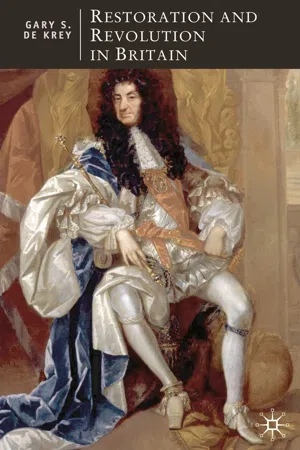 eBook - PDF
Restoration and Revolution in Britain
Political Culture in the Era of Charles II and the Glorious Revolution
- Gary S. De Krey(Author)
- 2017(Publication Date)
- Red Globe Press(Publisher)
Restoration gov-ernments in church and state had instead regulated intellectual life and the press in order to prevent the spread of ideas that chal-lenged established institutions. They were, moreover, suspicious of the undisciplined talk percolated in the clubs and coffeehouses of London and some provincial centres. The Glorious Revolution, however, was a particularly wordy event that shattered these efforts to control political and religious discourse. It provoked numerous pamphlets and treatises on a variety of issues that had to be settled in each kingdom. Although Anglican Tories sought to minimize the political disjuncture that had taken place in England, the ouster of James II and the accom-panying efforts at military and commercial defence were experi-enced by most, despite the language of ‘settlement’, as one of the The Glorious Revolution and Its Aftermath 297 most unsettling events since the Reformation. Political discussion once again, therefore, spilled over into the world of print and public debate in all the heady ways that Restoration authorities had sought to prevent. The annual output of the English press, which had reached some 1800 titles by the time of the Restoration Crisis, dipped only slightly during the 1680s before continuing to increase after 1689 towards an annual total of over 2400 titles by 1710. In 1695, after much consideration, parliament permitted the Restoration Licensing Act of 1662 to lapse. The resulting freedom of the press was a triumph for the purveyors of printed ideas over those who sought instead to mould minds in support of approved conventions. The press contributed to the enlargement of a public sphere of discourse and debate in Britain that had few continental analogues, except in the Netherlands. After 1689, print helped make politics out of doors as ordinary in Britain as politics within the doors of parliamentary chambers, country houses, and bor-ough corporations. eBook - ePub
Politics under the Later Stuarts
Party Conflict in a Divided Society 1660-1715
- Tim Harris(Author)
- 2014(Publication Date)
- Routledge(Publisher)
It presented William and Mary not only with a Claim of Right – a statement of basic constitutional principles akin to the English Declaration of Rights – but also with various Articles of Grievances demanding changes in the law, and clearly intended the transfer of the Crown to be conditional upon the acceptance of the terms of these documents. The Claim of Right also condemned prelacy as ‘a great and insupportable grievance and trouble to this Nation’, and the following year, with the Scottish bishops refusing to acknowledge the new rulers, episcopacy was overthrown and Presbyterianism established. 74 It was a settlement which was to have significant ramifications for British politics, as we shall see later when we come to consider the issue of Jacobitism. If the changes wrought by the Glorious Revolution in England seem, by contrast, much more limited, it would be wrong to react too far and suggest that very little of significance was achieved by the events of 1688–9. The Revolution certainly marked a belated victory for the policy of Exclusion, and finally established the legislative sovereignty of Parliament. However, it is difficult to agree with those historians who see 1688–9 as a major watershed in early modern English history, which altered the basic issues of political life at both the national and local level. 75 In many respects the Revolution did little to settle the issues which had caused such bitter political division in Restoration England. The fact that so few of the Crown’s powers were redefined in 1688–9 meant that neither the old conflicts between Court and Country, nor those between advocates of limited versus strong, autocratic monarchy, had reached any satisfactory resolution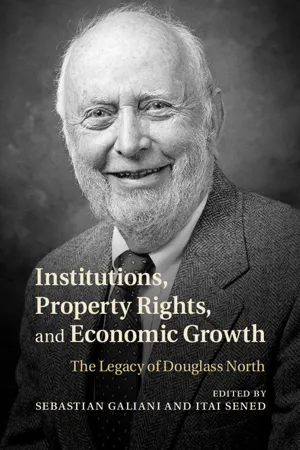 eBook - PDF
Institutions, Property Rights, and Economic Growth
The Legacy of Douglass North
- Sebastian Galiani, Itai Sened(Authors)
- 2014(Publication Date)
- Cambridge University Press(Publisher)
This new territorial empire, he believed, would allow him to split up the world with his French cousin Louis XIV. Louis XIV would rule over Europe, while James would have an English overseas empire. This new empire would fill James II’s coffers with a minimum of parliamentary oversight. It was both the domestic and imperial projects that the revolutionaries cut short in 1688. The immediate proximate outcome of the Glorious Revolution was that James’s programs of absolutism both at home and abroad failed. William and Mary abandoned James II’s grand plans to build a self-financing central- ized empire. However, William and Mary were not constrained to abandon James II’s grand imperial vision by the Bill of Rights or any other statutory element of the Revolution Settlement. Nothing in the Revolution Settlement stipulated the demise of the Dominions of New England or the West Indies; nothing demanded that Josiah Child’s plans for a vast territorial empire in India be abandoned. William and Mary also surrendered the right to collect customs for life. Since the reign of Henry IV, English kings had been granted the customs income for life on their accession. James II started to collect the customs before being granted it and announced “That some might possibly suggest that it were better to feed and supply him from time to time only, out of their inclination to frequent Parliaments; but that, would be but a very improper Method to take with him.” 39 Persuaded by James II’s promises not to alter the constitution in church and state, both Commons and Lords went along with it. In 1689, attitudes had changed. William wanted the customs for life, but he only got it for four years. Another interesting example of William and Mary’s tacit surrender of rights comes from reduced use of the royal prerogative. Though the 39 E. A. Reitan, “From Revenue to Civil List, 1689–1702: The Revolutionary Settlement and the `Mixed and Balanced’ Constitution,” The Historical Journal 13(4): 572. eBook - ePub
Revolutions and the Revolutionary Tradition
In the West 1560-1991
- David Parker(Author)
- 2002(Publication Date)
- Routledge(Publisher)
4 1688: A political revolutionW. A. SpeckIntroduction
On 11 December 1688 James II fled from his capital city and made his way down the Thames hoping to escape to France. His departure produced the first breakdown of government in the Glorious Revolution. For a time a group of peers agreed to ‘take upon them the Government for the preservation of the Kingdom and this great City’. As one of them noted, ‘we had otherwise been a state of banditi, and London had certainly been the spoil of the rabble’. This alternative administration did not last long, for the King returned to the capital on 16 December. He had been intercepted by fishermen at Faversham, from whom he had been rescued by a party of guards sent to bring him back to London. James tried to resume the reins of power and even held a meeting of the privy council. But when William of Orange entered the capital on 18 December he asked the King to remove himself from the seat of government and James agreed, retiring to Rochester. Once more there was a vacuum of power, which the peers, meeting in the House of Lords, again attempted to fill. When James fled to France on 23 December, however, this time successfully, they met on Christmas Eve and asked William to call a free Parliament to meet on 22 January, and meanwhile to take upon himself ‘the administration of public affairs, both civil and military, and the disposal of the public revenue’. He delayed acceptance until former Members of Parliament of King Charles II’s time also asked him to govern the country on 26 December. William then carried out the task not just until the Convention assembled, for it too asked him to be chief executive until the constitutional position had been resolved. He therefore governed the country by virtue of these informal ad hoc arrangements until 13 February, when he and his wife Mary, James’ daughter, accepted the Convention’s offer of the Crown.For seven weeks, therefore, England was without a king or queen. This was a unique era in constitutional history, for the rule was ‘the king is dead, long live the king’. No interregnum was recognised legally even between the execution of Charles I in 1649 and the Restoration of 1660. Charles II dated his reign from the day of his father’s death. The Convention elected in 1689, however, accepted that the throne was vacant between the flight of James II and the acceptance by William and Mary of the Bill of Rights. This was arguably the most telling sign that 1688 was a truly revolutionary year.1 eBook - PDF
- Stephen Baxter(Author)
- 2023(Publication Date)
- University of California Press(Publisher)
IV THE Glorious Revolution AS SPECTACLE: A NEW PERSPECTIVE Lois G. Schwoerer The Glorious Revolution as a spectacle is the new perspective on the Revolution of 1688-89 which I want to develop in this essay. 1 The Glorious Revolution is not usually thought of as having the characteristics of a spectacle. Perhaps this is because historians have focused attention on the origins and results of the revolution rather than on the revolution itself. Thus they have treated only in a perfunctory way the processions, ceremonies, bonfires, and fireworks that filled the day, February 13, 1689, when the revolu- tion was publicly brought to an end. On that day the Declaration of Rights was carried through the streets in grand procession to the Banqueting Hall at Whitehall Palace. There it was read to Prince William and Princess Mary of Orange and the crown was offered to them. Then, ancient officers of the state and political leaders again in grand procession marched to four places in Lon- don to proclaim William and Mary king and queen. I believe that an examination of these proceedings may not only vivify the revo- lution, but also deepen understanding of the political process underlying it and clarify aspects of the Declaration of Rights. I will argue that the principals in the revolution contrived a stylized ceremony, organized the two elaborate processions, promoted the 109 1 1 0 T H E GLORIOUS R E V O L U T I O N use of bonfires and fireworks, and encouraged the appearance of printed written and pictorial materials. Their purpose in so doing was to create certain political impressions and to win from Prince William an implicit commitment that could not be obtained directly—a commitment that assured that this revolution would change not only the English king but also the kingship. 2 Ten years ago, it might have been necessary to justify using cer- tain ceremonies and processions as evidence for understanding the political process. eBook - PDF
Conscience and Community
Revisiting Toleration and Religious Dissent in Early Modern England and America
- Andrew R. Murphy, Andrew R. Murphy(Authors)
- 2001(Publication Date)
- Penn State University Press(Publisher)
35 (Indeed, William would lead England into war with France shortly after his accession.) 134 Revisiting Early Modern Toleration and Religious Dissent Edinburgh, 1851), vol. 13; J[ohn] H[umfrey], The Authority of the Magistrate, About Religion, Discussed (London, 1672); and Slingsby Bethel, The Present Interest of England Stated (London, 1671). Gary S. DeKrey surveys the various sorts of conscience arguments advanced during the Restoration in “Rethinking the Restoration: Dissenting Cases for Conscience, 1667–1672,” Historical Journal 38 (1995): 53–83. 32. England in the 1690s: Revolution, Religion, and War (Oxford, 1999), 161. 33. Robert Beddard goes so far as to call the Revolution of 1688 a “Whig revolution.” See his “Unexpected Whig Revolution of 1688,” in The Revolutions of 1688: The Andrew Browning Lectures 1988, ed. Beddard (Oxford, 1991), chap. 1. For general overviews of the events of James’s reign, see Maurice Ashley, The Glorious Revolution of 1688 (London, 1966), and Stuart E. Prall, The Bloodless Revolution: England 1688 (Madison, Wis., 1972). 34. Pincus emphasizes this popular anti-French rhetoric, noting its religious as well as pragmatic elements: see “To Protect English Liberties,” esp. pp. 81–89. 35. Rose, England in the 1690s, 20. See also Tony Claydon, William III and the Godly Revolution (Cambridge, 1996), chaps. 1–3. The European perspective is also addressed by the James reigned, then, against a European background. He practiced a policy of exempting Roman Catholics from the requirements of the Test Act, received papal emissaries, and reinstituted celebration of the mass in the royal household. In April 1687, James issued a Declaration of Indulgence, granting liberty of conscience and worship to Roman Catholics and Protestant Dissenters, and exempting public officials from compliance with the Test Act. Legally speaking, the Declaration was based upon the king’s suspending power.
Index pages curate the most relevant extracts from our library of academic textbooks. They’ve been created using an in-house natural language model (NLM), each adding context and meaning to key research topics.

