Politics & International Relations

UK Political History
The political history of the UK encompasses a rich tapestry of events, including the development of parliamentary democracy, the expansion of the British Empire, and significant social and political reforms. Key moments include the Magna Carta in 1215, the Glorious Revolution of 1688, the establishment of the welfare state after World War II, and the UK's entry into the European Union in 1973.
Written by Perlego with AI-assistance
Related key terms
1 of 5

3 Key excerpts on "UK Political History"
 eBook - ePub
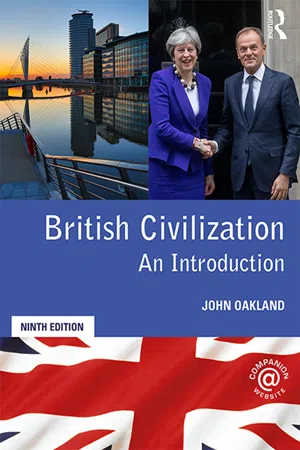
British Civilization
An Introduction
- John Oakland(Author)
- 2019(Publication Date)
- Routledge(Publisher)
5Politics and government- Political history
- Local government and devolution
- The contemporary British political framework
- Constitution and monarchy
- UK Parliament: role, legislation and elections
- The UK party political system
- The UK government
- UK parliamentary control of government
- Attitudes to politics
- Exercises
- Further reading
- Websites
This chapter examines the growth of political culture in the United Kingdom (UK) since ad 43 and evaluates its contemporary institutions and structures.Britain’s political history shows the weakening of monarchical and aristocratic power in its original nations (England, Scotland, Wales and Ireland). This led to political and legislative authority being centralized in London in a UK parliament, a UK government and a UK Prime Minister. A central break in this structural development occurred when the UK joined the European Economic Community (now EU) in 1973, before eventually voting to leave the organization in 2016. Changing social conditions resulted in the growth of political parties, extension of the vote to all adults, development of local government and a twentieth-century devolution (transfer) of central political power from the UK Parliament to Wales, Scotland and Northern Ireland. These processes were accompanied by political, social and religious conflicts, and constitutional compromise.The UK political structures have been vigorously debated and there is at present public disillusionment with the political process and the performance of politicians. The government in London is accused of being too secretive, too centralized, too remote, too media-reactive, too controlling, too oriented to party politics and insufficiently responsive to the needs of the diverse peoples of the country. It is argued that the UK Parliament has lost influence over the executive government; that political power has bypassed Parliament and shifted to a presidential Prime Minister with a prime ministerial office in 10 Downing Street, London; that unelected bodies, such as regional business groups, and quangos (‘quasi-autonomous non-governmental organizations’) and political advisers have become too influential; that the Civil Service has been politicized; that there are weaknesses at devolved and local governmental levels; that recent parliamentary expenses and sex scandals have further tarnished the reputation of politicians; and that the British political system needs reform in order to make it more efficient, more accountable to the electorate and more adaptable to modern requirements. eBook - PDF
The historian between the ethnologist and the futurologist
A Conference on the Historian Between the Ethnologist and the Futurologist, Venice, April 2–8, 1971
- Jerôme [Ed.] Dumoulin, Conference on the Historian Between the Ethnologist and the Futurologist(Authors)
- 2018(Publication Date)
- De Gruyter Mouton(Publisher)
Here political history as a special discipline within the sciences dedicated to the study of societies is in its legitimate sphere. Political history always asks when and where and how in a given society of a specific historical type decisions of historical relevance came about. It will, of course, always remain a matter of dispute, in which spheres of the social process the vital decisions are located. Are they located in the political organisations exercising power in the narrow sense of the term, more or less legitimated by a legal system, or are they found in the economic sphere or perhaps even at a much more elementary level, involving, for example, biological factors such as population movement. Political history will have to pay attention to this question and will have to develop a new outlook to enable it to integrate these diverse aspects of social change in historical dimensions into its conceptual framework. On the other hand, not only political history, but all history depends on the assumption that in any given situation the historical process was open and that the future, at least to a certain degree, is given into the hands of purposeful, acting groups. The excitement which is evoked by any historical work of any distinction derives from the knowledge that there were alternatives for the acting groups concerned, and that the respective 148 Political history in crisis political courses decided upon had immense consequences, which affected indirectly or even directly our own social and political reality or our consciousness. What is meant by this can perhaps be illustrated somewhat more clearly by turning to a historical phenomenon of outstanding relevance to our own historical-consciousness revolutions, especially political revo-lutions. The term revolution nowadays is used by historians, social scientists, and the general public as well with the most diverse meanings. eBook - PDF
- D. Cannadine(Author)
- 2002(Publication Date)
- Palgrave Macmillan(Publisher)
Of course, much of that work falls within a genre that we might call the history of political leadership, whether it takes the form of political biography (a uniquely powerful and popular British genre) or of studies of party politics and government. From the standpoint of other European historians, the sheer amount of that scholarship is striking. The many shelves of books analysing the emergence, composition, electoral strategies, governing practices and demise of the Liberal Party astound the historian of French radicalism (a comparably significant force), who is forced to rely on Serge Berstein’s Histoire du Parti Radical and a few other monographs. Likewise, although Gustav Stresemann might have stood alongside Lloyd George or at least Austen Chamberlain in his influence on both national and international politics, German historians have accorded him only a fraction of the scholarly attention that their British counterparts have lavished on every utterance and action of even relatively minor early twentieth-century politicians. True, when scholars in other national fields (not to mention American graduate students entering this field) look at British political history their admiration is not always unmixed with irritation, for this is a historiography that takes its own significance as given, makes no gestures to contemporary relevance, frankly disdains the attractions of ‘theory’ (and, to a degree, of systematization or generalization of any kind), and implicitly proclaims that if you can’t follow who the bit-players What is Political History Now? 39 are, you shouldn’t be watching the play. Yet, however interior and self- referential such a field might seem, it is, in my view, unrivalled in its scholarly standards and accomplishments.
Index pages curate the most relevant extracts from our library of academic textbooks. They’ve been created using an in-house natural language model (NLM), each adding context and meaning to key research topics.

