History

UK Economic Growth History
The UK has experienced periods of economic growth and contraction throughout its history. Notable periods of growth include the Industrial Revolution in the 18th and 19th centuries, the post-World War II boom, and the expansion of the financial services sector in the late 20th century. Economic growth has been influenced by factors such as technological advancements, global trade, and government policies.
Written by Perlego with AI-assistance
Related key terms
1 of 5
7 Key excerpts on "UK Economic Growth History"
 eBook - ePub
Study of Economic History
Collected Inaugural Lectures 1893-1970
- N.B. Harte(Author)
- 2012(Publication Date)
- Routledge(Publisher)
Tonight, I propose neither to bore you by discussing the details of my own research, nor to entertain you by belabouring my professional colleagues. Instead, I shall compromise by considering the subject of economic growth, and some of the general problems that economic historians encounter in dealing with it.II
Economic growth is essentially an economist’s concept: strictly speaking, it means a rise in real income per capita, or, in other words, a rise in average purchasing power per head of population, and it is obviously important because the welfare of any community is directly affected by the size and the trend of its output of goods and services. Needless to say, this is not everything: prosperity does not ensure happiness (though it surely helps); rapid economic growth may be accompanied by great economic, social, and political instability; and the distribution of wealth is almost as important as its size. Moreover, an undue preoccupation with economic growth can lead to a neglect of some aspects and periods of economic history and a distortion of others, even if we extend the mathematical range to include zero and negative growth and recognize that economic and social conditions interact upon each other. Yet whatever its dangers,2 the study of economic growth is a central theme in economic history, and I shall use it as a peg on which to hang some illustrations of the present condition of the subject and its current and prospective connections with economics and history. In what follows, for the sake of brevity, I shall speak of economic history rather than economic and social history; but at a later stage I shall comment on the relations between the social and economic aspects of the subject.In a sense, the economic historian’s dilemma is a by-product of current efforts to promote economic growth, both in advanced and so-called underdeveloped countries. It is often suggested that historians can shed light on the problems of the present by disclosing the secrets of the past, and as most of the underdeveloped countries are in a pre-industrial stage of development, and anxious to have an industrial revolution of their very own, an added stimulus has been given to the study of the first or ‘classic’ industrial revolution which occurred in eighteenth century England. This interest can, of course, be gratifying, even flattering to the scholar; but it has its disadvantages. Those who study history in the hope of relieving present discontents are apt to distort the past; and if the economic historian tries to provide answers to the questions posed by his academic colleagues, or by the general public, he immediately encounters serious difficulties—difficulties of communication, of method, and of substance—all of which stem from the endless subtlety and complexity of the process of economic and social change. Here, as elsewhere, as knowledge advances it becomes more precise and technical, more difficult to communicate to the layman; yet if the economic historian wishes to be heard he must be prepared to make simple straight forward statements about complex historical processes which he may not fully understand. This problem arises not only in addressing a popular audience but also in communicating with his indispensable academic colleagues, the economists and historians, though the difficulties are not the same in each case. It is his duty to warn the economists whenever they seem over-eager to apply the ‘lessons’ of the past to the problems of the present; but in order to command a respectful hearing the economic historian must not only acquire some command of the economists’ peculiar language, he may also be called on to make broad generalizations about the results of his researches in a way that troubles his historical conscience. His dealings with the historians, on the other hand, are less exacting, and they should be mutually beneficial provided that the economic historian displays a due regard to the limitations of his evidence, and an awareness of the dangers of a deterministic economic interpretation of history. The historians ought to sympathize with the economic historian’s desire to communicate, for the original meaning of the word history was: to inquire, to know, to tell what one has learned; but in approaching his fellow historians, the economic historian often senses that he must overcome certain barriers of scepticism, tradition, and indifference. Whenever this is so, he must restrain his impatience, remembering that he is a comparative newcomer to Clio’s circle, a dealer in parts rather than wholes; and he must recall J. H. Clapham’s well-known remark that while economic history is the most ‘fundamental’ type of history, it is not the most ‘important’, for ‘foundations exist to carry better things’.3 eBook - ePub
- Alec Cairncross(Author)
- 2016(Publication Date)
- Routledge(Publisher)
3 Economic Growth in Britain1 DOI: 10.4324/9781315623801-31 Based on the thirteenth Hugh Macmillan Memorial Lecture delivered on 23 March, 1971 and reprinted from the Transactions of the Institute of Engineers and Shipbuilders in Scotland by kind permission of that Institution.It may seem natural—indeed inevitable—that economists should concern themselves with economic growth and development, a subject very much in everybody's mind since the Second World War. But if one looks back it is remarkable how little thought was given for well over a century to economic growth as opposed to such matters as tariffs, monopoly, taxation, imperialism, unemployment and financial crises. Economic growth was either taken for granted or submerged in more compelling issues such as tariff reform or trade depression. For a couple of generations before 1939 one hardly so much as heard the words ‘economic growth’; and the very concept of more or less continuous expansion of the economy seemed novel and paradoxical when there were still widespread fears of a post-war slump and a renewal of the chronic and seemingly interminable unemployment of the inter-war years. Yet the country has been advancing for nearly a generation at a rate never before experienced and complaining that it is not nearly fast enough and falls well below what other countries are achieving.In such a situation one might expect a flood of literature explaining why things have changed since before the war; why unemployment has been so consistently low and growth rates so consistently high all over the world; why the British record compares unfavourably with the record abroad; and what, if anything, can be done to accelerate economic growth in this country. There has, indeed, been a flood of literature; but some of it is not very readable and a great deal that is readable is superficial and unconvincing. I hesitate to add to the flood particularly as what I have to say may be thought to merit the epithets that I have just used. But I know of few subjects on which it would be more reasonable to turn to an economist for guidance or one better calculated to produce controversy and confusion in equal measure. Not that I aspire to settle the controversy or dispel the confusion. That is well beyond my powers. As with all major issues in economics it is only at election time that one is given simple and conclusive answers and as most of us learn in due course the answers then given become progressively less simple and less conclusive. eBook - PDF
Studies in Economics and Political Science
13 Volume Set
- Various, Various Authors(Authors)
- 2022(Publication Date)
- Routledge(Publisher)
The Growth of the British Economy 1918-1968 BY G. A. PHILLIPS University of Lancaster AND R. T. MADDOCK University College of Wales, Aberystwyth London GEORGE ALLEN & UNWIN LTD RUSKIN HOUSE MUSEUM STREET First published in 1973 This book is copyright under the Berne Convention. All rights are reserved. Apart from any fair dealing for the purpose of private study, research, criticism or review, as permitted under the Copyright Act, 1956, no part of this publication may be reproduced, stored in a retrieval system, or transmitted, in any form or by any means, electronic, electrical, chemical, mechanical, optical, photocopying, recording or otherwise, without the prior permission of the copyright owner. Enquiries should be addressed to the publishers. © George Allen & Unwin Ltd. 1973 ISBN 0 04 330233 5 hardback 004 330234 3 paperback Printed in Great Britain in lOpt Times Roman type by Alden & Mowbray Ltd at the Alden Press, Oxford PREFACE Throughout the history of industrial societies, economists have been concerned with the nature and causes of economic growth. The purpose of this book is, briefly, to relate this thinking, or some aspects of it, to the historical experience of Britain since the end of the First World War. Our object has been, not to produce any substantial amount of new factual material, but to attempt to leaven known facts with $ larger theoretical ingredient. Our starting point has been the prediction, put forward by the founders of the discipline and repeated for more than a century thereafter, that mature economic systems would inevitably face stagnation. By the end of the First World War empirical evidence seemed partly to have validated this belief so far as the British economy was concerned. Thereafter, of course, the pattern of economic development has come to seem much more complex and resistant to simple generalization. eBook - PDF
The Economics of UK-EU Relations
From the Treaty of Rome to the Vote for Brexit
- Nauro F. Campos, Fabrizio Coricelli, Nauro F. Campos, Fabrizio Coricelli(Authors)
- 2017(Publication Date)
- Palgrave Macmillan(Publisher)
UK Economic Growth Performance in a European Context: Has EU Membership Made Much Difference? Nicholas Crafts 1 Introduction The growth performance of the UK economy has varied considerably during the post-war period both in absolute terms and, perhaps more significantly, relative to its European peer group. Clearly, many relevant aspects of the economic environment have changed since the early 1950s. Here we focus on the implications of EU membership for growth out- comes. Of itself, this will surely have varied both across countries and over time and could potentially affect growth differentials. The proximate sources of growth can be found in rates of increase of factor inputs including capital, human capital and hours worked, and of the productivity of those inputs. At a deeper level, economics highlights the importance of micro-foundations of growth in terms of the key role played by the incentive structures which inform decisions to invest, to innovate and to adopt new technology and which depend on an econ- omy’s institutions and its policy framework but are also influenced by circumstances beyond policymakers’ control such as the scope for catch-up growth. Obviously, there are a large number of supply-side policies that affect growth performance. These include areas such as N. Crafts (&) CAGE, University of Warwick, Coventry CV4 7AL, UK e-mail: [email protected] © The Author(s) 2017 N.F. Campos and F. Coricelli (eds.), The Economics of UK–EU Relations, DOI 10.1007/978-3-319-55495-2_2 9 competition, education, infrastructure, innovation, regulation and taxa- tion. Moreover, even for EU members, to a large extent these are decided by domestic governments. Nevertheless, openness is an important part of the picture. The key idea with which to approach the post-war European experi- ence is catch-up growth. The leader throughout has been the USA but for much of the period since 1950 Western European countries were reducing productivity gaps with that country.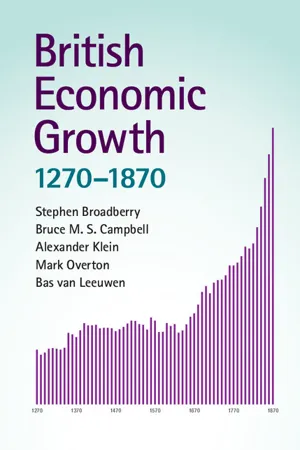 eBook - PDF
- Stephen Broadberry, Bruce M. S. Campbell, Alexander Klein, Mark Overton, Bas van Leeuwen(Authors)
- 2015(Publication Date)
- Cambridge University Press(Publisher)
In contrast to the post-Renaissance stagnation and decline experienced by Italy (Malanima: 2011), Britain belonged to an elite club of north- west European countries whose economies displayed considerable dynamism and growth from the sixteenth century to the point in the nineteenth century when modern economic growth began. 370 part ii analysing economic growth 10 Britain in an international context 10.1 introduction How does Britain’s experience of long-run economic growth and devel- opment, as revealed by the output-based estimation of GDP per head set out in Part I of this book, compare with that of other countries? Maddison’s (2010) historical national income estimates show that by the middle of the nineteenth century Britain had become the most developed economy in the world, with higher output per head than any other country in Europe, Asia or the Americas. A majority of its population lived in towns, agriculture contributed less than a quarter of employment and a fifth of value-added output, after centuries of mercantilism it was trading across the world under the banner of free trade, and the value of that international commerce accounted for a fifth of national income and was rising. Demographic and economic growth were proceeding in tandem and thereby fulfilling one of Kuznets’s (1966) key requirements of modern economic growth. Contrary to Malthus’s gloomiest predictions, the population was not only growing but it was becoming richer. The Great Exhibition of 1851, conceived to make clear to the world Great Britain’s role as industrial leader, could not have been better timed. Eight centuries earlier, when William of Normandy had cast his covetous eyes upon the Crown of England, the country had been less a land of plenty than a kingdom with plenty of land. eBook - PDF
The Forces of Economic Growth
A Time Series Perspective
- Alfred Greiner, Willi Semmler, Gang Gong(Authors)
- 2016(Publication Date)
- Princeton University Press(Publisher)
C H A P T E R 1 Economic Growth in Historical Perspective 1.1 HISTORICAL PERSPECTIVE Over the past two hundred years, countries have varied widely in their patterns of economic growth. In the nineteenth century, the United Kingdom was the leading industrialized country, with Germany and France catching up, and then the United States leapfrogged the European countries around the turn of the century. In the period after World War II, per capita income in Japan and Germany increased dramatically. Out of these spurts of growth emerges a long-term historical trend: the United States and other countries that now belong to the Organization for Economic Cooperation and Development (OECD) have seen a persistent increase in per capita income of roughly 2 percent per annum over the last century. Yet during the same period, other countries have continued to languish in poverty. This marked difference in economic performance is not accidental, for in some countries major forces of growth were set in motion that were lacking in other countries. The problem of economic growth has been studied for as long as eco- nomics has been a recognizable discipline. In the eighteenth century, Adam Smith (1976) saw that the forces of growth were released by freeing market agents from external restrictions. He predicted that the increasing size of markets, as well as increasing returns and externalities due to a rising division of labor, would spur development. Early in the nineteenth century, David Ricardo (1951) emphasized investment in machinery as a cause of the increase in per capita income. Karl Marx (1967), following Ricardo, also saw investment in machinery and capital accumulation as major sources of growth. John Stuart Mill (1900), by contrast, empha- sized education and the sciences as engines of growth. All of the classical authors understood that economic activity, carried out by private agents in markets, must be complemented by social and public infrastructure. eBook - PDF
Making History Now and Then
Discoveries, Controversies and Explorations
- D. Cannadine(Author)
- 2008(Publication Date)
- Palgrave Macmillan(Publisher)
4 Economy: The Growth and Fluctuations of the Industrial Revolution 1 Throughout the twentieth century, Britain was engaged in a dialogue with what increasingly came to seem the much greater, more confident Victorian era; and while one of these many past-and-present national conversations was about the history of parliament, another of them, which began considerably earlier, concerned the causes, the nature, the consequences, the meaning and the moral status of those events, inventions, transforma- tions and developments which took place during the late eighteenth- and early nineteenth-century economy, and which from the 1840s became known as ‘the Industrial Revolution’. For as the British economy evolved and changed, declined and fell, survived and adapted, between 1900 and 2000, it did so against a historical background of earlier industrial prowess and global supremacy that was being constantly re-interpreted, re- evaluated and re-assessed, both by public commentators and, increasingly, by academics, who were economists, historians and economic historians. 2 As such, they had agendas and interests which were partly determined by the internal imperatives and academic dynamics of their own professions or sub-specialisms. But those agendas and interests were also externally influenced by the changing circumstances and contemporary conditions of Britain’s twentieth-century economic performance and, on occasions, by the performance of the global economy as a whole. The result was that in every generation, one particular interpretation of the British Industrial Revolution was both more pervasive and more resonant than any other, not only within universities, but also in the broader public realm of punditry and policy making. 83
Index pages curate the most relevant extracts from our library of academic textbooks. They’ve been created using an in-house natural language model (NLM), each adding context and meaning to key research topics.

