History

Byzantine Empire
The Byzantine Empire, also known as the Eastern Roman Empire, was a continuation of the Roman Empire in the eastern Mediterranean. It was a powerful civilization that preserved and transmitted classical Greek and Roman knowledge, art, and culture. The empire's capital, Constantinople, was a center of trade, wealth, and intellectual pursuits for over a thousand years.
Written by Perlego with AI-assistance
Related key terms
1 of 5
10 Key excerpts on "Byzantine Empire"
 eBook - ePub
Daily Life of Women
An Encyclopedia from Ancient Times to the Present [3 volumes]
- Colleen Boyett, H. Micheal Tarver, Mildred Diane Gleason, Colleen Boyett, H. Micheal Tarver, Mildred Diane Gleason(Authors)
- 2020(Publication Date)
- Greenwood(Publisher)
The Byzantine Empire INTRODUCTION Byzantine history is a continuation of Roman history. The empire that we refer to as “Byzantine” today was called “Roman” by those who ruled and inhabited it. Roman political, social, and cultural institutions remained at work in the Byzantine Empire down to its fall in the fifteenth century. In the seventeenth century, scholars in the West began to refer to the period of Roman history after Constantine as something different, designating this “Byzantine,” a reference to Byzantion (Latin, Byzantium), which was the classical predecessor of Constantinople and often a synonym for it. This terminology was influenced by a well-established Western, anti-Byzantine bias, whose roots were in the medieval period, that viewed the West as superior. This terminology was useful in the attempt of these scholars to distance Byzantium from this Western heritage. Fortunately, historical study today has moved beyond medieval and early modern biases to recognize connections and continuities, something already apparent to astute observers in the past. The great eighteenth-century British historian Edward Gibbon, in his classic study, The Decline and Fall of the Roman Empire, told the story of the Roman Empire from its high point in the second century CE down to the fall of Constantinople in 1453. He well understood that this was all Roman history. Yet, the terms “Byzantine” and “Byzantium” have since generally been adopted by modern historians to denote the Christian empire that existed from the fourth to the fifteenth centuries CE in contrast to the pagan Roman Empire that preceded it. Still, it must be noted that the inhabitants of the Byzantine Empire always called themselves Rhomaioi, the Greek word for “Romans,” and even the Ottoman Turks called their Orthodox Christian subjects by the name that they called themselves, “Rum” (or “Roman”), until the early twentieth century eBook - ePub
Events That Formed the Modern World
From the European Renaissance through the War on Terror [5 volumes]
- Frank W. Thackeray, John E. Findling, Frank W. Thackeray, John E. Findling(Authors)
- 2012(Publication Date)
- ABC-CLIO(Publisher)
8 The Fall of Constantinople, 1453
Introduction
By 1453, the Byzantine Empire had shrunk to a mere shadow of its former self. It had dwindled to little more than its capital city—the wealthy and sophisticated Constantinople—and its environs. However, it had not always been like this. The Byzantine Empire, sometimes referred to as the Eastern Roman Empire, was the direct lineal heir of antiquity’s fabled Roman Empire. For centuries it had continued many of the Roman Empire’s traditions in a cosmopolitan, prosperous, energetic atmosphere. The Byzantine Empire at its height included most of the Balkans and Asia Minor (Anatolia), and it dominated the eastern Mediterranean Sea. Constantinople, named after the famous Roman emperor Constantine, sat astride several of the world’s great commercial routes. From its location on the western shore of the Bosporus (the narrow strait along with the Sea of Marmara and the Dardanelles that separates Europe from Asia), Constantinople handled trade from China and the Far East, the Middle East, western Europe, Egypt, and Russia.In the thousand years before its fall, the Byzantine Empire had experienced several periods of decline followed by recovery. One of these periodic recoveries occurred under the auspices of a ruling dynasty called the Macedonians (867–1081). However, as the Macedonian dynasty grew weak, several problems arose that in the long run proved fatal to the empire. In the Balkans, indigenous people such as the Bulgars and the Serbs resisted Byzantine overlordship. At the same time, the empire’s economic and military base also deteriorated. By the eleventh century, large, aristocratic estates were absorbing the free Anatolian peasantry (who provided the manpower for the empire’s army and the taxes for its treasury) and turning these peasants into serfs. Furthermore, energetic Italian city-states such as Genoa and, especially, Venice began to chip away at the Byzantine Empire’s commercial domination of the eastern Mediterranean. Trade concessions followed, and a weakened empire even devalued its currency for the first time in centuries. eBook - PDF
The Sacred Architecture of Byzantium
Art, Liturgy and Symbolism in Early Christian Churches
- Nicholas N. Patricios(Author)
- 2014(Publication Date)
- I.B. Tauris(Publisher)
The term ‘Byzantine’ is recent, coined in the sixteenth century but only came into general use in the nineteenth century. Nowadays it is generally accepted that the terms Byzantine or Byzantium are used to designate the architecture, art, religion and other features of the Eastern Roman Empire from the fourth to the fifteenth century. The Eastern Roman or Byzantine Empire as it was also known was Christian, from about the fifth century Eastern Orthodox in form, and essentially Greek-speaking. In contrast the Western Roman Empire was Latin and Catholic in religion. While modern authors label the people of the Eastern Roman Empire ‘Byzantines’ 1. Constantine Augustus. Head of the emperor in the courtyard of the Palazzo dei Conservatori, Rome 2 THE SACRED ARCHITECTURE OF BYZANTIUM 2. The Byzantine world under Justinian I in the sixth century 3. Byzantine Empire territory before and after Justinian I CHURCH AND STATE 3 the inhabitants and most of their neighbours understood themselves as Romäoi (‘Romans’) and their Empire as Romania. As the East became more Greek, Emperor Herakleios (r. 610-641) adopted the title Vasiléos (Basileus) and thereafter each Byzantine Emperor regarded himself as a Vasiléos Romanós (‘Roman Emperor’). Although Emperor Theodosius separated the former unified Roman Empire into halves, at the end of the fourth century each half shared a common world view, at least initially. This changed when barbarian invasions began to conquer the Western Roman Empire. According to Edward Gibbon’s influential work The Decline and Fall of the Roman Empire, published in five volumes between 1776 and 1787, the West succumbed to ‘barbarism and religion’, declined and ceased to exist after 476. His view of the waning of the West as well as his dismissal of the Byzantine civilization in the East Empire has largely prevailed.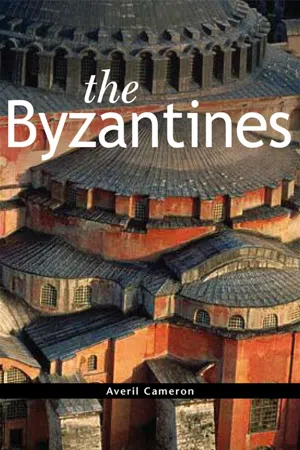 eBook - PDF
- Averil Cameron(Author)
- 2009(Publication Date)
- Wiley-Blackwell(Publisher)
No single definition or characterization of Byzantium or the Byzantines could do justice to all of this, and part of the aim of this book is to draw attention to the sheer pace of historical change. Attitudes to Byzantium Why study Byzantium? Even now, to most Europeans, apart from Greeks and others of the Eastern Orthodox tradition, the very word, Byzantium, suggests something exotic and (probably) bureaucratic and even corrupt. According to the Oxford English Reference Dictionary , the term ‘Byzantine’ denotes something that is ‘a) extremely complicated, b) inflexible, or c) carried on by underhand means’. An anthropological work about the Nupe of Nigeria based on field work done in the 1930s used the title A Black Byzantium , apparently to denote hierarchy, social stratification and complexity. 1 To describe oneself in ordinary conver-sation as a Byzantine historian provokes incomprehension or disbelief. In the western European popular consciousness mention of Byzantium attracts two main responses: either it is still thought of as irrelevant and backward, the precursor of the Ottoman Empire and somehow implic-ated in the religious and political problems of the contemporary Balkans, or else it seems in some mysterious way powerfully attractive, 2 associ-ated as it is with icons and spirituality or with the revival of religion in post-Communist Europe. Each of these responses reveals the persistence of deep-rooted stereotypes and neither does justice to Byzantium or the Byzantines as they actually existed. There is also a great difference between the perceptions of the Byzantines held by the Orthodox and the non-Orthodox worlds, corresponding to the degree to which Byzantium does or does not belong to national histories. This presents an even greater challenge to historians than before, in view of the political changes that have taken place since the late twentieth century.
- Alexander A. Vasiliev(Author)
- 2012(Publication Date)
- University of Wisconsin Press(Publisher)
Byzantine history extends from the accession of Leo the Isaurian in 716, to the conquest of Constantinople by the Crusaders in 1204. (3) After the de- struction of the Eastern Roman Empire, Greek history diverges into many channels. The exiled Roman-Greeks of Constantinople fled to Asia and es- tablished their capital at Nicaea; they prolonged the imperial administration in some provinces on the old model and with the old names. In less than sixty years they recovered possession of Constantinople; but though the government they established retained the proud title of Roman Empire, it was only a very poor replica of even the Byzantine state. This third period Finlay called the Greek Empire of Constantinople. Its feeble existence was terminated by the Ottoman Turks when they took Constantinople in 1453. (4) When the Crusaders conquered the greater part of the Byzantine Empire, they divided their conquest with the Venetians and founded the Latin Em- pire of Romania with feudal principalities in Greece. The domination of the Latins marked the decline of Greek influence in the East and caused a rapid diminution in the wealth and numbers of the Greek nation. This period extends from the conquest of Constantinople in 1204 until the conquest of Naxos by the Ottoman Turks in 1566. (5) The conquest of Constantinople in 1204 caused the foundation of a new Greek state in the eastern provinces of the Byzantine Empire, called the Empire of Trebizond. It represents a curious episode in Greek history. Its government bore a strong resemblance to the Georgian and Armenian monarchies, indicating the influence of Asiatic rather than European manners. For two and a half centuries it exercised considerable influence, based, however, on its commercial position and resources rather than on its political strength or Greek civilization. It had little influence on the fate of Greece, and its conquest in 1461 excited little sympathy. eBook - PDF
- T. Venning, J. Harris(Authors)
- 2006(Publication Date)
- Palgrave Macmillan(Publisher)
There was not too much difficulty deciding when it was that the Byzantine Empire came to a close. The fall of Constantinople in 1453 brought the long succes- sion of Byzantine emperors to an abrupt end, although one could continue to 15 August 1461 when Trebizond, the last independent Byzantine territory, surrendered to the Ottomans. Much more problematic has been deciding when it was that Byzantine history can be said to have begun. As far as the Byzantines themselves were concerned their empire had been inau- gurated by the emperor Augustus following his victory over Mark Anthony and Cleopatra at the Battle of Actium in 31 BC. They referred to themselves as ‘Romans’ and their empire as the Roman empire. After all, a direct line of succession could be traced from Augustus to the last emperor who died defending the walls of Constan- tinople in 1453. From a more recent perspective, however, that was hardly satisfac- tory. It was only too clear that Byzantium was a body politic which was very different from the empire of Augustus. It was Christian in religion. Its capital city was Constantinople rather than Rome. Its language was Greek rather than Latin, and for most of its history it dominated a far smaller territory than that of the Roman empire at its height. To denote the difference German scholars of the nine- teenth century coined the terms ‘Byzantine Empire’ and ‘Byzantium’. Not everyone agreed with the new terminology. The English Byzantinist, J.B. Bury (1861–1927), insisted to the end in referring to the ‘East Roman Empire’. 4 In general, however, the words stuck. Yet if most scholars had now reached an agreement on a name for the empire, the problem remained of when it had begun, or rather when one could cease to speak of a Roman empire and start to discuss a Byzantine one. Several possible starting points have been proposed. eBook - PDF
The Limits of Universal Rule
Eurasian Empires Compared
- Yuri Pines, Michal Biran, Jörg Rüpke(Authors)
- 2021(Publication Date)
- Cambridge University Press(Publisher)
4 The Medieval Roman Empire of the East as a Spatial Phenomenon (300–1204 CE) Johannes Preiser-Kapeller This chapter analyses the medieval Roman Empire of the East, commonly known as the ‘Byzantine Empire’, 1 as a spatial phenomenon in the Eastern Mediterranean and beyond. A particular focus of members of the Vienna School of Byzantine Studies, entire books have been written about this subject; the fundamental long-term project Tabula imperii Byzantini (devoted to the historical geography of Byzantium) being a prime example. 2 In this chapter, I discuss some general principles of spatial organisation and perception as can be reconstructed from Byzantine sources as well as the definition and dynamics of frontiers between competing imperial formations in early medieval western Eurasia. The chronological focus is 330–1204 3 ; from the inauguration of Constantinople as new capital of the Roman Empire to the Fourth Crusade. After that time, the permanent political fragmentation of the former core sphere of the Byzantine Empire provided a very different spatial framework. 4 4.1 The Perception and Organisation of Space 4.1.1 Borders and Territories When estimates of the territorial extent of the medieval Roman Empire are plotted on a graph, a clear downwards trend is evident (Fig. 4.1), seemingly in accord with the image of Byzantium’ s history as a long and painful decline from the height of the Imperium Romanum as established by Edward Gibbon (1737–94). 5 The 1 On the terms ‘Roman’ and ‘Byzantine’ see esp. Stouraitis 2014, 175–220. Throughout the chapter, I use both terms. 2 Koder 2001; Hunger and Koder 1976–2020 (http://tib.oeaw.ac.at/). A very insightful analysis of the spatial dimensions of Byzantine history is also provided in Whittow 1996, esp. 15–37 on the strategic geography of the Near East. 3 All dates are CE unless indicated otherwise. 4 See Prinzing 1992, 129–83; Laiou 2006, 42–53; Preiser-Kapeller 2012a, 69–127. eBook - ePub
The Chief Periods of European History
Six lectures read in the University of Oxford in Trinity term, 1885
- Edward A. (Edward Augustus) Freeman(Author)
- 2015(Publication Date)
- Perlego(Publisher)
Greek to distinguish a prince or a people speaking the later shape of the tongue of Hellas from princes and people speaking the later shapes of the tongue of Latium. When we step within the range of theological controversy, our difficulties become greater still. If we keep to our elder language, the special badge of the Roman will be that he denies the authority of the Roman Church. The Roman name, as the formal name of a power, ceased only in 1453, or rather in 1461. The Roman name, as the name of a people, can hardly be said to have even now passed away. But from 800 onwards we may fairly use such distinguishing forms as “Eastern” and “Byzantine”; from 1204 onwards we can hardly help adopting the Western language of the time, and speaking of those scattered fragments of the Eastern Empire which were still held by its own people as “Greek.”The Empire of Nikaia may seem to have well proved its right to be looked on as the true successor of the old Empire by the great exploit of winning back the Imperial city. For eight hundred years we have had to deal with powers that win back oftener than with powers that can be strictly said to advance; but to win back Constantinople in the thirteenth century was to gain a richer prize than even to win back Rome in the sixth. Without Constantinople an East-Roman or Greek Empire might seem to have no position in the face of the world. In possession of Constantinople, it might seem to be brought back to something like its old place among powers and nations. Still the Empire of the Palaiologoi was but a feeble representative, a mere shadow and survival, not only of the Empire of the Macedonians, but of the Empire of the Komnênoi. For a while it was an advancing power in Europe; even when its northern frontiers had fallen back before the Bulgarian, the Servian, the Ottoman himself, it could still advance in the old Greek lands. It showed the Byzantine power of revival in its last and strangest form, when the whole of Peloponnêsos, bating the points held by Venice, was again united under a Greek prince. In those days it was something for the Roman Empire to outlive the principality of Achaia, days when the Isle of Pelops formed the main body of an Empire of which the city of Constantine was the distant head. If the last Emperor of the West took his crown at Bologna, the last Emperor of the East took his on the spot which had been Sparta. But “Emperor of the East” I should not say. That is one of the many conventional ways of describing the princes of the Eastern Rome, the use of which may sometimes help to turn a sentence. But no prince reigning at Constantinople ever called himself Emperor of the East, and there was another prince who did. In those days Empires arose and fell with speed in the Eastern world. Even before 1204, a stranger born on English soil, a Count of Poitou whom a strange chance made also King of England, had the privilege of overthrowing an Emperor of the Romans whose Empire was bounded by the isle of Cyprus. Master of that island, that old battle-field of Aryan and Semitic man, he had the wisdom to get rid of an useless possession, and to bestow it as a kingdom on a vassal of his own who had lately been King of Jerusalem. So, after the great crash of the Latin conquest, momentary Emperors had reigned in Epeiros and at Thessalonikê. But there was yet another Imperial claimant whose power, like that of him of Nikaia, was more than momentary. It should never be forgotten that the last fragment of Greek-speaking Roman power that the world saw lingered on, not in Megarian Byzantium but at Arkadian Trebizond. As the northern shore of the Euxine saw the last Greek commonwealth, so its southern shore saw the last Greek Empire. For Greek we must call it. The Komnênos at Trebizond, admitting the superiority of the Palaiologos at Constantinople, cast aside his Roman style, and called himself among other titles Emperor of the East. The West had long before heard of an Emperor of Britain and of an Emperor of the Spains; but now for the first time in the East a man was found calling himself βασιλεύς and αὐτοκράτωρ , but βασιλεύς and αὐτοκράτωρ of something else and not Ῥωμαίων . But an Emperor of the East, an Emperor of all the East, πάσης τῆς ἀνατολῆς eBook - PDF
AETOS
Studies in Honour of Cyril Mango presented to him on April 14, 1998
- Ihor Sevcenko, Irmgard Hutter, Ihor Sevcenko, Irmgard Hutter(Authors)
- 2012(Publication Date)
- De Gruyter(Publisher)
The subsequent history of the Byzantine Empire was in Toynbee's view a long-drawn-out agony, relieved only by temporary rallies, such as the one led in the late eleventh century by Alexius Comnenus. We may note, in this scenario, the almost exclusive concern with military history and the virtual absence of any discussion of social, economic, and cultural affairs. Toynbee does show at times a sensitivity to art: one can feel it in his brief but admiring reference to the mosaics of the church of the Chora (the Kariye Camii) in Constantinople, in his lengthy musings at Mistra, and even in his highly idiosyncratic remarks on the architecture of St. Sophia 16 . It is, however, a curious fact that a work whose declared intention is to study the history of human civilizations should be principally concerned with political and military history. 14 Epanagoge, tit. Ill, cap. 8, ed. C. E. Zachariae von Lingenthal, Collectio librorum juris graeco-romani ineditorum, Leipzig 1852, 68; I. and P. Zepos, Jus graecoromanum, II, Athens 1931,236-368. 15 A Study of History, III, 26-27. 16 Op. at., IV, 54-55, 359-360; X, 107-108. Toynbee and Byzantium 249 II I now come to the second theme of this paper: Toynbee's interpretation of Russia's Byzantine heritage. It is, I would argue, of more than marginal signi-ficance for our subject. For Toynbee's treatment of this theme illustrates his vision of Byzantium, the workings of his mind, and his historical method. His views on the subject are most fully expressed in a chapter entitled Russia's Byzantine heritage of his book Civilization on Trial, published in 1948. For a thousand years, he argues, the Russians have been members of the Byzantine civilization. Like its parent body, Russian culture shows a remarkable degree of continuity. Thus, for all the sweeping changes introduced by Peter the Great and Lenin, the Russia of today, i.e. the Soviet Union, still preserves some salient features of her Byzantine past. eBook - PDF
Imagining the Byzantine Past
The Perception of History in the Illustrated Manuscripts of Skylitzes and Manasses
- Elena N. Boeck(Author)
- 2015(Publication Date)
- Cambridge University Press(Publisher)
Introduction In Byzantium history was supposed to be endowed with permanence. It was expected to function as a common cultural currency with intrinsic worth and enduring value. But claims of truthful authority in Byzantine histori- cal narratives often masked anxieties about a past perverted by historians. A thirteenth-century Byzantine author, George Akropolites, expressed his worries that historians who succumbed to bias, or did not gather infor- mation from all available sources, would “distort the truth like those who tamper with or counterfeit a coin.” 1 This example both illuminates the per- ceived, tangible positivist value of history and the danger that constantly confronts it. Like a metal unit of monetary exchange it can become debased, reshaped, devalued, and even completely recast. The two medieval illustrated manuscripts analyzed in this study repre- sent the malleability of all history. The two manuscripts are sophisticated intellectual endeavors that celebrate the value of history while simultane- ously undermining its narrative permanence. They testify to the enduring and far-reaching importance of the Byzantine Empire in shaping political discourses far beyond its borders, but they actively contest key aspects of Byzantine historical memory. Neither accepts Byzantine historiography at face value. For both it is merely a precious ore for fashioning new specie, creating new value, and recasting messages that Byzantines would consider counterfeit. Both in their distinct ways recast the Byzantine model of empire into new molds. This book is the first comparative, cross-cultural study of medieval illus- trated histories that engage in a direct dialogue with Byzantine historical memory and construction of the past. By exploring how medieval patrons and artists re-imagined and represented the past, this study significantly 1 George Akropolites, Georgii Acropolitae opera, ed. A. Heisenberg I (Stuttgart: Teubner, 1978), 1.16–18.
Index pages curate the most relevant extracts from our library of academic textbooks. They’ve been created using an in-house natural language model (NLM), each adding context and meaning to key research topics.

