History

Eastern Orthodox Church
The Eastern Orthodox Church is one of the oldest Christian traditions, tracing its roots back to the early Christian church. It is characterized by its rich liturgical worship, emphasis on tradition and apostolic succession, and its decentralized structure with multiple autocephalous (self-governing) churches. The church has had a significant impact on the history, culture, and spirituality of Eastern Europe and the Middle East.
Written by Perlego with AI-assistance
Related key terms
1 of 5
11 Key excerpts on "Eastern Orthodox Church"
 eBook - PDF
- Edward Jabra Jurji(Author)
- 2015(Publication Date)
- Princeton University Press(Publisher)
Yet we can hardly answer them unless we have some notion of the main spiritual and historical issues of Eastern Orthodoxy in general. THE NAME OF THE CHURCH The names of the Eastern Church vary in different official and unofficial documents: "The Orthodox Catholic and Apos- tolic Church of the East," "The Orthodox Eastern Church," "The Eastern Church," "The Orthodox Church." In recent times, the theologians of the East have spoken simply of "Orth- odoxy" or of the "Orthodox Church." The term "Orthodoxy" means to them more than right dogma or doctrine; it means the totality of right worship, right confession, and the undis- rupted continuity of hierarchy and sacramental communion originating in the apostolic church and going down to the present. The word "Eastern" does not designate any local or geographic boundary of the Church. It indicates the glorious memory of Second Rome, Constantinople, which in the mind of Eastern Christians succeeded the Rome of St. Peter and St. Paul, and became the mother of Orthodoxy and apostolic tradi- tion. After 381 the bishop of Constantinople was granted an 285 EASTERN ORTHODOXY honor second only to the bishop of Rome, and the Eastern Church has never questioned the primacy of honor due to the Roman bishop. However, the head of the Roman Church for- feited his privileges and honors by violating the dogmatic tra- dition and by claiming a jurisdictional and doctrinal supremacy which contradicts, in the judgment of Eastern Christians, the very spirit and freedom of the apostolic Church. The primacy of the bishop of Constantinople is purely historical and sym- bolic without any jurisdictional implications. After the fall of Constantinople in 1453, t n e Russian Ortho- dox Church became increasingly aware of her actual leadership within the area of Eastern Christianity. Her intellectual repre- sentatives developed a philosophy of history in which Moscow appeared as Third Rome, being a legitimate heir both of Rome and Constantinople. eBook - PDF
The Changing World of Christianity
The Global History of a Borderless Religion
- Dyron Daughrity(Author)
- 2011(Publication Date)
• C H A P T E R T H R E E • EASTERN EUROPEAN CHRISTIANITY hristianity has been in Eastern Europe since the days of the apostles. According to the Bible, the apostle Paul traveled to Greece and Cy-prus. The Eastern Orthodox tradition claims that the apostle Andrew traveled to the Ukraine in the 50s AD and tried to evangelize the region. There is a legend that Andrew proclaimed one day Kiev would be a great Christian city, which indeed occurred in the year 988, drastically changing the religious landscape of this massive swath of territory known to us as Eastern Europe. The year 988 is generally known as the beginning of the “conversion of the Slavs.” Of the eight regions of the world as defined in this book, Eastern Europe is the only place where the majority of the Christians are from the Orthodox traditions. Around 67% of Eastern European Christians are from the Ortho-dox families of churches. This percentage is far higher than anywhere else in the world. Middle Eastern Christians are 29% Orthodox. African Christianity is 10% Orthodox. The remaining five regions of the world have only tiny Or-thodox communities, comprising 3% or less of the Christian population in those regions. Thus, a study of Eastern European Christianity is, more than anywhere else, a study of Orthodoxy. In many ways, Eastern European Chris-tianity is a testament to the power and influence of the once-mighty Byzantine Empire, which lasted from 330 to 1453. When investigating Eastern European Christianity, this Byzantine legacy should be kept in mind. What Is Eastern Europe? Defining cultural blocks is a challenge, especially when it comes to Europe and Asia. Some scholars prefer to use the term Eurasia to encompass the three cul-tural regions of Western Europe, Eastern Europe, and Asia.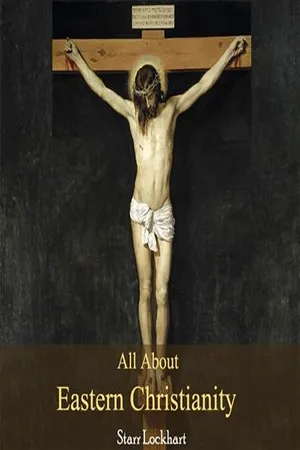 No longer available |Learn more
- (Author)
- 2014(Publication Date)
- University Publications(Publisher)
Nonetheless, they remain Orthodox in their faith and practice. Virtually all the Orthodox cultures – Arabic, Greek, Georgian, Russian, Serbian, Macedonian, Albanian, Ukrainian, Romanian, Bulgarian – are represented in the United States. There are also many converts to Orthodoxy of all conceivable ethnic backgrounds. In fact nearly half of the clergy of the Orthodox Church in America and Antiochian Orthodox Christian Archdiocese of North America are of a convert background. Orthodox missions are alive and well in the United States, Canada, and Mexico seeing a growth instead of a decline as in most other churches today. Relations with other Christians Orthodoxy represents the majority of Eastern Christianity. The Orthodox trace their bishops back to the apostles through apostolic succession, venerate saints, especially Mary the Mother of God as the Theotokos, pray for the dead, and continue the ancient Christian practice of monasticism. Some, if not all, of these practices are rejected by the majority of Protestant groups, although they are partly retained in some of the earliest liturgical Protestant movements, such as the original German form of Lutheranism. They are also retained by some within the Anglican tradition as Anglicanism is generally considered to be a via media (middle way) between the Roman Catholic and Protestant traditions. Orthodoxy does not openly promote statuary, although it is not expressly condemned, instead limiting itself primarily to two-dimensional iconography. The Western theological concepts of original sin, predestination, purgatory, and particular judgment have had far less influence in Orthodoxy and are generally rejected by traditional Orthodox theologians. The Orthodox understand themselves to be the One Holy Catholic and Apostolic Church; the true Church established by Jesus Christ and placed into the care of the apostles.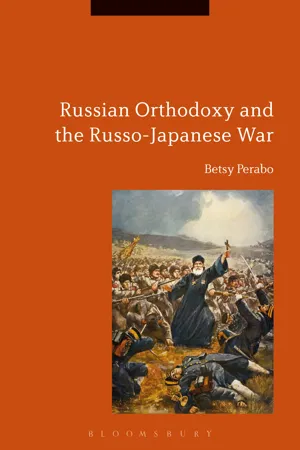 eBook - PDF
- Betsy Perabo(Author)
- 2017(Publication Date)
- Bloomsbury Academic(Publisher)
That is, they considered at what point allegiance to the state required idolatry or became a form of idolatry. This question would later be answered differently by Orthodox, Protestant, and Roman Catholic Christians. Orthodoxy and Divided Christianity It is impossible to provide an objective account of the historical divisions within Christianity—the movements, developments, rebellions, and reforms that have led to the formation of different Christian institutions and groups. It is not simply that some facts are lacking but that the facts that are known lend themselves to many different interpretations and take on more or less significance depending upon the narrative framework of the storyteller. Here I will sketch in very rough form the stories told by Roman Catholics, Protestants, and Orthodox Christians. In the West, the form of Christianity practiced by Russians is often referred to as Eastern Orthodoxy, but the Orthodox themselves do not use the term “Eastern.” Russians practice what they call Pravoslavie. This word is the transla-tion of the Greek word “Orthodox,” which contains two roots: ortho , “correct,” and dox , “belief.” The root dox also connotes glorification or worship, so that the word Orthodox means both “right worship” as well as “right belief.” 7 In Russian, 18 Russian Orthodoxy and the Russo-Japanese War 18 pravo , meaning “true” or “right,” maps well onto ortho . The root slav empha-sizes the “worship” or “glorification” element of dox ; it does not elsewhere mean “belief.” It also carries echoes of the ethnic term “Slavic.” The terms Eastern Orthodoxy and Pravoslavie highlight the different concep-tions of the ways in which Christianity is divided. There are Christians in the East and Christians in the West; and, in the eyes of most believers, there are correct and incorrect ways of being Christian: correct and incorrect beliefs and correct and incorrect practices. eBook - ePub
- George D. Chryssides, Margaret Z. Wilkins(Authors)
- 2014(Publication Date)
- Routledge(Publisher)
10 Eastern OrthodoxyTo many people mention of Orthodoxy conjures up pictures of something foreign and exotic: a white-washed monastery on a Greek island or the onion-shaped domes of Saint Basil’s Cathedral in Moscow, towering over Red Square. But in the course of the twentieth century a whole variety of Orthodox communities took root both in Britain and the United States, first as a result of emigration from traditionally Orthodox countries and more recently as a consequence of increasing interest in the distinctive forms of faith and practice developed in the eastern half of the Christian world.Orthodox Worship
The interior of an Orthodox church may look unfamiliar to those who are more familiar with Western Christianity. The first thing that will probably strike the visitor is the iconostasis—the screen that divides the sanctuary from the main body of the church. Raised up a little above the level of the rest of the interior, with a double door or gate in the middle and smaller ones on either side, and covered with ranks of icons, it dominates the building. Behind it stands the altar, which for most of the time is concealed from view by the closed doors of the iconostasis. There are usually no pews, though some churches may have chairs. Russian and other Eastern European churches are more likely to have nothing but a bench or a few chairs against a wall for those who are unable to stand the whole time.The experience of Orthodox worship, too, is likely to feel unfamiliar to a Western Christian. Anyone who attends the Sunday liturgy in an Orthodox church will probably find that there is already a service going on when they arrive, as Matins is celebrated before the eucharistic liturgy begins. People come in gradually, not at any fixed time. Worshippers are free to move around, perhaps to pray or light a candle before one of the icons on stands that one finds as one enters the church. It is quite acceptable to slip into the church quietly and out again, and this can be done without causing any distraction. Even where there are chairs, which is common in Greek churches, sitting and standing during worship are not as tidily regimented as they tend to be in Western Christianity. Formality and informality, though, work in different ways in Orthodox churches; while it is perfectly acceptable to move around quietly, it is not considered appropriate to sit with one’s legs crossed or stand with one’s hands behind one’s back. Worshippers cross themselves frequently during the service (but from right to left, not left to right as in the West).
- Ken Parry(Author)
- 2008(Publication Date)
- Wiley-Blackwell(Publisher)
Naturally, for some western-ers coming to Orthodoxy this can be an attractive alternative to an overemphasis on individual guilt and responsibility. Nor did it inherit a tradition distinguishing the realm of history from that of God, such as that inaugurated by Augustine’s Civitas Dei . On the contrary, because of its privileged position in the fourth, fifth and sixth centuries, when Christian dogma was formulated, it retained a triumphalist and imperial understanding of history, with the basileia of the Christian emperor in time as the visible symbol of the eternal kingdom of God. Eastern theology removes a sense of time from humanity, by elaborating concepts of eternity and the beyond ( epekeina ) in exactly the same way as the imperial polity perceived itself when Constantinople was established, as the Christian capital of an eternal Christian empire. GREEK CHRISTIANITY AFTER 1453 179 Liturgically, the Orthodox Church has maintained the Scholastic doctrine of the liturgy ex opere operato ( ex ergou ergasmenou ), which has led to the ritual becoming autonomous, without any reference to the individual, the faith of the participants or the actual meaning of words. The doctrine ex opere operato led to the conspicuous the-atricality of the liturgy and the self-dramatization of its language. The ornate polysyl-labic words of a sacramental Greek language were always treated as sacred objects in themselves, thus creating an auto-suggestive mechanism that de-materialized circum-stances and abstracted people from their very reality. In the Orthodox liturgy with its doxological and adulational character we can detect the birthplace of the atemporal, ahistorical and immaterial universe that has been conceptually elaborated by almost the totality of Greek theology. As Yannaras has stated, Orthodox theology is based on the concept of ‘good, very good indeed’ (Gen. 1: 31). Such a theological approach hindered Orthodox believers from internalizing their own history.
- Arthur Stanley(Author)
- 2003(Publication Date)
- Gorgias Press(Publisher)
70 The Epochs of lay it out, as in the West, by regular chronological periods. The second epoch of universal importance in Eastern Christen-dom, is the birth and growth of Mahometanism. All great religious movements, which run parallel, even though counter, to Christianity, form a necessary part of ecclesiastical history. But the religion of Mahomet is essentially interwoven with the Eastern Church. Even without considering the directly Christian influences to which the Arabian teacher was sub-jected, no one can doubt that there are points which his system, in common with that of the Eastern Church, owes to its Oriental origin. In other points it is a rebound and reaction against that Church. The history of the Greek and Sclavonic races can only be understood by bearing in mind their constant conflict with the Arabs, the Tartars, and the Turks. 1 3. The conversion and establishment of the Russian Church, and through the Russian Church of the Russian Empire, forms the third and most fertile epoch of the history of Oriental Christendom. It is enough to indicate the successive stages in the growth of the Empire, the rise and fall of the Patriarchate, the tragical struggle of Alexis and Nicon, the singular develop-ment of Russian dissent, the career and character of Peter the Great, hardly less remarkable in its religious than in its civil aspect. Every one of these events teems with dramatic, some with European interest, and every one of them is bound up with the history of the national Church, and therefore with the history of Eastern Christianity. 2 III. These, then, are the principal divisions of the history, properly so called.
- Alexander Hore(Author)
- 2003(Publication Date)
- Gorgias Press(Publisher)
From that time the fate of Constantinople was certain. It was the Fourth Crusade and the action of Pope Inno-cent III. that led to its sacking by the Turks in 1453, the destruction of the Eastern Empire, and the down-fall of the Greek Church. And since the days of Ma-homet II., not the Turks alone, but, shame to say, Western Christendom also, have been its persistent enemies. The existence of the Greek Church to the present day is alone a proof of its divine origin. The wonder is, not that it should have fallen so low, but that, afflicted on every side, oppressed by schism from within and cruel persecution from without, it should so nobly have struggled on; many of its members no doubt succumbed in the unequal contest ; but the way in which the Orthodox Church has weathered the storm and adhered to its faith and Liturgy is little short of a miracle. T h e Greek rite, says the Rev. W. Palmer®, who afterwards joined the Church of Rome, i s like a plant which though covered with dust, and somewhat shrunk, has preserved its original shape and proportions, whereas the Latin is so changed that it is like a new building con-structed in part out of the ruins of the old. T h e Holy and Orthodox Eastern Church glories in the Lord over the long and terrible persecutions and conflicts of martyrdom ; the Heavenly Bridegroom having pitied and loved, did not deprive it of the bright mystic candlestick and of all the c Dissertations on the Orthodox Communion. General View of the Orthodox Greek Church. 7 perfect and unsullied treasure of the Apostolic and God-delivered faith d . The conversion of Russia by the Greek Church is the mightiest conquest the Christian Church has ever made since the time of the Apostles, and the future of that Church is a problem which it would be difficult to solve. eBook - PDF
The Ecumenical Movement
An Introductory History
- Thomas E. FitzGerald(Author)
- 2004(Publication Date)
- Praeger(Publisher)
These difficulties have arisen chiefly over the revival of Eastern Catholic Churches in Central and East- ern Europe as well as by Protestant missions, which were perceived often as proselytism. At the same time, many Orthodox have called into ques- tion the direction, programs, and ethos of the World Council of Churches and some other ecumenical bodies. Concerns and Contributions of the Orthodox Church 163 Despite these recent tensions, the Orthodox contribution to the theolog- ical discussions of the ecumenical movement has been considerable throughout the twentieth century. With distinctive theological perspec- tives, the Orthodox have made a major contribution to the discussions on church unity as well as to the broader issues of Christian life and thought today. In responding to the challenge to heal the wounds of Christian divi- sions, the Orthodox have also provided profound insights into the funda- mental affirmations of the Christian faith. The insights of Orthodox theology in some cases have challenged the theological perspectives of both the Roman Catholic Church and the Protestant churches, which are so influenced by the Reformation and Counter-Reformation debates as well as by the Enlightenment. In other cases, the insights of Orthodox the- ology have enabled Roman Catholics and Protestants to reappropriate valuable perspectives on the Christian faith, which are part of their own heritage but were underappreciated in recent centuries. NOTES 1. "Decision of the Third Pre-Conciliar Pan-Orthodox Conference (November 6,1986)/' in Orthodox Vision of Ecumenism, ed. Gennadios Limouris (Geneva: WCC Publication, 1994), p. 112. 2. J.M. Hussey, The Orthodox Church in the Byzantine Empire (Oxford: Claren- don Press, 1986), pp. 220-94; John Meyendorff, Byzantine Theology (New York: Fordham University Press, 1974), pp. eBook - PDF
A Storm of Images
Iconoclasm and Religious Reformation in the Byzantine World
- Philip Jenkins(Author)
- 2023(Publication Date)
- Baylor University Press(Publisher)
These screens are lavishly decorated with images, sometimes rising in multiple layers from floor to ceiling: literally, this is the “icon-stand.” These pictures are seen by every faithful believer attending a liturgy and taking Communion, at which moment they are symbolically surrounded by so many saints and martyrs, part of the heav- enly cloud of witnesses. 15 Legacies: East and West | 189 The New Orthodox World From the mid-ninth century, the prestige of the restored empire con- tributed to the spread of Christianity in its distinctive eastern and Byz- antine forms, a trend with vast consequences for the later history of Christianity. That Eastern Christianity, that Orthodoxy, spread inexo- rably through much of Slavic Europe, which it would not conceivably have done if the Roman state was viewed as a flailing statelet constantly on the verge of conquest by stronger neighbors. Material strength con- tributed to spiritual prestige. In the 850s the king of the powerful realm of Great Moravia accepted missionaries, including the monks Cyril and Methodios. This decision was partly intended to ensure Moravian inde- pendence from the powerful Germanic and Frankish empires of the West, but the consequences were far reaching. At that point, the king- dom stretched over lands we would later know as the Czech Republic, Slovakia, Hungary, and southern Poland. Cyril became famous as the inventor of the Cyrillic script, which was based on Greek but suitably adapted to express Slavic languages. 16 In the following decade, the Bulgarian khan Boris accepted Chris- tianity. Of itself, such a choice implied no kind of submission to Byz- antine authority, but that eastern orientation would be critical for later cultural history. Nor was it the only outcome that might have occurred. Like the Moravians, the Bulgarians had many diplomatic ties to the Franks, and a Catholic conversion and western orientation would have been quite imaginable.
- Adrian Fortescue(Author)
- 2001(Publication Date)
- Gorgias Press(Publisher)
The English Non-jurors made equally futile proposals. But of late years especially the Orthodox authorities have been very friendly towards Anglicans, who alone do not try to proselytize in the East. On the other hand, the belief that they are the whole Church held by the Easterns seems to make any hope of cor-porate reunion between them and Anglicans impossible. Cyril Lukaris of Alexandria and Constantinople caused the greatest trouble during this period. He was a Protestantizer who wrote a purely Calvinist Confession. After the Sultan had killed him four councils, of which the most important was that at Jerusalem in 1672 under Dositheos, condemned his heresies. P A R T I V THE ORTHODOX CHURCH AT THE PRESENT DAY THIS last part is to contain some account of what is a tangled subject, the present state of the Orthodox Church. In the first place we must distinguish three great groups of Eastern Christians : (i) the Orthodox Churches in communion with the Patriarch of Constantinople, (2) the other schismatical Churches, that is, the four Monophysite bodies, Armenians, Jacobites, Copts, and A byssinians, and the one Nestorian body, all of whom are out of communion with either Pope or (Ecumenical Patriarch, (3) the people who in order of honour should come first, the Uniates, Christians of Eastern rites, who are in communion with the Holy See, and who, of course, are just as much Catholics as we are. It is important to remember the difference between groups 1 and 2 above. Group 1 (the Orthodox) con-sists of sixteen Churches, all independent, but all in union with one another (except for one schism now going on). Group 2 (the non-Orthodox) has nothing whatever to do with those sixteen Churches. Thus we speak of the Church of Russia, of Greece, of Armenia; but we must remember that the Churches of Russia and Greece are in full communion with one another, whereas the Armenians are to them as much heretics and schis-matics as Latins or Protestants.
Index pages curate the most relevant extracts from our library of academic textbooks. They’ve been created using an in-house natural language model (NLM), each adding context and meaning to key research topics.

