History

The Spread of Christianity
The spread of Christianity refers to the expansion of the Christian religion from its origins in the Middle East to become a global faith. This process involved missionary activities, the conversion of rulers and populations, and the establishment of churches and religious institutions. The spread of Christianity had significant cultural, social, and political impacts, shaping the history of many regions around the world.
Written by Perlego with AI-assistance
Related key terms
1 of 5
8 Key excerpts on "The Spread of Christianity"
 eBook - PDF
The Lopsided Spread of Christianity
Toward an Understanding of the Diffusion of Religions
- Robert L. Montgomery(Author)
- 2001(Publication Date)
- Praeger(Publisher)
I am considering the spread of Chris- tianity from its beginning so that by the year 1500, when the modern era of Western expansion began, the lopsided spread of Christianity became evident. Actually, Christianity had spread to all the areas east of Jerusalem that are under consideration by 1000, the same period in which it spread throughout Europe. However, events in China in the thirteenth century and the diffusion of Islam reversed or froze the dif- fusion of Christianity. The terms for the five stages of diffusion (knowledge, persuasion, deci- sion, implementation, confirmation) are somewhat arbitrary, and others might be substituted and perhaps added, especially for the spread of religions. However, although diffusion researchers have used them pri- marily in the examination of the spread of technologies, the terms point to a similar process in the diffusion of religions and ideologies. The first three stages of knowledge, persuasion, and decision are fairly self-evident and fit well with terms applied to religions. They draw attention to the fact that preliminary knowledge or knowledge before decision may be fairly superficial and apply simply to knowledge of religious names and terms. The decision to identify with a religious community through par- ticipation (after persuasion) brings, of course, a new level of knowledge. Persuasion brings to mind various means of inducement, especially to those who do not share convictions with people in a spreading religion or who do not have any religious convictions. I am assuming that all religions offer rewards that are both tangible and intangible and that people can be persuaded that any single set of rewards warrants a deci- sion to become identified with a particular religion. I took implementation to be various activities that take place when a religious community becomes established, such as organization, build- ing, educational efforts, and, especially, development of literature. eBook - ePub
Advanced Missiology
How to Study Missions in Credible and Useful Ways
- Kenneth Nehrbass(Author)
- 2021(Publication Date)
- Cascade Books(Publisher)
178 theorized that the expansion was possible because early Christian society offered more tangible benefits than the Greco-Roman world did.On the other hand, historians have had to explain why Christians since the first century experienced persecutions and martyrdom. “Their enemies patently trifled with the truth when they referred to the Christians as ‘imbeciles’ (Lucian), ‘god-forsaken fools’ (Celsus), and haters of the human race’ (Tacitus) . . . The Christians were generally despised, often hated, by the people among whom they lived. They were accused of being atheists, immoral and unpatriotic.”179The Spread of Christianity beyond the Near East was also a chief question for Moore.180 More recently the question of how Christianity became a world religion was taken up by Robert.181 And Montgomery has specifically applied Diffusion Theory from the social sciences to understand the “lopsided” expansion of Christianity throughout history.182Other histories of missions focus on how the gospel spread in a specific region. Examples include Robinson’s study of the Christianization of Europe,183 or Addison’s research on the conversion of Northern Europe during the Middle Ages.184 The earliest and most prevalent explanation for The Spread of Christianity has been the sovereign will of God.Following “Providential Guidance” Throughout HistoryBefore the Enlightenment, church history was aimed at showing the continuity and sovereignty of God over time. “History (or at least chronicle) was written not critically, but inspirationally; and in a cosmos perceived as a battleground between God and the Enemy, only one side of the story was worth the telling.”185 eBook - ePub
Christians and Muslims
From Double Standards to Mutual Understanding
- Hugh Goddard(Author)
- 2003(Publication Date)
- Routledge(Publisher)
Since the end of the Second World War most parts of the globe which had previously been under European control achieved their political independence, and the heyday of European imperialism thus came to an end. This did not mean, however, that the spread of the Christian church, allied as it had sometimes been with European political influence and control, came to an end. Rather, in many parts of the world at least, that process has accelerated as the Christian church became indigenised and identified itself more fully with local culture and life.The Christian church in this period has thus witnessed spectacular growth in Africa, and also in some parts of Asia. In the latter, for example, there has for some centuries been one nation in which the majority of the population is Christian, namely the Philippines, whose name derives from that of the Spanish king Philip II, but now there is a second nation in which it seems that Christians may shortly make up the majority of the population, namely South Korea. This development may be explained in part by the particular political circumstances arising from the legacy of the Korean War and the Cold War era, but it is one clear piece of evidence for the assertion that the dismantling of European empires has not resulted in the end of the process of Christian expansion. In addition the emergence of flourishing local traditions of Christian thought testify to the vitality of Christian communities in different continents.14On the other hand, in the part of the world from which the modern expansion of the faith began, namely Western Europe, the Christian church is today witnessing a considerable decline in its influence and power. This is largely as a result of the process of secularisation which can be traced back to the Enlightenment, and certainly in terms of attendance at public worship the various churches of Western Europe have seen a spectacular decline in numbers. On the other hand, in the part of the world which since 1945/1365 has been seen as the leading power of “the West”, namely the United States, church attendance continues to flourish, to a far greater extent indeed than in the nineteenth/ thirteenth century, and the corrosive effects of secularisation are therefore less obvious and more subtle. eBook - PDF
Europäisches und Globales Christentum / European and Global Christianity
Herausforderungen und Transformationen im 20. Jahrhundert / Challenges and Transformations in the 20th Century
- Katharina Kunter, Jens Holger Schjoerring, Katharina Kunter, Jens Holger Schjoerring, Jens Holger Schjørring(Authors)
- 2011(Publication Date)
- Vandenhoeck & Ruprecht(Publisher)
Or, to use another comparison: By now we have some quite useful overview maps for the history of Christianity of different regions, together with sometimes excellent city plans. Some are highly topical. Others, however, are sketchy and outdated and merely showing the path to the nearest mission stations, which have been closed down long ago. 3. Europe and the global South How to deal with this situation? Various suggestions should be directed to dif- ferent persons. In any case, an increased cooperation between representatives from different disciplines and regional expertise is absolutely imperative. In order to develop global perspectives of the history od Christianity, both in teaching and in research, a first and very helpful step would be to localize cen- tral data of the traditional, usually Euro-centric Church History curriculum within the wider context of World Christianity. The map segments of the Eur- opean history of Christianity should be placed and identified on the larger over- view map of global Christianity, and interactions between the different regions examined. To discuss just one paradigm: the sixteenth century as the decisive epoch in the formation of early modern Christianity. It is characterized by two major events: the reformation movement on the one hand, with the resulting confes- sional divisions of occidental Christianity, and the Iberian overseas expansion on the other, which led to a Christian presence in numerous cultures outside Europe, where Christianity was previously unknown. Both developments have made a lasting impact on world Christianity till today. Yet only one movement, the reformation with its various ramifications, effects and counteractions, is treated in the common Church History compendia, while the other is usually ignored – despite the fact, that often the very same persons have been active in both contexts. eBook - PDF
Environment and Nation
Geographical Factors in the Cultural and Political History of Europe
- Griffith Taylor(Author)
- 2019(Publication Date)
- University of Toronto Press(Publisher)
CHAPTER X THE EXPANSION AND DIFFERENTIATION OF CHRISTIANITY IN EUROPE A. The First Three Centuries One of the most potent factors in the development of the various nationalities of Europe has been Religion. When the Roman Empire dropped the torch of Civilisation it was picked up by the young Christian Church. Yet in spite of its noble purpose it is at least argu-able that Christianity in its present imperfect form has produced more disunion than union among the peoples of Europe, though tribal, national and economic factors complicated the issues then as now. I-Jistory indicates rather clearly that the so-called Christians through all the centuries since the time of Christ have fought more vigorously in support of rather controversial and relatively unimportant aspects of Christianity than they have ever done to advance the simple, self-evident truths of the Great Teacher. Probably the most disastrous wars in all our period (excluding the Great War) were the Religious Wars in central Europe during the 16th and 17th centuries, at the outset fought ostensibly to decide which was the true fashion to wor-ship the Prince of Peace. For instance, Robinson (1917) states that Great Britain and Ireland are perhaps the only countries in which the profession of Christianity was not at one time or another spread by persecution and death. Even to-day when a general tolerance in regard to religion is advocated by all people of reasonable intelligence, the cleavages due in large part to bygone religious differences still tend to hold the nations apart. In an earlier chapter (p. 22) it was indicated that Religion played a part only second to Language-and far more important than Race-in determining national distinctions and antagonisms. It is clear, then, that we must examine in some detail the spread of the Christian Religion, more especially as it re-placed the Pax Romana as the great civiliser of central and northern Europe.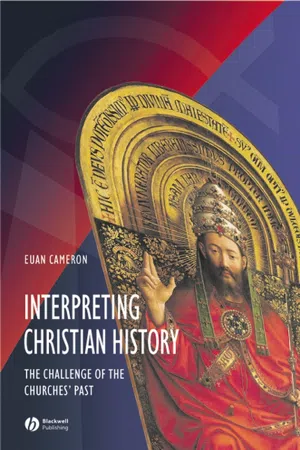 eBook - PDF
Interpreting Christian History
The Challenge of the Churches' Past
- Euan Cameron(Author)
- 2008(Publication Date)
- Wiley-Blackwell(Publisher)
Chapter 1 The Unfolding of Christian History: a Sketch Christianity today demonstrates a bewildering range of diversity. Most of this present-day diversity results from historical processes of change, devel-opment, disagreement, and diversification. Yet the present state of affairs, confusing as it is, does not exhaust the diversity of the Christian experience. The Christian Church has taken on many other forms (especially in the preindustrial West) that no longer exist. History starts to explain the present level of diversity; but it also introduces us to new levels of difference and variety that the modern observer barely sees. A brief thumbnail survey and exploration of the history of the Christian Church up to the present is here offered, in the expectation that most nonspecialist readers may not have a clear idea of the overall history of the Church over the past 20 centuries. It is (obviously) the very opposite of comprehensive. It is open to challenge on nearly every point. This brief and very selective sketch serves only two specific functions. It aims to give a framework for the phenomena of diversity described in the Introduction, and to explain how some of them arose. It also opens up the field for the remainder of this discussion, since analysis of the theological implications of the diversity of Church history cannot proceed without some skeleton of the most basic data. Christianity: a Jewish Heresy Spreads Across the Eastern Empire The movement of the followers of Jesus, as described in the Epistles and the Acts of the Apostles, began as a dissenting tendency within the Jewish communities of the Eastern Mediterranean. As Paul put it, ‘‘according to the Way which they call a sect [Greek hairesis , root of our word ‘‘heresy’’] I worship the God of our ancestors.’’ 1 Rapidly, but not without No longer available |Learn more
- Charles H. Kraft(Author)
- 2005(Publication Date)
- William Carey Library(Publisher)
Is Christianity a Religion Or a Faith? 85 concept of contextualization and continue, in the name of religion, the conversion of the peoples of the world to Western ways. Or, like many, we could see religion as the beliefs concerning supernatural beings and powers and the behavior and rituals associated with those beliefs. This definition would nicely cover the beliefs and practices of most of the peoples of the world plus the minority of Westerners who take their relationship with God seriously. It would see religion as embodied in a culture, whether as the core of that culture or as something more peripheral, and as requiring the learning of some important aspects of the originating culture if one converts to it. As Christians, then, we would see our beliefs and practices as basically in competition with the beliefs and practices of nonChristians and seek to convert them to the cultural forms of our religion on the assumption that these forms, our religion, are the best of the competing religious options available. This is, in fact, what has ordinarily been aimed at by Christian witnesses down through history. Christianity has been identifiable by the cultural forms in which it has been encapsulated and it is those forms that are carried from society to society as the religion spreads. Taking the Christian religion to the peoples of other societies, then, involves the taking of our religious forms and adapting them to the culture of the receiving peoples. A third approach is, however, the one that is basic to any consideration of contextualization. This approach is the one recommended by the Apostle Paul in Acts 15 as not requiring that Gentiles be converted to Jewish custom in order to follow Jesus. Paul had learned this approach by watching God give the Holy Spirit to Gentile converts on the basis of their faith alone, in spite of the fact that they had made no attempt to convert to Jewish culture. eBook - ePub
- William Charlton(Author)
- 2017(Publication Date)
- Routledge(Publisher)
Chapter 6 The Spread of ChristianityEarly in Luke’s Gospel there is an attempt to fix the time at which John the Baptist started baptizing. We are told that it was in the fifteenth year of the reign of Tiberius; that would be about 28 AD. At that time Jesus of Nazareth had not started his mission, so there could have been no Christians: no one believed or had even heard of the central doctrines of Christianity. Perhaps three years later Jesus was executed, and his surviving followers were few in number, fearing for their lives, and convinced that his mission had been a failure. They thought he was dead and gone, and his teaching had died with him. Three hundred years later Christianity became the official religion of the Roman Empire, and in the centuries that followed it became the sole religion of the Mediterranean world. The Olympian gods lost all their followers, and so did any other gods there may have been on the fringes of the Roman Empire. In the seventh century the followers of Mohammed took over the eastern and southern shores of the Mediterranean, but they worshipped the same God as the Christians and the Jews. How Christianity spread is a question that has engaged many historians, and many books have been written and will be written in the future to answer it. In the present chapter I shall first survey some answers historians propose, and then consider one or two questions they omit to ask or fail to answer.Evans-Pritchard says of anthropologists:It was not just that they asked, as Bergson put it, how it is that ‘beliefs and practices which are anything but reasonable could have been, and still are, accepted by reasonable beings’. It was rather that implicit in their thinking were the optimistic convictions of the eighteenth century rationalist philosophers that people are stupid and bad only because they have bad institutions, and they have bad institutions only because they are ignorant and superstitious, and they are ignorant and superstitious because they have been exploited in the name of religion by cunning and avaricious priests and the unscrupulous classes which have supported them.1
Index pages curate the most relevant extracts from our library of academic textbooks. They’ve been created using an in-house natural language model (NLM), each adding context and meaning to key research topics.

