History

Portuguese Missionaries
Portuguese missionaries were religious individuals sent by Portugal to spread Christianity in various parts of the world, particularly during the Age of Discovery. They played a significant role in the expansion of the Portuguese Empire and the spread of Catholicism, establishing missions, schools, and churches in regions such as Africa, Asia, and the Americas. Their efforts had a lasting impact on the cultures and societies they encountered.
Written by Perlego with AI-assistance
Related key terms
1 of 5
3 Key excerpts on "Portuguese Missionaries"
- Pius Onyemechi Adiele(Author)
- 2017(Publication Date)
- Georg Olms Verlag(Publisher)
This attitude of the Crown of Portugal and its representative in Kongo and elsewhere made Charles Boxer to describe its empires and the missionary enterprise in them especially in Africa as “a commercial and maritime empires cast in a military and ecclesiastical mould. ” 61 He proved this assertion, from the point of view of the fact that both ecclesiastical and civil administrators working for the Crown of Portugal in its overseas colonies were paid directly from Lisbon. But owing to the fact that the financial capacity of the Portuguese Crown was not sufficient enough to sustain them, they resorted to trading in human beings. According to him: “Everyone, from Viceroy to cabin -boy sought to supplement his income by trading so that virtually every man in Portuguese Asia and Africa became either a full-time or a part-time merchant.“ 62 Their missionaries working in Kongo and elsewhere in Africa were also affected by this development. Boxer confirmed this fact when he said: “This affected even many of the regular and secular clergy whose stipends were often paid in trade-goods. Few of them achieved more than a mediocre morality.” 63 And this kind of doing business in Africa under the cloak of evangelizing the continent led Adrian Hastings to evaluate the Portuguese missionary enterprise in Africa in the following manner: “The Portuguese African empire had its original function to act as a controlled passage between Lisbon and Asia. From the mid-seventeenth century, its basic purpose changed and it became instead a 59 Weber, Die portugiesische Reichmission, pp. 70-71. 60 Hastings, Church in Africa, p. 89. 61 Boxer, Four Centuries of Portuguese Expansion, p. 18. 62 Ibid, p. 19. 63 Ibid. See also, Hastings, The Church in Africa, p. 124. IV. The Portuguese and the Evangelization of Africa 446 source of labour supply for Brazil, the only economically thriving part of the empire. eBook - PDF
Portuguese and Luso-Asian Legacies in Southeast Asia, 1511-2011, vol. 2
Culture and Identity in the Luso-Asian World: Tenacities & Plasticities
- Laura Jarnagin(Author)
- 2012(Publication Date)
- ISEAS Publishing(Publisher)
33 Obviously, not much of the Portuguese proselytization efforts from the past two centuries had remained among the local people, although Bartholomäus Ziegenbalg, the first Protestant missionary in India in 1706, reports that he had to learn Portuguese to communicate with the local people. 34 Considering the relatively small percentage of the population in Southeast Asia in general and in India in particular that are Roman Catholics, from a long-term perspective the Portuguese presence and especially the missionary work were rather unsuccessful: according to Coelho, “by the early seventeenth century it had become clear that the Jesuits were falling far short of their goal in converting Indians to Christianity.” 35 The reasons for this relatively insignificant legacy are diverse and have led scholars to formulate the following main arguments. 36 First, unlike some areas of South America and Africa, the Asian countries were kingdoms with a clearly defined and working infrastructure long before the Portuguese conquest. Furthermore, the Portuguese mainly stayed along the strategic trade routes and did not occupy whole countries. 37 However, they utilized conflicts between local groups for their own benefit — “benefit” here mainly meaning the fostering and support of trade and economic development. Around the year 1600, the Dutch and the English began to explore their own commercial routes to Asia and thus became serious competitors not only to the Portuguese trading system. Such conflicts erupted into battles and massacres, accompanied by the attempt to proselytize in the region with the new Protestant reformed faith that both the Dutch and the English professed, albeit in different and occasionally conflicting ways.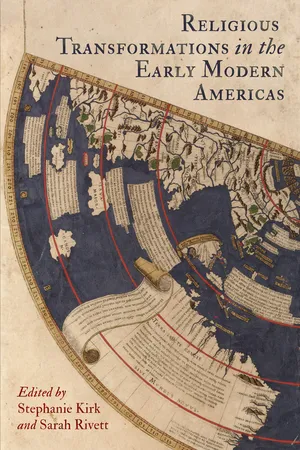
- Stephanie Kirk, Sarah Rivett, Stephanie Kirk, Sarah Rivett(Authors)
- 2014(Publication Date)
- University of Pennsylvania Press(Publisher)
As for the evangelization of the New World, the primary orders, espe-cially the Jesuits, had assumed a preponderant role. 62 It was during the reign of Dom João III (1521–57) that the Society of Jesus, founded by Ignatius of Loyola in 1534 and approved by papal bull in 1540, established itself in Portu-gal. Dom João III “believed that Portuguese colonization in the New World would only take firm hold and reach completion with the conversion of its peoples to Catholicism,” 63 thus expanding the founding mission of the Portu-guese Crown, and in this endeavor he found an ideal partner in the Jesuits. In 1541, Francisco Xavier set sail for India, where he arrived in 1549. That same year, accompanying the entourage of the first governor, Tomé de Souza, the Jesuits disembarked in Brazil. Many primary orders followed in their wake, such as the Franciscans, the Carmelites, and the Benedictines, but these had a structure that was independent of the state and even of the Vatican, which meant that, though recognized as important and viewed as partners, they were also feared because they were hard to control. The secular clergy, however, had always served as an important instru-ment of evangelization in Portuguese expansion. 64 In the Congo, for example, 192 Missions in 1491, following the expedition that initiated the kingdom’s conversion to Catholicism, four priests stayed behind armed with the necessary objects to perform the mass and with only an interpreter to facilitate communication with the local population. 65 At the end of the eighteenth century, Fathers Cipriano and Vicente, following in the steps of their predecessors, were en-trusted with teaching the Catholic dogmas to the Dahomey elites and with performing their religion’s main rituals there, in the hopes of spreading their religion to the local population. Portuguese Catholicism adhered to the principles of the Council of Trent.
Index pages curate the most relevant extracts from our library of academic textbooks. They’ve been created using an in-house natural language model (NLM), each adding context and meaning to key research topics.

