History

Charter Colonies
Charter colonies were established through a royal charter granted by the English monarch, giving settlers the authority to create their own government. These colonies, such as Rhode Island and Connecticut, had a significant degree of autonomy and self-governance. The charters outlined the colony's political structure, rights, and responsibilities, providing a foundation for democratic governance in the New World.
Written by Perlego with AI-assistance
Related key terms
1 of 5
6 Key excerpts on "Charter Colonies"
 eBook - PDF
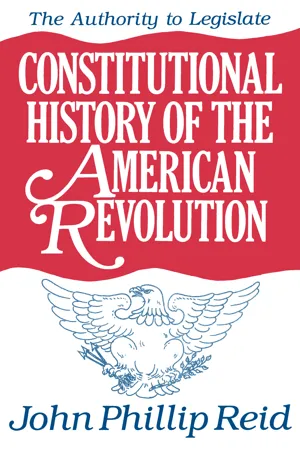
Constitutional History of the American Revolution, Volume III
The Authority to Legislate
- John Phillip Reid(Author)
- 2013(Publication Date)
- University of Wisconsin Press(Publisher)
8 Indeed, it was even immaterial that one of the so-called "En- glish" colonies, Delaware, had never been granted a royal charter. It claimed the same privileges of internal legislation and the same immu- nities from parliamentary supremacy claimed by colonies with royal charters. In other words, even though it did not have a royal charter, colonial whigs did not hesitate to claim for Delaware charter privileges and charter immunities. If the generality of charter argument is unexpected, it may be that we have been conditioned to think of charters as organic acts. Colonial char- ters were not constitutions. They were, rather, grants of territory and rights of government conferred on proprietors or companies of adven- turers. Because the privileges and immunities vested by charter generally were those of a trading company rather than a colonizing enterprise, the charters had been modeled on articles of incorporation, and had been drafted as outlines of hierarchial control rather than as blueprints for governmental action. In fact, many imperialists claimed that the corpo- rateness of charters settled the revolutionary controversy as it meant that colonial charters had created corporations, not separate, independent governments. Colonial charters "are undoubtedly no more than those of all corporations, which impower them to make bye-laws, and raise duties for the purposes of their own police, for ever subject to the superior authority of Parliament," Soame Jenyns insisted. therefore they can have no more pretence to plead an exemption from this parliamentary authority, than any other corporation in England."9 Due to its simplicity, the "corporation" argument was very attractive to imperialists, especially to commentators like Samuel Johnson who did not understand prescriptive constitutional law. A charter, Johnson the- orized, was a grant to colonizers "permitting them to settle in some dis- tant country, and enabling them to constitute a Corporation, .
- Lawrence Lowell(Author)
- 2020(Publication Date)
- De Gruyter(Publisher)
C H A P T E R L V THE SELF-GOVERNING COLONIES The North EXCEPT for India, which was only beginning to be more CXSMT than a collection of trading stations under the management of a chartered company, the foreign possessions of England in the middle of the eighteenth century consisted for the most part of the West Indian Islands and the colonies along the coast of North America. These dependencies differed much in origin, and not less in their early forms of govern-ment. In those on the mainland, which were destined to have the largest growth, the mother country took for a time little interest, and some of them conducted their affairs with great independence. This was notably the case with Massachusetts Bay, for by the transfer of the charter to America that colony came to be ruled almost from the start by its freemen, who elected their own legislature and gov-ernor without restraint. But as England grew more con-scious of the importance of her transatlantic possessions, as she began with the Navigation Acts to develop a colonial policy in mercantile relations, and as her own internal strife subsided, she came to interfere with the colonies more. By proceedings in the Court of Chancery the old charter of Massachusetts Bay was annulled, and in 1691 another was granted which vested the appointment of the governor in the Crown. By the transfer to the Crown of the rights of the proprietors in some places, and by sundry other changes elsewhere, the forms under which the different colonies were administered became at last very much alike. Before the eighteenth century was far advanced a single type of government had become prevalent in most of the important British colonies, both on the mainland of North 392 THE SELF-GOVERNING COLONIES 393 America and in the West Indies. No longer available |Learn more
- (Author)
- 2014(Publication Date)
- Orange Apple(Publisher)
The governor had the power of absolute veto, and could prorogue (i.e., delay) and dissolve the assembly. The assembly could make all local laws and ordinances that were not inconsistent with the laws of England. Proprietary colonies Pennsylvania, Delaware, New Jersey, and Maryland were proprietary colonies. Proprietary governments were grants by patents for special territory to one or more persons from the monarch, giving them rights as proprietors of the land and with general powers of government, in the nature of a feudal principality or royal dependency, and subject to the control of the monarch. The proprietaries appointed the governor and the legislature was organized and called at his (or their) pleasure. Executive authority was held by the proprietary or his governor. ________________________ WORLD TECHNOLOGIES ________________________ Charter Colonies Massachusetts, Rhode Island and Providence Plantation, and Connecticut were Charter Colonies. Charter governments were political corporations created by letters patent, giving the grantees control of the land and the powers of legislative government. The charters provided a fundamental constitution and divided powers among legislative, executive, and judicial functions, with those powers being vested in officials. Political culture As Bonomi (1971) shows, the most distinctive feature of colonial society was the vibrant political culture, which attracted the most talented and ambitious young men into politics. First, suffrage was the most widespread in the world, with every man who owned a certain amount of property allowed to vote. While fewer than 1% of British men could vote, a majority of white American men were eligible. The roots of democracy were present, although deference was typically shown to social elites in colonial elections. Second, in the colonies a very wide range of public and private business was decided by elected bodies, especially the assemblies and county governments in each colony.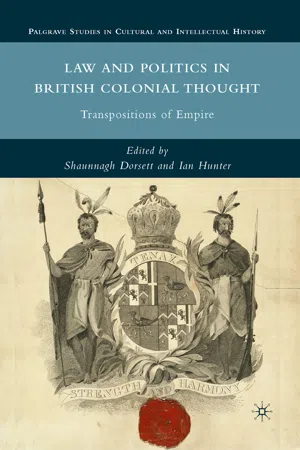 eBook - PDF
Law and Politics in British Colonial Thought
Transpositions of Empire
- S. Dorsett, I. Hunter, S. Dorsett, I. Hunter(Authors)
- 2010(Publication Date)
- Palgrave Macmillan(Publisher)
Colonial charters mapped both territory and the institutional and cultural forms in which authority would be applied to (and within) that territory. Carefully expressing the claim that territory was legitimately appropriated by use, all were catalogs of intense creative activity. From the early 1620s, English charters also embraced and anticipated massive transfers of population as colonization’s purpose. Clearly the first to do so was Sir William Alexanders’s “New Scotland” grant. Its emphasis lay on colonization as an act of self-renewal undertaken by a population “led forth into new territory, which they may fill with colonies.” 72 The sentiment became commonplace. 73 With growing emphasis on command of territorial expanse and the importation of population to fill and improve it, what had English char- ters to say of indigenous populations? Local populations, always slighted, were increasingly subject to conceptual and physical expulsion. This is particularly noticeable as a theme of the patents drawn up after the so- called Jamestown massacre of March 1622. Indigenous populations quite suddenly cease to appear as inhabitants of the territories in question with whom accommodations might be reached and become implacable enemies threatening them from outside. The original Virginia patent had only glanced at the “people living in those parts” and had not displaced them, suggesting rather they would be beneficiaries of English colonizing. In abrupt contrast, the Avalon patent, the first granted after the massacre, licensed the expulsion of indigenous populations from the territory they inhabited and authorized perpetual war against them. Describing the lands granted as “not yet husbanded,” the patent acknowledged they were “in some parts . . . inhabited.” It then separated inhabitants from land by renaming them barbarian invaders against whose “Incursions . . . as of other Enimies, Pirats and Robbers” the proprietor was empowered “to make warre . eBook - ePub
- Brian Smith(Author)
- 2020(Publication Date)
- Routledge India(Publisher)
There is room, however, to think that Locke held some more ambiguous view of the political status of the North American colonies. As seen above, the exact nature of political jurisdiction in the seventeenth century was much more complicated than might be initially assumed. In other words, Locke may have viewed the proprietary colonies as being much more politically independent (radically and experimentally so), even though they subsisted in some formal sense under the sovereign umbrella of English authority, as stipulated by the colonies’ founding charters. This reading implies that even though the colonies were under the jurisdiction of English authority, Locke viewed them as novel, and indeed, utopian experiments in political living with a much greater degree of political autonomy.The relevant consideration in assessing the independence of the colonies was not whether they were absolutely independent of the jurisdictional umbrella of England, but whether the settler communities were free to “[set] up new governments,” which offered a high degree of practical political sovereignty.74 On this view, proprietary colonies, especially those designed with an eye to religious tolerance and free trade, would be freer than, say, corporate charters, which predicated membership on narrow denominational affiliation, and royal colonies, which were overseen by royally appointed governors. After all, in his critical assessment of the Virginia colony, Locke continually contrasts the lack of freedoms and provisions in Virginia, which was a royal colony, with those found in proprietary colonies. He writes, “It may be hoped that the hardships occasioned by the badness and arbitrariness of the [Virginia] Constitution (hereafter to be mentioned) will be remedied at leasure much as they are in any proprietorship or other English plantation.”75 eBook - ePub
Unto a Good Land
A History of the American People, Volume 1: To 1900
- David Edwin Harrell, Edwin S. Gaustad, John B. Boles, Sally Foreman Griffith(Authors)
- 2005(Publication Date)
- Eerdmans(Publisher)
By the 1730s, all thirteen original North American colonies except Georgia had been founded and set on their course of political development. Just as the terms and conditions of each colony in its first years had differed, so the local political development of each varied both in its nature and its rate of evolution. The days of joint-stock companies had passed; those of proprietorship were rapidly passing. Only in Pennsylvania, Delaware, and Maryland did the proprietor choose the governor. In other colonies, the king made his choice, and in the process met varying degrees of cooperation or resistance in the local legislatures.EMERGING COLONIAL LEGISLATIVE POWER
The lower houses or assemblies in each colony saw themselves as roughly analogous to the House of Commons in Parliament. Just as the House of Commons struggled with the king over the boundaries of power, so the colonial assemblies jockeyed with a succession of governors for a clearer delineation of their authority. Within these assemblies, an increasingly assertive, confident elite spoke with an ever stronger and more authoritative voice.Connecticut and Rhode Island continued in the eighteenth century to operate under generous charters granted in the 1660s. These instruments of government granted virtually unlimited power to the assemblies — always provided, of course, that their local laws were not “repugnant” to the laws of England. But since their legislation did not require regular review in London, “repugnance” only came to anyone’s attention if the sacrosanct Navigation Acts were violated. On occasion, however, persons aggrieved with the justice they received in either of these colonies might appeal directly to the Crown.In Connecticut, for example, a property holder who died without a will had his property divided, not according to English Common Law, but according to the biblical Deuteronomic Law. Under the Common Law, all property would pass to the eldest son; but the Deuteronomic Law required that provision first be made for the widow and then that the property be divided equally among all the children, with perhaps a double portion to the eldest son.
Index pages curate the most relevant extracts from our library of academic textbooks. They’ve been created using an in-house natural language model (NLM), each adding context and meaning to key research topics.

