History

Columbian Exchange
The Columbian Exchange refers to the widespread transfer of plants, animals, culture, human populations, technology, and ideas between the Americas and the Old World following Christopher Columbus's voyages to the Americas in 1492. This exchange had a profound impact on both the New and Old Worlds, leading to significant cultural, ecological, and economic changes.
Written by Perlego with AI-assistance
Related key terms
1 of 5
11 Key excerpts on "Columbian Exchange"
 No longer available |Learn more
An Economic History of the United States
Connecting the Present with the Past
- Mark V. Siegler(Author)
- 2017(Publication Date)
- Red Globe Press(Publisher)
47 3 European Settlement and the Columbian Exchange The “Columbian Exchange” refers to the widespread exchange of diseases, plants, food crops, animals, ideas, culture, and human populations between the Old World (Eurasia and Africa) and the New World (Americas) following the voyage to the Americas by Christopher Columbus in 1492. 1 This was an unprecedented event in human history, which had profound ramifications throughout the world. This chapter examines how this exchange helped create the foundations for the United States’ economy and sowed the seeds for future economic growth and development. In economics, “exchange” usually refers to voluntary and mutually beneficial exchange, so the Columbian Exchange is somewhat of a misnomer since it was decid-edly one-sided. European populations in the Americas and Europe expanded dramat-ically due to new crops, while indigenous populations and societies in the Americas collapsed because of the onslaught of devastating European diseases and weapons. In 1500, the European share of the world population was 11 percent, while the indige-nous populations in the Americas represented 7 percent of the world total. By 1800, however, the European share of the world population had almost doubled to 20 percent, while the indigenous populations in the Americas had plummeted to less than 1 percent. 2 Populations in Africa grew as well, but millions of Africans were enslaved and forcefully transported to the New World, in part to fill the void created by the collapse in Native American populations. Four main questions are addressed in this chapter: • What were the consequences of the Columbian Exchange? eBook - ePub
Atlantic Lives
A Comparative Approach to Early America
- Timothy Shannon(Author)
- 2019(Publication Date)
- Routledge(Publisher)
2 The Columbian ExchangeFigure 2.1 Smallpox among the Nahuatl in Sixteenth-Century Mexico.Of the many diseases transmitted across the Atlantic in the Columbian Exchange, smallpox was the most deadly for Native Americans (see Selection 2). Considered a childhood disease in Europe, in America it led to fatality rates that ranged from 30 to 90 percent of infected populations. This image of Native Americans suffering from smallpox comes from a sixteenth-century Spanish collection about the Aztecs.Source: Florentine Codex, Book XII folio 54. Bernardino de Sahagún, Historia general de las cosas de la Nueva España (1540–1585).Introduction
The passage of human beings between the Old World and the New led to a much wider transfer of plant and animal life commonly known as the Columbian Exchange. Some of this exchange occurred by design, such as when Old World farmers planted American crops in their fields; other times, the exchange was inadvertent, such as when colonists unwittingly introduced new diseases to Native American populations. Whether purposeful or accidental, such exchanges forever altered the nature of plant, animal, and human life on both sides of the Atlantic. Formerly isolated ecosystems became intertwined and transformed in the process. Some species experienced extinction or near extinction, while others flourished in new surroundings unchecked by natural enemies. While scholars have typically studied the human actors involved in this drama, we cannot appreciate the full impact of the Columbian Exchange without considering the other forms of life it affected.The most profound changes wrought by the Columbian Exchange resulted from the transmission of microbes from the Old World to the New. European sailors, explorers, traders, and colonists brought to the Americas a number of diseases to which Native Americans had had no previous exposure, and therefore, no natural immunities. Smallpox, measles, influenza, bubonic plague, and others broke out in “virgin-soil epidemics” among these new host populations. Estimating the impact that these diseases had on Native Americans has become a contentious business among scholars, involving debates over the pre-Columbian population of the Americas and the fatality rates associated with virgin-soil epidemics. On the high end, some scholars estimate that as many as 18 million Indians lived in North America prior to 1492, and that Old World microbes reduced that number by as much as 95 percent. More conservative estimates place the pre-Columbian population of North America at 4–7 million, with a 60–70 percent reduction in that number by 1700. eBook - PDF
- Frank Uekötter, Frank Uekotter, Frank Uekötter(Authors)
- 2010(Publication Date)
- University of Pittsburgh Press(Publisher)
21 A famous pulse of ecological exchange followed upon Columbus’s voyage from Spain to the Americas in 1492. After the original human invasion of the Americas toward the end of the last ice age, very little interaction took place between the Americas and the rest of the world. The histories of the Western and Eastern Hemispheres, although showing some parallels (such as domestication, state-creation, and urbanism), remained separate. But after 1492, as the eminent environmental historian Alfred Crosby memorably showed, the flora and fauna of the two hemispheres mixed together with tumultuous results. Crosby coined the phrase “the Columbian Exchange” to refer to this ongoing human-assisted migration of plants, animals, and microbes across the Atlantic. 22 The most disruptive component of the Columbian Exchange was disease. Eurasian and African infections ran rampant among Amerindian populations, reducing them by 50 percent to 90 percent between 1500 and 1650. Amerindians, e First Hundred Thousand Years j . r . m c n e i l l with their scant experience of domesticated herd animals, had no prior expe-rience of smallpox, mumps, measles, whooping cough, influenza, and several other lethal killers that had become routine endemic diseases in most of Eurasia and Africa. They had no acquired immunities to any of these infections. More-over, because the entire population of the Americas was descended from a small number of forebears who had migrated across Beringia at the end of the last ice age, these people had minimal genetic diversity among them. This meant that any particular strain of smallpox or influenza that easily circumvented one Am-erindian’s immune system would likely circumvent everyone’s. A more geneti-cally diverse population—Africa’s is the world champion in this regard—made the spread of infectious disease more difficult. eBook - PDF
Cuisine and Culture
A History of Food and People
- Linda Civitello(Author)
- 2011(Publication Date)
- Wiley(Publisher)
But mismanagement, overspending, and wars squandered the fortune. The sixteenth century began with Catholic Spain’s rise to power; it ended with Spain starting to decline as the power passed to northern European coun- tries which had converted to a new Christian religion, Protestantism. Fifth Course THE Columbian Exchange 120 Food Goes Global CHRONOLOGY—EXPLORATIONS WHEN NAME COUNTRY SPONSORING/ NATIONALITY WHERE EXPLORED 1003 Leif Eriksson Vikings North America 1405–1433 Zheng He China Africa; probably South America 1415–1460 Henry the Navigator (Dom Henrique) Portugal Africa, west coast 1488 Dias Portugal Africa, south and east coast 1492–1503 Columbus Spain/Italian Caribbean; South America, north shore 1497 Cabot England/Italian Eastern Canada 1498 da Gama Portugal India, west coast 1500 Cabral Portugal Brazil 1501 Amerigo Vespucci Portugal/Italian South America, east coast 1512–1513 Ponce de León Spain Florida 1519 Cortés Spain Mexico 1519–1522 Magellan Spain/ Portuguese First to sail around the world 1530–1533 Pizarro Spain Peru, western South America 1534 Cartier France Canada 1540–1542 Coronado Spain Santa Fe, New Mexico 1609–1610 Hudson England Hudson’s Bay, Canada; Hudson River, NY The Columbian Exchange The collision of the eastern and western hemispheres—Old and New Worlds— and the foods, plants, animals, and diseases that went back and forth is called the Columbian Exchange. The phrase “The Columbian Exchange” was coined by food historian Alfred W. Crosby Jr. in his groundbreaking 1972 book, The Columbian Exchange: Biological and Cultural Consequences of 1492. He said that “two worlds [the hemispheres], which were so very different, began on that day [October 12, 1492] to become alike.” 1 Old World to New 121 During what historians call the Time of Contact, humans overrode millions of years of natural development in life forms on planet Earth by shipping them all around the globe. eBook - PDF
The New World History
A Field Guide for Teachers and Researchers
- Ross E. Dunn, Laura J. Mitchell, Kerry Ward, Ross E. Dunn, Laura J. Mitchell, Kerry Ward(Authors)
- 2016(Publication Date)
- University of California Press(Publisher)
Alfred Crosby’s scholarly engagement with environmental change has spanned more than four decades. His pioneering study, The Columbian Exchange: Biological and Cul-tural Consequence of 1492, appeared in 1973 and has proved so influential that his title phrase is now an item in the basic vocabulary of world history—including the vocabu-lary of textbooks and curriculum standards. Children of the Sun , published in 2006, charts the long-term changes in human energy use, differentiating among muscle power; the controlled use of fire; the release of biomass from burning wood, peat, and charcoal; and the consumption of fossil fuels. The chapter “The Columbian Exchange,” reprinted here, recapitulates the major arguments of The Columbian Exchange, situat-ing the transatlantic exchange of crops, domestic animals, weeds, and diseases in the context of changing human food production that followed the control of fire, cooking, and advancing agricultural technologies. Crosby repurposed aspects of his well-known book to make arguments not just about the consequences of early modern maritime exchanges but also about the long-term technological innovations that have altered the way humans interact with the earth and its resources. Crosby’s essay displays three elements that are common in global environmental history: attention to the planet’s biological past; identification of clear pivot points in the relationship between human communities and the natural world; and explanation of how the development of specific technologies changed our ability to exploit natural resources—for example, harnessing the wind with sails and adapting food crops to new habitats. The full scope of Children of the Sun examines energy use and the relationship between the sun and the earth from the era of single-celled organisms through human attempts to produce controlled nuclear fusion.
- Amanda L. Logan(Author)
- 2020(Publication Date)
- University of California Press(Publisher)
Popularized by Alfred Crosby’s 1972 book, which was revised in 2003, the exchange is understood to have operated on a scale and with consequences that make previous world systems seem minor by comparison. Animals, plants, Choosing Local over Global 41 people, diseases, commodities, and knowledge passed between the previously isolated Western and Eastern hemispheres. Illustrative of the impact on present foodways are the facts that before the Columbian Exchange there were no toma-toes in Italy or potatoes in Ireland; both crops were domesticated in the Americas and found new audiences and new cultural signifcance once they were adopted in Europe. Africa’s contributions to and benefts from the Columbian Exchange are less well known. Tough Crosby devotes only three speculative pages to the African continent, his interpretation has proved remarkably tenacious, as seen in the jux-taposition of quotes above. McCann (2005) also draws on Jared Diamond’s (1999) environmental determinist argument, which like many explanations of crop adop-tion in Africa accord environments more agency than the humans who fashioned them (La Fleur 2012). Tis is in part simply a limitation of archive: we know much more about the properties of diferent crops and environments than we do about the people who decided to adopt and modify them centuries ago. Unfortunately, when information is especially limited, reasoning based on the scarcity slot tends to fll in the gaps. Both quotes referenced above imply that Africans were incapa-ble of developing their own crops (scarcity slot tenet 2), and consequently, lacked sufcient calories to feed their populations (scarcity slot tenet 1). eBook - ePub
Virtual History
How Videogames Portray the Past
- A. Martin Wainwright(Author)
- 2019(Publication Date)
- Routledge(Publisher)
The presence of coffee and sugar in Central America today tells an important story. It’s the story of the “Columbian Exchange,” the transfer of people, commodities, and diseases between the Old and New Worlds, and among regions of both groupings of continents, in the centuries following Columbus’s opening of regular contact between the Americas and Afro-Eurasia. This story is a central focus of modern historical analyses pertaining to European expansion, and European expansion is one of the major themes of Europa Universalis, as well as other grand strategy games that cover the period, including Sid Meier’s Civilization. In fairness to Paradox, the development team includes the Columbian Exchange as an “institution” that modifies productivity in Europe. This institution is supposed to emulate the effect of certain commodities, such as potatoes, in the European diet. However, this level is much more abstract than, for instance, having Europeans find a Central American territory producing chocolate (a New World crop) and turning it over to coffee cultivation. That neither the Europa Universalis nor Civilization series highlight the Columbian Exchange is evidence of at least two potential challenges to portraying the impact of humans on the environment and vice versa. One is the limitations inherent in making commercial videogames simple enough to attract a large market. The other is the extent to which game designers consider environmental aspects of history to be a priority. These challenges are important because human interaction with the physical environment has played an increasingly important role in the work of historians and other scholars dealing with the past. This chapter examines how well videogames deal with environmental issues while explaining how scholars have argued that the environment and human history are interconnected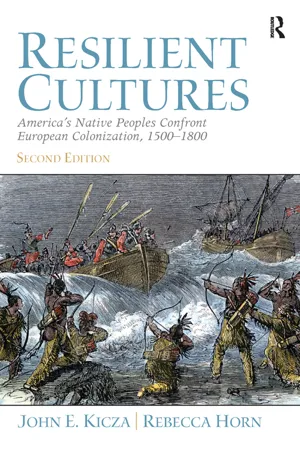 eBook - ePub
Resilient Cultures
America's Native Peoples Confront European Colonialization 1500-1800
- John E Kicza, Rebecca Horn, John Kicza(Authors)
- 2016(Publication Date)
- Routledge(Publisher)
8Enduring Connections between the New World and the OldThe preceding chapters have considered the nature of the native peoples of the Americas and how they were affected by and responded to European colonization. The first part of this chapter examines the impact of the incorporation of the Americas into the environmental and economic frameworks of the Old World, a process commonly termed “The Columbian Exchange.” For the first time, the Atlantic Ocean became a primary arena for the movement of people, diseases, animals, plants, and precious metals. This process transformed the environment of the Americas as much as it did the rest of the world. The following five sections consider the scope and impact of each of these emerging connections between the New World and the Old. A concluding section examines certain lasting patterns and trends in the history of Indian–European interactions in the colonial period.Before the discovery of the Americas, Western Europe participated only episodically in the exchange systems of the Old World. Located on the western periphery of the three continents of Africa, Asia, and Europe that constituted this trade zone, Western Europe produced few commodities or manufactured goods that could compete in African or Asian markets. Hence, it scarcely participated in the dynamic and flourishing trading networks centered in the Indian Ocean and the South China Sea. The complex economies of South Asia and China routinely shipped merchandise to East Africa, throughout Southeast Asia, and to the Spice Islands (modern Indonesia) and the Philippines.The Movement of PeoplesThe Americas had only minimal impact on the Old World in the exchange of people. Few Native Americans journeyed to Europe, and fewer still remained for very long. Europe certainly did not need people from America as settlers or laborers. Early explorers of the Americas, though, frequently kidnapped small numbers of young natives to take back with them. Once in Europe, they displayed the natives to the royal court and the public and also trained them to serve as translators in later voyages to the natives’ regions of origin. Surrounded by dense populations of disease-carrying peoples in Europe’s very different climate, many of these Indians became ill and died soon after their arrival. eBook - PDF
- Merry Wiesner-Hanks(Author)
- 2015(Publication Date)
- Cambridge University Press(Publisher)
These products were often consumed in new urban social settings and cultural institutions, where men—and a few women—shared ideas as well as commodities. Religious reforms and reinvigorations heightened spiritual zeal and created new arenas of conflict, as well as sharpening those created by rivalries over territory or resources. The early modern world was a new one of global connections, in which goods, ideas, and people—including peasants and slaves— moved and mixed, changing social and economic patterns and creating novel cultural forms. the spread of disease Prime among the disastrous effects of the Columbian Exchange was the spread of disease, which began with Columbus’ second voyage in 1493. This expedition was huge, with about 1,500 men, includ- ing adventurers, soldiers, artisans, and farmers who brought with them seeds for European crops and farm animals. This voyage set a pattern that would be followed in many other places. The ships landed on the large island of Hispaniola, which had a population between 400,000 and 600,000 engaged in farming cultivated plots. The Spanish were mostly interested in gold, and they captured, tortured, and killed the indigenous Taino in their search for precious metals. Many went back to Spain disappointed after a few weeks, and many more died of starvation, intestinal diseases from drinking 212 A new world of connections, 1500 CE–1800 CE the local water, or diseases they had brought from Europe with them, which most likely included malaria, typhus, influenza, and perhaps smallpox. Taino died even more readily from these, and from other Old World diseases against which they had no resist- ance, such as measles, mumps, diphtheria, bubonic and pneumonic plague, and scarlet fever. After a particularly virulent outbreak of smallpox throughout the Caribbean in 1518, very few Taino were left on Hispaniola, and the number of indigenous people on other islands had fallen dramatically. eBook - PDF
The Unending Frontier
An Environmental History of the Early Modern World
- John F. Richards(Author)
- 2003(Publication Date)
- University of California Press(Publisher)
part iii The Americas This page intentionally left blank 309 Chapter 9 The Columbian Exchange The West Indies 1. Leslie Bethell, The Cambridge History of Latin America, vol. 2 (Cambridge: Cambridge Uni-versity Press, 1984). Christopher Columbus’s voyages were the first systematic projection of state power to the Western Hemisphere. News of this feat inspired the imagina-tions of Renaissance statesmen and religious leaders. The monarchies of Eu-rope, supported by rapidly growing organizational sophistication, economic resources, and military strength, saw the New World as a source of riches to be ruthlessly exploited. Gold and silver, human labor, timber, fertile lands, and new plants could all be put to the service of the state at home. The Church saw among the strange peoples of the New World a fertile source of new converts. Gold and the cross were the two motives for sending annual fleets to the New World. The pattern had long been set by the reconquest of Iberia from the Moors and then the stepping-stone conquest and occupation of the island of Madeira, the Azores, and the Canary Islands. The Spanish, along with the Portuguese, were the first European kingdoms to conquer and colonize vast areas of the American continent. The first Spanish conquests after 1492 were in the islands of the Greater and Lesser Antilles in the Caribbean. Within three decades, between 1519 and 1540, the Spanish moved to the mainland and subjugated the densely populated heartlands of Mexico and Peru. By midcentury, Spain had claimed sovereignty over peoples occupying some 2 million square kilome-ters in the Americas. Only the area assigned to Portugal in Brazil was beyond its scope. Exploration and aggressive conquest continued, but the primary act of conquest had occurred. 1 To their Iberian conquerors, these were pre-viously unknown and unimagined new lands and new societies. Even three eBook - PDF
- B. W. Higman(Author)
- 2021(Publication Date)
- Cambridge University Press(Publisher)
These perceptions of health and strength were under- pinned by the rapid development of the trade in enslaved people from the forts of European merchants established along the coast of West Africa. Initially, this trade in enslaved people was merely a minor part of a trade in Columbian Cataclysm 96 commodities such as gold, pepper, and gum arabic, and this is why the enslaved people were sent north to Spain before being shipped to the Caribbean. The slave trade across the Atlantic, direct from Africa to the Americas, was inaugurated in 1518, when the first shipment of enslaved people reached Hispaniola. In the sixteenth cen- tury, there were also attempts by some African rulers to stop the trade or limit the flow of people from the interior to the forts. However, although the surge in demand for enslaved labourers came only after the wide-scale estab- lishment of plantation systems in the Americas, the sixteenth-century beginnings set the pattern that was to persist for another 300 years. Cassava and maize travelled in the opposite direction, transferred to West Africa, where they quickly regained their status as voyaging foods. This time, they served the cause of the trade in people, joining African yams in providing food for the middle passage. Being a trade, the forced migration of Africans was governed above all by cost and price. It depended on the supply of people to the trading forts in Africa and this flow, in turn, was determined by internal politics and patterns of local warfare that affected the numbers delivered and their price. The existence of the trade was influential, however, in encouraging the hierarchical development of West African societies and in separating subordinate ‘slave’ statuses from systems of kinship and household economy. The development of the slave trade also depended on the integration of shipping into the larger pattern of European trade with the Caribbean and mainland America and the existence of a merchant class in the islands.
Index pages curate the most relevant extracts from our library of academic textbooks. They’ve been created using an in-house natural language model (NLM), each adding context and meaning to key research topics.

