History

Conservatism in the United States
Conservatism in the United States is a political and social philosophy that emphasizes traditional values, limited government intervention, free market capitalism, and a strong national defense. It has been a significant force in American politics, advocating for individual liberty, personal responsibility, and a strict interpretation of the Constitution. Conservative principles have influenced policies on issues such as taxation, healthcare, and immigration.
Written by Perlego with AI-assistance
Related key terms
1 of 5

10 Key excerpts on "Conservatism in the United States"
 eBook - ePub
Conservatism in the Black Community
To the Right and Misunderstood
- Angela K. Lewis(Author)
- 2013(Publication Date)
- Routledge(Publisher)
Because the focus of this book is conservatism among Blacks, I do not spend a significant amount of time discussing conservatism in America. However, it is necessary to provide the reader with a basic understanding of conservatism. Completely understanding the entire realm of conservative thought is too large a task for this text and would shift the focus of the book away from what I am theoretically interested in studying, black conservatism. Moreover, conservatism as an academic study is largely immature, fractured, and inconclusive (Smith 2010). Nonetheless, this work seeks to provide a basic understanding of conservatism in America and its development as a political philosophy. The most basic way to begin this exercise is to provide a simple definition of conservatism. Scholars suggest that “conservatives are consistently opposed to governmental regulation of the economy and civil rights legislation, and in favor of state over federal action, fiscal responsibility and decreased governmental spending and lower taxes” (Tate and Randolph 2002, 1). Conservatism also demonstrates a strong resistance to government involvement in domestic aff airs. In addition, conservatism strongly supports economic individualism, a strong defense establishment, and traditional social values. Most scholars would agree that conservatives have a desire to conserve something, usually traditions, or a way of life. However, there are diff erences in what conservatives want to conserve and how they plan to conserve it. For example, there are four streams of conservatism in America, individualist, classical, neoconservatives, and the new right, which are discussed in more detail later in this chapter. However, for illustrative purposes each of these types of conservatives have diff erent objectives. Both classical conservatives and the new right are concerned with the moral fabric of the country and are accepting of utilizing government policy for conserving traditional family values. On the other hand, individualists are opposed to government restriction on individual freedom.ConservatismConservative thought in America evolved from a tradition rooted in 18th-century political thought. Generally, conservatives agree that human imperfection is the primary cause of the current human condition. Conservatives are distrustful of human nature, and they believe that humans primarily act in their own self-interest. Conservatives also believe that human institutions, culture, and trends contribute to the human condition. However, humans acting in their own self-interest, through government, are the primary cause of our condition, a view derived from the work of Edmund Burke, the founding father of conservatism. At the core of conservative thought is the idea that individuals are flawed and self-interested and that government is needed to control and restrain individuals and to maintain order, peace, and morality (Ball and Dagger 1991). eBook - ePub
- Edmund Neill(Author)
- 2021(Publication Date)
- Polity(Publisher)
1 Defining ConservatismThis book seeks to define the concept of conservatism and to explore its nature in the context of Western Europe and America, primarily looking at Britain, France and the United States. At first sight, this might appear to be a relatively simple task. For unlike some of the vaguer, more contested concepts in political theory, such as nationalism, populism or fascism, conservatism appears to have a relatively fixed and stable meaning. In particular, theorists investigating conservatism have often argued that conservatives advocate four key political commitments. First, they have argued that conservatives favour the importance of ‘natural’ forms of authority, such as the monarchy, the church, the nation and the family to guarantee social stability – as opposed to artificially designed ‘rationalist’ ones, particularly those provided by government. Second, relatedly, they have maintained that conservatives advocate ‘evolution’ over ‘revolution’, preferring incremental change over producing solutions from scratch, even if existing institutions are far from ideal. Third, such theorists have claimed that conservatives often consider human nature to be imperfect and fallible, with the result that they hold human inequality to be beneficial, or at the very least inevitable. Finally, within these limits, they have argued that conservatives often stress the importance of private property and capitalism in promoting individual freedom.1The Challenge of Defining Conservatism
In fact, however, as soon as one considers the concept of conservatism more closely, it throws up difficult definitional and conceptual challenges. For although some thinkers usually described as ‘conservatives’ have upheld the four commitments just described, others have not necessarily advocated all of them, or even, in some cases, any of them (Eatwell and O’Sullivan 1989: 47–61). First, although conservatives have often argued that traditional forms of authority are important, even those that have done so have not necessarily denied the importance of the state. Thus, Roger Scruton in The Meaning of Conservatism (1980), to take one modern example, was quite happy to stress the importance of governmental authority and the rule of law, as well as highlighting the vital role of traditional institutions like the family in ensuring social solidarity (Scruton 2001: 39–41). Still less, in any case, have conservatives agreed on which eBook - PDF
American Conservatism
Thinking It, Teaching It
- Paul Lyons(Author)
- 2009(Publication Date)
- Vanderbilt University Press(Publisher)
1 Introduction What Is American Conservatism? I begin with my dissatisfaction with the ways in which American con-servatism has been defined and represented over the past half century. Perhaps there is something in the American water that distills and sani-tizes conservative ideas and sensibilities, transforming them from their quintessential caution into a Reaganite “Morning in America,” just as we turned Freudian psychoanalysis into the power of positive thinking. Perhaps Louis Hartz was right that a political philosophy grounded in a dour view of human nature cannot take root in a culture committed to “the pursuit of happiness.” 1 At the core of conservatism is Edmund Burke and the notion that imperfection is congenital, that change must be pursued with sobriety and caution, that the human animal is flawed and prone to irrationality. Instead we seem to have invented an indige-nous “conservatism” that apes the very worst of social Darwinism and laissez-faire ideology. My discontents have been exacerbated by the strik-ing ignorance of both my conservative and liberal students concerning the mode of thought the former embraces and the latter eschews. As such I seek to help both, as well as those less ideologically committed, engage in a long-delayed conversation about traditional values. The beginning of my own story can be set during both my under-graduate and graduate education at Rutgers, when I found myself in-spired by several studies by the historian William Appleman Williams: The Tragedy of American Diplomacy , The Contours of American His-tory , and The Great Evasion . Williams, an Annapolis graduate and founding spirit of what used to be called the revisionist school of U.S. foreign policy, expressed considerable respect for the perspectives of con-servatives such as John Quincy Adams and Herbert Hoover. Several of my own graduate school mentors, most especially Warren Susman and eBook - PDF
- Nancy S. Love(Author)
- 2006(Publication Date)
- CQ Press(Publisher)
* * * Conservatism will likely remain a force in American politics, regardless of the legacy of the George W. Bush presidency. In times of national (re)definition, con-servatives have attended to the moral and spiritual principles at the core of American public life, providing a source of hope with their emphasis on com-munity, history, ritual, and tradition. Real hope, they once argued, could not be found in an ideology—even though democratic politics might seem to require one. In the words of Russell Kirk: Having lost the spirit of consecration, the modern masses are without expec-tation of anything better than a bigger slice of what they possess already. Dante tells us that damnation is a terribly simple state: the deprivation of hope . . . . How to restore a living faith to the routine of existence among the lonely crowd, how to remind men that life has ends—this conundrum the thinking conservative has to face. 102 Traditional conservatives responded to this conundrum by articulating a “pro-found respect for limits.” They placed such limits on “ambitions,” “budgets,” 74 conservatism “controls,” “governments,” “plans and projects,” and “values.” 103 The War on Terror—an undeclared war against an unknown enemy—challenges all these limits of the past. With today’s neoconservatives, an odd reversal has occurred. Anne Norton describes it well: Appeals to history and memory, the fear of losing old virtues, of failing to keep faith with the principles of an honored ancestry, came to seem curious and antiquated. In their place were the very appeals to universal, abstract principles, the very utopian projects that conservatives once disdained. Con-servatives had once called for limits and restraint; now there were calls to dar-ing and adventurism. Conservatives had once stood steadfastly for the Con-stitution and community, for loyalties born of experience and strengthened in a common life. eBook - PDF
- Alan Brinkley(Author)
- 2000(Publication Date)
- Harvard University Press(Publisher)
They have argued about the timing of this triumph and about whether 277 it has been a good or bad thing. But until recently, at least, they have seldom doubted that it occurred. A number of scholars in the last few years, myself among them, have been struck increasingly by other, quite different features of modern America: by the chronic weakness of the progressive state; 2 by the enor-mous difªculty liberals have had in securing and retaining popular loy-alties; and by the persistent strength of forces that, for lack of a better word, we generally call conservative, in a long and still unresolved battle over the nature of American politics and American culture. 3 This is an important and, at least until recently, largely neglected part of the story of twentieth-century America. And so the “problem of American con-servatism,” as I deªne it here, is not a problem facing conservatives themselves, and not any of the problems conservatives have created for their opponents. It is a problem of American historical scholarship, the problem of ªnding a suitable place for the right—for its intellectual traditions and its social and political movements—within our historiog-raphical concerns. Conservatism has not always been the orphan within American histori-cal scholarship that it is today. The progressive historians who domi-nated the writing of American history through much of the ªrst half of this century placed conservatives at the center of their interpretive scheme—a scheme that portrayed American history as a long and often intense struggle between popular democratic elements and entrenched antidemocratic interests. But theirs was a constricted view of conserva-tism, focused almost exclusively on economic elites and their efforts to preserve wealth and privilege. It is not surprising that later generations of scholars have found the progressive framework inadequate. eBook - ePub
Conservatism
A Contribution to the Sociology of Knowledge
- Karl Mannheim(Author)
- 2013(Publication Date)
- Routledge(Publisher)
With the appearance of an integrated conservative politics, or perhaps even somewhat earlier, a corresponding world-view and way of thinking emerge, which may be similarly classified as conservative. In our terminology and in relation to the first half of the nineteenth century, then, ‘conservative’ and ‘liberal’ refer to quite specific affinities to distinctive philosophies and to an associated distinctiveness in the manner of thinking, and not only to distinctive political aspirations. A distinctive overall structure of the world may thus be said to be implicit in the term ‘conservative’. The sociological definition of the term, inevitably more comprehensive than the historical-political one, must necessarily also refer to that historical structural situation in which this term could arise to designate a new fact]. 65 In our view, the socio-historical precondition for the emergence of conservatism is, in brief, a conjunction of the following factors: (1) The historical social whole (Sozialkomplex) must have become explicitly dynamic (processive). Individual happenings within the totality of events must to an increasing extent be in every sphere oriented to the same set of basic questions about the growth of the social whole. This orientation to the central issues of the overall movement happens unintentionally at first; but later it will become conscious and intentional, whereupon the significance of each element for the development of the whole will become increasingly clear. There will be accordingly a steady decline in the number of the discrete, self-contained social units which had previously predominated eBook - PDF
Conservatism in Crisis?
Anglo-American Conservative Ideology After the Cold War
- B. Pilbeam(Author)
- 2003(Publication Date)
- Palgrave Macmillan(Publisher)
In fact, mainstream American conservatives have typically sought to marry tra- ditionalism in the social spheres with the defence of market capitalism in the economic. This is true across journals from the National Review to Policy Review. One of the more difficult strands of American conservatism to place within the conservative spectrum is neoconservatism. Notable figures include Podhoretz, Irving Kristol, Michael Novak and Daniel Bell (even if Bell has always been uneasy with the label), while an array of journals can be identified with a neoconservative viewpoint: Commentary, the Public Interest (dealing with public policy issues), the National Interest (foreign affairs) and the New Criterion (culture and the arts). A younger generation to have inherited the neoconservative label is typified by William Kristol and writers for the conservative magazine he edits, the Weekly Standard. The historical difficulty in placing neoconservatism derives from the fact that most originally regarded themselves as liberals, who became disaffected by the ‘leftward’ turn liberalism took in the 1960s. Liberalism’s association with radical political movements and the spread of alternative lifestyles led neoconservatives to believe in the need to reassert traditional moral values and a democratic capitalist vision. They also reacted to what they saw as the overextension of the state’s role by the Great Society programmes of the era. Even so, neoconservatives continued to see themselves as defenders of the New Deal settlement of the 1930s, and thus qualified supporters of the welfare state. Nor have neoconservatives ever been advocates of laissez-faire economics. Indeed, excessive liberalism in the economic sphere is seen as a threat to custom and tradition, identified by Bell as capitalism’s ‘cultural contradictions’ (Bell, 1978) and responsible for Irving Kristol’s giving only two rather than three cheers for capitalism (Kristol, 1978). eBook - ePub
- Francesco Giubilei(Author)
- 2019(Publication Date)
- Regnery Gateway(Publisher)
The difference between reactionaries and conservatives lies in the different ways they approach the past. While a reactionary wants to return to the past by restoring previous forms of government and, with them, all the customs and dynamics that regulated that society, a conservative does not aim to conserve the entire past. Rather, conservatives aim to conserve “the natural and fundamental elements of society, which are: private property, family, the homeland, and even religion . . . the right-wing conservative is such not because he wants to conserve any regime and any institutions, but rather specific institutions and particular values.”The Differences between Conservatives, Liberals, and LibertariansToday, there is much confusion and sometimes misidentification of two distinct doctrines: liberalism and conservatism. Certain commonalities between the two are sure to be unmentioned or forgotten, whereas differences between them are substantial, undeniable, and often spoken of.To understand the differences between conservatives and liberals, one must begin with the origin of the term “liberal,” which first entered political discourse in 1812 with the Cádiz Cortes, the Spanish assembly that promulgated the constitution during the final year of the Spanish War of Independence. At this time, conservative and liberal stances were already dissociated: conservatives were in favor of maintaining an absolute monarchy, whereas liberals accepted the “Constitution of Bayonne” drafted during Napoleon’s domination, with some liberal modifications.Liberalism, as written by Giuseppe Bedeschi in Storia del pensiero liberale , is “a doctrine that affirms the limit of power of the state in the name of individual natural rights, inherent in every man.”66A clear first difference emerges from this definition: both conservatism and liberalism believe in the importance of freedom, but while liberals consider freedom the main value for men, conservatives consider it to be one of the values.Another important distinction can be found in conceptions of the individual. Liberals place individuals, and therefore individualism, at the forefront; without individualism (opposed to any form of organicism), liberalism does not exist. Conservatives, on the other hand, put community at the center. They share the same ideas about limits on the power of the state, but their ideas on how to limit that power are different. Conservatives highlight the value of intermediate bodies, whereas liberals highlight the individual. eBook - PDF
- Grant Gilmore(Author)
- 2003(Publication Date)
- Yale University Press(Publisher)
• 60 • The Redefinition of American Conservatism • political weaknesses in America: the absence of a public ideal of distrib-utive justice; modernist culture; the entry of gnostic intellectuals into key sectors of the polity. All were incapacitating the American public, pre-venting them from making political decisions necessary for the public good while enhancing the political influence of adversary intellectuals. The neoconservatives claimed that America had undergone three transformations in its economic base and mores. 79 The agrarian econ-omy and frontier expansionism had promoted a yeoman ethos, and the industrial revolution featured the values of Horatio Alger. The virtues of frugality, industry, sobriety, reliability, and piety influenced the de-mos. Most important, the yeoman and Alger ethos established an effec-tive public philosophy concerning distributive justice. It provided the public with a standard to judge the relation between an individual's moral character and the distribution of power, privilege, and wealth. These were also in accordance with a general Protestant ethic which maintained that America provided the conditions to pursue God's will on earth through labor, piety, discipline, and temperance. However, the postindustrial economic system, based on information processing and characterized by impersonal, bureaucratic institutions utilizing rational techniques of management, was not sustained by a standard of distributive justice. The diffusion of science among many sectors of the public also undermined the religious reinforcement of ide-als of justice. Recalling themes of Joseph Schumpeter, the neoconserva-tives feared that the acquisitive ethos was culturally naked, not legitimized. This undermined democracy by creating a citizenry for whom the public good was associated solely with acquisition and self-realization.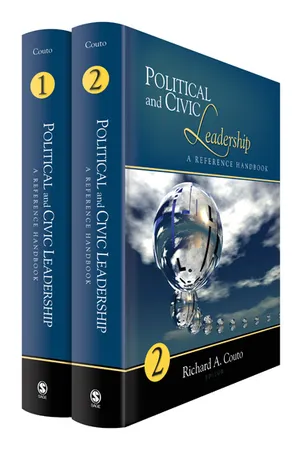 eBook - PDF
Political and Civic Leadership
A Reference Handbook
- Richard A. Couto(Author)
- 2010(Publication Date)
- SAGE Publications, Inc(Publisher)
For instance, Aristotle’s study of political regimes persuaded him that the presence of a strong middle class and an effective civic education were two key ingredients promoting stability. Those regimes that succeed in provid-ing political stability over time merit respect, given the fre-quency and ease with which political regimes collapse. This last observation offers a natural launching point for consideration of the conservative political tradition. Conservatism The conservative political tradition is associated with three recurrent themes. The first is the claim that substantial inequalities of power and other goods (including wealth, income, and social esteem) are morally justified and, indeed, are the hallmark of a decent society. The second is a posture of skepticism toward innovation, particularly rad-ical innovation, and respect for existing institutions. The third is a distrust of the masses and the belief that popular influence over political decision making should be at least partially offset by authority invested in a small elite or in individual statesmen. To be sure, not all conservative thinkers voice all these themes—as we shall shortly see, Plato’s Republic assumes the possibility of radical political and social reconstruction even as it goes on to defend thor-oughly hierarchical social arrangements. Moreover, actual conservative politics are often complemented by other themes, such as a concern with traditional social values and religion, nationalism and military strength, and (especially in recent times) celebration of free market economics. But 90 – • – II. PHILOSOPHY AND THEORIES OF POLITICAL AND CIVIC LEADERSHIP the three themes identified here are the most salient in understanding the conservative view of political leadership. Conservative thought regards hierarchy, inequality, and the investment of authority in particular leaders as both natural and just, reflecting actual inequalities of ability and virtue between leaders and followers.
Index pages curate the most relevant extracts from our library of academic textbooks. They’ve been created using an in-house natural language model (NLM), each adding context and meaning to key research topics.

