Politics & International Relations

Conservative Party
The Conservative Party is a major political party in the United Kingdom that traditionally advocates for free market policies, individual responsibility, and a strong national defense. It has historically been associated with conservatism, promoting traditional values and a limited role for the government in the economy. The party has been influential in shaping British politics and policies.
Written by Perlego with AI-assistance
Related key terms
1 of 5

4 Key excerpts on "Conservative Party"
 eBook - PDF
The Politics of Nationhood
Sovereignty, Britishness and Conservative Politics
- P. Lynch(Author)
- 1999(Publication Date)
- Palgrave Macmillan(Publisher)
Political ideas are important to Conservative politics, but are not its defining feature. British Conservatism is essentially a tradition of political practice, a concern with statecraft or government rather than ideological principle. Conservative ideas form an important backcloth, a sup- port mechanism for Conservative Party statecraft, rather than the guiding principles of a purposive ideology. 27 Thus, in an examina- tion of conservatism and the politics of nationhood, the prime focus should be on Conservative Party statecraft, assessing the means and ends of Conservative politics plus the relationship between populist patriotism and political strategy. The identification of the Conservative Party with the nation and nation-state was not one born solely (or even primarily) from an ideological attachment to the national community, but from considerations of party statecraft. Disraeli’s leadership was the pivotal moment in the development of a conservative state patriotism which formed a central plank of Conservative statecraft and self-image. For Lord Blake, ‘that then is Disraeli’s most lasting contribution to the success of this party. He made it the “national party”’. 28 The Conservative national strategy which developed in the late nineteenth century, whereby the poli- tics of nationhood became a central feature of party statecraft, had a number of core elements. (1) A concerted use of patriotic dis- course in which the Conservative Party was portrayed as the ‘national party’ and contrasted with an ‘anti-patriotic’ opposition. This was coupled with the popularization of conservative state patriotism through the myths and symbols of monarchy, Empire and national history. (2) A One Nation political strategy looking to national unity rather than sectional politics, rejecting alternative strategies such as a reactionary defence of landed interests staunchly opposing social and economic change.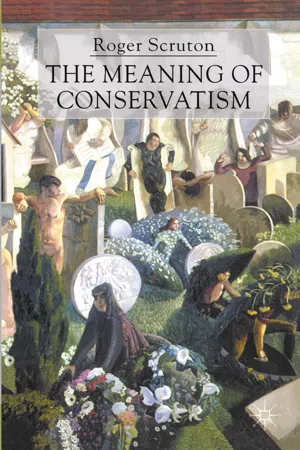 eBook - PDF
- Roger Scruton(Author)
- 2001(Publication Date)
- Palgrave Macmillan(Publisher)
1 The Conservative Attitude Conservatism is a stance that may be defined without identifying it with the policies of any party. Indeed, it may be a stance that appeals to a person for whom the whole idea of party is distasteful. In one of the first political manifestos of the English Conservative Party, appeal was explicitly made to 'that great and intelligent class of society ... which is far less interested in the contentions of party, than in the maintenance of order and the cause of good government' (Peel, The Tamworth Manifesto, 1834). Paradoxical though it may seem, it was from this aversion to factional politics that the Conservative Party grew. But it was an aversion rapidly overcome by another: that towards the chronic reform which only an organized party can successfully counter.? In England, therefore, conservatism has sought expression through the activity (or, just as often, through the strategic inactivity) of a particular party, a party dedicated to maintaining the structure and institutions of a society threatened by mercantile enthusiasm and social unrest. In recent years, the Conservative Party has often seemed to be about to break with its tradition; it has joined in the competitive market of reform, endorsing the delegation of power, the code of economic internationalism, the 'free market economy' which it once so strenuously opposed. It has presided over the reorganization of county boundaries, and of national currency, over the entry into Europe and the consequent surrender of legal autonomy. Under the impact of New Labour it has opted for a democratic second chamber, and is, at the time of writing, fighting to survive in the face of a conversion of its old elite to the idea of a Single European Currency, notwithstanding the resulting 4 The Conservative Attitude 5 loss of national sovereignty.
- John Charmley(Author)
- 2008(Publication Date)
- Bloomsbury Academic(Publisher)
1 The Conservative Tradition 1 The Conservative Party exists to conserve; it is the party of the status quo. Unfortunately for it and its adherents all things change – ‘the flower withereth and the grass fadeth’. In another world perhaps these things are restored and made new, but in this world the process of change poses a fundamental challenge to Conservatism as a political force. Many of those who vote Conservative do so because of an instinc-tive distaste for the consequences of change, but for a Conservative Party some accommodation with this process is inevitable – if only to ensure political survival. There is, then, a tension between instinctive Conservatism and expediency. Because of this, all Conservative leaders have faced charges of opportunism and betrayal; but historians have generally judged them by their success in adapting to change. Since the Conservative Party has existed for nearly 200 years, during which time Britain has changed beyond recognition, historians are agreed that the Party has been a great success; visceral Conservatives are less easily convinced. Even in 2005, after three successive election defeats, there were those in the Party who argued that its sufferings were due to its failure to abide by traditional values. This ‘Tory Taliban’ tendency, as one wag called it, has existed in every age, and its song has ever been the same: it harkens back to some bygone golden age, and calls its party to repentance and reformation of life. It might be unkind to point out that in the last golden glow of aristocratic rule, before the country went to the dogs, the Conservatives were, for the most part, in opposition, and that it was only with the advent of democracy that they came to dominate British politics; this always puzzled Marxists, since it ran counter to their theoretical model, but since 1989 those remaining disciples have had other things to distract them from this little local difficulty. eBook - PDF
The Primacy of Foreign Policy in British History, 1660–2000
How Strategic Concerns Shaped Modern Britain
- William Mulligan, Brendan Simms(Authors)
- 2010(Publication Date)
- Palgrave Macmillan(Publisher)
That allows us to develop an understanding of Conservative ideology which factors in approaches to international policy in its broadest sense. This may lead us to ask how far the divisions between and within parties have been influenced by interna- tional policy more generally. As it becomes increasingly clear that politics in the 1990s and the 2000s is divided along such lines, we may find more interesting parallels in the past than we have previously imagined. Much of twentieth-century British political history has been written in times when the crucial divisions within politics were about economic or social policy. As those divisions play less of a part in contemporary politics, and there- fore influence our own mindsets less, this is a time for taking a fresh look at the primacy of international issues in party politics at the very highest level. That politicians are motivated by ideals cannot be proven, but it is at least possible that politics is a more noble cause than Cowling ever allowed, one Richard S. Grayson 289 in which people fight for what they believe in. In that, international policy has been of central concern for many. Notes 1. R. S. Grayson (2001) Liberals, International Relations and Appeasement: The Liberal Party, 1919–39 (London: Frank Cass). 2. J. Callaghan (2007) The Labour Party and Foreign Policy: A History (London: Routledge). 3. M. Cowling (1971) The Impact of Labour 1920–1924: The Beginning of Modern British Politics (Cambridge: Cambridge University Press), p. 3. 4. HC Deb [Hansard], 27 June 2007 vol. CCCCLXII, part 113, col. 334. 5. R. S. Grayson (1997) Austen Chamberlain and the Commitment to Europe: British Foreign Policy, 1924–29 (London: Frank Cass). 6. R. Crowcroft (2008) ‘Maurice Cowling and the Writing of British Political History’, Contemporary British History, XXII, 279–286. 7. Cowling (1971), Impact of Labour, p. 3. 8. Crowcroft, ‘Cowling’, p. 282. 9. Ibid., pp. 284, 286. 10. Ibid., p. 284. 11. B.
Index pages curate the most relevant extracts from our library of academic textbooks. They’ve been created using an in-house natural language model (NLM), each adding context and meaning to key research topics.

