Politics & International Relations

Labour Party
The Labour Party is a center-left political party in the United Kingdom, advocating for social justice, workers' rights, and progressive policies. It was founded in 1900 and has been a major force in British politics, forming governments and advocating for policies such as nationalization of key industries, social welfare programs, and public healthcare.
Written by Perlego with AI-assistance
Related key terms
1 of 5

9 Key excerpts on "Labour Party"
 eBook - ePub
The Labour Party and the world, volume 2
Labour's foreign policy since 1951
- Rhiannon Vickers(Author)
- 2013(Publication Date)
- Manchester University Press(Publisher)
12 The Labour Party, however, has historically found this conception of foreign policy problematic, wanting to go beyond it with a call for foreign policy to be based upon moral purpose. This has been for two main reasons.First, the Labour Party has tended to encompass a wider spectrum of political opinions than the Conservative Party, and, with its emphasis on party democracy, has given greater importance to its extra-parliamentary institutions of policy-making. This has acted as a constraint on the party leadership. As outlined in Volume 1 of this study, given the Labour Party’s ideological and representational beginnings, and, particularly in its early years, the belief that the principles guiding domestic policy could be projected on to the international arena, different factions within the party have pulled foreign policy in different directions. There were five main influences on the early Labour Party. These were the trade union movement; the Independent Labour Party; the Social Democratic Federation, a British Marxist group; the Fabian Society; and radical Liberals, epitomised by the members of the Union of Democratic Control. Each of these groups had its own particular influence over the way that foreign policy and international affairs were thought about. Each had their own particular analytical framework for understanding relations between states, and each their own way of responding to concrete situations. These different influences provided a rich source for ideas on international politics, but also produced impulses towards Labour’s appropriate response to particular foreign policy issues which were sometimes antithetical to each other. This has added to the problems of developing a typology of the British Labour Party’s foreign policy, while also explaining in part the depth of the some of the intra-party conflict on international affairs.For believers in class struggle, the Labour Party’s role was to protect working-class interests, internationally as well as nationally, and to promote international working-class solidarity and socialist internationalism. The radical Liberals contributed greatly to Labour’s liberal internationalism, including the belief in self-determination, international justice, and in the workings of international organisations such as the League of Nations and the UN. For the ethical socialists and Nonconformists, pacifism and anti-militarism were important components of their worldview. The Independent Labour Party and the radical Liberals reinforced each other in their belief that militarism and secret diplomacy were the causes of war. Some of the radical Liberals influenced the Marxist perspective on the economic basis of inter-capitalist rivalry. These different contributing streams to Labour’s foreign policy often pulled in opposing directions, as evinced by the split over how to respond to the outbreak of the First World War in 1914, or debates over rearmament in the early 1930s.13 eBook - PDF
Social Democratic Parties in the European Union
History, Organization, Policies
- R. Ladrech, P. Marlière, R. Ladrech, P. Marlière(Authors)
- 1999(Publication Date)
- Palgrave Macmillan(Publisher)
Up to 1914, the party's electoral progress continued to depend in part upon co-operation with the Liberals in that an informal agreement operated whereby the two parties sought to avoid running parliamentary candidates against each other wherever possible (the original 'Lib-Lab Pact'). Given its eclectic socio-political background, it is not surprising that the early Labour Party lacked a distinctively socialist profile or a nation-wide mass-membership organization. Ideologically, it drew upon a melange of traditions; broadly speaking, these can be divided into socialist and labourist influences, though there were various significant sub-divisions, especially within the former camp. Given the predominance of the trade unions within the party's structure in the 1900s (they collectively accounted for 94 per cent of the initial affiliated membership), it is obvious that they should have had a 95 R. Ladrech et al., Social Democratic Parties in the European Union © Robert Ladrech and Philippe Marliere 1945 96 The British Labour Party profound influence on the ideology and ethos of the developing party. While it would be inaccurate to suggest that a monolithic union 'ideology' ever existed, many commentators have suggested that a typical union outlook has nevertheless permeated the Labour Party, typified by a 'labourist' approach to maximizing working-class gains within the economic structures and pro- cesses of capitalism, and within the political channels of parliamentarism (Leach, 1991; p. 134). Labour's socialist strand drew on a number of sub- traditions, including: Marxism (embodied in H.M. Hyndman's Social Demo- cratic Federation which was among the party's founder-affiliates); Christian socialism (hence former party General Secretary Morgan Phillips' oft-cited observation that Labour 'owes more to Methodism than to Marxism'); and Fabian social democracy (exemplified by the middle-class intellectual radic- alism of Sidney and Beatrice Webb). eBook - PDF
Against the Cold War
The History and Political Traditions of Pro-Sovietism in the British Labour Party, 1945-1989
- Darren G Lilleker(Author)
- 2004(Publication Date)
- I.B. Tauris(Publisher)
The internal divisions in the British Labour Party are amplified by the fact that the party was founded upon an alliance of autonomous or-ganisations. This factor led Shaw to conclude that Labour was “neither socialist nor… a party”. 3 He described the party as a confederation of societies that had amalgamated only because they represented, to differing extents, working class interests. This has led political analysts to define Labour’s ideology not as socialism but ‘labourism’; a coalition of group interests some of which can be described as ideological but, in general, are nothing more than political objectives derived from the interests of a sin-gle class. 4 We can therefore view Labour Party policy as having emerged 2 AGAINST THE COLD WAR out of a loose collection of ideological traditions, restricted by a traditional non-radical tendency within the electorate and the party’s structure and also by the existence of a largely right-wing parliamentary opposition. From this analysis we can recognise that socialist achievements, such as the na-tionalisation programme and foundation of the Welfare state, could only have been achieved in a consensual political atmosphere. 5 There is no easy way to characterise those parliamentarians who became known as the left-wing of the PLP. The left-wing traditions, which filtered into the ethos of the Labour Party, included the influence of Marx-ism and Trotskyism, libertarianism, intellectual humanism, Christianity and internationalism. It would be misleading to discuss the existence of a left-wing ideology, or indeed one definite labourist ideology. Across the party there existed divisions over the objectives that should be pursued, which were often dependent upon the individual’s socialist ideals. Furthermore, each of the ideological concepts held had blurred boundaries and lacked definite objectives relevant to everyday politicking. eBook - PDF
International Relations and the Labour Party
Intellectuals and Policy Making from 1918-1945
- Lucian Ashworth(Author)
- 2007(Publication Date)
- I.B. Tauris(Publisher)
A product of industrialisation, the rise of the Trades Union movement and the widening of the franchise, it was initially a coalition of affiliated trades unions, the Fabian society, the Marxist Social Democratic Federation (SDF, which left again a year later in 1901) and the largely non- 28 I NTERNATIONAL R ELATIONS AND THE L ABOUR P ART Y Marxist socialist Independent Labour Party (ILP). Formed out of a series of Trade Union Congress meetings in 1899 and 1900, the Labour Repre-sentation Committee, which was originally designed merely to promote candidates from the labouring classes, became the Labour Party after the 1906 election, when its thirty new MPs formed the first Parliamentary Labour Party (PLP). In addition to its affiliates, the Party structure now consisted of a Party Executive, the PLP and the annual Party Conference, the latter made up of the block votes of the affiliates and later on included the delegates of the Party constituency branches. Despite its important role, along with the Irish Party, in supporting the Liberal Governments of 1906 to 1915 (in exchange for concessions to Labour such as the repeal of the punitive Taff Vale judgement), it was still only the fourth largest party in Parliament behind the Irish Party. It also remained an ideologically and structurally ambiguous grouping. In sharp contrast to the social democratic and socialist parties now making major inroads into the centres of power in Germany and France, there was no unifying ideology for Labour, except a common commitment to the use of political action and a criticism of the existing society. 101 Although a mem-ber of the Second International, the Labour Party, in comparison with its larger sisters on the continent, appeared small and liberal, rather than socialist. eBook - ePub
- Bryan Evans, Ingo Schmidt(Authors)
- 2012(Publication Date)
- AU Press(Publisher)
THE BRITISHLabour Party In Search of Identity BetweenLabour and Parliament BYRON SHELDRICKThe British Labour Party has always held a unique place in the history of social democracy. As the birthplace of the Industrial Revolution, Britain can claim to have witnessed the emergence of the working class. The fact that Marx and Engels did much of their writing in England and based many of their observations on the conditions of the working class in its great industrial cities makes the history and trajectory of working-class politics and, by extension, the Labour Party, particularly significant. The Labour Party itself, however, has a history that, for many, is at best mixed. It has had high hopes yet has frequently failed to deliver (Coates 1996). The party has struggled to establish its identity: Is it a working-class party, a socialist party, or a party for all people? It has struggled to balance the conflicting demands of maintaining both electoral viability and a deep connection to its broader core constituencies.The inability to resolve these issues of identity has left the party particularly ill-suited to resolve the fundamental and deep contradictions of capitalism in Britain. As a result, despite relative electoral success in recent years, the party continues to be unable to provide a convincing response to economic crisis. Instead, it has retreated to a narrow electoralism based on an understanding of class not as a fundamental organizing principle of society but as a demographic construct for orienting electoral appeals. In part, this tendency reflects the historical origins of the Labour Party and the limits inherent to its structure. Rooted in the twin elements of labourism, on the one hand, and parliamentarianism, on the other, the party has never been able to develop a critical understanding of capitalism or of the limits and contradictions of the British economy. As a result, it has largely understood attempts to embed itself in the working class and to engage in an exercise of collective identity formation as fundamentally irreconcilable with electoral victory. eBook - PDF
Peace and Power in Cold War Britain
Media, Movements and Democracy, c.1945-68
- Christopher R. Hill(Author)
- 2018(Publication Date)
- Bloomsbury Academic(Publisher)
5 Labour and Political Communications The mobilization of popular opinion over defence and foreign policy has repeatedly brought the Labour Party into systemic crisis throughout its history, from the First World War to the invasion of Iraq in 2003. It has done so because of the ethical and structural diffi culties that this area of policymaking has entailed for a party with ideological roots in pacifism and a constitution that at least aspires to democratic participation. In the late 1950s and early 1960s, it was over nuclear disarmament that the entire constitutional framework and identity of the Labour Party was challenged; between and within the federal layers of the Parliamentary Party (PLP), the constituency parties (CLPs) and trade unions and between idealized models of the party as an extra-parliamentary movement and professionalized machine. 1 The issue of nuclear disarmament, then, was embedded in constitutional tensions over the conduct of party politics. These related not only to ideology, but also to political communication and practice and its embodiment in the party infrastructure, including the balance of representation among MPs, CLPs and trade unionists on the National Executive Committee (NEC) that administered the party as a whole. At their most basic and pronounced, these tensions were manifest in the activism and righteousness of the left and the managerialism and expediency of the right. They fed into debates over whether the Annual Conference or the PLP constituted the supreme instrument of policymaking, the former offering a ‘delegate democracy’ based on the party membership and the latter a pathway to parliamentary power based on the electorate. eBook - PDF
Class, Power and the State in Capitalist Society
Essays on Ralph Miliband
- P. Wetherly, C. Barrow, P. Burnham, P. Wetherly, C. Barrow, P. Burnham(Authors)
- 2007(Publication Date)
- Palgrave Macmillan(Publisher)
Labour leaders could now be cast in the role of reformist social planners (in the cap- italist context of course) solving problems with ‘the kind of good will, intelligence, knowledge and compassion which their Conservative opponents somehow lacked’ (Miliband, 1983b1, p. 108). Fourthly, the ideology of labourism is based on a restricted view of democracy which sees liberal capitalist democracy (the British model) as the most devel- oped and rational form of government conceivable. Grass roots acti- vism, direct democracy and extra-parliamentary activity all fall outside the ideological spectrum of labourism. Politics, in this model, is the preserve of the Parliamentary Party and in general terms there is neither interest nor enthusiasm in extending the political sphere to the working class or in mounting a sustained campaign of education on behalf of a socialist or even a reformist programme. Miliband (1983b1, p. 118) is emphatic: ‘ever since the Labour Party became a substantial electoral and political force, Labour leaders have taken the view – and have per- suaded many of their followers to take the view – that government was all; and that politics is about elections: on the one side, there is power, on the other, paralysis’. Furthermore, even within this framework, Labour leaders have shown little concern to reform the organization of the British state ‘so as to change the closed, oligarchic and profoundly conservative character of its administrative, judicial, police and mili- tary branches’ (Miliband, 1983b1, p. 108). Finally, labourism has a pro- foundly conservative and nationalistic approach to defence and foreign affairs. Sensitive to charges of being unpatriotic, Labour governments have sought to reassure foreign governments and investors and have continued long established trends in foreign policy (for example, the American alliance and NATO). Peter Burnham 53 eBook - PDF
- G. Taylor(Author)
- 1999(Publication Date)
- Palgrave Macmillan(Publisher)
The second area which requires attention is the internal policy- making structures of the party. Considerable and important changes have occurred in Labour's policy-making systems over the past few years and the question needs to be asked how this affects and will affect power relationships within the party. In short: whose positions have been strengthened by these changes and whose have been weakened? Finally, an area frequently neglected with regard to discussions of power within all parties is that of ideology, or what Drucker (1979) describes as ethos in respect of the Labour Party. This has been raised with regard to New Labour in particular because of the decision to amend Clause Four of the party's constitution which contained its main statement of ideological belief (Taylor, 1997, pp. 6-11). These last two together represent a major departure in previous elite dominance within the party and change the background to and the character of future power contests. What will be addressed here is what this means in terms of biasing future power struggles in particular directions, either towards particular groups within the party or towards particular policy outcomes. POLICY CONTROL Over the past fifteen years the Labour Party has gone through a quite remarkable promenade of policy restatements and initiatives. Ironically they began with the publication of Labour's Programme 1982 (Labour Party, 1982) which was intended as a codification of Labour's policies as agreed at the party's Annual Conference. The 280-page document was introduced by a foreword by Ron Hayward, then the party's General Secretary, which made no bones about the seat of policy-making power within the party: In the Labour Party, policy is made by the members. On all issues of principle, on all issues of fundamental policy, theirs is the final word. (Labour Party, 1982, p. 1)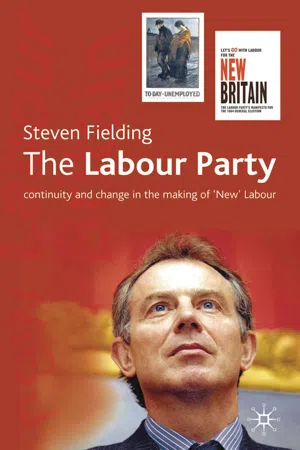 eBook - PDF
The Labour Party
Continuity and Change in the Making of 'New' Labour
- Steven Fielding(Author)
- 2017(Publication Date)
- Red Globe Press(Publisher)
An assessment of Labour’s founding 1918 constitution will indicate that the present leadership’s desire to minimize internal dissent is not exactly unique. This constitution restricted the members’ ability to influence policy, although they were still expected to help mobilize electoral support. In addition, while the constitution gave the unions a formally dominant position, in practice the party’s Westminster leadership enjoyed effective autonomy. This freedom was undermined during the Becoming Blair’s Party? 117 1970s when many active members and some union leaders asserted themselves. Thus, after 1983, Neil Kinnock set about restoring the lead-ership’s established position in order to facilitate policy change, yet it did not appear wise to simply restore the status quo ante. As a result, while reasserting the power of the leader, Kinnock and his successors also ‘modernized’ party organization to help it adapt to wider cultural changes. Consequently, as others have suggested, it will be argued here that although many of Labour’s organizational forms have changed in the recent past, the substantive position has altered less than it might appear (Tanner, 2000). Party Organization and Political Theory Before focusing on the impact of ‘New’ Labour on the party’s structures it is necessary first to locate the present within a wider perspective by briefly reviewing what leading students of political organizations have to contribute to our understanding of the subject. It is generally agreed that during the last 30 years or so the nature of political activity across the West has undergone a profound change. Many observers have detected a decline in civic engagement: social change has transformed active, publicly spirited citizens into passive, private-centred consumers. If this process has reached its apogee in the United States, that country merely embodies the future which awaits us all (Putnam, 2000).
Index pages curate the most relevant extracts from our library of academic textbooks. They’ve been created using an in-house natural language model (NLM), each adding context and meaning to key research topics.

