History

Constitutional Monarchy
A constitutional monarchy is a form of government in which a monarch acts as the head of state within the parameters of a constitution. The powers of the monarch are limited by the constitution, which often includes a system of checks and balances. This system allows for a separation of powers and the establishment of a parliamentary government alongside the monarchy.
Written by Perlego with AI-assistance
Related key terms
1 of 5


11 Key excerpts on "Constitutional Monarchy"
 eBook - ePub
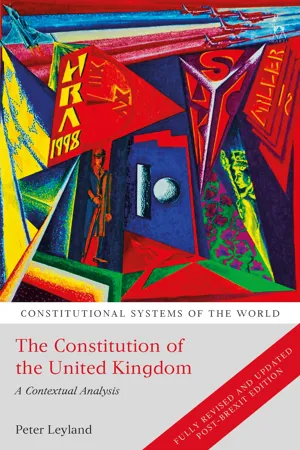
The Constitution of the United Kingdom
A Contextual Analysis
- Peter Leyland(Author)
- 2021(Publication Date)
- Hart Publishing(Publisher)
4Constitutional MonarchyMagna Carta – Royal Prerogative – Glorious Revolution – Abdication Crisis – Constitutional Monarchy – Head of State – The Crown – Defender of the Faith – Conferment of Honours – Liability in Contract and Tort – Preservation – AbolitionINTRODUCTIONT he united kingdom has a hereditary monarch as head of state. The Queen performs an important role as the personification of the nation. She appears on the national and international stage, and in this capacity she is often associated with occasions of pomp and ceremony that evoke memories of imperial glory. It is particularly this feature that distinguishes the British monarchy from its counterparts in the Netherlands, Belgium, and Scandinavia. However, as we shall see in the discussion that follows, although only limited power is exercised by the Queen on her own initiative, many constitutional functions still require her direct involvement. The path to Constitutional Monarchy has involved both the deliberate curtailment of royal power and its gradual erosion. The terminology is somewhat misleading. The government is still described as ‘Her Majesty’s government’, central government acts in the name of the Crown, and the courts are presided over by Her Majesty’s judges, but in modern times the monarch, although head of state, has a greatly subordinate constitutional role to Parliament, the government, and the courts. This is now accepted by reigning monarchs without question. In this chapter we will first discuss the institution of the monarchy, the royal prerogative, and the nature of the Crown as part of the current constitutional framework.During the Middle Ages and Tudor times kings and queens ruled through the exercise of the royal prerogative, but the idea that the powers of the monarch should be limited by law can be traced back at least as far as the Magna Carta of 1215. It was later established that general laws could not be made by way of proclamation – only Parliament could enact laws. It was also recognised that the King himself could not act as a judge, but must act through the judges in the courts. Since the Case of Proclamations1 it has been recognised that the scope of the prerogative can be determined by the courts.2 As we noted in Chapter 1 , the events of the seventeenth century, and in particular the Civil War 1642–49 and the ‘Glorious Revolution’ of 1688, are significant in English constitutional history because they signalled the decisive end of any pretensions to absolute monarchy, with most powers over legislation and delegated legislation eventually passing to Parliament. This coincided with the emergence of the doctrine of the supremacy of Parliament described by Dicey. This trend was reinforced in the eighteenth century with the Hanoverian succession of George I in 1714 to the throne, by which time ministers were directly responsible for the day-to-day running of government. The scope of government activity was then much more limited, with only a few Whitehall departments (such as the Treasury, the Foreign Office, and the Board of Trade), but as the foundations of the modern administrative state were laid in the late nineteenth and twentieth century, with the role of government being greatly expanded, so the monarch became increasingly peripheral to the central activities of the executive. In this sense, by the time of Queen Victoria it could be said of the monarch that: ‘she reigns but does not rule’.3 eBook - ePub
- Paul Barry Clarke, Joe Foweraker, Paul Barry Clarke, Joe Foweraker(Authors)
- 2003(Publication Date)
- Routledge(Publisher)
The French Revolution led in all European countries to demands for participation of elected representatives in power and to constitutions. Kings granted charters or were forced to accept constitutions limiting their powers. France became a republic, but with the exception of the USA, Switzerland, and for a short time Hungary and Spain, all countries were monarchies and even the independent Balkan states and Belgium established new dynasties. In the twentieth century, first in Portugal and then, after their defeat in the First World War when the German, Austro-Hungarian and Russian empires were overthrown, new republics were proclaimed. In the interwar years, seven of the European monarchies became stable democracies. In six other monarchies, democratisation was frustrated by dictatorship, in several with the support of the kings. The first seven are still parliamentary democratic monarchies, to which the instauration of the monarchy in Spain was added in 1975, when King Juan Carlos inherited all powers of the state from Franco as a king in a newly created monarchy. By 1978, a political and popular consensus legitimised the king’s dynastic rights as head of state while limiting his functions to those of a constitutional monarch. Of the sixteen European republics between 1918 and 1939, only five democracies survived. One could even argue, therefore, that monarchies contributed to democratic stability.The apparent contradiction between monarchs and democracies is resolved in modern societies through what one calls a Constitutional Monarchy where the legitimisation of the office comes from the constitutional system chosen by the people and the monarch does not rule. This system is valid as long as the office gathers enough popular support. The performance of each individual monarch influences this popular support, but scholarship tends to attribute more importance in constitutional democracies to the office of the monarch rather than to the individual as ‘was unambiguously demonstrated in Britain during the abdication crisis of Edward VIII’ (Rose and Kavanagh 1976: 550).Evolution rather than revolution has made the British system of government, replicated in other countries once part of the British Empire, such as Canada, Australia and New Zealand, a model when describing the workings of a Constitutional Monarchy. At the end of the nineteenth century, Walter Bagehot characterised it and defined the functions of an archetypal constitutional monarch as the dignified part of the constitution. It is the theory that, as a general rule, in a democratic Constitutional Monarchy a monarch reigns but does not rule, being the symbol and the embodiment of the historical continuity of the state but limited in its actions to the directives of the government which, as the emanation of the popular will through regular elections, is the one who directs the national and international policy of the state. This is in contrast to the nineteenth-century non-democratic constitutional monarchies, in which the government did not need the confidence of parliament or where there was the principle of the dual confidence of parliament and king. What are then the functions left to the monarch? Bagehot indicates that he possesses the right to be consulted, to encourage and to warn. The function of advice is important. The monarch is the recipient of a vast amount of information that he or she accumulates through time, which, with good judgement, allows him to form opinions that go beyond the political moment. This, as well as his or her position above party politics, not owing any role in elections, allows him or her to give advice to the government as a non-partisan member of the Cabinet, and also to the opposition. Furthermore, he or she is a player that, thanks to deference accorded to monarchy, cannot be ignored. Another function of the monarch is that of mediator in political difficulties, a good example being the beneficial role of King Juan Carlos in Spain during and after the failed coup of 1981. eBook - ePub
This Realm of New Zealand
The Sovereign, the Governor-General, the Crown
- Janet McLean, Alison Quentin-Baxter(Authors)
- 2017(Publication Date)
- Auckland University Press(Publisher)
In this chapter we explain some of the underlying concepts and principles of the British constitutional system which New Zealand has inherited. They have been essential to the development and operation of the Constitutional Monarchy and will be discussed more fully in the later chapters — particularly Chapters 8 to 11. We also explain that some of the ideas historically associated with the monarchy of an earlier age never came to apply in New Zealand. That is true, as we will show, in respect of the Queen’s role in the tenure of land.2FROM MONARCHY TO Constitutional Monarchy
Any explanation of how a monarchical system developed into a Constitutional Monarchy begins in England — and long before the United Kingdom Government sent its representatives to Aotearoa/New Zealand.When George III, acting without or contrary to ministerial advice, tried to collect taxes from the North American colonies, they rebelled and declared themselves to be a republic. After winning the revolutionary war, the “Founding Fathers” drafted a constitution for the newly independent state. The Sovereign was replaced by what was, in effect, an elected King called the President who headed the executive branch of government. Influenced by Montesquieu’s arguments for the separation of the executive, legislative and judicial powers, the constitution provided for the separate election of the members of a bicameral legislature. It was essential to the framers of the US Constitution that there should be rivalry and contest between the executive and legislative branches of government. This was intended to create limits on government action.British political leaders reacted in their own way to George III’s attempts to act independently of his Ministers. He was the last British monarch to have such success in imposing his will. The Kings and Queens who followed sometimes had strong opinions which they made known to their Ministers, but, generally speaking, they observed what had come to be seen as their duty to act on the advice of their responsible advisers. Democracy was not achieved by a revolution or a completely new constitutional beginning but by a process of constitutional evolution. No longer available |Learn more
- (Author)
- 2014(Publication Date)
- The English Press(Publisher)
Constitutional role In the uncodified Constitution of the United Kingdom, the Monarch (otherwise referred to as the Sovereign, the Crown, or His/Her Majesty, abbreviated H.M.) is the Head of State. Oaths of allegiance are made to the Queen and her lawful successors. God Save the Queen (or God Save the King ) is the British national anthem, and the monarch appears on postage stamps, coins, and banknotes. The Monarch takes little direct part in Government. The decisions to exercise sovereign powers are delegated from the Monarch, either by statute or by convention, to Ministers or officers of the Crown, or other public bodies, exclusive of the Monarch personally. Thus the acts of state done in the name of the Crown, such as Crown Appointments, even if personally performed by the Monarch, such as the Queen's Speech and the State Opening of Parliament, depend upon decisions made elsewhere: • Legislative power is exercised by the Crown in Parliament, by and with the advice and consent of Parliament, the House of Lords and the House of Commons. • Executive power is exercised by Her Majesty's Government, which comprises Ministers, primarily the Prime Minister and the Cabinet, which is technically a committee of the Privy Council. They have the direction of the Armed Forces of the Crown, the Civil Service and other Crown Servants such as the Diplomatic and Secret Services (the Queen receives certain foreign intelligence reports before the Prime Minister does). • Judicial power is vested in the Judiciary, who by constitution and statute have judicial independence of the Government • The Church of England, of which the Monarch is the head, has its own legislative, judicial and executive structures. • Powers independent of government are legally granted to other public bodies by statute or statutory instrument such as an Order-in-Council, Royal Commission or otherwise. • Apart from members of parliament and local authorities, no public officers are elected.
- Woodrow Wilson(Author)
- 2019(Publication Date)
- Columbia University Press(Publisher)
CONSTITUTIONAL GOVERNMENT IN THE UNITED STATES i WHAT 18 CONSTITUTIONAL GOVERNMENT? MY object in the following lectures is to examine the government of the United States as a constitutional system as simply and directly as possible, with an eye to practice, not to theory. And yet at the very outset it is necessary to pause upon a theory. The government of the United States cannot be intelligently discussed as a constitutional system until we clearly determine what we mean by a constitutional government; and the answer to that question is in effect a theory of politics. By a constitutional government we, of course, do not mean merely a government conducted according to the provisions of a definite constitution; for every modern government with which our thoughts deal at all has a definite constitution, written or unwritten, and we should not dream of speaking of all modern governments as constitutional. Not even when their constitutions are written with the utmost definiteness of formulation. The constitution of England, the most famous of constitutional governments and in a sense the mother of them all, is not 2 CONSTITUTIONAL GOVERNMENT IN UNITED STATES written, and the constitution of Russia might be without changing the essential character of the Czar's power. A constitutional government is one whose powers have been adapted to the interests of its people and to the mainte-nance of individual liberty. That, in brief, is the concep-tion we constantly make use of, but seldom analyze, when we speak of constitutional governments. Roughly speaking, constitutional government may be said to have had its rise at Runnymede, when the barons of England exacted Magna Carta of John; and that famous transaction we may take as the dramatic embodiment alike of the theory and of the practice we seek. The barons met John at Runnymede, a body of armed men in counsel, for a parley which, should it not end as they wished it to end, was to be but a prelude to rebellion. eBook - PDF
The Invisible Crown
The First Principle of Canadian Government
- David E. Smith(Author)
- 2019(Publication Date)
- University of Toronto Press(Publisher)
At its end, however, it was indisputable that in this country monarchy partook of a trinity. Thus, far from being an easy idea to comprehend, in Canada - a federation within an empire -monarchy required a sophisticated and expansive apprecia-tion of constitutional matters and relationships. The early history of the Canadian constitution is in large part the his-tory of these subjects as the country progressed along the road to auton-omy. By the time of the Statute of Westminster in 1931, which recognized the dominions as equal in status to Great Britain, the rules governing relations between governors general and their ministers mirrored those existing between the monarch and his ministers. Moreover, the office had been opened to local residents, an invitation Australia immediately (though temporarily) accepted in 1931 but Canada delayed acting upon until 1952. At that point evolution seemed to end, and rather than crystallize and clarify its position, the meaning of monarchy in modern Canada grew more not less opaque, thus inverting Bagehot's index of intelligibility. The reason is not far to seek: in a country increasingly worried about unity and sensitive to symbols, the Crown gained gov-ernment little in authority. Instead, during the last thirty years the monarchy has been overshadowed by the quest to reform the efficient The Monarchical Idea 5 institutions of government and federalism. With one notable exception in the late 1970s, the Canadian monarchy drifted in a constitutional backwater from where it failed to rouse passion, certainly none approaching the feeling expressed in the cause of Senate reform or even, for that matter, interprovincial free trade. Although Canadians seem willing to ignore and depreciate its impor-tance, the monarchical principle is the organizing principle of Canadian government. eBook - ePub
A Resilient Crown
Canada's Monarchy at the Platinum Jubilee
- D. Michael Jackson, Christopher McCreery, D. Michael Jackson, Christopher McCreery(Authors)
- 2022(Publication Date)
- Dundurn Press(Publisher)
Part OneA Constitutional Monarchy Passage contains an image
1 The Crown, the Queen, and the Structure of the Constitution
Warren J. NewmaniIntroduction
The Constitution of Canada reserves a central place for the Queen, and more broadly, the Crown, in its preamble and substantive provisions. The latter embody a series of underlying fundamental principles which are, in turn, protected by a web of unwritten conventions, practices, and understandings that govern how regal powers ought to be exercised and constitutional machinery should operate. The prerogatives appertaining to the Crown recognized by the common law, as well as the provisions of certain statutes of a constitutional character, complete the portrait.The modest ambition of this chapter is to provide an overview of and introduction to the constitutional framework outlined above, particularly as it relates to the relevant features of the monarchy in Canada. It is only by gaining an accurate understanding of the basic constitutional structure that one can then begin to appreciate the subtle, complex, and dynamic interactions that take place in applying the formal laws and underlying principles of the Constitution in relation to the Crown in Canada.Happily, one need not possess the vocation of a constitutional lawyer, historian, or political scientist to grasp these truths. All it takes is an overall sense of the constitutional design — the “constitutional architecture,” as the Supreme Court of Canada has called it — to realize the extent to which the institutions and principles of monarchy form an integral, and indeed pivotal, part of our constitution.The Constitution of Canada
The formal Constitution of Canada, as defined by the Constitution Act, 1982, begins with the Constitution Act, 1867 — the original British North America Act — and includes more than thirty statutes, amendments, and other instruments. Naturally, as our constitution is the fruit of evolution, not revolution, a venerable constitutional tradition has also sustained its growth and interpretation. “Behind the written word is an historical lineage stretching back through the ages,” the Supreme Court emphasized in the Quebec Secession Reference.1 eBook - PDF
Early Modern Europe
Issues and Interpretations
- James B. Collins, Karen L. Taylor, James B. Collins, Karen L. Taylor(Authors)
- 2008(Publication Date)
- Wiley-Blackwell(Publisher)
The further development of these written statements of political functions within the frame-work of a changing society and economy led, after the periods of representative monarchy and absolutism, to the constitutions of the present day. It has been their function, since the written constitutions of the North American states and the French Revolution, 8 to define “the total struc-ture of the state in a single written document” and to lay down “certain basic propositions con-cerning its essential structure”. 9 Under the constitutional monarchies of the nineteenth century, such instruments were agreed mainly between the ruler and the elected national assembly. They determined the areas of competence proper to the different organs of state, the king, the govern-ment, the national assembly and the law, as well as state bodies like the civil service and the army; in addition they laid down the principles underlying the cultural, social and economic order. As in the case of all historical development, the line from contractual monarchy to modern constitutionalism was not straight. Only in the organization of the government apparatus can one see a purposeful development. The other side of political life, the part played by representative institutions, 10 suffered a severe setback in the age of Absolutism and was realized only piecemeal, in new forms and in a new spirit, by revolutionary acts. In the period of representative constitu-tions we find the most varied attempts on the part of the estates to secure participation in the organs of state which were evolving under the guidance of the sovereign, in the expanding admin-istrative and legal apparatus, in military affairs, and particularly in the financial and fiscal sphere. eBook - PDF
The Constitutional Systems of the Commonwealth Caribbean
A Contextual Analysis
- Derek O'Brien(Author)
- 2014(Publication Date)
- Hart Publishing(Publisher)
2 The Head of State Background – The Crown as Head of State – The Constitutional Framework – Judicial Review of the Constitutional Functions of Presidents and Governors General – Conclusion PART I: BACKGROUND U PON ATTAINING INDEPENDENCE all the Commonwealth Caribbean countries adopted a parliamentary system of govern-ment. This was a system with which their politicians were by then familiar, following the end of ‘Crown Colony rule’, and was considered preferable to striking out in an entirely new direction by, for example, adopting a presidential system of government as favoured by their Latin American neighbours. One of the defining features of the parliamentary system is, of course, the separation of the head of gov-ernment, and the head of state; the latter being either a constitutional monarch or a ceremonial president with the word ‘ceremonial’ here being used to indicate that political power is exercised not by the head of state, as is the case under an executive presidency, but by the head of government. 1 Under a parliamentary system, the head of state is generally regarded as having two principal roles to play. The first, which is largely symbolic, and which encompasses a wide range of ceremonial duties, is to serve as the representative of the nation, a focus for national unity and continuity. 1 See DV Verney, ‘Parliamentary Government and Presidential Government’ in A Lijphart (ed), Parliamentary Versus Presidential Government (Oxford, Oxford University Press, 1992). 38 The Head of State The second is to perform a number of constitutional functions, such as assenting to legislation, appointing the Prime Minister and dissolving Parliament. The exercise of these functions is usually regulated by a set of rules, which are intended to ensure that the head of state acts at all times in accordance with the advice of the Prime Minister. eBook - PDF
The Second Creation
Fixing the American Constitution in the Founding Era
- Jonathan Gienapp(Author)
- 2018(Publication Date)
- Belknap Press(Publisher)
10 Because the British constitution was primarily customary in character, it was as much a description of how law and government actually functioned as a prescription for how it ought to work. This was especially true when the constitution was identified in the political institutions that embodied it. The so-called mixed constitution balanced the three organic social es-tates of the realm—the crown, lords, and commons—by instantiating each in a coequal body of government—the monarchy, House of Lords, and House of Commons. Such a notion of mixed constitutionalism had ex-isted for centuries, but the British incarnation was celebrated for curbing arbitrary authority and protecting liberty. Blackstone wrote in 1765 in his massively influential Commentaries on the Laws of England, “herein indeed consists the true excellence of the English government, that all the parts of it form a mutual check upon each other. . . . Like three distinct powers in mechanics, they jointly impel the machine of govern-ment in a direction . . . which constitutes the true line of liberty and hap-piness of the community.” 11 But while the constitution was often descriptive, it was nonetheless simultaneously prescriptive in character. It could be both located in govern-ment practices and yet distinguished from them. Writing in 1733, Henry St. John, Viscount Bolingbroke, captured this complex duality: “By con-stitution we mean, whenever we speak with propriety and exactness, that assemblage of laws, institutions and customs . . . that compose the general system.” Yet, concurrently, the constitution was also “derived from certain the second creation 28 fixed principles of reason . . . according to which the community hath agreed to be governed,” making it both the assemblage of political and legal practices and yet something outside of them. eBook - PDF
Ideology and Strategy
A Century of Swedish Politics
- Leif Lewin(Author)
- 1989(Publication Date)
- Cambridge University Press(Publisher)
Parliamentarism 1. FOUR CONCEPTS OF MONARCHY Ever since the 1880s, the monarchy had shown newly awakened political ambitions. During the tariff dispute, Oscar II had taken the opportunity to demonstrate his power by using his constitutional prerogative to dis- solve the Second Chamber, which had long been regarded as a dead letter. 1 Sweden's system of government, the king reasoned, was "constitutional but not parliamentary in the modern sense of this word." Consequently, the "verdict of the ballot box" alone should not determine the shape of the government. 2 During the suffrage dispute, the king had once again used his prerogative, this time negatively by citing the right of the mon- archy in principle to refuse to dissolve the Second Chamber when there were good reasons for adopting such a position. 3 The new king, Gustaf V, who assumed the throne in 1907, shared his father's constitutional views in all essential respects. The same period had also witnessed the emergence of a more and more ideologically conscious Left, with its roots in the political forces that members of Parliament had unwillingly helped unleash during the tariff dispute. Leftists advocated parliamentary government, as opposed to the division of powers specified in the Constitution. The controversy con- cerned the role of the king in the formation of a government. Did he have the right to choose his advisers freely, or did he have to yield to the wishes of a majority of Parliament? When the first election following the suffrage reform of 1907-1909 again made Karl Staaff the prime minister, a trial of strength between these two philosophies was inevitable. Sweden was thrown into a dramatic constitutional crisis whose high points were marked by the Farmers' March, the Palace Courtyard crisis, the resigna- tion of the Staaff government, and the formation of a "royal government" 1 Chapter 2, Section 2. 2 Ibid. 3 Chapter 3, Section 2. 87
Index pages curate the most relevant extracts from our library of academic textbooks. They’ve been created using an in-house natural language model (NLM), each adding context and meaning to key research topics.

