History

Royal Absolutism
Royal absolutism refers to a system of government where the monarch holds absolute power and authority, often justified by the divine right of kings. This form of governance was prominent in Europe during the 17th and 18th centuries, with rulers such as Louis XIV of France exemplifying its principles. Royal absolutism centralized power in the hands of the monarch, diminishing the influence of nobles and other governing bodies.
Written by Perlego with AI-assistance
Related key terms
1 of 5
8 Key excerpts on "Royal Absolutism"
 eBook - ePub
- Cesare Cuttica, Glenn Burgess, Cesare Cuttica, Glenn Burgess(Authors)
- 2015(Publication Date)
- Routledge(Publisher)
29Confronted by this cauldron of divergent interpretations, the historian aims to tease out the presence and status of some recurrent conceptual features. Accordingly, to facilitate our task we might start with Johann Sommerville’s definition of absolutism as a theory arguing that ‘the ruler in any state holds sovereign authority, cannot be actively resisted, can change existing constitutional arrangements in a case of necessity (though he ought otherwise to maintain them), and should be obeyed by his subjects provided that his commands are not contrary to those of God and nature’.30 This, however, is essentially a definition of a theory of sovereignty . The chapters below suggest that there is a contextual element as well, that theories historians are willing to label ‘absolutist’ usually functioned in particular contexts as attempts to elevate the (personal) authority of a monarch over other institutions. In that sense, a theory of absolutism is the application of a theory of sovereignty to the institution of monarchy, and can be distinguished from more impersonal theories of state sovereignty (though the two can be combined).III
This volume is structured in a thematic way. Each section focuses on a few major interpretative categories in order to give a complex and innovative picture of the multiple threads informing absolutist and monarchist political discourse across Europe between the late Middle Ages and the Enlightenment. This method should help to untangle the richness of topics and the complexity of meanings emerging from the works analysed. In this respect, we hope to have provided new coordinates with which to map out the territory of early modern absolutism. Through its chronological frame, our collection suggests patterns of both change and continuity informing the paradigm of absolute monarchical power and its interactions with government across Europe.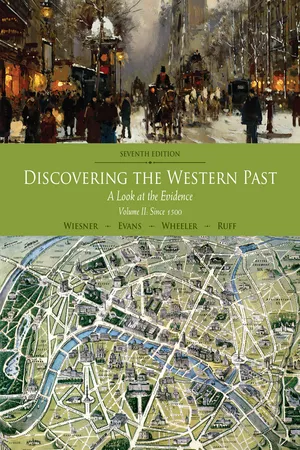 eBook - PDF
Discovering the Western Past
A Look at the Evidence, Volume II: Since 1500
- Merry E. Wiesner-Hanks, Andrew Evans, William Bruce Wheeler, Julius Ruff(Authors)
- 2014(Publication Date)
- Cengage Learning EMEA(Publisher)
[49] CHAPTER THREE STAGING ABSOLUTISM THE PROBLEM The “Age of Absolutism” is the label historians often apply to the history of Europe in the seventeenth and eigh-teenth centuries. In many ways it is an appropriate description because, with the exception of the Dutch Re-public and England (where the Civil War of 1642–1648 and the Glorious Revolution of 1688 severely limited royal power), most major European states in this era had monarchs who aspired to absolute authority in their realms. The Royal Absolutism that evolved in seventeenth-century Europe rep-resents an important step in govern-mental development. In constructing absolutist states, monarchs and their ministers both created new organs of administration and built on existing institutions of government to sup-plant the regional authorities of the medieval state with more central-ized state power. In principle, this centralized authority was subject to the absolute authority of the mon-arch; in practice, royal authority was nowhere as encompassing as that of a modern dictator. Poor communica-tion systems, the persistence of tradi-tional privileges that exempted whole regions or social groups from full royal authority, and other factors all set limits on royal power. Neverthe-less, monarchs of the era strove for the ideal of absolute royal power, and France was the model in their work of state building. French monarchs of the seven-teenth and early eighteenth centuries more fully developed the system of absolute monarchy. In these rulers’ efforts to overcome impediments to royal authority, we can learn much about the creation of absolutism in Europe. Rulers in Prussia, Austria, Russia, and many smaller states sought not only the real power of the French kings, but also the elaborate court ceremony and dazzling palaces that symbolized that power. Absolutism in France was the work of Henry IV (r. 1589–1610), Copyright 201 Cengage Learning.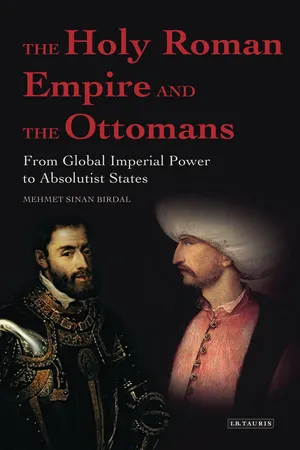 eBook - PDF
The Holy Roman Empire and the Ottomans
From Global Imperial Power to Absolutist States
- Mehmet Sinan Birdal(Author)
- 2011(Publication Date)
- I.B. Tauris(Publisher)
The literature on the origins of the absolutist state reveals the extent of social and political transformations that yielded the early modern state and the state system. As the review here demonstrates, the absolutist state marked an unprecedented level of centralization of political authority which manifested itself in three main domains: administration, taxation and foreign policy. In all these domains the state managed to achieve and sustain a stable coordination of the ruling class. This political and social coordination was the foundation for the emergence of the early modern state as a unitary actor in world politics. Thenceforth, the state would claim exclusive authority in domestic as well as foreign policy. According to Perry Anderson, the absolutist state was a precursor of the modern state. In the sixteenth century, the centralized monarchies in France, England and Spain broke with the pyramidal, parcellized sovereignty of medieval social formations, with their estates and liege-systems. 35 Absolutism was a reaction of the feudal aristocracy to commercialization; the transformation of the serf into a wage laborer could be prevented by the displacement of politico-legal coercion upwards to a centralized state. With the help of Roman law, the sovereignty of the state was established in more absolute terms and the fief system was turned into an allodial regime – an absolute, inalienable property regime. While transforming feudal ownership into private property, the absolutist state also used the sale of offices as a means of centralization and control over the tax-exempt aristocracy. 36 The emergence of the absolutist state also transformed the state system. Since the absolutist state was still aristocratic in character, the calling of aristocrats, i.e. war-making, remained the political rationale of the absolutist state. The absolutist ideology, mercantilism, was based on a zero-sum model of international politics. eBook - ePub
The Myth of Absolutism
Change & Continuity in Early Modern European Monarchy
- Nicholas Henshall(Author)
- 2014(Publication Date)
- Routledge(Publisher)
CHAPTER SIXA Theory of Absolutism?
Most critics of ‘absolutism’ as a concept have focused on the practice of governments. They have exposed the extent to which rulers failed to achieve their programmes. But the theory of ‘absolutism’ has been assumed rather than examined. The question is whether such a theory existed in early modern times. We start with the three ruler classifications used in early modern Europe – monarch, republic and despot. Then we shall see if we require another to make sense of the story.PROBLEMS OF EVIDENCE
Forms of government were regulated by a constitution, which laid down the distribution, procedures and limits of public power. Constitutions were usually customary, resulting from tacit agreement by the community about the best way of satisfying its collective needs. They might include written items, such as the English constitution’s Magna Carta and Declaration of Rights, but their weight rested on the acceptance of a customary way of doing things. Nineteenth-century European Liberals considered customary constitutions to be no constitutions at all, since they had benefited from what they considered the superior arrangements of the late eighteenth century -getting fundamentals on paper.The lack of written constitutions before the 1770s has an important consequence for historians. A definitive statement about the source and limits of power was beyond the capacities of contemporaries. Controversy rumbled at the time and subequently. Before we enter the fray, let us be clear that the Bourbon constitution had little objective existence. It was merely the sum total of what people said and thought about it at the time. Nor did the monarchs of seventeenth-century France ever make an official statement about the extent and nature of their power. A few one-liners are attributed to Louis XIV, including the notorious ‘L’état, c’est moi’ – which can be made to fit any theory of Bourbon power that one chooses. His motto was nec pluribus impar , which is Versailles-speak for ‘I’m the greatest’. It scarcely amounts to a political theory. He also wrote his Memoirs eBook - PDF
Seventeenth-Century Europe
State, Conflict and Social Order in Europe 1598-1700
- Thomas Munck(Author)
- 2017(Publication Date)
- Bloomsbury Academic(Publisher)
11 Absolute monarchy and the return of order after 1660 The later seventeenth century may be regarded as the period when absolute monarchy reached its classic form – a monarchy unlimited in law, seeking to project the King as an unchallengeable (even divinely ordained) judge and prince, underpinned by an administrative machinery whereby the daily exercise of power from the centre would become an accepted fact. This became in effect the ‘normal’ type of government in Europe for the next century or more. Yet, perhaps because the notion of monarchy was itself meant to be something of a divine mystery, there are relatively few formal statements of constitu-tional law from this period which can help clarify what precisely was intended. An unambiguous text is that of the substantial law code promulgated in Denmark in 1683, Danske Lov , whose very first arti-cle made clear that the monarch: alone has supreme authority to draw up laws and ordinances according to his will and pleasure, and to elaborate, change, extend, delimit and even entirely annul laws previously promulgated by himself or his ancestors. He can likewise exempt from the letter of the law whatsoever or whomso-ever he wishes. He alone has supreme power and authority to appoint or dismiss at will all officials regardless of their rank, name or title; thus offices and functions of all kinds must derive their authority from the absolute power of the King. He has sole supreme authority over the entire clergy, from the highest to the lowest, in order to regulate church func-tions and divine service. He orders or prohibits as he sees fit all meetings and assemblies on religious affairs, in accordance with the word of God and the Augsburg Confession. He alone has the right to arm his subjects, to conduct war, and to conclude or abrogate alliances with whomever he wishes at any time. eBook - ePub
The Emergence of Modern Europe
c. 1500 to 1788
- Britannica Educational Publishing, Heather Campbell(Authors)
- 2010(Publication Date)
- Britannica Educational Publishing(Publisher)
intendants (administrative officials), first used extensively by Richelieu, then, after their abolition during the Fronde, more systematically and with ever-widening responsibilities, by Louis XIV and his successors until 1789.Louis XIV (b. Sept. 5, 1638, Saint-Germain-en-Laye, France—d. Sept. 1, 1715, Versailles)The king of France from 1643 to 1715, Louis XIV ruled during one of France’s most brilliant periods. Known as the Sun King, he remains the preeminent symbol of absolute monarchy. He succeeded his father, Louis XIII, at age four, under the regency of his mother, Anne of Austria. In 1648 the nobles and the Paris Parlement, who hated the prime minister, Cardinal Mazarin, rose against the crown and started the Fronde revolt. In 1653, victorious over the rebels, Mazarin gained absolute power, though the king was of age. In 1660 Louis married Marie-Thérèse of Austria (1638–83), daughter of Philip IV of Spain. When Mazarin died in 1661, Louis astonished his ministers by informing them that he intended to assume responsibility for ruling the kingdom. A believer in dictatorship by divine right, he viewed himself as God’s representative on earth. He was assisted by his able ministers, Jean-Baptiste Colbert and the marquis de Louvois. Louis weakened the nobles’ power by making them dependent on the crown. A patron of the arts, he protected writers and devoted himself to building splendid palaces, including the extravagant Versailles, where he kept most of the nobility under his watchful eye. In 1667 he invaded the Spanish Netherlands in the War of Devolution (1667–68) and again in 1672 in the Third Dutch War. The Sun King was at his zenith; he had extended France’s northern and eastern borders and was adored at his court. In 1680 a scandal involving his mistress, the marchioness de Montespan (1641–1707), made him fearful for his reputation, and he openly renounced pleasure. The queen died in 1683, and he secretly married the pious marchioness de Maintenon. After trying to convert French Protestants by force, he revoked the Edict of Nantes in 1685. Fear of his expansionism led to alliances against France during the War of the Grand Alliance (1688–97) and the War of the Spanish Succession (1701–14). Louis died at age 77 at the end of the longest reign in European history. eBook - PDF
The Modern World-System I
Capitalist Agriculture and the Origins of the European World-Economy in the Sixteenth Century
- Immanuel Wallerstein(Author)
- 2011(Publication Date)
- University of California Press(Publisher)
It meant that the energy of men of all strata had to turn in significant part to the conquest of the political kingdom. To be sure, we are still talking in this era of a relatively small bureaucracy, certainly by comparison with contemporary Europe. 16 But the difference of size and structure by com-14 See, for example, Max Beloff, The Age of Absolutism, 1660-1815 (New York: Harper, 1962). 15 What then accounted for the difference between an actual absolutism in the 16th century and a theoretical absolutism in the middle ages, one which never became actual or only momentarily, noncontinuously, and intermittently? We must seek our answer in a new internal struc-tural organ of the State, that is in the reinforcement and extension of and the power acquired by the corps of public servants, the 'officers' of the King (or of the Prince)—what we call today the 'bureauc-racy'—which had come to the forefront of public life, and was involved in the daily activity of the State. Above all, as regards external affairs. Chabod, Actes du Colloque, pp. 63-64. Edouard Perroy argues this process began in France as early as the thirteenth century: The prog-ress of the private authority of the king of France, both seigniorial and feudal, led to the development of the organs of [central] power. . . . [in] the last quarter of the thirteenth century, royal power, without ceasing to become ever stronger, began to be transformed in its nature, under the influence of two factors. One was the idea of absolutism, that of public power [sov-ereignty]. . . . The other, equally important, was the pressure of the king's own men, whose numbers grew greatly with the growing complexity of administration and the ever expanded use of wri-ting: a new class was coming into existence, that of the agents of power, of the men of the law and the pen. eBook - PDF
- S.-J. Savonius-Wroth, Paul Schuurman, Jonathan Walmsley, S.-J. Savonius-Wroth, Paul Schuurman, Jonathan Walmsley(Authors)
- 2014(Publication Date)
- Bloomsbury Academic(Publisher)
ABSOLUTISM In the Two Treatises of Government (1689), Locke’s insistence that political authority derived from the collective consent of rational individuals was directed against rival theories of natural subjection and unlimited allegiance to absolute authority, particularly as advanced in Sir Robert F ILMER ’s Patriarcha (1680). Defining absolute government as a condition in which a ruler held ‘both Legislative and Executive Power in himself alone’, Locke regarded such claims as both false and politically dangerous. First, he equated obedience to absolute author-ity with political slavery in submitting oneself ‘to the inconstant, uncertain, unknown, Arbitrary Will of another Man’ ( TTG II.22). For this reason, ‘Absolute Monarchy, which by some Men is counted the only Government in the World, is indeed inconsistent with Civil Society, and so can be no Form of Civil Government at all’ ( TTG II.90). Although undivided political sovereignty could, in theory, be vested in governments comprised of the one, the few or the many, Locke always assumed absolute authority to imply government of the one: monarchy. Secondly, Locke was alarmed by the theoretical fragility of Filmer’s adherence to a ‘strange kind of domineering Phantom, called the Fatherhood, which whoever could catch, presently got Empire, and unlimited absolute Power’ ( TTG I.6). Rejecting the par-allels Filmer had drawn between paternal and political power, Locke sought to demonstrate that his opponent’s patriarchal derivation of absolute authority conferred neither legitimacy nor secure grounds for obedience. Although the main purpose of identifying the source of political authority was to differentiate between legitimate and illegitimate power, Locke claimed that Filmer’s Patriarcha instead ‘cuts up all Government by the Roots’ ( TTG I.126). Accordingly, ‘a Book, which was to provide Chains for all Mankind’, Locke perceived to be ‘but a Rope of Sand’ ( TTG I.1).
Index pages curate the most relevant extracts from our library of academic textbooks. They’ve been created using an in-house natural language model (NLM), each adding context and meaning to key research topics.

