History

Darwinism
Darwinism refers to the theory of evolution developed by Charles Darwin, which posits that all species of organisms arise and develop through the natural selection of small, inherited variations that increase the individual's ability to compete, survive, and reproduce. This theory has had a profound impact on the fields of biology, anthropology, and philosophy, shaping our understanding of the natural world and human origins.
Written by Perlego with AI-assistance
Related key terms
1 of 5


11 Key excerpts on "Darwinism"
- Michael Ruse(Author)
- 2013(Publication Date)
- Cambridge University Press(Publisher)
G 2 18 g G E s say 2 6 g Darwinism in Britain Peter Bowler C harting the course of evolutionism in Britain can be seen as an exer- cise in trying to understand the emergence of and response to what became known as “Darwinism.” Thomas Henry Huxley coined the term and tried to control how it was used – he was, of course, known as “Darwin’s bulldog” because of his aggressive support for the theory. But Darwinism certainly didn’t entail complete acceptance of the program outlined in the Origin of Species, because even Huxley would not have been a Darwinian on those terms (Fig. 26.1). To understand what was going on in the context of the time, we must be aware that the meaning of the term “Darwinism” has also changed over time. In the modern world it usually refers to the theory of evolution by natural selection. But in the late nineteenth century many evolutionists who did not believe that natural selection was the main mechanism of evolution called themselves “Darwinians.” The true value of the selection theory was recognized only in the twentieth century, so the contemporary reception of Darwin’s theory has to be understood in terms of a much broader debate over what evolution- ism entailed. To many ordinary people, Darwin simply became a symbol or figurehead for a generalized evolutionary philosophy, probably entailing notions of progress and the struggle for existence. In his later life, his face became familiar to all thanks to the pub- lication of portraits and caricatures – often emphasizing certain apelike aspects of his features – published in popular magazines (Browne 2002). Even at this level there were ambiguities, though. Our vision of the initial debate over the Origin of Species has been shaped by the negative reaction of conservative religious thinkers and by Huxley’s strident anticlericalism, both fueling the claim that evolution and Christianity are incompatible. eBook - PDF
Contributions to a History of Developmental Psychology
International William T. Preyer Symposium
- Georg Eckardt, Wolfgang G. Bringmann, Lothar Sprung, Georg Eckardt, Wolfgang G. Bringmann, Lothar Sprung(Authors)
- 2013(Publication Date)
- De Gruyter Mouton(Publisher)
A predilection to consider the past, especially as it informed explanation of the present and augured the future, began to emerge in the intellectual climate. Partly as a result of the publication of Darwin's Origin of Species in 1859, the notions of temporality, historicity, and open-ended development began spreading through nineteenth-century science and letters. 21 Overcoming the preexisting barrier of antagonism between science and history was as important a contribution of Darwin in this regard as was his evolution theory. 22 Prior to evolution theory the subject matter of science was essentially static, whereas the subject matter of history was essentially progressive. Following Darwin both areas of thought viewed their subject matter in terms of the genetic concept of evolution, a capitulation (Collingwood says) of the scientific perspective to the historical. 23 Scientific inquiry—indeed, most intellectual study—became infused with history. Even metaphysicians, such as Adam Sedgwick (1785-1873), and theoretically-inclined scien-tists, such as Louis Agassiz (1807-1873), felt obliged to produce progressionist theories, explicitly intending to reconcile scientific advance with Christian cosmology. In these efforts, development was admitted into the system, but in a human-centered, teleological way; change and emergence were not products of the natural process of evol-ution, but of miracle. A thorough natural scientific rendering of the evolution of organic species was considered blasphemous and, as Sedgwick intoned, a brutalizing blow upon the social fabric. In the period immediately preceding and following the publication of Darwin's Origin restric-tions on the openness with which scientists could address questions of evolution from a natural science perspective were quite apparent. Whereas Herbert Spencer (1820-1903) and Thomas H.Huxley (1825-1895) openly defended evolutionary theory, others such as Charles Lyell and Robert Chambers were far more discreet. eBook - PDF
- Paul Thagard(Author)
- 2018(Publication Date)
- Princeton University Press(Publisher)
Science and religion were not yet di- vided into separate spheres, and famous scientists wrote treatises proclaiming how the complexity of nature could only be explained by divine creation. William Paley's (1963) natural theology, with its descriptions of wonderfully adapted biological structures such as the eye, impressed many scientists, in- cluding the young Darwin. Just as the development of Lavoisier's oxygen theory must be understood against the background of the phlogiston theory, so Darwin's theory of evolution must be seen as a direct challenge to the creationist views of his contemporaries. This challenge was potentially heret- ical, as well as conceptually revolutionary, which partially explains why Dar- win kept his theory to himself and a few trustworthy friends for twenty years. What was Darwin's theory? He was by no means the originator of the hypothesis that species evolved. For example, Jean Lamarck in 1809 and Robert Chambers in 1844 published books that proclaimed the transmutation of species. Darwin's own grandfather, Erasmus Darwin, had still earlier writ- ten a book in verse that advocated what we now call evolution. But Charles Darwin understood evolution very differently from these earlier thinkers, since he saw natural selection as the primary mechanism that produced evolu- tion. According to Lamarck, organisms have both an inherent tendency to increase in complexity and a capacity to inherit acquired characteristics that are useful in particular environments. Darwin did not reject the inheritance of acquired characteristics, a rejection that occurred only with the development of Mendelian genetics early in the twentieth century. But he viewed changes in species that resulted from environmental influences as much less important for biological evolution than the changes that resulted from random variation and natural selection. Darwin was born in 1809 and graduated, with no particular distinction, from Cambridge University in 1831.
- Warren Breckman, Peter E. Gordon(Authors)
- 2019(Publication Date)
- Cambridge University Press(Publisher)
The challenge is to give that diversity its due without denying that there is a history of social Darwinism to tell – and, ideally, explain – as part of the history of Darwinism. 3 “Darwinism” Curiously, “social Darwinism” has a more traditionally stable meaning than “Darwinism” itself. Sometimes “Darwinism” is treated as a synonym for “evolution.” A history-of-science commonplace has it that in the Origin of Species Darwin furnished a new argument for an old idea, evolution, which went back at least to the days of Darwin’s grandfather, the physician Erasmus 2 Lyell to Darwin, October 3 and 4, 1859, and Darwin to Lyell, October 11, 1859, Darwin Correspondence Project, letters 2501, 3132, and 2503; for discussion see Mike Dixon and Gregory Radick, Darwin in Ilkley (Stroud: History Press, 2009), Chapter 2. 3 Recent overviews rising to this challenge include Diane B. Paul, “Darwin, Social Darwinism and Eugenics,” in The Cambridge Companion to Darwin, ed. Jonathan Hodge and Gregory Radick, 2nd edn. (Cambridge: Cambridge University Press, 2009), 219–245; and Mike Hawkins, Social Darwinism in European and American Thought 1860–1945 (Cambridge: Cambridge University Press, 1997). Darwinism and Social Darwinism 281 Darwin, and his French contemporary, the Paris naturalist Jean-Baptiste de Lamarck. Unquestionably, there was nothing new in the idea of the mut- ability of species, which can be found in ancient Greek and Roman writings. Yet the word “evolution” does not appear in the 1859 first edition of the Origin of Species. The term carried associations of planned directionality that, as we saw in the run-up exchange with Lyell, Darwin was keen to avoid. And though Darwin studied the work of his grandfather and others who wrote on species mutability or, to use a term favored at the time, “transmutation,” the Origin of Species’ two main proposals were at least as novel as the argument mounted in support of them. eBook - PDF
Charles Darwin
The Shaping of Evolutionary Thinking
- Lance Workman(Author)
- 2017(Publication Date)
- Red Globe Press(Publisher)
56 As we have seen, Darwin’s theories did not appear in a social or a scientific vacuum. He was strongly influenced by a number of great thinkers and went on to influence many other prominent thinkers. Many scientists and philosophers of the late nineteenth and early twentieth century, although influenced by Darwin, introduced their own ingredients into the Darwinian stew. The term ‘Darwinism’ took on subtly different meanings to different people as each strove to make sense of and apply evolutionary theory to their own worldview. Today Darwinism remains a vague term to many, and the seeds of this confusion were sown by the writers of this time. In this chapter we explore both the biological progress that was made during the years following Darwin’s death and the prominent writ- ers who were influenced by his ideas. We will see that, whilst many within biology refined and developed the concept of Darwinian evolution, others who took his ideas into field outside of biology often did so to prop up their own political and philosophical ideologies (as we have already seen in the case of Spencer – see Chapter 2). Before we examine these philo- sophical figures, however, there is some unfinished biological business to attend to as the demise of natural selection proved to be premature. Natural selection – The wilderness years At the time of his death Darwin was famous for his many discoveries and in particular for providing strong evidence that evolution had taken place. However, as we have seen, his theory to explain evolutionary change – natural selection – had dropped out of favour by the late nineteenth century. The main sticking point was that the physical mechanism of inheritance was unknown during Darwin’s lifetime. This lack of a physi- cal basis for natural selection, combined with the problems outlined 4 Darwin and Darwinism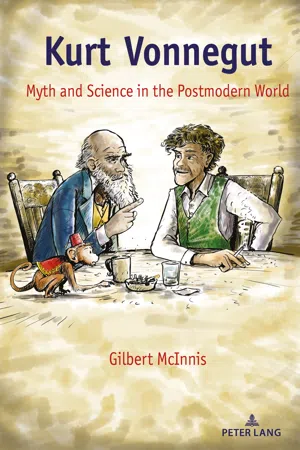 eBook - PDF
Kurt Vonnegut
Myth and Science in the Postmodern World
- Gilbert McInnis(Author)
- 2020(Publication Date)
- Peter Lang Group(Publisher)
C H A P T E R O N E Darwinism, Social Darwinism, and Mythology Before moving on to examine the mythological implications of Darwin’s theory of evolution by natural selection in Vonnegut’s writings and in Darwin’s too, I need to deal with an issue that continues to be an ongoing problem in the academic world. This issue is the problem of the willed ambivalence of many academics (and scientists) who refuse to accept Darwin’s science as “social,” and therefore to accept the idea that there is no distinction between Darwin’s ideas on the one hand and the principles of social Darwinism on the other. After careful examination of key passages from both The Origin of Species By Means of Natural Selection, or the Preservation of Favoured Races In the Struggle for Life (1859) and The Descent of Man (1874), I agree with many others that Darwin, in addition to being strictly a scientist, was in fact the first social Darwinist. Robert Young describes various misunderstandings of social Darwinism: One definition presents social Darwinism as ‘the type of theory that attempts to describe and explain social phenomena chiefly in terms of competition and conflict, especially the competition of group with group and the equilibrium and adjustment that ensues upon such struggles’… Another described it as ‘the name loosely given to the application to society of the doctrine of the struggle for existence and survival of the fittest’… Another definition said that it’s ‘the more general adaptation of Darwinian, and related biological concepts to social ideologies’… A last example was: ‘a ruthless form of laissez-faire that it has become fashionable to “social Darwinism’”(621). eBook - PDF
- Robert Jurmain, Lynn Kilgore, Wenda Trevathan, Eric Bartelink(Authors)
- 2016(Publication Date)
- Cengage Learning EMEA(Publisher)
Having said this, we must recognize that Western science borrowed many of its ideas from other cultures, especially the Arabs, Indians, and Chinese. In fact, intel-lectuals in these cultures and in ancient Greece had developed notions of biological evolution centuries before Charles Darwin (Teresi, 2002), but they never formulated them into a cohesive theory. Copyright 2017 Cengage Learning. All Rights Reserved. May not be copied, scanned, or duplicated, in whole or in part. Due to electronic rights, some third party content may be suppressed from the eBook and/or eChapter(s). Editorial review has deemed that any suppressed content does not materially affect the overall learning experience. Cengage Learning reserves the right to remove additional content at any time if subsequent rights restrictions require it. A BRIEF HISTORY OF EVOLUTIONARY THOUGHT 27 27 Charles Darwin was the first person to explain the basic mechanics of the evo-lutionary process. But while he was developing his theory of natural selection , a Scottish naturalist named Alfred Russel Wallace independently reached the same conclusion. That natural selection, the single most important force of evolutionary change, was proposed at more or less the same time by two British men in the mid-nineteenth century may seem like a strange coincidence. But actually, if Darwin and Wallace hadn’t made their simultaneous discoveries, someone else soon would have, and that someone would probably have been British or French. That’s because the groundwork had already been laid in Britain and France, and many scientists there were prepared to accept explanations of biological change that would have been unacceptable even 25 years before. Like other human endeavors, scientific knowledge is usually gained through a series of small steps rather than giant leaps. Just as technological change is based on past achievements, scientific knowledge builds on previously developed theories. eBook - PDF
When History Accelerates
Essays on Rapid Social Change, Complexity and Creativity
- C. M. Hann(Author)
- 2016(Publication Date)
- Bloomsbury Academic(Publisher)
Bannister, R.C. (1979) Social Darwinism: Science and Myth in Anglo-American Social Thought, Philadelphia: Temple University Press, Bertram, C. (1990) 'International competition in historical materialism', New Left Review, 183, 116-28. Bock, K. (1955) 'Darwin and social theory', Philosophy of Science, 22, 2, 123-34. Bock, K. (1966) 'The comparative method of anthropology', Comparative Studies in Society and History, 8, 3, 269-80. Bock, K. (1980) Human Nature and History: A Response to Sociobiology, New York: Columbia University Press. Bowler, P.J. (1984) Evolution: The History of an Idea, Berkeley, CA: University of California Press. Burrow, J.W. (1966) Evolution and society: A Study in Victorian Social Theory, Cambridge: Cambridge University Press. Byrne, R. and A. Whiten (1988) Machiavellian Intelligence: Social Expertise and the Evolution of the Intellect in Monkeys, Apes and Humans, Oxford: Clarendon. Canithers, M. (1992) Why Humans Have Cultures: Explaining Anthropology and Social Diversity, Oxford: Oxford University Press. Clifford, W.K. (1901) [1879] Lectures and Essays, ed. Leslie Stephen and Sir Frederick Maitland, 3rd edn, 2 vols, London: Macmillan. Cloak, F.T. jr. (1975) 'Is a cultural ethology possible?', Human Ecology, 3, 3, 161-82. Collini, S„ D. Winch and J. Burrow (1983) That Noble Science of Politics: A Study in Nineteenth-Century Intellectual History, Cambridge: Cambridge University Press. Collins, R. (1988) Theoretical Sociology, San Diego, CA: Harcourt Brace Jovanovich. Daniel, G. (1962) The Idea of Prehistory, London: CA. Watts. Darlington, CD. (1959) Darwin's Place in History, Oxford: Basil Blackwell. Darwin, C (1902) [1859] On the Origin of Species by Means of Natural Selection. Or The Preservation of Favoured Races In The Struggle for Life, London: Grant Richards. 50 When History Accelerates Darwin, C. (1901) [1871] The Descent of Man and Selection in Relation to Sex, London: John Murray.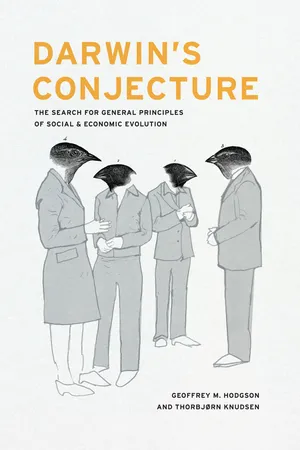 eBook - PDF
Darwin's Conjecture
The Search for General Principles of Social and Economic Evolution
- Geoffrey M. Hodgson, Thorbjørn Knudsen(Authors)
- 2010(Publication Date)
- University of Chicago Press(Publisher)
Evolutionary discourse was, instead, dominated by Spencerian and other ideas of automatic progress or develop-ment, with the causal mechanisms inadequately explained. The publication of August Weismann’s ( 1 893) critique of the doctrine of acquired character inheritance turned the tide against Lamarckism and Spencerism in biology, but perceived problems with Darwinism remained. Even the emergence of Mendelian genetics in the early years of the twentieth century did not immediately rescue Darwinism. Indeed, Mendelian genetics and mechanisms such as mutation (De Vries 1 909) were seen as alternatives rather than complements to Darwin’s ideas. It was not until the 1 940s that the synthesis between Mendelian genetics and Darwinism was achieved. 1 6 c h a p t e r o n e To be extended to the social sciences, Darwinian ideas had to overcome the resistance of strong intellectual traditions that either minimized the ap-plication of common principles to both biology and the social sciences or saw those principles as being non-Darwinian in nature. The influential so-ciologist Émile Durkheim excluded both biological and psychological ex-planations from his theory. Karl Marx and Frederick Engels found “dialec-tics” in both nature and human society, but they declared that the scope of Darwinism was confined to biology (Singer 1 999; Hodgson 2006a). In the surge of nationalism before and during the First World War, phrases such as Spencer’s survival of the fittest and Darwin’s struggle for existence were given nationalist and racist associations. Vaguely Darwinian ideas were also bandied about to justify or illustrate all sorts of contradic-tory social and political stances, including nationalism, militarism, imperi-alism, free trade, individualism, socialism, and even pacifism (Himmelfarb 1 959, 407). eBook - PDF
Science and Religion
Some Historical Perspectives
- John Hedley Brooke(Author)
- 2014(Publication Date)
- Cambridge University Press(Publisher)
But from the standpoint of twentieth- century humanism, Darwin’s theory was the focus, if not the cause, of a transition into a modern world in which humanity could no longer delude itself that there was a caring providence, that pain and suffering had an ultimate 415 Science and Religion rationale, or that there was any destiny other than engi- neering the future course of evolution. This was, however, a destiny of a kind. And if social improvement, even human perfectibility, was grounded in a law of nature, then there was a basis for a secular religion pursued with all the fervor of the sacred. The vocabulary of its exponents does indeed suggest that sci- entific naturalism could take on the mantle of a religion in which human values were corroborated, if not positively derivable, from the facts of biology. T. H. Huxley would preach what he called “lay sermons” to a public whose con- sciousness of the value of science he sought to raise. His campaign to gain greater social prestige for the scientific professional, having as its corollary the exclusion of the clerical amateur, can easily be parodied as the bid to cre- ate a “church scientific.” For Herbert Spencer there was a power behind evolution, an “Unknowable Power” that nevertheless made for righteousness. In 1884 he declared that it was a power that “stands towards our general con- ception of things, in substantially the same relation as does the Creative Power asserted by Theology.” For Darwin’s cousin Francis Galton, as for Huxley, it was vital that any prerogatives claimed by the clergy to control the machin- ery of education should be denied. The pursuit of science, he wrote, is “uncongenial to the priestly character.” As a member of the scientific priesthood, Galton had his alter- native religion, which he called practical Darwinism. eBook - PDF
- Robert Jurmain, Lynn Kilgore, Wenda Trevathan, Russell Ciochon(Authors)
- 2017(Publication Date)
- Cengage Learning EMEA(Publisher)
That natural selection, the single most important force of evolution-ary change, was proposed at more or less the same time by two British men in the mid-nineteenth century may seem like a strange coincidence. But actually if Dar-win and Wallace hadn’t made their simultaneous discoveries, someone else soon would have, and that someone would probably have been British or French. That’s because the groundwork had already been laid in Britain and France, and many sci-entists there were prepared to accept explanations of biological change that would have been unacceptable even 25 years before. In science as in other human endeavors, knowledge is usually gained through a series of small steps rather than giant leaps. Just as technological change is based on past achievements, scientific knowledge builds on previously developed theo-ries. Therefore, it’s informative to examine the development of ideas that led Darwin and Wallace to independently arrive at the theory of evolution by natural selection. Throughout the Middle Ages, one predominant feature of the European world-view was that all aspects of nature, including all forms of life and their relationships to one another, never changed. This view was partly shaped by a feudal society that was itself a rigid class system that had barely changed for centuries. But the most important influence was an extremely powerful religious system in which the teach-ings of Christianity were held to be the only “truth.” Consequently it was generally accepted that all life on earth had been created by God exactly as it existed in the present and the belief that life-forms could not and did not change, came to be known as fixity of species . Anyone who questioned these notions of fixity, especially in the fifteenth and sixteenth centuries, could be accused of challenging God’s perfec-tion, which was heresy.
Index pages curate the most relevant extracts from our library of academic textbooks. They’ve been created using an in-house natural language model (NLM), each adding context and meaning to key research topics.
