History

Enlightenment Ideologies
Enlightenment ideologies were a set of philosophical and intellectual ideas that emerged in Europe during the 18th century. They emphasized reason, individualism, and the rights of the individual. Key concepts included the belief in progress, the importance of education, and the promotion of freedom and equality. These ideologies had a profound impact on politics, society, and culture, influencing movements such as the American and French Revolutions.
Written by Perlego with AI-assistance
Related key terms
1 of 5

10 Key excerpts on "Enlightenment Ideologies"
 eBook - PDF
- Encyclopaedia Britannica, Inc.(Authors)
- 2008(Publication Date)
- Encyclopaedia Britannica, Inc.(Publisher)
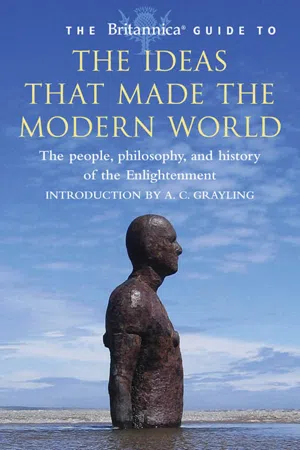
1 A HISTORY OF THE ENLIGHTENMENT The Enlightenment (in French the Sie Ácle des Lumie Áres ( ``Age of the Enlightened''), in German Aufkla È rung ) swept through Europe in the 17th and 18th centuries. With new ideas con-cerning God, reason, nature, and man, the Enlightenment offered a world view that gained wide assent and instigated revolutionary developments in art, philosophy, and politics. Central to Enlightenment thought were the use and the cele-bration of reason, the power by which man understands the universe and improves his own condition. The goals of ra-tional man were considered to be knowledge, freedom, and happiness. The Enlightenment was both a movement and a state of mind. The term represents a phase in the intellectual history of Europe, but it also serves to define the programmes of reform advocated by influential French writers, philosophers, and scientists, known as ``philosophes'', who were inspired by a common faith in the possibility of a better world. The special significance of the Enlightenment lies in its combination of principle and pragmatism. There are two traditional schools of thought regarding its character and achievements. The first sees the Enlightenment as the preserve of an elite centred on Paris and as primarily a French movement, while the second perceives it as an inter-national phenomenon with as many facets as there were countries affected. Although most modern interpreters incline to the latter view, there is still a case for the French emphasis, given the genius of a number of the philosophes and their associates. Unlike other terms applied by historians ``the Enlightenment'' was used and cherished by those who believed in the power of the mind to liberate and improve.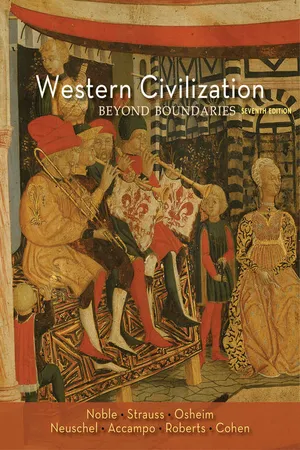 eBook - PDF
Western Civilization
Beyond Boundaries
- Thomas F. X. Noble, Barry Strauss, Duane Osheim, Kristen Neuschel(Authors)
- 2013(Publication Date)
- Cengage Learning EMEA(Publisher)
514 Chapter 18 Europe on the Threshold of Modernity, ca. 1715–1789 Profound changes in economic and social life accompanied this revolution in intel- lectual and political spheres. The increasing economic and strategic importance of overseas colonies made them important focal points of international conflict. Economic growth spurred population growth, which in turn stimulated industry and trade. As the century closed, Europe was on the threshold of truly revolutionary changes in politics and production that had their roots in the intellectual, economic, and social ferment of eighteenth-century life. The Enlightenment What were the most important ideas in Enlightenment thought, and what were some of the intellectual, social, and political conditions that favored its development? The Enlightenment was an intellectual movement that brought to political and social questions the confidence in the intelligibility of natural law that Newton and other scientists had recently achieved. Following Descartes and Locke, Enlightenment thinkers believed that human beings could discern and work in concert with the laws of nature for the betterment of human life. Above all, Enlightenment thought gave people the confidence to question tradition. A belief grew that society must be grounded on rational foundations to be determined by humans, not arbitrary foundations determined by tradition and justified by religious authority. Enlightenment thought was debated in increasingly widespread publications, such as newspapers. There were new opportunities for exchanging views in literary societies, salons, and cafés. These new means of sharing information ensured that informed public opinion would become a new force in political and cultural life. Given this broad base, Enlightenment thinking was certain to challenge the very foundations of social and political order. eBook - PDF
- Stephen Eric Bronner(Author)
- 2004(Publication Date)
- Columbia University Press(Publisher)
Western na-tions still carry the scars of racism, sexism, homophobia, xenophobia, and class inequality. Enlightenment thinkers evidenced anticipatory insights, speculations, and contradictory views on an extraordinary variety of issues. The less sys-tematic the thinker, it is possible to assume, the more perverse the ways in which his or her ideas could be appropriated. Enlightenment thinkers, how-ever, were rarely endorsed or embraced by conservative or fascist political movements: it is hard to imagine a bust of Locke or Voltaire sitting on the desk of Mussolini. The philosophes had their most profound impact on the Left: Locke and Kant influenced all manner of liberals, socialists, and anar-chists. Beccaria, Holbach, and Adam Smith were deeply committed to moral development and social reform. Thomas Paine is among the founders of modern internationalism. There is hardly a genuinely democratic regime that is not indebted to Montesquieu. Enlightenment philosophers would in-spire generations of those languishing under the weight of despotism and dogma. The extent to which their political contribution is forgotten is the extent to which the contemporary left will constantly find itself intellectual-ly reinventing the wheel. The Enlightenment privileged a critical reflection on society, its tradi-tions, its ideologies, and its institutions. Its spirit was opposed from the beginning, both in terms of style and content, by the type of fanaticism ev-idenced yesterday by secular totalitarians and today by religious funda-mentalists. Just as there is a spirit of the Enlightenment, there is a phe-nomenology of the anti-Enlightenment. The language of both has—often unwittingly—carried over into the modern age. A lack of awareness about the past, however, has undermined the ability to make sense of the pres-ent. Arguing that the Enlightenment with its emphasis upon civil liberties, METAPHYSICS, TRADITION, AND POLITICS 7 eBook - PDF
- Gerald F Gaus, Chandran Kukathas, Gerald F Gaus, Chandran Kukathas(Authors)
- 2004(Publication Date)
- SAGE Publications Ltd(Publisher)
For a generation after World War II the liberal aspects of eighteenth-century thought enjoyed an enthusiastic revival, although misgivings about the ‘Enligh-tenment project’ that had been expressed earlier continued to be pursued by scholars of the Frankfurt School. Recent years have seen a renewal of criticisms, some new and some amounting to variations on older themes. Conservatives deplore the Enlightenment’s overconfident utopianism or reformism, communitarians its individualism, multiculturalists its universalism, feminists its patri-archalism, Foucauldians and critical theorists its legacy of technologies of social control and manip-ulation, postcolonial theorists its endorsement of Eurocentrism and imperialism, and postmodernists its earnest embrace of foundationalism (e.g. MacIntyre, 1984; 1988; Rorty, 1989; Gray, 1995). To actual scholars of the period, however, it seems that the very concept of ‘the Enlightenment’, and especially the notion of a unitary ‘Enlightenment project’, have often been constructed by the critics and bear little relation to what is found in the texts of the period (Schmidt, 2000). Certainly the moral and political theories of the Enlightenment are far more complex and diverse than the criticisms imply, with such key figures as Montesquieu, Rousseau, and Hume scarcely fitting such stereotypes as ‘rationalism’ or disregard of history and context. Nevertheless, each age rewrites history from its own perspective, including the history of political thought, and new questions have and will continue to provoke new research into what will doubtless continue to be referred to by many, if sometimes obscurely, as the Enlightenment. A noteworthy feature of recent Anglophone political philosophy has been a relative decline in the stature accorded to Locke, for two unrelated reasons. eBook - PDF
- Richard Stivers(Author)
- 2008(Publication Date)
- SUNY Press(Publisher)
The rising middle classes per- ceived that the extant political and economic order was unjust. 12 En- lightenment ideology was first and foremost middle-class ideology. It would be hard to do justice to the wealth of treatises and essays during this period. For my purposes I want to contrast British and French thought in the Enlightenment in the persons of John Locke and Jean-Jacques Rousseau. The former represents a type of liberal- ism that greatly influenced the American Revolution and the found- ing of America; the latter, a kind of humanism that informed the French Revolution and with the concept of a “social contract” aided 14 The Illusion of Freedom and Equality the American Revolution as well. In these two writers (with occa- sional brief discussions of related authors such as Adam Smith and Benjamin Constant), we can discover the tension in Enlightenment thought between individualism and holism. Are freedom and equality to be defined exclusively in terms of the individual, or are they to be articulated in an interpersonal or societal context? JOHN LOCKE AND LIBERALISM John Locke wrote that individuals are according to their nature free and equal. Humans possess natural rights, and these rights are equal for all members of the species. These rights include: (1) the right to life; (2) the right to freedom from the arbitrary control of one’s actions and possessions; (3) and the right to property. 13 This final right, as we will see later, introduces inconsistencies if not con- tradictions into his theory. Above all, the liberalism of the late seventeenth century through the mid-nineteenth century, was a champion of the individual. Al- though theorists continued to discuss nature, nature’s laws, and human nature, they examined them from a scientific rather than a religious perspective. Locke’s psychology was a combination of ra- tional hedonism and “sensationalism.” Human beings, in this view, are rational in the pursuit of pleasure and the avoidance of pain. eBook - PDF
What Is Enlightenment?
Eighteenth-Century Answers and Twentieth-Century Questions
- James Schmidt(Author)
- 1996(Publication Date)
- University of California Press(Publisher)
Introduction What Is Enlightenment? A Question, Its Context, and Some Consequences James Schmidt The Enlightenment has been blamed for many things. It has been held re-sponsible for the French Revolution, for totalitarianism, and for the view that nature is simply an object to be dominated, manipulated, and ex-ploited. It has also been implicated in one way or another in European imperialism and the most aggressive aspects of capitalism. While some have insisted that its skepticism about absolute values infects our culture with a nihilistic sluggishness, others have suggested that liberal societies should divest themselves of the Enlightenment's obsession with philosophical foun-dations. I It is said that its passion for rights and liberties unleashed a de-structive individualism that undermines any sense of community.2 Yet it has also been argued that its assumption that human nature was infinitely malleable has provided the intellectual inspiration for attempts by total-itarian states to eradIcate all traces of individuality from their subjects. 3 It has been criticized for its insensitivity to the tragic character of moral con-flicts and for its naive assumption that all dilemmas have simple solutions. 4 It has been argued that its attempt to construct a moral philosophy ended in failure, leaving us with either an impoverished moral vision that sup-presses all values that cannot be reduced to instrumental efficiency or a corrupted moral discourse in which ethical evaluations are nothing more than a mask for individual preferences. s It has been castigated for its affec-tion for master metanarratives and its hostility toward otherness.6 Its racism and its sexism have not passed unnoticed. 7 Looking over this list of charges, one wonders how one period could have been responsible for so much and so many different kinds of harm. eBook - PDF
- Katerina Deligiorgi(Author)
- 2012(Publication Date)
- SUNY Press(Publisher)
Indeed, if we are to pay close attention to historical con- text as Klein urges us to do, then we must also acknowledge the present historical context in which enlightenment becomes a question for us today. This context is informed by the self-image of contemporary Western culture as, for good or ill, the inheritor culture of the Enlightenment. I say “for good or ill” because the value of this inheri- tance is a matter of fierce contestation. In these competing assessments what is presented as philosophically important or worthwhile is set programmatically against a particular diagnosis of our inherited gains and ills. While some authors continue to view enlightenment as a process of emancipation from the external authority of church and state, and as a discovery of the “inner light” of reason, others focus on the Enlightenment’s “shadows,” identifying destructive consequences that are still felt today. The advanced procedures for the “domination” and “manipulation” of nature that drive contemporary technology are identified as a disastrous result of the emancipatory promise held out 2 INTRODUCTION by enlightened scientific reasoning. 5 The belief that social practices ought to be anchored securely on rational foundations is seen as having contributed to the depletion of vital resources for sustaining the fabric of moral and social life. More specifically, the demand that actions be judged on the basis of abstract and universalist principles is seen as having contributed to a devaluation of local, familial, and communal bonds that can function as the bases of ethical obligations. And con- versely, the failure of Enlightenment thinkers to recognize the diversity of human experience in relation to race, culture, and gender has been causally related to a lack of social and political structures that can respond to the demands of a genuinely pluralistic society.
- Warren Breckman, Peter E. Gordon(Authors)
- 2019(Publication Date)
- Cambridge University Press(Publisher)
Marx, by contrast, saw the collective own- ership of society’s productive means as the sine qua non of true democracy. If Marx and Engels famously believed that history is driven by class struggle, thinkers of other stripes offered quite different generalizations about the engine of history. Some liberals reduced history to a perennial struggle between the individual and the state. Nationalists in the first half of the century, such as J. G. Fichte and Giuseppe Mazzini, often imagined the course of human affairs as an equally perennial contest between sovereign (or ethnically unitary) peoples and dynastic – frequently foreign – overlords, whereas nationalists in the second half of the century saw it as a contest between rival peoples; pioneering feminists wavered between seeing the subordination of women as the grounding fact of the existing order or as one dimension of more general social and political inequities. The former position anticipated critiques of patriarchy that became familiar in twentieth- Introduction 3 century feminism; the latter opened complicated and often tense relations between feminism and other progressive movements such as socialism or democratic reformism. The core issue of European political thought in the nineteenth century was emancipation: for whom, to what extent, and by what means? The French Revolution opened up this recognizably modern political landscape; but, in the broadest sense, the issue of emancipation formed the ground tone of the Enlightenment. 2 The most famous statement of Enlightenment values was perhaps Immanuel Kant’s 1784 answer to the question “What is Enlightenment?”: “Enlightenment is man’s exit from his self-incurred minority. Minority is the incapacity to use one’ s intelligence without the guidance of another. Such minority is self-incurred if it is not caused by lack of intelligence, but by lack of determination and courage to use one’s intelligence without being guided by another. eBook - PDF
Politics, Social Theory, Utopia and the World-System
Arguments in Political Sociology
- C. el-Ojeili(Author)
- 2012(Publication Date)
- Palgrave Macmillan(Publisher)
The second of the major ideologies is liberalism, which Wallerstein (1995, p. 76) characterizes as “consciousness of being modern”, the com- mitment to conscious, continual, intelligent reformism. Liberalism chal- lenged the old order of absolutism, criticized traditional privileges (where privilege was linked to birth rather than talent and hard work), and is committed to limiting power, safeguarding liberties, and to values such as diversity, tolerance, individualism, and justice. Individualism is often taken as key, with individuals figured, after Kant, as “ends in themselves” (Heywood, 2003). This is linked to the theme of freedom, which initially was predominantly understood by liberals as a “negative freedom” to do what did not harm others, and eventually came to mutate, for most Ideologies and Utopias 73 modern or social liberals, in a more “positive” direction. The liberal faith in reason is a key Enlightenment theme, with individuals portrayed as rational creatures, capable of defining and pursuing their own best inter- ests. Liberals also often abhor violence and argue that conflicts should rather be solved by reason and open debate. In terms of justice, legal and political equality were dominant initial demands, equality of opportunity and meritocracy, but modern liberals have been more inclined to advo- cate at least some measure of social equality. Toleration and a com- mitment to diversity are similarly seen as core to the liberal creed, and diversity is often viewed as a pivotal feature of societal progress. Mean- while, liberals are frequently fearful of governmental power, advocating limits on governments, with checks and balances to be firmly put in place. Initially fearful of democracy as a danger to individual liberty, by the twentieth century most liberals were convinced democrats. eBook - PDF
The History of Human Rights
From Ancient Times to the Globalization Era
- Micheline Ishay(Author)
- 2008(Publication Date)
- University of California Press(Publisher)
Nevertheless, recent inconsistent humanitarian justifications for military interventions reflect continued liberal ambivalence about loy-alty to the national interest versus solidarity with an international au-thority predicated on human rights. Both during the Enlightenment and today, this dual allegiance has contributed to the perpetuation of a dou-ble standard of moral behavior in which various appeals to human rights obligations remain subordinated to “the national interest.” human rights for whom? In addition to being characterized by such conflicts over means and ends, the eighteenth century universal liberal agenda was undermined by an-other set of concerns over who would be the primary beneficiaries of hu-man rights. Unquestionably, the social conditions of many improved dur-ing the Enlightenment. The struggle for the right to life, freedom of religion and opinion, and property rights broke the back of feudal regimes Human Rights and the Enlightenment 107 and transformed humankind’s prospects for realizing human rights. De-spite the Enlightenment’s critical contribution to the development of the modern human rights agenda, the revolutions of the mid–seventeenth and eighteenth centuries remained incomplete. Many individuals were still considered ineligible to be entrusted with all the freedoms invoked by the English, American, and French declarations of rights.
Index pages curate the most relevant extracts from our library of academic textbooks. They’ve been created using an in-house natural language model (NLM), each adding context and meaning to key research topics.

