History

Origins of Enlightenment
The origins of the Enlightenment can be traced back to the 17th and 18th centuries in Europe, characterized by a shift towards reason, science, and individualism. It was a period marked by intellectual and cultural advancements, challenging traditional authority and promoting ideas of liberty, progress, and tolerance. Key figures such as John Locke, Voltaire, and Immanuel Kant played significant roles in shaping the Enlightenment movement.
Written by Perlego with AI-assistance
Related key terms
1 of 5

10 Key excerpts on "Origins of Enlightenment"
 eBook - PDF
- Encyclopaedia Britannica, Inc.(Authors)
- 2008(Publication Date)
- Encyclopaedia Britannica, Inc.(Publisher)
1 A HISTORY OF THE ENLIGHTENMENT The Enlightenment (in French the Sie Ácle des Lumie Áres ( ``Age of the Enlightened''), in German Aufkla È rung ) swept through Europe in the 17th and 18th centuries. With new ideas con-cerning God, reason, nature, and man, the Enlightenment offered a world view that gained wide assent and instigated revolutionary developments in art, philosophy, and politics. Central to Enlightenment thought were the use and the cele-bration of reason, the power by which man understands the universe and improves his own condition. The goals of ra-tional man were considered to be knowledge, freedom, and happiness. The Enlightenment was both a movement and a state of mind. The term represents a phase in the intellectual history of Europe, but it also serves to define the programmes of reform advocated by influential French writers, philosophers, and scientists, known as ``philosophes'', who were inspired by a common faith in the possibility of a better world. The special significance of the Enlightenment lies in its combination of principle and pragmatism. There are two traditional schools of thought regarding its character and achievements. The first sees the Enlightenment as the preserve of an elite centred on Paris and as primarily a French movement, while the second perceives it as an inter-national phenomenon with as many facets as there were countries affected. Although most modern interpreters incline to the latter view, there is still a case for the French emphasis, given the genius of a number of the philosophes and their associates. Unlike other terms applied by historians ``the Enlightenment'' was used and cherished by those who believed in the power of the mind to liberate and improve. eBook - PDF
Western Civilization
A Brief History, Volume II since 1500
- Jackson Spielvogel(Author)
- 2019(Publication Date)
- Cengage Learning EMEA(Publisher)
Ironically, at the same time that reason and materialism were beginning to replace faith and worship, a great outburst of religious sensibility manifested itself in music and art. Clearly, the grow- ing secularization of the eighteenth century had not yet captured the hearts and minds of all European intellectuals and artists. 17-1 THE ENLIGHTENMENT Q Focus Questions: What intellectual developments led to the emergence of the Enlightenment? Who were the leading figures of the Enlightenment, and what were their main contributions? In what type of social environment did the philosophes thrive, and what role did women play in that environment? In 1784, the German philosopher Immanuel Kant (i-MAHN-yoo-el KAHNT) (1724–1804) defined the Enlightenment as “man’s leaving his self-caused immaturity.” Whereas earlier periods had been handi- capped by the inability to “use one’s intelligence with- out the guidance of another,” Kant proclaimed as the motto of the Enlightenment: “Dare to know! Have the courage to use your own intelligence!” The eighteenth- century Enlightenment was a movement of intellectuals who dared to know. They were greatly impressed with the accomplishments of the Scientific Revolution, and when they used the word reason—one of their favorite 390 ■ CHAPTER 17 The Eighteenth Century: An Age of Enlightenment had embarked on voyages of discovery to other parts of the world in the late fifteenth and sixteenth centuries. In the course of the seventeenth century, traders, mis- sionaries, medical practitioners, and explorers began to publish an increasing number of travel books that gave accounts of many different cultures. Then, too, the new geographic adventures of the eighteenth century, especially the discovery in the Pacific of Tahiti, New Zealand, and Australia by the British explorer James Cook, aroused much enthusiasm. Educated Europeans responded to these accounts of lands abroad in differ- ent ways. eBook - PDF
Western Civilization
Beyond Boundaries
- Thomas F. X. Noble, Barry Strauss, Duane Osheim, Kristen Neuschel(Authors)
- 2013(Publication Date)
- Cengage Learning EMEA(Publisher)
514 Chapter 18 Europe on the Threshold of Modernity, ca. 1715–1789 Profound changes in economic and social life accompanied this revolution in intel- lectual and political spheres. The increasing economic and strategic importance of overseas colonies made them important focal points of international conflict. Economic growth spurred population growth, which in turn stimulated industry and trade. As the century closed, Europe was on the threshold of truly revolutionary changes in politics and production that had their roots in the intellectual, economic, and social ferment of eighteenth-century life. The Enlightenment What were the most important ideas in Enlightenment thought, and what were some of the intellectual, social, and political conditions that favored its development? The Enlightenment was an intellectual movement that brought to political and social questions the confidence in the intelligibility of natural law that Newton and other scientists had recently achieved. Following Descartes and Locke, Enlightenment thinkers believed that human beings could discern and work in concert with the laws of nature for the betterment of human life. Above all, Enlightenment thought gave people the confidence to question tradition. A belief grew that society must be grounded on rational foundations to be determined by humans, not arbitrary foundations determined by tradition and justified by religious authority. Enlightenment thought was debated in increasingly widespread publications, such as newspapers. There were new opportunities for exchanging views in literary societies, salons, and cafés. These new means of sharing information ensured that informed public opinion would become a new force in political and cultural life. Given this broad base, Enlightenment thinking was certain to challenge the very foundations of social and political order. eBook - PDF
- Robert Anchor(Author)
- 2023(Publication Date)
- University of California Press(Publisher)
THE ENLIGHTENMENT AS CULTURAL REVOLUTION: ORIGINS As late as 1748, however, little change was apparent on the surface of French society. Church and state seemed as stable and secure as ever. The king was still popular after a successful war, and the parlements and Jansenists had as yet made little headway in their struggle against absolutism and the Jesuits. The Enlightenment was not yet a coherent movement, but only a conception taking shape in the minds of a scattered handful of individual thinkers, writers, and social critics. Nothing at this time suggested that the Old Regime could not continue to main- tain itself. But, as we have seen, decisive social and political regroupings were in process between 1715 and 1748. Then in 1748 appeared Montesquieu's The Spirit of the Laws, Hume's Inquiry Concerning Human Understanding, La Mettrie's Man a Machine; in 1749 Diderot's Letter on the Blind; in 1750 Rousseau's first discourse; in 1751 the first 34 T H E E N L I G H T E N M E N T AS C U L T U R A L R E V O L U T I O N 3 5 volume of the Encyclopedia; and in 1755 Morelly's Code of Nature, the first modern conception of a communist so- ciety. The brief period during which these and many other important writings appeared marks the point at which the forces at work below the surface came to the fore and began to gain the upper hand. Montesquieu and the Problem of Society In tracing this early phase of the Enlightenment, we must go back to the greatest literary work of the Regency. Montesquieu's The Persian Letters (1721), the first great writing of the first great phUosophe. A sharp, satirical criti- cism of contemporary France, it continued the spirit of seventeenth-century philosophy. Descartes' rationalism, Locke's empiricism, the scepticism of Pierre Bayle, all con- tributed to the undermining of men's confidence in the past as a guide to action in the present. eBook - ePub
The Emergence of Modern Europe
c. 1500 to 1788
- Britannica Educational Publishing, Heather Campbell(Authors)
- 2010(Publication Date)
- Britannica Educational Publishing(Publisher)
CHAPTER 6 T HE E NLIGHTENMENT T he Enlightenment was both a movement and a state of mind. The term represents a phase in the intellectual history of Europe, but it also serves to define programs of reform in which influential literati, inspired by a common faith in the possibility of a better world, outlined specific targets for criticism and proposals for action. The special significance of the Enlightenment lies in its combination of principle and pragmatism. Consequently, it still engenders controversy about its character and achievements. Two main questions and, relating to each, two schools of thought can be identified. Was the Enlightenment the preserve of an elite, centred on Paris, or a broad current of opinion that the French intellectuals known as the philosophes, to some extent, represented and led? Was it primarily a French movement, having therefore a degree of coherence, or an international phenomenon, having as many facets as there were countries affected? Although most modern interpreters incline to the latter view in both cases, there is still a case for the French emphasis, given the genius of a number of the philosophes and their associates. Unlike other terms applied by historians to describe a phenomenon that they see more clearly than could contemporaries, it was used and cherished by those who believed in the power of mind to liberate and improve eBook - PDF
- J. S. McClelland, Dr J S Mcclelland(Authors)
- 2005(Publication Date)
- Routledge(Publisher)
Looked at as part of history in general, The politics of enlightenment 293 the history of organised religion in the West was not an encouraging tale. Eras of clerical domination showed themselves to be ages of darkness and superstition. Civilisation in the past had reached its height in the ancient Greek city-states and at Rome before it was corrupted by its emperors. A period of darkness followed on from the conquest of the Roman Empire in the West with the foundation of the barbarian kingdoms, which were eventually to become Christian. That part of the Roman Empire which survived at Byzantium fell an easier prey to the impudent fanaticism of monks than it did later to the armies of the Turk. The Renaissance’s rediscovery and revitalisation of what was best in the ancient world was a step in the right direction, the beginning of that progress which was to be continued by the great discoveries of seventeenth-century science. Reason was on the move, and it was left to the eighteenth-century Enlightenment to spread the gospel of science into all areas of human enquiry and activity. Enlightenment, then, represented a state of human civilisation at least as advanced as the ancient world at its best. What happened in between had at best been patchy and at worst disastrous. This may not be the most sophisticated of historical schemes, though it was probably the most sophisticated to date, but what it importantly did was genuinely to historicise the human condition. Human history was not just one damned thing after another. The way human beings lived their lives was subject to real historical conditions, and differences in those conditions really mattered. The word ‘alienation’ had not yet entered the vocabulary of social and political theory, but the idea was already available that alienation in the Christian sense was not, so to speak, a fixed quality or condition which would permanently disfigure the life of the human race. eBook - PDF
- Frank Kidner, Maria Bucur, Ralph Mathisen, Sally McKee(Authors)
- 2018(Publication Date)
- Cengage Learning EMEA(Publisher)
Masonic lodges spread throughout Europe in both Catholic and Protestant countries, despite the pope’s condemnation of the Freemasonry Social and intellectual movement that originated in England during the eighteenth century and spread across Europe. cameralism Eastern Euro-pean tradition of political thought emphasizing rational government policy making that melded with Enlighten-ment principles. Wolfgang Amadeus Mozart (1756–1791) Com-poser of symphonies, operas, and many other works who perfected the classical style in music. Copyright 2019 Cengage Learning. All Rights Reserved. May not be copied, scanned, or duplicated, in whole or in part. Due to electronic rights, some third party content may be suppressed from the eBook and/or eChapter(s). Editorial review has deemed that any suppressed content does not materially affect the overall learning experience. Cengage Learning reserves the right to remove additional content at any time if subsequent rights restrictions require it. 484 CHAPTER 17 The Scientific Revolution and the Enlightenment, 1550–1790 growing chorus of voices commenting on and even criticizing what they did. Although criticism of rulers could lead to charges of treason, it also forced governments to become more open in explaining and justifying their policies. As states made increasing demands on their subjects, rulers were increasingly expected to account for their actions. 17-5 Enlightenment Debates ❱ » How did ideas about Europe’s place in the world change during the Enlightenment? ❱ » How did Enlightenment thinkers confront ideas about difference among human beings? Discussion and debate were at the heart of Enlight-enment intellectual life. Debating clubs, where men and women could hear opposing views on subjects of current concern, often addressed the degree of like-ness and difference in the human community. The philosophes believed in universal natural laws and a universal human nature. eBook - PDF
- Katerina Deligiorgi(Author)
- 2012(Publication Date)
- SUNY Press(Publisher)
Chapter 1 The Enlightenment in Question 1. Enlightenment as an “Age of Criticism” One of the difficulties encountered when reflecting about the Enlightenment is to determine first of all what the object is. This is not just a demand for geographical and historical precision, but also, importantly, for identifying the set of ideas under discussion, the con- tent so to speak of the term. But therein lies the difficulty: “Enlightenment” is descriptively elusive. There is no date or concept that we can afford to take as our unproblematic, self-evident starting point. Taking our cue from the darkness-dispelling metaphor that is Enlightenment, however, we can begin by asking: How are darkness and light apportioned? How is illumination to be brought about? In terms of what we have come to view as the characteristic concerns and ambitions of the “Age of Reason,” the answer to these questions is obvious: the way to secure intellectual progress and human happiness is by eradicating superstition and by setting the various branches of human knowledge on a sound scientific footing. Familiarity with the aspirations of this optimistic, progress-oriented Enlightenment, how- ever, has tended to obscure a strand of eighteenth-century thinking that offers a more cautious view of the future and questions the nature and achievements of both “enlightenment” and “civilization.” The aim of this chapter is to flesh out the questions this critical Enlightenment raises about the social and cultural context of reasoning, the reliability of reason as a guide for human action, and, finally, the nature, powers, and limitations of human rationality. In his now classic study of the period, The Philosophy of the Enlightenment, Ernst Cassirer observes that “‘Reason’ becomes the 13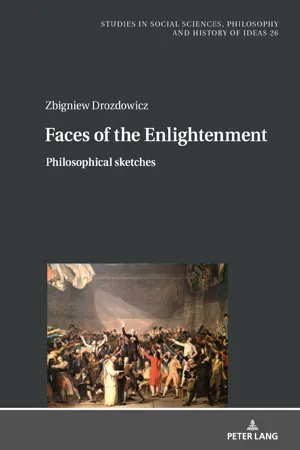 eBook - PDF
Faces of the Enlightenment
Philosophical sketches
- Zbigniew Drozdowicz(Author)
- 2020(Publication Date)
- Peter Lang Group(Publisher)
One of those correctives is issued in the essay: “What is Enlightenment? (Was ist Aufklärung?)” 116 . In its light: “Enlightenment is man’s emergence from his self-imposed immaturity. Immaturity is the inability to use one understanding without guidance from another. Self-incurred is this tutelage when its cause lies not in lack of understanding (Verstand), but rather of resolve and courage to use it without direction from another. Sapere Aude! Have courage to use your abstract view of the Enlightenment or to ignore its anti-intellectual character, then it would become difficult to admit that the “rational systems” had long been dead and the “Copernican turn” was already under way when Kant entered the scene. In the German conditions, the situation was defined by the struggle between the school of Wolff and his detractors, which somehow forced Kant to belatedly discover anew certain truths that were already cliché for the West-European Enlightenment. Cf. P. Kondylis, Die Aufklärung im Rahmen des neuzeitlichen Rationalismus, op. cit., p. 673 et seq. According to the Polish expert on the philosophy of I. Kant – Marek Siemek – there are elements in Kant’s pre-critical writings which can also be found in the works of such philosophers of the Enlightenment period such as Leibniz or Ch. Wolff: “it is around 1770 that Kant finally realizes the fundamental difference between both major endeavors of this metaphysics, rational ontology and theodicy and his own ideas”. In his general evaluation he states that “although the intellectual horizon of Kant’s philosophy goes well beyond the boundaries of Enlightenment, his philosophy did actually result from the dynamics of the Enlightenment thinking in most of its crucial points.” Cf. M. Siemek, Racjonalizm i naturalizm w filozofii niemieckiego Oświecenia, in Filozofia niemieckiego Oświecenia, op. eBook - PDF
Hugh Trevor-Roper
The Historian
- Blair Worden(Author)
- 2015(Publication Date)
- I.B. Tauris(Publisher)
Intellectual History: ‘The Religious Origins of the Enlightenment’ • 137 drawn, the Enlightenment. In the course of the essay he was able to settle his final accounts with Weber, whose interpretation of the relation between Protestantism, capitalism and intellectual progress had preoccupied him for so long. More positively, he could respond to the pleasure he had received from reading Giannone, whose determination to resist the attempts of the papacy to silence him had been such an inspiring antidote to the chilly intellectual climate of Braudel’s Paris. After the essay’s publication in 1967, it was clear that intellectual history had become a major, if not a predominant, interest for Trevor-Roper. In the long run, the collection Catholics, Anglicans and Puritans , which contained the Great Tew essay, together with the posthumously published study of Mayerne, Europe’s Physician , and his essays on historians, collected in History and the Enlightenment , may be regarded as the fullest, most developed products of this reorientation of his interests. But ‘The Religious Origins of the Enlightenment’ was among the first and most important signposts of the new direction. For its own arguments, and for their subsequent elaboration under the influence of Frances Yates, it stands out as a seminal essay. So far, this study has been concerned to place ‘The Religious Origins of the Enlightenment’ in the context of Trevor-Roper’s development as a historian. In conclusion, I shall attempt to add historiographical perspective to the story, with a brief assessment of Trevor-Roper’s conception of intellectual history. As Irene Gaddo has observed, it is not easy to pin down. 74 While Trevor-Roper passionately believed that good historical writing required a philosophy of history as well as a commitment to scholarship, this did not entail adherence to a formal methodology.
Index pages curate the most relevant extracts from our library of academic textbooks. They’ve been created using an in-house natural language model (NLM), each adding context and meaning to key research topics.

