History

European Revolutions
The European Revolutions refer to a series of political upheavals that took place across Europe in the 19th century. These revolutions were characterized by widespread social and political unrest, with the aim of challenging existing power structures and promoting liberal and nationalist ideals. While some of these revolutions resulted in short-term changes, they ultimately contributed to the broader transformation of European society and politics.
Written by Perlego with AI-assistance
Related key terms
1 of 5
12 Key excerpts on "European Revolutions"
 eBook - PDF
The Great Cauldron
A History of Southeastern Europe
- Marie-Janine Calic, Elizabeth Janik(Authors)
- 2019(Publication Date)
- Harvard University Press(Publisher)
The Age of Global Revolutions 197 1870s, and finally culminating in the decade of Balkan wars between 1912 / 13 and 1923. Only then did an order of nation-states sweep aside the last traces of the Ottoman Empire from the European continent. The Dissolution of the Old Order, 1770–1830 No other event influenced modern southeastern Europe as decisively as the French Revolution. Political, social, and cultural transformations in France drove the revolutionary movements and uprisings, and also the liberal political cultures that took root over the course of the nineteenth century. 3 The French Revolution and Napoleonic dictatorship brought groundbreaking changes to structures of government and society, which eventually led to the formation of nation-states and to a fundamental re-orientation of political thought and the experience of time. After a longer period of social change, contemporaries broke with the tradition of the ancien r é gime. They experienced the collapse of foreign rule, the con-struction of new social orders, the spread of national ideologies, and fi-nally, the most comprehensive reorganization of the political landscape in the entire modern era. 4 The nature of political thought underwent a fun-damental transformation, moving away from a religiously determined worldview and toward the values and sense of order that distinguished the early bourgeoisie. Many intellectuals came to see equality and responsible governance as the measure of social coexistence. The peoples of south-eastern Europe entered the first phase of nation- and nation-state-building, which was initially shaped by a small circle of religious and secular elites. The ideas of universal liberty and human rights combined with an early patriotic nationalism. The opposition between revolutionary, or Bonapartist, models of lead-ership and those of monarchical restoration stoked new conflicts, resulting in the formation of a new international system. eBook - ePub
The History of Democracy
A Marxist Interpretation
- Brian S. Roper(Author)
- 2012(Publication Date)
- Pluto Press(Publisher)
7
The revolutions of 1848–49 INTRODUCTIONIn 1848 the wave of revolutionary upheavals that swept across Western and Central Europe combined ‘the greatest promise, the widest scope, and the most immediate initial success, with the most unqualified and rapid failure’ (Hobsbawm, 1975: 37). But if these revolutions failed to achieve the creation of lasting republican democracies loosely modelled on those of the French and American revolutions, nonetheless they profoundly shaped the future course of European history, demolishing what remained of serfdom in Western and Central Europe, forcing monarchs to make liberal concessions that resulted in the prevalence and persistence of parliamentary forms of governance in which property owners were more widely represented than before 1848, and leading to the creation of constitutional, juridical and political arrangements that were significantly more favourable to the development of capitalism.This chapter outlines the wider historical context and underlying causes of the 1848 revolutions, provides a brief descriptive overview of the main events in France, Germany, Austro-Hungary and Italy, considers the June insurrection of workers in Paris, describes the conservative counter-revolution that destroyed the new governments created during the initial phase of the revolutions, and finally identifies the common features and historical legacy of these revolutions.BACKGROUND AND CAUSESThe revolutions of 1848 took place in the wider historical context of the transition from feudalism to capitalism, uneven development of capitalism across Europe, the rapid growth of industrial capitalism in Britain that provided the economic underpinning for the global expansion of the British Empire, and finally the growing pressure on France and Germany to introduce capitalist relationships in agricultural production and to industrialise in order to be able to compete with Britain’s growing economic and military power. Much of this has been discussed earlier. Nonetheless, it is important to recognise that the persistence of serfdom and feudal relationships in Central and Eastern Europe was a major cause of discontent among serfs and peasants, and was viewed as increasingly anachronistic by the bourgeoisie, state officials and enlightened members of the nobility. In this context maintaining the extraction of surplus product from peasants and workers as feudalism declined and capitalism developed was a major challenge for the landowning nobility and emerging bourgeoisie (Mooers, 1991: 27–40). eBook - PDF
- Stefan Berger, Holger Nehring, Stefan Berger, Holger Nehring(Authors)
- 2017(Publication Date)
- Palgrave Macmillan(Publisher)
In this sense—i.e. because they aided and abetted these forces, and not because the bourgeoisie played a central role in these struggles—one can say that these revolutions were ‘bour- geois’ (revolutions promoting capitalism). Several revolutions also occurred in nineteenth and twentieth century Europe. Since the French Revolution was aborted halfway, in the fol- lowing decades there were several attempts to restart the process. Thus, further upheavals came about in 1830 and 1848. This latter revolt made France a republic once more, and inspired other revolutionary movements that unfolded in the German and Habsburg empires almost simultane- ously. After the French army had been defeated by the Prussians, a highly 194 M. VAN DER LINDEN symbolic rebellion took place between March and May of 1871. The resi- dents of the capital organized the self-governing, so-called ‘Commune of Paris’, in which soldiers elected their own officers, night work in the baker- ies was forbidden, and a significant women’s movement developed. During the ‘Bloody Week’ ( Semaine Sanglante) at the end of May, the French government, with Prussian support, succeeded in recapturing the city. The First World War (1914–1918) strongly destabilized social rela- tions in the belligerent nation states, particularly the losers in that conflict. Thus, large protest movements emerged in Russia in 1916, but also in oth- ers countries like Germany, Austria, Hungary and Italy. In Russia, which had already seen a failed revolution between 1905 and 1907, the Tsarist regime collapsed in 1917. On March 2 of that year, an uprising broke out in Petrograd in reaction to food shortages. It could not be suppressed because the soldiers refused to shoot on the masses in revolt. The tsar stepped down in favour of his brother, but even he only stayed in office for a few hours. A new, predominantly liberal, government was formed. eBook - PDF
The Rise of Organised Brutality
A Historical Sociology of Violence
- Siniša Malešević(Author)
- 2017(Publication Date)
- Cambridge University Press(Publisher)
This chapter aims to shed some light on the complex social dynamics of revolutions. In the first section, I critically engage with the leading sociological accounts of the revolutionary experience, while in the second section I offer an alternative interpretation that analyses revolutions as the distinctive forms of organised violence. As in the previous chapters, my argument centres on the role organisational cap- acity, ideological penetration and microsolidarity play in the rise and expansion of revolutions. 174 Defining Revolutions The common sense understanding of revolution is inevitably tied with the image of France 1789–1799. In this vision, a revolution is perceived as a popular violent overthrow of an oppressive ancient regime, a pro- foundly changed and more inclusive structure of governance and deep social transformations bringing about a fairer and rational organisation of social order. Moreover, the outcome of such a revolutionary experience is often associated with the irreversible progress, greater enlightenment, social equality and individual autonomy. This model of revolutionary events has influenced generations of scholars and has been often used as an analytical yardstick to assess whether a particular rebellion, revolt or uprising constitutes a genuine revolution. From the classical analyses of Marx (1968 [1871]) and Trotsky (1931) to the later works of Brinton (1965) Gurr (1970) or Moore (1966) revolution was envisaged not only as a powerful vehicle of social change but also implicitly or explicitly as a stepping stone towards a better world. Karl Marx is generally identified with a proscriptive view of revolutionary change that foresaw the proletar- ian revolution repossessing and dismantling the capitalist state, as formu- lated in the Communist Manifesto (Marx and Engels 1998 [1848]). However, he also provided more analytical accounts of revolutionary situations as in 1848 European Revolutions or 1871 Paris Commune (Marx 1968[1871]). eBook - PDF
Western Civilization
Beyond Boundaries
- Thomas F. X. Noble, Barry Strauss, Duane Osheim, Kristen Neuschel(Authors)
- 2013(Publication Date)
- Cengage Learning EMEA(Publisher)
Europe was transformed both by the shifting balance of power and by the spread of revolutionary ideas. Understanding the French Revolution means understanding not only its origins but also its complicated course of events and their significance. Challenging the king’s power was not new, but overthrowing the king was revolutionary. A new understanding of the people became irresistible; they were the nation and, as citizens, had the right to representation in government. Louis XVI was transformed from the divinely appointed father of his people to an enemy of the people, worthy only of execution. Central to the Revolution was the complex process by which public opinion was shaped and, in turn, shaped events. Change was driven in part by the power of symbols—flags, rallying cries, inspiring art—to challenge an old political order and legitimize a new one. An Age of Revolution, 1789–1815 The Origins of Revolution, 1775–1789 ◆ ◆ What factors led to revolution in France in 1789? The Phases of the Revolution, 1789–1799 ◆ ◆ Why did several phases of revolutionary change occur after 1789 and what were the characteristics of each phase? The Napoleonic Era and the Legacy of Revolution, 1799–1815 ◆ ◆ What impact did the Revolution and Napoleonic rule have on France, the rest of Europe, and the wider world? Chapter Overview 19 Copyright 2012 Cengage Learning. All Rights Reserved. May not be copied, scanned, or duplicated, in whole or in part. Due to electronic rights, some third party content may be suppressed from the eBook and/or eChapter(s). Editorial review has deemed that any suppressed content does not materially affect the overall learning experience. Cengage Learning reserves the right to remove additional content at any time if subsequent rights restrictions require it. eBook - PDF
The Anatomy of Revolution Revisited
A Comparative Analysis of England, France, and Russia
- Bailey Stone(Author)
- 2013(Publication Date)
- Cambridge University Press(Publisher)
The following pages will place this evolution of affairs under our analytic microscope, and try to evaluate its overall import for the study of European Revolutions, in three steps. First, they briefly recapitulate the chronology of events – relatively prolonged, as we have just noted, for England, much less so 254 The “Revolutionizing” of the Revolutions 255 for France, and especially for Russia – which, in all three situations, take us from the dissipation of any lingering “honeymoon” illusions to the seizure of power by political extremists prepared at all costs to salvage the revolutionary cause. Second, they analyze the critical dialectic in all three upheavals between war (civil or foreign or both) and the struggles of ´ elitist political factions for state power. And third, they interrogate the extent to which those public figures contending for power in these challenging circumstances were willing – for preexisting ideological reasons, for reasons of political expediency, or perhaps for a combination of both – to accommodate and even (in some respects) to champion aggressively the aspirations of their societies’ urban and/or rural masses. Chronologies of Radicalization The progression in England from what is frequently known as the “first rev- olution” of 1640–42 to the more decisive revolution of January 1649 was punctuated, technically, by two civil wars rather than by just one – both of them occurring against the somber backdrop of the climactic decade of the Thirty Years’ War on the Continent. In the case of France, the “revolutionizing of the revolution” involved the return of this traditionally belligerent country to the ways of foreign war – war that gradually cast off its originally defensive trappings to become an offensive leviathan catching up all of French society in its toils. eBook - ePub
Western Civilization: A Global and Comparative Approach
Volume II: Since 1600
- Kenneth L. Campbell(Author)
- 2015(Publication Date)
- Routledge(Publisher)
The legacy of the French Revolution, the ongoing conflict between supporters and opponents of the revolutionary tradition, the forces of the Industrial Revolution, and the intellectual ferment that saw the rise of several new ideologies all culminated in a wave of revolution that swept across Europe in 1848. These were not the first revolutions of the post-Napoleonic period; the first wave of revolutions occurred in 1820 and included Spain, Portugal, and Italy. The Greek war for independence against the Ottoman Empire that began in 1821 was both a nationalist uprising against foreign rule and part of the same revolutionary wave of the post-Napoleonic period. Although repressive regimes across the continent crushed these revolutions (with the exception of the Greeks, who won their independence from the Ottomans in 1829), the revolutionaries and secret societies of this period sowed the seeds for future revolutions through the influence they had on young men such as Giuseppe Mazzini (1805–1872), a key Italian revolutionary in 1848.The next phase of revolution occurred in 1830 and included revolutions in France, Belgium, and Switzerland. In France, Charles X (r. 1824–1830) provoked widespread opposition with his July Ordinances of 1830, suspending freedom of the press, dissolving the newly elected Chamber of Deputies, placing further restrictions on the right to vote and the number of deputies in the chamber, and postponing new elections until September. Liberals regarded this as a blatant attempt to overthrow the constitution and to restore absolute authority to the crown. Almost immediately, revolutionaries threw up barricades in the streets of Paris. By July 30 Charles had rescinded the ordinances; on August 9 he abdicated his throne, saying he would rather be a woodcutter than a constitutional monarch such as the king of England. The French revolution of 1830 was thus spectacularly successful, resulting in the replacement of Charles by a cousin, Louis Philippe, who styled himself “King of the French.” In the same year, Belgium gained its independence and many Swiss cantons gained liberal constitutions as a result of their respective revolutions.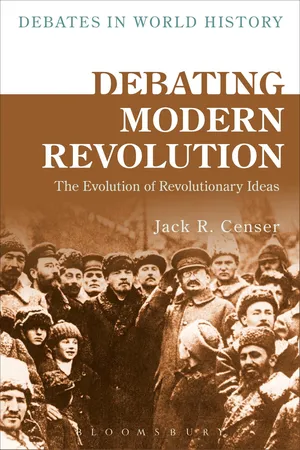 eBook - PDF
Debating Modern Revolution
The Evolution of Revolutionary Ideas
- Jack R. Censer(Author)
- 2016(Publication Date)
- Bloomsbury Academic(Publisher)
W ith the idea of revolution established in the “West,” and firmly linked to general conceptions of legal equality and democracy, the following chapters examine the way that the concept of revolution mutated and added different beliefs during the next two centuries. To expand this examination from two main locales—the British North American colonies and France—to a worldwide phenomenon necessitates a far more general approach: thus the focus will be more on the ideas than their sources, more on major new accretions than the changes in older ones; revolutionary themes that were most prominent and diasporic will be emphasized. Considering the deployment of ideas in Latin American revolutions, a huge new beachhead from its origins, this chapter then focuses on the two big “isms” that played such a large role in future revolutions: nationalism and socialism. In regard to this first notion, the unification of Italy provides an important example. Although Marx made no revolution, his successors did, so we must examine the origin of the Marxist ideology. In its essay, to elaborate on these new ideas, the chapter analyzes the differing views of the revolution of 1848 in France between the “liberal” social and political analyst Alexis de Tocqueville and Karl Marx, 2 Latin America and Europe and the New National and Economic Meanings of Revolution, 1800–1871 DEBATING MODERN REVOLUTION 56 the most systematic and widely known scholar and activist in the revolutionary tradition. This contrast will deepen the understanding of the revolutionary waves that swept both sides of the Atlantic as well as show the impulses and resistance to change. Latin America Beyond France and the United States, revolutions spread globally, beginning with the Latin American revolutions in the early nineteenth century. South of the British colonies, from the middle of North America to the tip of South America, lay lands claimed by Portugal and Spain. eBook - ePub
- Richard Lachmann(Author)
- 2013(Publication Date)
- Polity(Publisher)
3 Revolutions and Social MovementsSome events are more consequential than others. Revolutions are among the most momentous in world history. How can we study such epochal historical moments? How do we explain why social actors decide to take great risks to challenge the powerful at some rare times, when for the most part people resign themselves to the existing social order? As we see how some historical sociologists have sought to answer these questions, we will be able to explore methods for addressing the role of human agency in historical change.Most people through most of human history have been poor, miserable, and exploited, and they have been unhappy about their condition. Misery is not enough to create a social movement or to spark a revolution. As Barrington Moore (1978, p. 161) puts it, “in the human repertoire of responses to deprivation and injustice an aggressive counterattack is scarcely the one to anticipate as automatic and somehow ‘natural.’ ” If we want to explain why revolutions and social movements occur and how they matter, we need to work our way through three distinct steps.- First, we must identify moments when revolutions or social movements occurred. This is partly a problem of definition, just as it is with explaining the origins of capitalism. As with the origins of capitalism, we can cut through inconclusive debates by focusing on identifying moments of historical change. In the case of revolutions, we need to find occasions when not just rulers were overthrown but the form of rule itself was transformed. In the case of social movements, we need to find moments when popular groups went beyond making demands and protesting and actually won significant concessions from those against whom they mobilized.
- Second
 eBook - ePub
Contemporary European Politics
A Comparative Introduction
- José M. Magone(Author)
- 2019(Publication Date)
- Routledge(Publisher)
Figure 2.1 ). However, in southeastern Europe, the Ottoman empire remained a major player until the end of seventeenth century, only to then decline in terms of power in the eighteenth and nineteenth centuries. In the northeast, the commonwealth of Poland and Lithuania was tragically partitioned by their neighbours Prussia, Austria and Russia in 1772, 1993 and 1995, and ceased to exist. One of the main reasons was the increasing corruption of the nobility in Poland’s Sejm, who became manipulated by the interests of external powers.The French Revolution and the emergence of the national stateAfter the Peace of Westphalia of 1648, the French Revolution of 1789 should probably be considered the most important event for modern European politics. The year 1789 represents a shift from the remnants of a feudal world towards a modern one. The revolutionary period lasted from 1789 to 1799. The main reason for the French Revolution was the deterioration in the finances of the French monarchy. Mismanagement, the heavy costs of wars in Europe and around the world, and the effects of systemic corruption led to a growing demand for convening the parliament of estates, the Estates-General (États-Généraux ). They met on 5 May 1789 in Versailles. Nevertheless, the privileged estates’ clergy and nobility were against the introduction of a simple majority vote, because the Third Estate (Tiers État ) was the strongest group. The Third Estate consisted of members of the new bourgeoisie who wanted the introduction of constitutional government, including reform of the political system, press freedom and decisions over new taxes, so limiting the arbitrary powers of the King. This led eventually to the proclamation of a National Assembly by the Third Estate against the will of the king. On 27 June King Louis XVI capitulated and accepted the National Constituent Assembly and the drafting of a new constitution. The climax of the revolution was the storming of the Bastille, where political prisoners were held, on 14 July 1789, the present national holiday in France. (Rudé, 1980: 83–105) (Box 2.2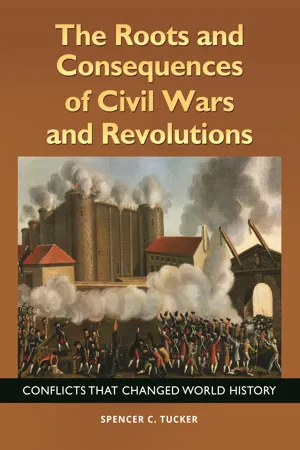 eBook - ePub
The Roots and Consequences of Civil Wars and Revolutions
Conflicts That Changed World History
- Spencer C. Tucker(Author)
- 2017(Publication Date)
- ABC-CLIO(Publisher)
New Cambridge Modern History: The Zenith of European Power 1830–70, edited by J. P. T. Bury, 389–415. Cambridge: Cambridge University Press, 2000.Rapport, Michael. 1848: Year of Revolution. New York: Basic Books, 2009.Robertson, Priscilla Smith. Revolutions of 1848: A Social History. Princeton, NJ: Princeton University Press, 1952.Sked, Alan. The Survival of the Habsburg Empire: Radetzky, the Imperial Army and the Class War, 1848. New York: Longman, 1979.Sperber, Jonathan. The European Revolutions, 1848–1851. 2nd ed. New York: Cambridge University Press, 2005.Stearns, Peter N. 1848: The Revolutionary Tide in Europe. New York: Norton, 1974.Vick, Brian. Defining Germany: The 1848 Frankfurt Parliamentarians and National Identity. Cambridge, MA: Harvard University Press, 2002.SPENCER C. TUCKER eBook - PDF
1848 — A European Revolution?
International Ideas and National Memories of 1848
- A. Körner(Author)
- 2000(Publication Date)
- Palgrave Macmillan(Publisher)
At present we only have a few isolated works which make comparisons along these lines, and even those are largely written within national limits. Political comparisons Revolution is a situation in which there is no single or stable locus of power. This is usually brought about by popular action and involves violent conflict between existing power-holders and those opposed to them. Compared to the ‘great’ revolutions what is striking about 1848 is that the level of violence was quite limited as was the dura- tion of the revolution. However, within that broad characterization there are important variations. Nowhere else was there a popular ris- ing so massive nor a repression so savage as the June insurrection. Only in Hungary did rebels succeed in institutionalizing revolution- ary power over a wide territory in the form of effective local adminis- tration and a regular army. 19 Comparisons at the political level could work within the common framework of revolution as involving viol- ence and competing power blocs but should then seek to explain these variations. 42 John Breuilly I can envisage various ways in which such analysis might be pursued. First, and most obvious, is in terms of broad political currents. Roughly speaking one can distinguish democratic, liberal and con- servative positions after the outbreak of revolution. The democrats wanted to sustain the momentum of change in order to construct a political order in which authority was grounded upon popular con- sent. Liberals wanted to use the initial breakdown of authority to construct a political order based on parliamentary consent although insulated from direct popular pressure. Conservatives wanted to reverse the breakdown of authority and to restore a political order based on acceptance of social hierarchy and traditional authority. There are problems with these characterizations (e.g. how does one categorize Bonapartism?).
Index pages curate the most relevant extracts from our library of academic textbooks. They’ve been created using an in-house natural language model (NLM), each adding context and meaning to key research topics.

