History

Fall of Saigon
The Fall of Saigon refers to the capture of Saigon, the capital of South Vietnam, by North Vietnamese forces on April 30, 1975, marking the end of the Vietnam War. The event led to the reunification of Vietnam under communist control and the evacuation of American personnel and Vietnamese civilians from the city.
Written by Perlego with AI-assistance
Related key terms
1 of 5
4 Key excerpts on "Fall of Saigon"
 eBook - PDF
After Saigon's Fall
Refugees and US-Vietnamese Relations, 1975–2000
- Amanda C. Demmer(Author)
- 2021(Publication Date)
- Cambridge University Press(Publisher)
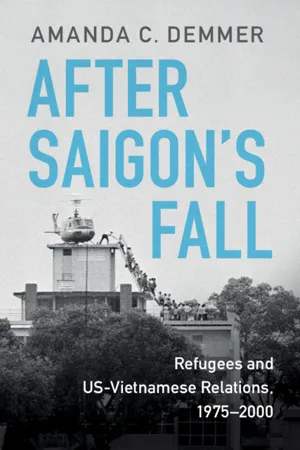
part i 1975 – 1980 1 The Fall of Saigon Throughout March 1975, North Vietnamese forces won a string of mili- tary victories with such speed that it surprised not only officials in Washington and Saigon but also those in Hanoi. The successful DRV offensive prompted massive desertion among the South Vietnamese army (the ARVN), and the fighting displaced a considerable portion of the population. More than half a million fled to Da Nang, the second- largest city in South Vietnam. The rapid influx left the once-prosperous port city feeling “like a refugee camp.” 1 In late March, communist forces encircled the overcrowded city and sheer pandemonium ensued; desperate mobs gathered at the airfield and shoreline, hoping to find a way out of the crumbling metropolis. Journalist Arnold R. Isaacs suggests that Da Nang “disintegrated in its own terror” more so than it was actually “captured.” 2 While records indicate that all Americans were able to survive the mad scramble out of the city, many of their South Vietnamese employees did not, despite “American promise[s] of evacuation.” 3 The little-discussed evacuation of Da Nang served as a shot across the bow for US policy makers; President Gerald Ford and his administration were determined to prevent a repeat of this failure in Saigon. In many ways, the administration failed. The chaos, desperation, and unfulfilled promises that characterized Da Nang were also unmistakably evident when the South Vietnamese capital fell a month later. For many of those on the ground in Saigon – Americans and especially South Vietnamese – the last days of April 1975 were a special sort of hell. Americans were desperate to assist longtime friends and employees yet often unable to do so; Vietnamese looked into the eyes of their children 23 and elderly parents, fearful for the future and often forced to make impossible choices. These are the realities most vividly associated with South Vietnam’s last days. No longer available |Learn more
Vietnam's Christians:
A Century of Growth in Adversity
- Reg Reimer(Author)
- 2011(Publication Date)
- William Carey Library(Publisher)
On April 30, 1975, the symbolism of the North Vietnamese tank crashing through the gate of the old palace in Saigon and a formal surrender by the remnants of the old regime clearly marked a new era for all of Vietnam. All missionaries either left or were evacuated except a few of a pacifist persuasion who chose to stay. A year later they also were “invited to leave.” The events around the “fall” or “liberation,” depending on which side you were on, fostered confusion and deep fear for many Vietnamese Christians. The confusion in the church at the time remains an embarrassment; very little serious reflection about that situation has occurred. However, in 1995, twenty years after the Fall of Saigon, one Vietnamese pastor collected the documents of the ECVN(S) during those tumultuous times. The documents, compiled under the translated title Twenty Years After by Pastor Tran Thai Son, 17 show clearly there was no overall strategy or plan on how to react to a Communist victory. Hence confusion reigned. The ECVN(S) president, Rev. Doan Van Mieng, had been strongly en-couraged by a Korean pastor friend, citing the Korean experience, to leave Vietnam in the event of a Communist takeover. In the end, Pastor Mieng decided to stay, though most of his large family left. In the panic, the son of one nationally prominent pastor, a South Viet-nam Air Force pilot, “commandeered” a C-130 transport plane. He landed it on a highway to rescue his parents and family, along with another pastor, a prominent lay Christian man, and their families. They even loaded a car before escaping to Singapore! There were also rumors that some foreign 17 This document, privately published and circulated by the author, caused controversy be-cause it recalled some church actions which proved regrettable in hindsight. CHAPTER 6 The “Fall of Saigon” or “Liberation Day”? Vietnam’s Christians 54 organizations had money and contingency plans to rescue their staff and cer -tain church leaders. eBook - PDF
American Ambassadors in a Troubled World
Interviews with Senior Diplomats
- Dayton Mak, Charles Stuart Kennedy(Authors)
- 1992(Publication Date)
- Praeger(Publisher)
12 The Fall of Saigon: Spring 1975 The war in Vietnam dominated American political lives throughout the presidencies of Lyndon Johnson and Richard Nixon and into that of Gera Ford. Finally, in the spring of 1975, North Vietnamese forces swept sout, and in April it was all over, the war was lost. Our ambassador in Saigon during that period was A. Graham Martin. He had as his deputy Wol Lehmann, who held the title of deputy ambassador, a unique title creat because of the size of our mission and the importance of the U.S. committ to South Vietnam. The eyes of the entire nation were on Vietnam as the government in Washington wrestled with the problem of what to do so as to end the warh the minimum cost in lives, money, and prestige. Events moved swiftly i Vietnam and involved not only U.S. military forces but large civilin contingents including our embassy. The president and the entire U.S. government werefranticallytrying to bring order out of the chaos that s developing which resulted finally in a complete withdrawal. Ambassador Martin and his staff were dealing with the situation in Sai Events were moving faster than those in Washington could appreciater accomodate in their planning. Unexpected situations arose requiring t ambassador and his deputy to make critical decisions without awaiting approvalfromWashington. Many of these concerned the safety and evacu of Americans and allied persons. Deputy ambassador WOLFGANG J. LEHMANN was charged with organizing and supervising the evacuation of Americans and Vietnamese f South Vietnam. Coordination with the U.S. military was constant and eff 160 American Ambassadors in a Troubled World and the evacuations were earned out successfully under the most chaotic frightening circumstances. eBook - ePub
The American Military
A Narrative History
- Brad D. Lookingbill(Author)
- 2013(Publication Date)
- Wiley-Blackwell(Publisher)
Even though Hanoi repeatedly violated the Paris Peace Accords, communist leaders postponed a final offensive to defeat Saigon until Ford succeeded Nixon. The NVA launched artillery attacks in South Vietnam that December, and their divisions captured the Phuoc Long Province near the Cambodian border on January 5, 1975. They waited for a military blow from the U.S., but none came. Because Congress previously terminated funding for bombing campaigns in Southeast Asia, all war plans remained on the shelf. No additional military aid for Saigon was forthcoming. Thieu began to abandon the Central Highlands and redeployed ARVN to defend the cities near the coast. From the vantage point of Hanoi, the situation seemed ideal for renewing the war for national unification.War raged across Southeast Asia. The Khmer Rouge guerrillas in Cambodia seized power, while the Pathet Lao forces achieved dominance in Laos. By March, the North Vietnamese launched a full-scale invasion across South Vietnam and quickly captured Hue, Da Nang, and Cam Ranh Bay. Within days, they controlled the northern half of South Vietnam. Civilians fled in panic, but not until communist forces had massacred thousands. ARVN hastily established a defensive perimeter around Saigon. Thieu soon resigned from office, and Duong Van Minh became the last president of South Vietnam. As the closing campaign to overrun the capital began, ARVN units disintegrated. The end was near.In Washington D.C., the Ford administration authorized Operation Frequent Wind to evacuate Saigon. Helicopters transported 7,100 Americans and South Vietnamese to Navy vessels waiting off shore. At least 70,000 South Vietnamese reached the safety of U.S. warships in the South China Sea. Television cameras recorded the last airlift out of the capital, which departed from the roof of the U.S. embassy. On April 30, 1975, Saigon fell to the North Vietnamese, who soon renamed it Ho Chi Minh City.Conclusion
While winning the international race to the moon, the U.S. stumbled badly in the Third World. Following the Gulf of Tonkin Resolution, the Johnson administration counted on graduated pressure to secure South Vietnam. North Vietnam survived the attrition, because the Soviet Union and China replaced many of the assets that U.S. firepower destroyed. Hanoi paid a high price in lives for the Tet Offensive, but Washington D.C. decided to pursue a settlement thereafter. The war in Vietnam divided the American people and demoralized the armed forces. As the troops exited Indochina, the Nixon administration ended the draft. Instead of “peace with honor,” the Fall of Saigon seemed indicative of American decline. “You know you never defeated us on the battlefield,” said Colonel Harry Summers to a North Vietnamese officer after the war. “That may be so,” replied his former adversary, “but it is also irrelevant.”
Index pages curate the most relevant extracts from our library of academic textbooks. They’ve been created using an in-house natural language model (NLM), each adding context and meaning to key research topics.

