History

Indian Ocean Trade
Indian Ocean Trade refers to the exchange of goods and ideas between the countries bordering the Indian Ocean from ancient times to the present day. This trade network facilitated the exchange of spices, textiles, precious metals, and other commodities, as well as the spread of religions and cultures across the region. The Indian Ocean Trade played a significant role in shaping the economies and societies of the countries involved.
Written by Perlego with AI-assistance
Related key terms
1 of 5

11 Key excerpts on "Indian Ocean Trade"
 eBook - PDF
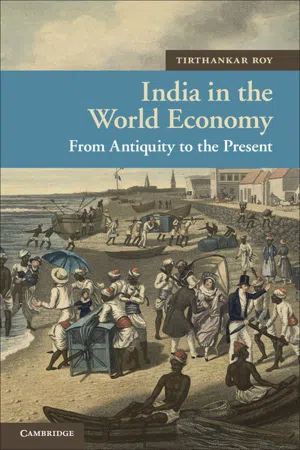
India in the World Economy
From Antiquity to the Present
- Tirthankar Roy(Author)
- 2012(Publication Date)
- Cambridge University Press(Publisher)
4 The Indian Ocean Trade, 1500 –1800 Indo-European trade laid the foundation for a new economic order in Asia and in Europe. Asian goods created new consumer markets in Europe. Asian trade had a formative effect on the world’s money markets. In the eighteenth century, the European desire to maintain the supply of Asian goods contributed to the motivation to colonize. Indo-European trade was also the medium of transmission of new technological knowl- edge in both directions. There was so much two-way traffic that it would be hard to characterize the effects in terms of a model of European influence on India or an Indian “incorporation” into a European world economy. In any case, the hybrid technological, institutional, and political order that followed had momentous consequences for India. This chapter explores the evolution of Indo-European trade. The discussion leads to larger questions about the meaning of the trade for Indian history. The Indian Ocean world at 1500 Situated in the middle of the “great arc” of Asian trade, India is geo- graphically well placed to trade with both sides of the Indian Ocean. 1 It was not usual for any one merchant group to connect the extremities of the arc. Direct trade between West Asia and China was not unknown but, always rare, it declined after 1400. One consequence of that decline was the relative expansion of India’s ports as points where cargo could change ships and ships could be restocked with food and water. This development strengthened the segments within the Indian Ocean and brought the West Asian and African ports of Aden, Hormuz, and Kilwa into closer contact with Malacca in Southeast Asia; at the same time, the middleman position of India grew. The Indian ports were more than transit points, however. 1 I borrow the phrase from Om Prakash, European Commercial Enterprise in Pre-colonial India, Cambridge: Cambridge University Press, 1998. 78 eBook - PDF
Monsoon Islam
Trade and Faith on the Medieval Malabar Coast
- Sebastian R. Prange(Author)
- 2018(Publication Date)
- Cambridge University Press(Publisher)
It saw a notable economic florescence, often referred to as the “Asian sea trade boom”, that is observable across the entire span of monsoon Asia. 48 This notable increase in long-distance trade across the Indian Ocean created closely interconnected “border- less” zones of material, cultural, and knowledge transfers. 49 It was accompanied by a parallel growth of Muslim merchant networks, which came to dominate much of this commerce, especially the enormously profitable spice trade. This study extends into the sixteenth century for two reasons. First, with the arrival of the Portuguese in the Indian Ocean, a sig- nificant corpus of additional sources becomes available in the form of European-language sources. Many of these, especially those dating to 47 R. Chakravarti, “An Enchanting Seascape: Through Epigraphic Lens”, Studies in History n.s. 20:2 (2004), 307. 48 J.W. Christie, “Javanese Markets and the Asian Sea Trade Boom of the Tenth to Thirteenth Centuries A.D.”, Journal of the Economic and Social History of the Orient 40:4 (1998), 344–381. Also see D. Heng, “Trans-Regionalism and Economic Co- Dependency in the South China Sea: The Case of China and the Malay Region (Tenth to Fourteenth Centuries AD)”, International History Review 35:3 (2013), 486–510. 49 K.R. Hall, “Commodity Flows, Diaspora Networking, and Contested Agency in the Eastern Indian Ocean c.1000–1500”, Trans-Regional and National Studies of Southeast Asia 4:2 (2016), 387. Note on Sources 19 19 the early years of the Portuguese presence in the Indian Ocean, reflect on the pre-existing conditions that they encountered there. Moreover, Portuguese writers in particular paid very close attention to Muslims, since these were the principal rivals to Portugal’s attempt to monopolize the spice trade.
- Om Prakash(Author)
- 2023(Publication Date)
- Routledge(Publisher)
II India in the Indian Ocean Trading Network on the Eve of the Europeans' Arrival in the Asian Seas DOI: 10.4324/9781003420750-2Among the historic consequences of the discovery by the Portuguese at the end of the 15th century of the all-water route to the East Indies via the Cape of Good Hope was the overcoming of the transport technology barrier to the growth of trade between Asia and Europe. The volume of this trade was no longer subject to the capacity constraint imposed by the availability of pack animals and river boats in the Middle East. Also, it was only after the discovery of the Cape route that the procurement of Asian goods as well as their transportation to Europe was organised by the Europeans themselves, who had travelled to the East in any number for the first time. What kind of trading network did the Portuguese find in operation on their arrival in the Indian Ocean? This paper analyses the central elements of this network from the vantage point of India, which was at the centre of the Portuguese - and later of the other Europeans’ trading activities in Asia,An analysis of the structure and the mechanics of the early modem Indian Ocean Trade, alternatively referred to as Asian trade, ought perhaps to start with a recognition of the simple fact that this trade transgressed the boundaries of both the Indian Ocean as well as those of Asia. While in the east, it intruded prominently into the South China Sea, in the west, it embraced maritime trade with East Africa. Traditionally, the great arc of Asian trade included the Persian Gulf and the Red Sea in the northwest. The principal natural divisions of this huge area were the Arabian Sea, the Bay of Bengal and the South China Sea. Within each of these zones, there were important blocks of ports across which a large amount of trade had traditionally been carried on. The western or the Arabian Sea zone included ports in the Persian Gulf, the Red Sea, those on the East African coast and on the west coast of India. The Bay of Bengal network included ports in Sri Lanka, the Coromandel coast, Bengal, Burma, Thailand, Malaya and Acheh in Sumatra. Ports such as Canton and Zaiton in the South China Sea had extensive contacts both with the Indonesian ports as well as with ports in the straits of Malacca. Within each of these zones, there were also clearly identifiable sub-zones. To take an example, in the west, the ports of Aden, Hormuz, Cambay and Calicut formed one such sub-zone, while those of Kilwa, Mogadishu, Aden and Jiddah constituted another. Needless to emphasise, in terms of the ability of different constituents of a given zone to put important tradeable goods on the market, for which there was adequate demand elsewhere in the zone, there was a very definitive basis for trade within each of the zones. Such a basis also existed to an important degree across zones leading to the creation of significant long-distance trade flows in the Indian Ocean and beyond. By far the longest distance was covered by the route that connected Aden to Canton traversing a very large part of the total area covered by the great arc of Asian trade. There is evidence to suggest that this route was in regular use at least from the 7th century on. The principal group which had initiated trade on the route was the Persian merchants who had, however, been supplanted by and large by Arab merchants since about the 9th century on. The principal stops on the way were either Cambay or Calicut on the Indian west coast and a port such as Palembang in Sumatra. It would seem that sometime during the 12th century, Chinese junks also began operating on this route. There is evidence that the Chinese merchants established commercial contacts with places such as Sri Lanka, Quilon on the Malabar coast and with Hormuz in the Persian Gulf. The Chinese participation in trade on this route would appear to have reached important levels by the early years of the 15th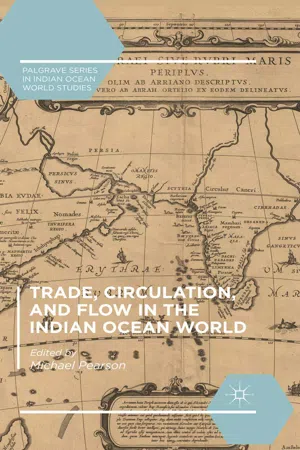
- Michael Pearson(Author)
- 2016(Publication Date)
- Palgrave Macmillan(Publisher)
The product and its trade networks may have been at the farthest eastern end of the Indian Ocean, but they were nevertheless linked to the wider Indian Ocean world . . . , the history of the massoi trade provides further support for the view that the Indian Ocean forms a meaningful unity.” Thus, this study by a very senior historian of Southeast Asia answers one of our central questions, that is whether or not there is indeed an Indian Ocean World with enough commonalities to be susceptible of study. Raden Fernando’s chapter is similarly revisionist. He challenges the usual view of trade in Southeast Asia during the VOC (Dutch East India Company) period, when older studies depicted this European trading company exercising a near-hegemonic control over all trade in the archipelago. Fernando successfully disentangles long-distance and local trade, basing his empirical analysis on the port records in Melaka. His laborious compilation of data show that local trade in fact continued to flourish well into the eighteenth century. The traders were a heterogeneous lot: Javanese, Malay, Indian, Chinese, Armenian, and European. This modest and exemplary study contributes to a bet- ter understanding of the impact of the European trading companies in the early modern Indian Ocean, the period before capitalism. The matter of inland versus maritime, how far inland does the maritime historian need to go, is raised in Rila Mukherjee’s chap- ter. Mukherjee writes on two contrasting cities, Kasimbazar and Chandernagore: ostensibly one is inland, the other maritime. However, it is clear that in fact neither is wholly defined in this way; rather both mingle terrestrial and aquatic features. This encourages us to avoid too rigid a binary between land and sea. It is much more complicated than this! What she shows is that water “worlds” should be under- stood to include noncoastal areas via the inland movement of oceanic eBook - PDF
Ocean of Trade
South Asian Merchants, Africa and the Indian Ocean, c.1750–1850
- Pedro Machado(Author)
- 2016(Publication Date)
- Cambridge University Press(Publisher)
1 Merchants of the ocean South Asian merchants such as Laxmichand Motichand had been active in the ports of the Indian Ocean for centuries, participating in long- distance trade whose routes criss-crossed the waterways of the ocean. Merchant networks involved groups that were drawn from different areas of the subcontinent, such as Chulias and Sindhis; however, it was merchants from Gujarat, both Hindu and Muslim, who for centuries had been perhaps most prominent in commercial exchanges throughout the Indian Ocean. Indeed, as a region marked by movement and connection to the oceanic space in which it was embedded, Gujarat is rightfully identified as “a land of the Indian Ocean as well as of India”. 1 In early periods, close commercial ties between ports in Gujarat, Kathiawar and Kutch and the western Indian Ocean saw merchants visit and trade with ports in the Persian Gulf and Red Sea, as well as along the coast of the Horn of Africa. 2 This has been the focus of most scholarship that has studied these merchants. However, from the late seventeenth and early eighteenth centuries, as this chapter will show, Gujarati merchants forced out of these traditional markets to varying degrees began to turn their attention increasingly towards Southeast African markets. Their interest in African markets was not new to the early modern period, though, as South Asian merchants appear to have been present on Sokotra Island, located a short distance from the Northeast African coast, as early as the fourth century bce. But over the following centuries 1 David Ludden, “Presidential Address: Maps in the Mind and the Mobility of Asia”, The Journal of Asian Studies, 62, 4 (2003), 1068. See also Ludden, “History Along the Coastal Zones of Southern Asia”, paper presented at the South Asia Seminar, Columbia University, 18 October 1999. 2 André Wink, Al-Hind: The Making of the Indo-Islamic World. eBook - PDF
The Periplus Maris Erythraei
Text with Introduction, Translation, and Commentary
- Lionel Casson(Author)
- 2012(Publication Date)
- Princeton University Press(Publisher)
II. T R A D E IN THE INDIAN O C E A N T H E S E T T I N G From at least the beginning of the second millennium B.C. traders were using the seaways of the Indian Ocean. Mesopotamian ships went from ports at the head of the Persian Gulf along the southern coast of what is today Iran and Pakistan to Indian ports at the mouth of the Indus; Indian ships did the journey in reverse. 1 Further west, the Old Kingdom pha- raohs sent vessels to the Straits of Bab el Mandeb at the mouth of the Red Sea and possibly as far as Cape Guardafui. 2 During the subsequent ages such voyaging was continued by Phoeni- cian, Arab, Indian, and perhaps other seaman, continued by them for cen- turies before Greek vessels appeared in these waters. 3 In the course of these centuries the Arabs and Indians unquestionably learned to exploit the monsoons, those seasonal winds that, in the western Indian Ocean, Gulf of Aden, and Arabian Sea, blow from the southwest during the summer and from the northeast during the winter, thereby ensuring a favorable voyage both ways (App. 3). Somehow they were able to keep this knowledge from Greek seamen so that, when these do start taking part in the trade with Arabia and India, they sailed, as the Periplus specif- ically informs us (26:8.28-29), no further east than Eudaimon Arabia, where Aden now stands, less than one hundred nautical miles from the mouth of the Red Sea. Here they unloaded whatever cargoes they were carrying and took on what Indian vessels had brought from their home ports (26:8.27-31); Eudaimon Arabia was truly an entrepot. Then came the moment when Greek seamen no longer stopped short 1 See S. Ratnagar, Encounters: The Westerly Trade of the Harappa Civilization (Delhi, 1981). 2 As early as ca. 2400 B.C., Egypt dispatched expeditions to a land called Punt to bring back myrrh or frankincense (CAH i.2 183 [1971 3 ]). eBook - PDF
The Making of an Indian Ocean World-Economy, 1250–1650
Princes, Paddy fields, and Bazaars
- Ravi Palat(Author)
- 2015(Publication Date)
- Palgrave Macmillan(Publisher)
Introduction Toward a Framework to Debate World History: Bringing South India and the Indian Ocean Back In One of the ironies of recent historical writing is that South India has slipped out of discussions of world historical change, despite it being the source of the spices that reportedly drove Europeans to launch “exploratory” voyages across the seas and a major production site of the most widely traded manufactured good before the industrial age—cotton textiles. Trade across the Indian Ocean—the “old- est of the seas in history,” as Michael Pearson (2003:3) rightly calls it—predated commerce across all other oceans. And yet, as the ori- gins of the modern world are being debated and the factors that were once held to have been peculiar to Europe—private property in land, free markets, rule of law, among others—are now seen to have oper- ated elsewhere as well, South India rarely figures in contemporary debates on comparative world history. The excision of South India from these discussions is perhaps because the source materials for the region are primarily stone and copper inscriptions, a handful of literary texts, and a few travel- ers’ accounts. There are no registers of farm expenses and sales, tax registers, account books of merchants with costs, prices, and asso- ciated trading practices, or production schedules of weaving house- holds, records of mints, export and import figures: none of the staple sources of economic history. Consequently, much of the literature on the political economy of South India has revolved around notions of ritual polities, sacred kingships, and the “segmentary state” (Stein 1980, 1985a, 1989). Yet these inscriptions also contain considerable information about land tenures, expansion of cultivation, rates of 2 The Making of an Indian Ocean World-Economy taxation, administrative hierarchies, and social classes. eBook - PDF
- Serge Cleuziou, Maurizio Tosi, Dennys Frenez, Roman Garba, Dennys Frenez, Roman Garba(Authors)
- 2021(Publication Date)
- Archaeopress Archaeology(Publisher)
In the background there is a pot where a baby was buried at a later period (photograph Joint Hadd Project). Chapter 7 • Trade and the Beginnings of Seafaring in the Indian Ocean 282 282 This was technically accomplished by the fishermen who opened the direct sea route between Arabia and India, taking advantage of their thousands years old experience in ocean navigation. The cities growing along the Nile and on the shores of the great rivers flowing from Anatolia to the Gulf were the main engine of the economic revolution that took place in the first half of the 3 rd millennium BC. Goods and people came there from two main channels: the Nile-Black Sea circuit and the Euphrates-Arabia one. The first, centred on Egypt, extended south-north, from Nubia across the Nile Delta and along the Eastern Mediterranean shores till Troy, and from here it reached the Kuban valley and the gold of Maikop, north of the Caucasus. The second circuit was centred in the Mesopotamian cities and moved west-east along the full length of the Euphrates from the woods and the metals of the Anatolian highlands to the Gulf, and further extending along the shores of Arabia and Iran to the Indian Ocean. True sub-continental basins of economic integration, these circuits had existed since millennia, since their regional sections had been operating from Neolithic times. With the urban growth after 3000 BC, they were expanded in two different ways: by extending sideways in all directions to incorporate new lands and resources around them, and by connecting with each other to form vast continental systems. It is evident that whoever was able to make and control these connections was to be granted exceptional opportunities for wealth and power. FIGURE 169. Two Fasciolaria trapezium conch shells cut as drinking vessels found in the Royal Graves of Ur. They are engraved with the name of the Sumerian king Rimush (ca. 2600-2500 BC). eBook - PDF
- David Armitage, Alison Bashford, Sujit Sivasundaram(Authors)
- 2017(Publication Date)
- Cambridge University Press(Publisher)
60 In the Arab world and many parts of the Indian Ocean, teak or coconut wood was used for the making of hulls, giving rise to an important trade in teak out of India. In building a vessel, wood was stitched together using coir or reed rope, with no iron or bolting. Arab ships displayed lateen sails, woven out of palm leaves, likened in Arab literature to a whale’s fin or spout. 61 While it is easy to visualise the Indian Ocean as the domain of the dhow, Chinese junks, South and Southeast Asian outrigger canoes, sometimes classed together as perahu, and the Indonesian jong, also plied the waterways. Looking beyond the physical craft to temple murals, art, graffiti, memorial stones, coins and sealings reveals a dizzying range of traditions of representing ships. 62 Shipping proved a rich stream of meaning for littoral societies: in Indonesia, for instance, as Barbara Watson Andaya beautifully illustrates, household relationships were expressed in terms of shipboard life, and in Sulawesi, ‘the construction of the boat mirrors the union of men and women and it is understood that an owner and his wife should have sexual relations before the keel is joined to ensure good fortune’. 63 The passage of the winds of the monsoon and its navigation involved the watching of nature’s cycles, even as Ibn Majid’s nautical science touched on everything from fish to stars. If this was so, historiographical debate about European impact has also stretched to accounts of coastal environments. Using archaeobotany, ethnobotany and climatic studies, scholars now hold that the Indian Ocean was a terrain of plural plant and agricultural exchanges from the third millennium onwards, prior to European botany. Coastal sites in Arabia and India served as centres of agricultural experimentation and the diffusion of plants.
- Jason Neelis(Author)
- 2011(Publication Date)
- Brill(Publisher)
CHAPTER THREE TRADE NETWORKS IN ANCIENT SOUTH ASIA Te survey of ancient and early medieval South Asian history in the preceding chapter amply demonstrates that establishing and maintain-ing control of trade networks and arteries of cross-cultural religious transmission was a signifcant impetus for political dynamics. Based on this diachronic foundation, our attention now shifs to a synchronic exploration of specifc route systems in the Indian subcontinent. Tis treatment of transregional networks emphasizes religious and cul-tural geography more than economic patterns, since available literary, epigraphic, numismatic, and archaeological sources do not permit a quantitative assessment of early trade. 1 Te aim of retracing routes and identifying nodes is to understand how trade networks shaped patterns of Buddhist transmission and how Buddhist ideologies provided an impetus to cross-cultural mobility and material exchanges. Trade can be broadly understood as a form of exchange involving the movement of commodities with fuctuating values conditioned by a wide range of economic, environmental, geographical, social, cultural, and reli-gious factors. Combining Karl Polanyi’s general defnition of trade as “the mutual appropriative movement of goods between hands” (1957: 266) with Neville Morley’s sense of trade as the “movement of goods across diferent sorts of boundaries” (2007: 11) as starting points, this examination is more concerned with exchanges across relatively long distances and interconnections between regional nodes than with local distribution and exchange networks. 2 Rather than focusing on 1 Chattopadhyaya, Brajadulal. Studying Early India: Archaeology, texts, and histori-cal issues . New Delhi: Permanent Black, 2003, 217–231 (= Chattopadhyaya, Brajadu-lal. 1988–89. “Trends of Research on Ancient Indian Economic History.” Journal of Ancient Indian History 18: 109–131) remarks that “. eBook - ePub
Spices, Scents and Silk
Catalysts of World Trade
- James F Hancock(Author)
- 2021(Publication Date)
- CAB International(Publisher)
6 Origins of the Spice Trade in the Indian Ocean Setting the Stage – Central Role of RiversThe ancient civilizations of Egypt, Mesopotamia and Harappa all evolved along mighty rivers that provided rich alluvial soils, irrigation waters and transportation. The Tigris and Euphrates Rivers were the backbone of ancient Sumer and the Mesopotamian kingdoms that followed. The ancient Harappa civilization relied on the Indus River. The Nile served as the lifeblood of the Egyptian kingdoms. These rivers fed the agricultural productivity of these great states and served as a vehicle to move grain, ores, stone and luxury products.Ultimately, these great societies became connected by their seafarers following their rivers through linking seas and gulfs to the Indian Ocean. Once linked, they became united through maritime trade. This trade was driven by the human desire for the exotic – manufactured goods, precious stones, metal ores, unusual animals and spices. In particular, the spices cinnamon, ginger and pepper came to generate the lion’s share of profits to the merchants willing to tackle the treacherous sea journeys. The movement of these spices came to be known as the ‘Spice Route’ and eventually spanned 15,000 kilometres (9300 miles) from the west coast of Japan, through the islands of Indonesia, around India to the Middle East and across the Mediterranean to Europe.Persian Gulf RoutesWater transport down the Tigris and Euphrates was likely born about 6000 years ago to transfer copper from the Ergani mines in Anatolia to the southern Sumerian settlements around Uruk in southern Iraq. Travel down the turbulent rivers would have been rapid with prevailing north to south winds; upstream travel would have been very difficult. The earliest vessels of the Mesopotamians were made of reeds or skins to prevent their hitting the bottoms of shallows (Paine, 2013
Index pages curate the most relevant extracts from our library of academic textbooks. They’ve been created using an in-house natural language model (NLM), each adding context and meaning to key research topics.

