History

Trans-Saharan Trade Route
The Trans-Saharan Trade Route was a network of trade routes that connected the Mediterranean coast of North Africa to the sub-Saharan regions. It facilitated the exchange of goods, ideas, and culture between North Africa and West Africa, including gold, salt, ivory, and slaves. The trade route played a significant role in the economic and cultural development of the regions it connected.
Written by Perlego with AI-assistance
Related key terms
1 of 5
11 Key excerpts on "Trans-Saharan Trade Route"
 eBook - ePub
Africa in Global History
A Handbook
- Toyin Falola, Mohammed Bashir Salau, Toyin Falola, Mohammed Bashir Salau(Authors)
- 2021(Publication Date)
- De Gruyter Oldenbourg(Publisher)
Chapter 3 Tran-Saharan Networks to 1800
Moses I. Olatunde IloAbstract
This chapter focuses on the development of a long-distance trade that linked sub-Saharan Africa with North Africa and other parts of the world. The trans-Saharan trade, from earliest times to 1800 identifies important trade routes, articles of trade, markets networks, and commercial networks. The chapter also demonstrates that despite the significance of the relevant commercial networks and the trans-Saharan trade in general, the trade in question gradually declined from the late sixteenth century due to several factors including the rise of the Atlantic trade.Keywords: Commercial networks, trans-Saharan trade, Islam, slavery, ethnicity.Introduction
South of both the Mediterranean Sea and Mediterranean northern Africa lays the Sahara Desert. This desert is greater than the whole of Europe, and it is by far the largest desert in the world. Even though the Sahara Desert is largely characterized by dry sand, it also has mountains and oases that allow for agriculture and sedentary living in several places. Even though the desert presents many obstacles, it could be crossed. Indeed, right from the premodern times, the Sahara Desert became home to major trade routes associated with the famous trans-Saharan trade.1The trans-Saharan trade was mainly characterized by interactions between sub-Saharan Africa and North Africa, but it also fostered connections between Africa and other parts of the world. The trade reached its height in the sixteenth century before experiencing a gradual decline. This chapter examines the factors responsible for the growth and expansion of the trans-Saharan trade. It also discusses the effects of trans-Saharan exchanges and the factors responsible for the decline of the trade. In examining these issues, this chapter demonstrates the importance of the use of camels for transportation, the rise of Islam, and of the development of market and commercial networks as key factors in the expansion of the trade between sub-Saharan Africa and North Africa. In addition, the chapter stresses that the trans-Saharan trade left a complicated legacy and that its decline resulted from several factors including political insecurity as well as the rise of the alternative trade across the Atlantic. eBook - PDF
Muslim Societies in Africa
A Historical Anthropology
- Roman Loimeier(Author)
- 2013(Publication Date)
- Indiana University Press(Publisher)
Rather than seeing the Sahara as a periphery, the Sahara and its various populations should thus be perceived as a major region in its own right that has survived and repeatedly denied efforts to impose outside control. The Trans-Saharan Trade The Sahara, the great desert, stretching from the Atlantic to the Red Sea and from the Atlas Mountains and Mediterranean coast to the edges of the bilād al-sūdān in the south, has often been depicted as a great divide, separating North Africa from sub-Saharan Africa. This has been far from the truth for most of the time. In reality, the Sahara has been one of the world’s major connective spaces, crisscrossed by trading routes and dotted with numerous smaller or larger oases which made the crossing of the Sahara with an experienced guide a fairly uncomplicated undertaking. The major problem involved in crossing the Sahara was of a logistic nature: the central question was which route would sustain a caravan of which size in which season of the year. Not all oases would yield the water to supply a caravan of several thousand camels and The Sahara as Connective Space | 55 a corresponding number of men (and women). Sometimes, caravans might choose a longer route when rainfall had produced good pastures in a specific region. The bigger the distances between watering places, the more water and fodder had to be trans-ported by the caravan itself, to the detriment of trade goods. Supply of water and fod-der, distances between watering places, and annual variations thus largely defined the size of caravans. In addition, there was the problem of recurrent feuding and raiding in the Sahara, often over the control of oases and caravan routes. Correspondingly, the knowledge as to which route would be best at which time of the year was crucial. eBook - ePub
Encyclopedia of World Trade: From Ancient Times to the Present
From Ancient Times to the Present
- Cynthia Clark Northrup, Jerry H. Bentley, Alfred E. Eckes, Jr, Patrick Manning, Kenneth Pomeranz, Steven Topik(Authors)
- 2015(Publication Date)
- Taylor & Francis(Publisher)
c.e . The reasons behind these forays remain a mystery, but they were probably a mixture of military opportunism and the need for slaves. Roman trade goods, including glass, jewelry, and Roman coins, found at a mountain oasis settlement in the southern SaharaUse of the camel beginning around the first century c.e . helped promote Saharan and trans-Saharan trade. (Library of Congress)dating from at least the fourth century c.e . suggest the extent of trans-Saharan trade.The main routes of the trans-Saharan commerce started from the southern Maghreb towns of Marrakesh, Sijilmasa, Tuwat, Wargla, and Ghadames, which were all linked to ports like Tunis or Tripoli, where swifter naval transport was available toward the East. Through the oases of Murzuk, Ghat, Bilma, and Taghaza, caravans reached their Sudan destinations at Tadmekka, Timbuktu, Awdaghust, Kumbi Sale, Kano, or Kukawa. Trade, however, flowed not just along the shortest North-South axes, but the East-West links toward Egypt and Asia also played an important role. In fact, a continuous eastward shift of the Sudanic centers is discernible. Central Sudanic states, like Wadai, Dar Fur, and Borno, partly owed their growing importance to the lively traffic of pilgrims.The most important development in Saharan trade aside from use of the camel was the gradual introduction of Islam, first to North Africa and then across the Sahara, between the seventh and eleventh centuries. Early Muslim traders established far-flung networks of fellow Muslim agents across the desert and in sub-Saharan Africa in the centuries before larger-scale conversions to Islam. Islam provided a basic shared cultural framework that governed everything from personal behavior to contractual agreements and taxes. This common reference point made trade easier and made Islam attractive to African rulers and other elites. Conversion to Islam provided not only social differentiation but also access to education, favorable trade terms, and access to credit.
- Njoki Nathani Wane(Author)
- 2019(Publication Date)
- Palgrave Macmillan(Publisher)
History and oral tradition indicate Africa was involved in such trading activities before European arrival on the continent. Oral tradition, cartography, and contemporary economics in Africa have chronicled trading locations, goods that were traded, taxation, the routes that traders traveled, and the people involved in the trading (Fagan 1969). This account, Fagan emphasizes, in many ways provided ample evidence that the pre-colonial trade was stimulated by many races and tribes, but the North African Arabs were notable for the trans-Saharan trade as this was sustained by their Islamic faith and powerful commercial incentives. As a result of their resilience, they and the indigenous Berber people developed a network of trade routes across the Sahara Desert. What was their motivation for taking such high risks? The absence of in-demand commodities in both the north and south motivated the necessity to begin trading essential commodities across barriers, defying ecological boundaries to reach the consumer, and of course to also earn a livelihood (Connah 2004, p. 107). It is worth mentioning that Arabs contributed and influenced this trade in the Sudanese and savanna regions of Africa between 1000 and 1500 CE (Mohammed 2000). Long-distance trade is generally defined and characterized by the geographic extension of its commercial networks, the high entry tax it implies in terms of capital but also of commercial and sometimes technological knowhow, as well as the potentially large amount of income that can be gained from it. It is an important source of analysis as it’s a way of reviving comparative studies and delving into historical antecedents since long-distance trade began to develop in Europe as well as in Black Africa long before antiquity. It was also due to the role generally attributed to it in the birth, emergence, and consolidation of capitalism (Petre-Grenouilleau 2001, p. 165) eBook - ePub
Caravans in Global Perspective
Contexts and Boundaries
- Persis B. Clarkson, Calogero M. Santoro, Persis B. Clarkson, Calogero M. Santoro(Authors)
- 2021(Publication Date)
- Routledge(Publisher)
Dar al-Islam, certainly played a key role in the establishment of these long-distance gold routes. But despite these ancient contacts that may have been sporadic or even common, it was the strong political pressure of the Middle East that made it possible to build a lasting connection between the Sahel belt and the Mediterranean regions (Haour 2017). The widespread use of the domestic dromedary in North Africa – introduced to the region during the first millennium BC – was, in the course of late antiquity, the final element to establish a traffic system on a continental scale through the now totally desert environment of the Sahara (Almathen et al. 2015:6708).Figure 9.1 Map of Trans-Saharan Trade Routes as mentioned by Ibn Hawqal (tenth century) and Al-Bakrî (eleventh century). Doc. Ch. Capel.The first attempts to open new routes across the Sahara on the fringes of the transversal routes seem to have taken place at the end of the Umayyad era, i.e., around the middle of the eighth century AD; the Arab–Andalusian author Al-Bakrî (eleventh century) echoed this by reporting that ’Abd al-Rahman ibn Habîb, Governor of Ifrîqiya (now Tunisia) in the last years of the Damascus Caliphate, ordered the digging of wells to make a passable route from Tâmdûlt (southwest Morocco) to Awdaghust (south Mauritania) along a north–south axis, near the Atlantic coast (Al-Bakrî 1911:154, 1913:296–297). Whether or not journeys actually occurred under the supervision of the Ifrîqiyan governor, this caliphate project suggests that there were several reasons for creating new routes. The first concerns the practicality and safety of the route to make journeys faster and easier, and thus more enticing and profitable. The aim was to create routes with reliable water sources, secure from raids, accessible to rest stops, and without any dangerous or hazardous crossings. This is why local security conditions were as important as the environmental conditions, and why the chosen routes could quickly shift according to regional realities. The second parameter defining the routes was the location of the production and consumption centers, which were the objective of Saharan crossings. However, these termini evolved over time, depending on the wealth of the political powers who were invested in the trade. Thus, in the Near East, North Africa, and Sahel, geopolitical entities underwent substantial changes between the eighth and the fifteenth centuries, causing a constant displacement of the major power centers, such as Kairouan, Fez, Marrakech, Tlemcen, and Tunis in North Africa; Damascus, Cairo, and Aleppo in the Near East; Gao, Ghana, Mali, and Timbuktu in western Sahel; and Kanem and Borno around Lake Chad, thus directly influencing the layout of major trade routes (Devisse 1972, 1990). But the main criterion for the definition of a caravan route was based upon local resources, on which a large part of trade and travelers’ supplies were based. Above all, a good route consisted of quality stops where competent guides, numerous and robust camels, abundant fodder, and quality and varied goods were available. Therefore, a stopover could become preferred because of a popular local craft industry such as that of the leatherworkers at Zawîla (Libya) (Al-Ya‘qûbî 1892:345, 1937:205), the availability of the famous dates of Ghadâmes (Libya) (Al-Bakrî 1911:182, 1913:340), the precious salt resources of Awlîl (Mauritania) (Ibn Hawqal 1938:92, 1964:89; Al-Bakrî 1911:171, 1913:328), or of renowned prostitution services at Tadmekka (Mali) (Al-Bakrî 1911:182, 1913:339–340). Each one of these criteria could have been a decisive consideration in determining itineraries. eBook - ePub
Global Byzantium
Papers from the Fiftieth Spring Symposium of Byzantine Studies
- Leslie Brubaker, Rebecca Darley, Daniel Reynolds, Leslie Brubaker, Rebecca Darley, Daniel Reynolds(Authors)
- 2022(Publication Date)
- Routledge(Publisher)
2686–2181 BC). 67 Indeed, the classical writers also refer to trans-Saharan trade, through the desert from east to west as well as north to south. Both Strabo and Pliny described semi-precious stones sourced in West and sub-Saharan Africa brought to Carthage by Garamantian traders in the first centuries BC and AD, illuminating one of the commodities travelling along the stated routes. 68 And Herodotos, writing much earlier in the fifth century BC, even seems to describe a network that ran through the Sahara, connecting peripheral communities. In his Historiai, Herodotos appears to have used a caravan itinerary to structure his description of the peoples of Libya and beyond. 69 The route started in Thebes and travelled to the Siwa oasis, one of the smaller oases of the Western Desert to the northwest of Dakhla, before heading to the Augila oasis in Northeast Libya, the Fezzān, and from there either north towards Morocco or south to the Ghat oasis and Chad basin. In his description, Herodotos provides travel times and physical descriptions of the landscape, as an itinerary for a merchant might. While the travel times and stops in this description are occasionally suspect, 70 it is the earliest written record of a trade route passing through the Sahara that is not directly related to a Mediterranean port. The tenth-century AD geographer Ibn Hawqal attested to the continued use of such routes, describing several caravan roads that passed through the Egyptian oases, including ones that led to Ghana, the Maghreb, and Barca on the Libyan coast through the Fezzān. 71 Although there are many gaps in the evidence, caravan routes that connected the desert communities with West Africa spanning a period of over 1,000 years is suggestive of sustained contact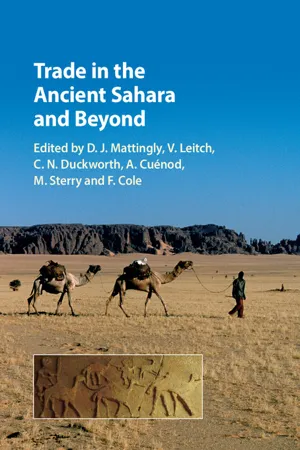 eBook - PDF
- D. J. Mattingly, V. Leitch, C. N. Duckworth, A. Cuénod, M. Sterry, F. Cole(Authors)
- 2017(Publication Date)
- Cambridge University Press(Publisher)
88 Lovejoy 1986, esp. 223–31. 89 Hamani 1989. 90 Dyer 1979, 30. 92 Anne Haour Ghana. 91 Taking into account the possibility of east–west exchanges link- ing Tilemsi, Aïr and Kawar is plainly important given the many calls in the recent literature for a consideration of small-scale networks of exchange internal to the Saharan regions. 92 Trade between the two ends of the central Saharan route – or any Trans-Saharan route – cannot be envisaged without looking more closely at interlocking networks within the Sahara itself. 93 For Peregrine Horden, this concern with smaller-range connections rein- states the proper role of the Sahara – no longer a transparent medium for trade, a blank canvas ready to be washed by cultural tides, but a space in its own right. 94 Behind the fact of many Saharan oases’ very existence lies the question of their connection with the wider world. Connectivity is the key theme here, and this leads directly to a discussion of the actors involved and to the question of networks of trust. Trust Networks The question of the impact of political and large-scale religious change on the flux of Trans-Saharan trade has been oft-discussed. But the history of dynasties and polities only partly explains events on the ground: between the lines written about these vast political entities are multiple overlapping networks. Vikør 95 cautions that Kawar probably constituted a decentra- lised oasis community, with centres of political and commercial impor- tance that varied over time. In the early medieval period, certain Sahelian sites such as Marandet may have been ephemeral and vulnerable to col- lapse because they relied too much on trade and on a narrow network of specialised traders. 96 Networks of specialised traders are often described as trade diasporas. A trade diaspora is defined by Abner Cohen as ‘a nation of socially interdependent, but spatially dispersed, communities’. eBook - ePub
The Southern Shores of the Mediterranean and its Networks
Knowledge, Trade, Culture and People
- Patricia Lorcin(Author)
- 2017(Publication Date)
- Routledge(Publisher)
The trans-Saharan slave trade in the context of Tunisian foreign trade in the western Mediterranean Ismael M. Montana Department of History, Northern Illinois University, DeKalb, USAThe paper explores effects of local Tunisian reforms and broader economic and political developments occurring in the western Mediterranean shores during the late eighteenth and early nineteenth centuries on the trans-Saharan slave trade. While the scanty available literature stresses the insignificance of the trans-Saharan slave trade to Tunisia, this paper examines the complex interplay of Tunisian economic reforms and the burgeoning European commercial expansion that shaped the Tunisian economy and, in turn, the trans-Saharan slave trade. Impact of these developments was not limited to Tunisian trade with Europe and the Levant. A significant increase in trade activities between the Regency of Tunis and the African interior can be observed on a number of levels. In particular, aside from the favourable conditions arising from Hammuda Pasha’s reform and economic policies, expanding European trade in Tunisia, mainly after 1788, was a major force behind a continuation and growth of the trans-Saharan slave trade which continued until outlaw in 1841. In addition to Hammuda Pasha’s economic reform policies that led to the integration of the Ghadames caravan trade into burgeoning economy, trade growth between Tunisia and the African interior was further fuelled by European capital infusion in the western Mediterranean.IntroductionBeginning in the late 1780s, the trans-Saharan slave trade from the African interior, while becoming a principal branch of the Regency of Tunis’ network of overland trade, was typically not considered important for burgeoning European commercial expansion that stimulated agricultural production, commerce and Tunisian economy. Nearly a century prior to the late 1780s, the Muradites, who undertook the consolidation of various economic infrastructures following the Ottoman conquest of Tunisia in 1574 (along with corsair expeditions, they developed as a ‘legitimate commerce’ of the Ottoman province), integrated the trans-Saharan slave trade into the nascent Tunisian foreign trade. Successors of the Muradids, the Husaynids (1705–1957), maintained the trade via Ghadames. Until the early 1780s, however, it remained a marginal branch of the Husaynids’ foreign trade. eBook - ePub
A Different Vision
Race and Public Policy, Volume 2
- Thomas D Boston(Author)
- 2002(Publication Date)
- Routledge(Publisher)
18At the same time, commodity exchanges with the Islamicized Sudan, Bilad al Sudan [Arabic, meaning land of the blacks], were extensive, and the study of the economic life of the great Sudanic empires of Ghana, Mail, and Songhay from the eleventh through the sixteenth centuries is important. With procolonial West Africa, these were complementary economic trade regions, and commerce in the Sudan existed not in isolation from that of the Guinea coastal states, but as a part of an interconnected West African economic unit. As it was, European greed to secure sub-Saharan trade commodities from West Africa, thus avoiding Arab middle men costs, propelled their exploration of Guinea Coast Africa.In his discussion of the economic history of Africa, Ralph Austen describes the degree to which trade connections along the upper Guinea Coast in both precontact and precolonial West Africa had been either established with Sudanic trans-Saharan markets or were integrated into the Sudanic commercial world. As he indicates, the Senegambia-Upper Guinea region was “a direct extension of the Western Sudanic savanna although somewhat distant from its main economic and political centre of the Middle Niger.” The forest regions of the Gold Coast and the Bight of Benin, he adds were “strongly linked to the Sudanic economy but never fully assimilated to it.” Of the remaining three zones, located east and south of the Niger River and its coastal delta, the Bight of Biafra, Gabon-Congo and Angola, Austen said that “Sudanic contacts disappear entirely.”19 eBook - ePub
An Economic History of Tropical Africa
Volume One : The Pre-Colonial Period
- J.M. Konczacki, Z.A. Konczacki(Authors)
- 2013(Publication Date)
- Routledge(Publisher)
PART VI
Trade Routes and Trade Centres
 Passage contains an image
21
SOME REFLECTIONS ON AFRICAN TRADE ROUTES*
Gervase MathewThere will be four main factors in the reconstruction of pre-European African history south of the Sahara; the recording of oral history, the study of anthropology, archaeological research and geographical analysis, all four must always be co-ordinated, in some instances they will blend.There is none of the northern antithesis between tradition and the written source for normally the few chronicles are essentially segments of oral history recorded at different periods in documentary form as in the case of the chronicles of Kilwa and of Pate. The factual value of traditional history must always depend on the character of the social setting in which it has been preserved, adapted and at times created. In consequence the valid study of oral history is inseparable from scientific anthropology. But it is also interwoven with archaeological research whether the study of sites or of beads or of pottery forms; African tradition has often provided archaeology with its clues as in Uganda. Archaeology is providing the study of traditional history with a new technique for objective checking.But geographical analysis combined with a perpetual awareness of economic factors must give the setting for any reconstruction of the African past. Perhaps the most immediate need is to apply the evidence of oral tradition, archaeology and geography to the re-discovery of pre-European trade routes. There are four main groupings of such routes to be investigated.There are the lines of coastal traffic along the shores of the Indian Ocean and of the Atlantic, and perhaps along the deserts of the Sahara which formed an inland sea. There are the tracks by which exports from far into the interior reached the coast and were ultimately forwarded to foreign markets. There is the network of internal trade within Africa brought into being by local needs for salt or iron or copper. Finally there is the possibility of transcontinen al trade routes. And in each case we are only at the beginning of any scientific study. In this paper I am tentatively making suggestions based primarily on personal experience. eBook - ePub
- Paul Finkelman(Author)
- 2019(Publication Date)
- Routledge(Publisher)
Furthermore, traffic of some kind across the Sahara between North and West Africa had been in existence for something like a thousand years at least before the Arab conquests began in the seventh century A.D. It has been shown, in fact, that a trans-Saharan trade in Negro slaves must have existed, though perhaps in little volume, as early as about the second century A.D. 5 However, we have no means of knowing what relation this may have had to slavery and the slave trade within West Africa itself. In default of evidence of the relation between the existence of an external demand for slaves and of slavery and an internal trade in slaves for the West African Sudan, we must turn to the Guinea area, where commonly the first truly external traders were the European sea-traders, who first arrived on the coasts in the fifteenth century. The evidence for Upper Guinea, from the Gambia to modern Liberia, has been analysed by Dr Walter Rodney. 6 The ethnographic picture that can be built up for this part of the coast-lands from sixteenth- and seventeenth-century European, especially Portuguese, accounts would seem to be good and detailed, but the references to slaves are few and far between. They indicate little more, Rodney says, than that the kings and chiefs of the area had a small number of ‘political clients’ in their households. There is no evidence for the existence of ‘chattel slaves, agricultural serfs, or even household servants’ in any numbers, or in any condition to differentiate them from ordinary citizens. He concludes, therefore, that there was no sizeable class of men, and no indigenous trade in men, which could serve as a launching-pad for the Atlantic slave trade
Index pages curate the most relevant extracts from our library of academic textbooks. They’ve been created using an in-house natural language model (NLM), each adding context and meaning to key research topics.

