History

Lost Colony of Roanoke
The Lost Colony of Roanoke refers to the mysterious disappearance of a group of English settlers in the late 16th century. The colony was established on Roanoke Island, off the coast of present-day North Carolina, and was led by John White. When White returned from a supply trip, the settlers had vanished without a trace, leading to enduring speculation and mystery surrounding their fate.
Written by Perlego with AI-assistance
Related key terms
1 of 5
11 Key excerpts on "Lost Colony of Roanoke"
 eBook - PDF
Figures of Pathos
Festschrift in Honor of Elisabeth Bronfen
- Frauke Berndt, Isabel Karremann, Klaus Müller-Wille, Frauke Berndt, Isabel Karremann, Klaus Müller-Wille(Authors)
- 2023(Publication Date)
- Königshausen & Neumann(Publisher)
Certainly, the demise of the colony did not halt American colonization by England for long, and soon its story was overshadowed by the endeavors of the Virginia Bay Company and its settlement in Jamestown, which faced similar risks and obstacles, yet prevailed, as well as the religiously motivated colonists at Massachusetts Bay further North. For better or worse, to this day, the “lost colony” of Roanoke is seen as the anti-Jamestown. The chronology of the lost colony is anchored in the year 1587, when a group of Englishmen and -women willing to settle in North America 1 Recently numerous new publications focus on Jamestown (Horn 2005, Kelso 2018, Woolley 2007) and its history has inspired a new television series named Jamestown (three seasons, 2017–2019). For an overview of US foundational my- thology, see Paul 2014. The “Lost Colony” of Roanoke 339 arrived at the Outer Banks of North Carolina. Two earlier journeys had identified the spot and had supposedly paved the way for this long-term venture: In 1585, Sir Walter Raleigh had sent Arthur Barlowe and Philip Amadas on a reconnaissance expedition to explore the region (cf. Quinn 1974, 283); they returned to England with two Native men, Manteo and Wanchese, and conveyed confidence in the building of a settlement at this location. The name “Roanoke” was of Indian origin and translates to “white beads made from shells” (Kupperman 2012, 94), and Thomas Harriot’s de- scriptions of the area in his Report were enticing and promised economic gain (cf. Harriot 2007). Queen Elizabeth I granted Raleigh permission, and the latter sent Ralph Lane and Sir Richard Grenville on a second journey to settle Roanoke. Following self-induced tensions with the local Natives, food shortage, and Lane’s mismanagement overall, they came back to Eng- land in 1586. eBook - PDF
Indography
Writing the "Indian" in Early Modern England
- J. Harris(Author)
- 2012(Publication Date)
- Palgrave Macmillan(Publisher)
It is not simply the rendering of absence in this early instance of Indography that can make people lose their indigenous land claim. Instead it is the power to control the absented body or item that ultimately justifies dispossession. Simply put, the fact of absence is not the only determining factor. In early American Indography, it is the power to disappear objects, others, or even oneself that ultimately matters. The power to disappear or to render items as “lost” is bound up entirely with the discourse surrounding the Roanoke voyages. For a cultural critic, it is almost too perfectly ironic that the first attempt at permanent English colonization in the Americas becomes the Lost Colony. Beginning from a place of loss allows the continuation of a deeply ahistorical narrative of U.S. (and hemispherically, American) history. The story of the 1587 settlement on Roanoke Island constitutes an iconic, albeit fleeting, moment of historical significance. Additionally, the birth of Virginia Dare, the first English child born in the Americas, remains as a familiar flashpoint in colonial history. Most enduring, however, is the powerful mystery of the colony. With the dramatic backdrop of England’s confrontation with the Spanish Armada, John White’s failed attempt in 1590 to find the colony, which included his own daughter and granddaughter, marks a point of familial and national loss Gina C a ison 46 in the English New World. Likewise, the cryptic messages of “CRO” and “Croatoan” inscribed on trees, as well as the ruined remnants of White’s personal papers scattered about the abandoned site, establish a narrative of intrigue and chaos involving English settlers disappearing into the Indian wilderness of the American landscape. What remains from this narrative of loss is collected in the extensive letters, journals, travel logs, and propaganda materials detailing the voyages along the present-day Carolina coast from 1584 to 1590. eBook - ePub
Seasons of Misery
Catastrophe and Colonial Settlement in Early America
- Kathleen Donegan(Author)
- 2013(Publication Date)
- University of Pennsylvania Press(Publisher)
Moreover they indicate serious breaches in the ability to interpret or account for events in the first English incursion into Native America, while also emphasizing the proximity of violence and indeterminacy. The stories are left unresolved; either the corpse silently absorbs the unreadable narrative into itself or the body goes missing, leaving no trail behind. These abandonments indicate that the cultural longevity and elaboration of the mystery of the Lost Colony is a legend that screens but also repeats a suppressed history of other people left behind in Virginia. In 1587 John White led yet another group of English colonists to try again to plant a permanent and self-perpetuating English settlement in North America. The ships that brought these colonists were the sixth round to arrive at Roanoke in three years: Barlowe's, Lane's, Drake's, the supply ship, Grenville's, and now White's. White took passage on four of these voyages, as did Manteo, who accompanied him. 70 After Lane set the deadly terms of Anglo-Indian engagement with the murder of Pemisapan, Roanoke had grown increasingly dangerous for the English with each arrival. Although White and his company originally planned to settle in the Chesapeake, they first stopped in Roanoke to check on the men Grenville had left garrisoned there. As members of Lane's colony, both White and Manteo knew the situation created by the raid on Dasemunkepeuc and Pemisapan's murder, but somehow they thought Grenville's men were still alive, albeit in need of relief. Even before reaching the fort, however, it was clear to White that they were mistaken, seeing no “signe that they had bene there, saving only we found the bones of one of those fifteen, which the Savages had slaine long before” (524). This was the third time English people had found the same patch of land mysteriously forsaken in two years. In 1586 the supply ship found Roanoke deserted by Lane's colony eBook - ePub
Set Fair for Roanoke
Voyages and Colonies, 1584-1606
- David Beers Quinn(Author)
- 2017(Publication Date)
- The University of North Carolina Press(Publisher)
The Roanoke colonists and their planners were unable to achieve the ends they set for themselves. Although a small party could coast the southern part of Chesapeake Bay and penetrate the interior to the south of it in 1585–86, successive attempts to return there by sea were frustrated by inefficiency. The Lost Colonists were left to disappear without any effective attempt to find them for nearly twenty years. This fact (combined with Sir Walter Ralegh’s self-interest) demonstrated that neither the will nor the means to explore further were present until prestige factors came into play after the Spanish war ended. The Roanoke experiments, however, did provide at least some inkling of the necessity for long-term and substantial deployment of capital resources if colonization was to be effectively attempted, but it should not have taken twenty years for this to sink in.War, it is true, frustrated expeditions by both England and Spain that would have made the Chesapeake a wartime base for one power or the other. But after 1590, down to the Treaty of London in 1604, either side should have been able to carry out some part of its plans without affecting its war effort significantly, even if in the years before 1590 the exploitation of North America for naval purposes was not feasible. Lassitude overtook Spanish plans. English attention was diverted by Dutch successes in the East, and they moved to emulate them there rather than intervene before 1607 in North America.There were positive results, too, from the Roanoke voyages. The maintenance of more than a hundred men for over ten months on Roanoke Island in 1585–86 indicated that Englishmen could live in North America, even if the experience of the early Jamestown colonists suggested the contrary. The introduction of European epidemic diseases by the same Roanoke colonists was not regarded as significant. If it was regarded at all it would have been thought to have been a good thing, a means of clearing the original occupants from soil it was thought they did not effectively exploit. There was little awareness of the complications of introducing a progressive intrusive series of colonies into a closed Native American society, every inch of whose soil was part of the ideological property of its inhabitants. Indians, if they would not move, might have to be removed. Or they might, in Thomas Harriot’s view, be introduced to the benefits of European civilization and religion and remain in substantial parts of their own territory, even if full assimilation was rarely contemplated. The Roanoke voyages initiated for the English the intrusion that in the relatively short run was to remove most of the eastern Indians by death or their relegation to scarcely viable reservations inside their former territories. There were cultural exchanges both in 1584–87 and after 1607. The Indians were to master the use of metal tools and weapons; the English were to learn how to cultivate corn and other Indian horticultural novelties. But neither exchanged enough of each other’s cultural heritage to make the exchange a radical, or, from the Indian perspective, a fair one. The idealistic view, as it may be regarded, of John White was scarcely to be implemented. eBook - ePub
Empire Imagined
The Personality of American Power
- Giselle Frances Donnelly(Author)
- 2022(Publication Date)
- SUNY Press(Publisher)
6 THE ROANOKE COLONY In the spring of 1588, Sir Richard Grenville, one of the foremost sailors of the Elizabethan age and close associate of Francis Drake and Sir Walter Ralegh, readied a small fleet of seven ships, including the queen’s twenty-two-gun Tiger, for the reinforcement and provisioning of the first English permanent colony in North America, at Roanoke on the barrier islands of what today is North Carolina. Grenville’s preparations were nearing completion at the end of March, when the privy council intervened and ordered Grenville “to forebeare to go his intended voyage.” In the season of the Spanish Gran Armada, “Her Majesty dothe receave dayly advertisement of the preparations of the King of Spayne to increase, whereupon it is also thought necessary her Navyes on the seas should be reinforced and strengthened, and to that end order is given bothe for the staye of all shippes in the port townes of the Realme, and to the said townes to furnish a certain number of vessels, &c.” Grenville, lord of the manor of Bideford in north Devon, was “to have shippes so by him prepared to be in readynes to ioyne with her Majesties Navye as shalbe directed hereafter.” 1 Thus was the Roanoke colony, established the previous year, “lost,” or, as Kenneth Andrews mordantly put it, “effectively sentenced to death.” 2 The Roanoke effort was a product of the developing war with Spain and finally the victim of it: intended, first of all, as a potential haven for English privateers hoping to intercept King Philip’s treasure fleets, a forward base in the New World, Roanoke had to be sacrificed to defend the home waters from the threat of the Gran Armada. The colony was an expression of the expanding scope of English strategists but also of the limits of English military, economic, and other means eBook - PDF
Decentring the Renaissance
Canada and Europe in Multidisciplinary Perspective 1500-1700
- Carolyn Podruchny, Germaine Warkentin(Authors)
- 2017(Publication Date)
- University of Toronto Press(Publisher)
By this Elizabethan connection, Roanoke gives America a genealogy; it assures us that the American people 'directly connect' with an English sixteenth century populated by the epic figures of a golden age (C. Porter 1985, 3). If Roanoke provides a link to England, it also becomes an origin story for (English-speaking) America. Robert Arner writes: 'early in the nine-teenth century, when Americans began to cast about for materials out of which to construct a national mythology, the story of the Lost Colony was one of the first sources they discovered ... The emphasis was upon attempts to explain how the missing settlers, Englishmen no longer, had become Americans and what legacies, if any, they might have left us. It was transparently a quest for American parentage' (Arner 1985, 12). In the light of these uses of history, we might notice not only that Roanoke is imagined as or in terms of the feminine, but that this imaginative gen-dering is associated with ideas about the colony's capacity for parenting and reproduction. Symbolic genealogies affiliate America's first colony backwards, to the Virgin Queen, and forward, to subsequent genera-dons of Americans; claims about reproduction assert that the English engagement with the land has been consummated and validated. At the Images of English Origins in Newfoundland and Roanoke 145 Fort Raleigh National Historic Site on Roanoke Island, two large plaques mark the first Christian baptism in America and the first English birth. On Roanoke Island, biological and social reproduction are the real ceremonies of possession. As Robert Arner (on whose work I draw) has documented, fictional writing on the Roanoke colony gravitates to Virginia Dare, the first English child born in America -about whom nothing is known but her birth.
- Susan-Mary Grant(Author)
- 2012(Publication Date)
- Cambridge University Press(Publisher)
Leaving them there, White himself sailed with the fleet to England to secure supplies, arriving home just in time for his ship to be requisitioned as part of England’s defense against the Spanish Armada (1588). On his return in 1590, he found the Roanoke colony deserted and the settlers, including his daughter and granddaughter, gone. All that remained was the word “Croatoan” carved into a tree. This was possibly a reference to the Croatan people, but whether the settlers had been rescued or murdered by them, no one knew. As far as the English were concerned, the fate of the “Lost Colony” of Roanoke could only be imagined. This inauspicious beginning did not bode well for future English colon- ization efforts, but neither did it diminish the growing enthusiasm for the opportunities perceived to exist across the Atlantic. In naming the land Virginia, Ralegh had accorded it a validity it had not previously held in New Found Land 25 the English worldview. No longer terra incognita, Virginia became a place on the map, fixed in the English imagination as both location and poten- tial property. In the English mind, it became, as Thomas Hariot would describe it, a “New Found Land” that, having been “found,” could not then be forgotten. Hariot’s study, A Briefe and True Report of the New Found Land of Virginia, first published in 1588 and then two years later with engravings by de Bry of illustrations by White, and translated into English by Hakluyt, was in every sense a composite view of the state of understanding of the New World in England when it was published. A Briefe and True Report offered a more measured assessment of the country and its population than many previous reports or propagandist works had provided and, even acknowledging the failure of the Roanoke expedition, sustained interest in the possibility of settlement in America (Figure 1.3). eBook - PDF
Lethal Encounters
Englishmen and Indians in Colonial Virginia
- Alfred A. Cave(Author)
- 2011(Publication Date)
- Praeger(Publisher)
Soon thereafter, the fleet was struck by a hurricane, which sank four ships, including the one intended for Lane’s use. Hariot was convinced that Prelude 19 the storm came upon the English in punishment for their mistreatment of the Indians. Most of the colonists were immediately evacuated. Those left behind sub- sequently disappeared. They may have joined Manteo’s tribe nearby, which was headed by his mother. However, it is also possible that they may have perished at the hands of less friendly Indians. A second colony was founded in 1587. Originally intended to be planted at Chesapeake Bay and called the City of Raleigh, this colony’s founders were uncer- emoniously deposited at the old site at Roanoke, as the crew of the ship that had carried them across the Atlantic was eager to go privateering. Under the gover- norship of John White (who may or may not have been the same adventurer who painted the peoples of Roanoke), the colonists numbered 115 and, unlike the earlier venture, included 17 women (two of whom were pregnant) and nine children. The colony was assisted in its relations with the local Indians by Manteo, who, unlike Wanchese, remained pro-English. (After converting to Christianity, he was named by the English “Lord of Roanoke.”) After a month, the colonists persuaded Governor White to return to England to seek supplies. He did so, and in response to his appeal, preparations were made to send a fleet of eight ships to Virginia to provision the colony. Those plans, however, were disrupted by the outbreak of war with Spain and by the Spanish Armada crisis. When White finally returned in August 1590, he found no trace of the colony at Roanoke, other than a word carved on a tree—Croatoan—which led him to believe that the settlers may have moved to that island. Once again, storms disrupted efforts to help the colony.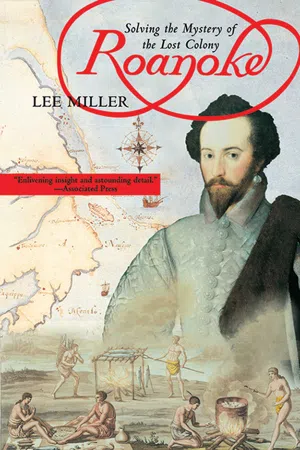 eBook - ePub
Roanoke
Solving the Mystery of the Lost Colony
- Lee Miller(Author)
- 2012(Publication Date)
- Arcade(Publisher)
PART ONE
A CASE OF MISSING PERSONS
 Passage contains an image
1 THE DISAPPEARANCE
Roanoke Island, North America—July 1587. A mystery is unfolding. One hundred and seventeen people have landed on a remote island off the North American coast. The men, women, and children, sent out by Sir Walter Raleigh, are the first English colonists in America. Despite the care taken for their safety, the explicit instructions, the plans for provisions, all will vanish. The only known survivor will be their Governor, John White — an artist and veteran of Raleigh’s previous Roanoke expeditions. He had known, from the moment they landed, that they could not survive on Roanoke Island.The commander of the ship that brought them there reported nothing amiss. In the weeks before he left them, the colonists had begun to repair the houses of an abandoned English fort. New cottages were constructed of brick and tile,1 and on August 18, White’s daughter Eleanor and husband Ananias Dare became the parents of a baby girl. Christened Virginia, she was the first English child born in North America. Several days later, another celebration. A boy was delivered to Dyonis and Margery Harvie.2And yet the ship’s captain was mistaken, for something was wrong. Terrible events had been set in motion from which there would be no escape. No one on the island knew what form it would take or when it would strike. Defenseless and impotent, they could only wait. In one of the last glimpses we have of them, it has already begun: colonist George Howe has been found dead, floating facedown among the reeds along the shore. With time running out, an envoy is urgently dispatched for help to the neighboring Secotan nation through an Indian liaison named Manteo. There is no response.August 27. At the height of the turmoil John White abruptly abandons the island. He leaves behind his daughter Eleanor, her baby Virginia, relatives and close friends, and sails back to England, pledging to return within three months. It is a promise he fails to keep. eBook - PDF
British Colonial America
People and Perspectives
- John A. Grigg(Author)
- 2008(Publication Date)
- ABC-CLIO(Publisher)
This settlement, called Roanoke, entered American history as the famous “lost colony.” Its inhabitants, left to fend for themselves for some years, disappeared at some point after 1587. The people Harriot described in his Briefe and True Report of the New Found Land of Virginia cannot be described as “typical” Indians, as Indian societies differed so much. Nonetheless, these coastal Carolina Algonquians shared some cultural patterns with other nations in eastern North America. Harriot described the Carolina Algonquians as living in several small towns, gov- erned by political leaders he called wiróans (also called weroances). His ac- count suggests that political power was divided in the region, as he wrote, “In some places, one onely towne belongeth to the government of a Wiróans or chiefe Lorde; in other some two or three, in some sixe, eight, & more; [but] the greatest Wiróans that yet we had dealing with had but eighteene townes in his governme[n]t” (Harriot 1972, 25, 46). A late-16th-century Indian village is depicted in this illustration by explorer and artist John White, engraved by Theodor de Bry. (Library of Congress) 6 B R I T I S H C O LO N I A L A M E R I C A P E R S P E C T I V E S I N A M E R I C A N S O C I A L H I S T O R Y Harriot also described many other aspects of Indian life, from their clothes to their houses. The Indians, he wrote, wore much less clothing than the English, only “loose mantles made of Deere skins, & aprons of the same rounde about their middles.” They lived in houses constructed of bark and rush mats laid over a framework of “small poles made fast at the tops in rounde forme.” Such homes were longer than they were wide, ranging in length from twelve yards to twenty-four yards and thus could hold more than a single family. The typical town, he wrote, held only 10 or 20 such houses (Harriot 1972, 24). eBook - ePub
Explorers of the American East
Mapping the World through Primary Documents
- Kelly K. Chaves, Oliver C. Walton(Authors)
- 2018(Publication Date)
- ABC-CLIO(Publisher)
Taking the two sets of extracts from Barlowe’s account together, these then were the reasons for the choice of Roanoke for Ralegh’s colony: it was located inside the first inlet that Barlowe and Amadas found, and they did not explore any farther in search of an alternative, despite the difficulties in passing through the channel; the land appeared very fertile; the local people appeared to be kindly disposed and generous with their food supplies; and Manteo and Wanchese provided further information about the local geography and other nearby settlements, while the English failed to understand the significance of this political information. It was also a sufficiently obscure location to be fairly safe from the Spaniards. This was enough for a positive marketing piece to reassure potential investors and colonists. Would it be a sufficient preparation for actual colonization?Sixteenth-century illustration of the first English expedition by Amadas and Barlowe approaching Roanoke Island, engraved by Theodor de Bry and printed in 1590, and incorporating elements from drawings by John White and Thomas Hariot. It shows the settlements nearby as well as Native economic activity on land (hunting and agriculture) and on water (canoeing and fishing). (Library of Congress)34. Account from the Tiger: The Voyage to Plant the ColonyINTRODUCTIONFollowing the return of Barlowe and Amadas with glowing reports of the friendly Native population in the fertile land of Virginia, Ralegh began to set in motion preparations for a major expedition to plant a colony on the island of Roanoke. He entrusted command of the expedition to his cousin, Sir Richard Grenville, while Ralph Lane was to be the governor of the colony. A flotilla of seven vessels left Plymouth on April 9, 1585. The Tiger was the flagship; it and the Roebuck each had capacities of 140 tons. The other vessels were smaller, including “for speedy services, two small pinnesses” that must have been below 50 tons in size. They took 107 colonists, all men, plus supplies and trading goods to Roanoke Island.As Barlowe and Amadas had done, the flotilla took the southerly route, picking up the trade winds from the Azores toward the West Indies. Here they stopped to allow the squadron to reassemble, having been separated in the course of the Atlantic crossing, and gather provisions. The first passage is from this part of the account, when the English established a temporary fort at Tallaboa Bay on the south side of Puerto Rico, a Spanish possession.The second part covers the period near Roanoke, starting with the squadron’s arrival at the Outer Banks; Wocokon is known today as Portsmouth Island. The account has many gaps, especially lacking any information about establishing the colony, and has little of substance between the end of this excerpt and the departure of the fleet for England on August 25, over a month later.
Index pages curate the most relevant extracts from our library of academic textbooks. They’ve been created using an in-house natural language model (NLM), each adding context and meaning to key research topics.

