History

National Convention French Revolution
The National Convention during the French Revolution was a pivotal governing body that abolished the monarchy and established the First French Republic. It was responsible for significant changes, including the execution of King Louis XVI and the Reign of Terror. The National Convention also drafted a new constitution and implemented radical social and political reforms.
Written by Perlego with AI-assistance
Related key terms
1 of 5
6 Key excerpts on "National Convention French Revolution"
 eBook - PDF
Paths to a New Europe
From Premodern to Postmodern Times
- Paul Dukes(Author)
- 2017(Publication Date)
- Bloomsbury Academic(Publisher)
Hundreds of lives were lost in the ensuing scrap, but the Commune was victorious. It insisted that the monarchy must be overthrown and a more democratic republic brought into being through the election of a national Convention. Before this new body could meet, the Parisian crowd decided on further action. Three years before, it had stormed the royal prison known as the Bastille to release its political inmates. Now, it attacked prisons throughout Paris to kill their political inmates, counter-revolutionary suspects who were thought to be plotting a mass, mur-derous break-out. A measure of the intensification of the Revolution was that while hardly any candidates for rescue could be found on l4 July 1789, well over 1000 ‘conspirators’ were murdered on 2 Sep-tember 1792. Terror had arrived by popular demand before the Republic was officially declared by the Convention on 20 September. But as better news from the front helped to restore calm behind the lines, the Convention was given a respite of several months in which to debate orderly procedures towards the furtherance of revolutionary aims. Could further terror be avoided? And, in particular, could the life of the king be saved? 157 THE FRENCH REVOLUTION AND NAPOLEON, 1789–1815 The previously radical Girondins of the Legislative Assembly now found themselves playing the part of moderates in the National Con-vention. They sought to act as a restraint on the Commune of Paris, while another group, known as the Montagnards (men of the moun-tain, because of their occupancy of the high back benches in the Convention), assumed the role indicated by their position to the left of the tribune, the raised platform at the front of the meeting. They demanded that the king should be brought to justice in order to protect the new order, although everybody knew that this would mean a summary trial and execution.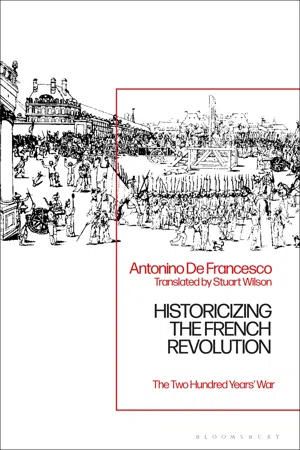 eBook - PDF
Historicizing the French Revolution
The Two Hundred Years’ War
- Antonino De Francesco(Author)
- 2022(Publication Date)
- Bloomsbury Academic(Publisher)
Condemnation of the latter soon went hand in hand with celebration of the former, turning into the manifesto of an entire generation of liberal youth that refused the policy of oblivion fostered by the Bourbon Restoration. 8 Historicizing the French Revolution 1. The death of Condorcet Paris, summer 1793: the French Republic, which had come into being a year earlier following the insurrection of 10 August 1792, was already hanging in the balance. The demonstrations of 31 May and 2 June 1793 in front of the National Convention, elected to give France a new democratic constitution, had forced the assembly to expel twenty-nine deputies, all belonging to the so-called Girondin faction. The triumph of the other party, la Montagne , ‘the Mountain’, which had taken advantage of popular protests to settle accounts with opponents, however, provoked the outrage of those who saw in that decision an attack on popular sovereignty. With the news of the event, many provincial cities tried to offer resistance, including armed dissent, to the political changes in Paris: the war on the frontiers, which broke out in April 1792, and the uprising in the Vendée, which exploded in March 1793, were now joined by a federalist revolt – so called because the Convention saw in the protests an attempt to break up the unity of France itself. To put an end to the resistance, the Convention swiftly finished drawing up the constitution and put it to the vote of the country’s leading assemblies. Popular consensus was, apparently at least, complete: even the rebellious cities voted in favour, in the naive belief that, once the constitution had been ratified, the Parisian assembly would remit the mandate, call new legislative elections and give a second chance to those who had been expelled.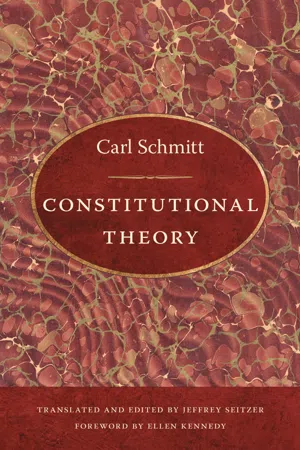 eBook - PDF
- Carl Schmitt, Jeffrey Seitzer(Authors)
- 2008(Publication Date)
- Duke University Press Books(Publisher)
Trough the practice of the American states and the famous ex-ample of the French National Convention of 1792, the word retained the meaning of an assembly that produces the draft of the constitutional legislation. By the decree of 21 September 1792, the French National Convention established as a basic principle that any constitutional legislation must be confrmed expressly by the people (“qu’il ne peut y avoir de Constitution que celle qui est acceptée par le peuple”). Consequently, the constitution of the Convention of 24 June 1793 was presented to the people for approval, to the nominating assemblies specifcally [86]. It was almost unanimously accepted ( Duguit-Monnier p. XXXXI). Despite this, however, it did not enter into force, because the National Convention suspended the proto-constitutional condition and instituted the dictatorship of the Jacobins (le gouvernement révolutionaire), during which government was conducted through measures, not by formal legislative acts, etc. Te same National Convention later concluded another constitution, that of the Year III of 22 August 1795 (the so-called Directorial Constitution). It was also proposed to the consent of the electors and was accepted with a great majority (Duguit-Monnier, p. LXII). (c) Special circumstances at the constitutional convention for a federal state constitution. In this instance, the constitution can be submitted to the people of the individual member states for their consent. Te federal constitution of the United States of America of 1787 was drafted by a constitutional convention. It was then set before the Congress of the assembled states, which, in turn, recommended its acceptance to the people of the individual states. Finally, it was accepted in each of the thirteen states through special ratifying conventions, in other words, assemblies elected exclusively for this purpose. On the great difculties of this process and the often very slight accidental majorities, cf. eBook - ePub
A Short History of Europe, 1600-1815
Search for a Reasonable World
- Lisa Rosner, John Theibault(Authors)
- 2015(Publication Date)
- Routledge(Publisher)
The first act of the new body was to decide what to do with the king. Like Charles I in 1649, Louis was generally distrusted, and there were few objections when the monarchy was formally abolished, and France declared a republic, on September 21, 1792. But as in England, the trial of a king was a delicate matter. Louis, unlike Charles, was allowed defense counsel; like Charles, he behaved with unexpected dignity. And like Charles, his execution was a foregone conclusion. On Monday, January 21, 1793, Louis XVI was executed. The instrument used was a new invention, developed as a more humane method of carrying out capital punishment than decapitation by sword: the guillotine. Proven in political executions since the preceding April, it was to be used many more times in the years to come.Year One
The prison massacres of September 2, 1792, had been horrible, but they seem to have reassured the Paris sans-culottes that their families were safe. In the succeeding weeks, 20,000 men of Paris volunteered for the army to fight against the Prussians and Austrians. On September 20, 1792, the French army had its first decisive victory at the town of Valmy, to the east of Paris. Foreign armies, stopped in their tracks, opened negotiations for a truce. Amidst general rejoicing, the new National Convention set about its formal task: legislating a whole new France, free from tainted monarchical trappings of the ancien régime.The National Convention resumed the rationalization process of 1790 with a vengeance. Now, it was not just geography, but time, that could be molded to reason. The old system for numbering years was abolished, and a new numbering system instituted to commemorate the revolution. September 22, 1792, now became the first day of Year One of the Republic. The old names for months of the year, with their references to imperial Rome, were also changed, replaced with names that reflected seasons of the year or agricultural tasks: Thermidor for the heat of August, Brumaire for the fog of November. Feudal coinage, weights and measures, and the religious calendar were all to conform to reason: a national decimal coinage, the metric system, and a ten-day week, with a new day, Décadi, replacing Sunday as the day of rest, were all introduced. Catholicism itself was outlawed as contrary to reason and republican virtue.The National Convention also drafted another new constitution, this time for a republic with universal manhood suffrage, not a constitutional monarchy. It was ready by the summer of 1793. Technically, the National Convention could have dissolved itself at that time and called for new elections based on the new constitution. But Year One had been disastrous for the country. After the victory at Valmy, the French had moved north and east into Dutch and German territories, proclaiming the revolution wherever they went; Britain entered the war in February 1793 and, with Prussia, Austria, Russia, and Spain, constituted an encircling European alliance against the French. When the government tried to raise more troops, by conscription when volunteers were not forthcoming, it met with massive evasion. The removal of price controls on bread and other goods had led to high prices and grain shortages, leading to bread riots and making it near-impossible to provision the army. eBook - PDF
The French Revolution and Empire
The Quest for a Civic Order
- Donald M. G. Sutherland(Author)
- 2008(Publication Date)
- Wiley-Blackwell(Publisher)
Instead, Bare Áre, Danton, Robespierre and Jeanbon Saint-Andre  spoke or wrote of the necessity of an alliance with the people which would win over popular support by making economic concessions, such as subsidizing bread by a tax on the rich or selling e Âmigre  property in small lots to make it available to the poor. Such considerations were also linked to the nightmare of another Vende Âe. In so far as the revolu-tionaries had a sociology of counterrevolution, it was the belief that its origins lay in poverty and that the rich, who had abandoned the Re-public, had stirred it up. Thus the sympathies for economic hardship that they had always held became harnessed to the political aim of saving the Revolution. The special tribunals, the revolutionary committees, the special taxes, the maximum and the wide-ranging powers granted to representatives on mission were all vital elements of the Terror. Its development was a chaotic process with the Paris Commune and sections, Convention committees and ordinary deputies on the ¯oor contributing, its various authors responding in their own way to the pressures of the March crisis. The very circumstances of its origin show that it was not intended to be a system, nor was it, since most of the legislation was applied half-heartedly, if at all. Yet the way the legislation was perceived in the provinces and the way it ®ltered through the particular character of 162 The First Year of Equality local Jacobinism in some regions contributed to the very process of disintegration the Convention was trying to stop. Federalism and Extremism Insofar as it is possible to characterize patriot provincial opinion up until March, most of it did not take sides in the Girondin±Montagnard struggle. An overwhelming number of clubs approved of the execution of Louis XVI but this did not in itself imply acceptance of the Montag-nard line.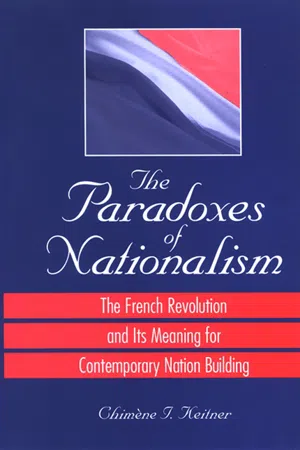 eBook - PDF
The Paradoxes of Nationalism
The French Revolution and Its Meaning for Contemporary Nation Building
- Chimene I. Keitner, Chimène I. Keitner(Authors)
- 2012(Publication Date)
- SUNY Press(Publisher)
Our way of thinking, Lord knows how national it is! and our written works are like our thoughts.] 16 This statement illustrates just how all-encompassing the Revolutionary idea of the nation could become. (Corroborating Chantreau’s impres- sion, the permanent exhibit on the French Revolution at the Musée Car- navalet, Paris, displays everything from dinnerware painted with Revolu- tionary mottoes to trunks with locks sculpted in the shape of the Bastille.) Even in personal matters such as a person’s way of being, thinking, and dressing, the concept of the nation was omnipresent. Chantreau’s com- mentary testifies to the role of language and symbols in forging a national consciousness that can manifest itself even in the mundane activities of daily life. Despite widespread agreement on the importance of this changing vocabulary, some commentators voiced skepticism about the viability of the nation as a guide for creating political institutions. One anonymous dictionary author devotes several pages to the concept of the nation, but seems equivocal about its political utility. He (or she) explicitly affirms the contractarian account of the origins of society and government: individu- als in the state of nature join together in order to protect themselves and to enjoy freedom as members of a common community. But he questions how a person could at once have a private will and be part of a unified body, insisting that this could only work within a very small group of peo- ple and that, as soon as a leader began to act out of private rather than public interest, the association would dissolve back into the state of nature. 17 Through such critiques, pamphleteers pinpointed the more problematic aspects of Rousseauean and Revolutionary thought. Skepticism could engender outright cynicism and even protest.
Index pages curate the most relevant extracts from our library of academic textbooks. They’ve been created using an in-house natural language model (NLM), each adding context and meaning to key research topics.

