History

Robespierre
Maximilien Robespierre was a key figure in the French Revolution, known for his role in the Reign of Terror. As a leader of the radical Jacobin faction, he advocated for the use of violence to achieve revolutionary goals. Robespierre's uncompromising stance and pursuit of revolutionary purity ultimately led to his downfall, as he was arrested and executed in 1794.
Written by Perlego with AI-assistance
Related key terms
1 of 5
9 Key excerpts on "Robespierre"
 eBook - PDF
British Women Writers and the French Revolution
Citizens of the World
- A. Craciun(Author)
- 2005(Publication Date)
- Palgrave Macmillan(Publisher)
Tench cites these episodes as evidence that Robespierre has been made the scapegoat for the crimes of others, and more disturb- ingly, for the complicity of many. The imprisoned royalist spy Madame de Fleury similarly resisted this tendency to scapegoat Robespierre, as this chapter’s epigraph shows. Other contemporaries agree with Tench, and with modern historians, that Robespierre and his Committee of Public Safety did not order the massacres at Nantes, but in fact tried to rein them in in their campaign to oust the ‘ultra-revolutionaries’ in March 1794; in the spring of 1794 Robespierre and his allies also tried to centralize the Terror in Virtue and Terror 117 Paris, arresting the members of the revolutionary committee of Nantes for the mass drownings (12 June). 22 Nevertheless, Robespierre became synonymous with the Terror, and in women’s fiction this association took some fascinating turns. In Mary Robinson’s The Natural Daughter (1799), Helen Craik’s Adelaide de Narbonne with Memoirs of Charlotte de Cordet (1800) and Fanny Burney’s The Wanderer (1814), Robespierre emerges as a sexualized avatar of violent ambition, in effect the embodiment of men’s Reign of Terror on women. These feminist critiques of French and British gender politics do more than use the name of Robespierre to conjure up the ultimate allegorical libertine villain. In their representations of Robespierre as Terror we glimpse an early and unidentified strand of the historical novel, in which two specific historical crises – Robespierre’s crafting of the ideology of Terror, and the gender crisis of the revolutionary decade – are fused in sensationalized feminist narratives. What intrigues and appalls these writers is Robespierre’s perversion of Terror as an emanation of Virtue. Drawing heavily on Williams’s Letters from France, Robinson and Craik share a desire to sever Robespierre and the Terror from the virtuous legacy of 1789.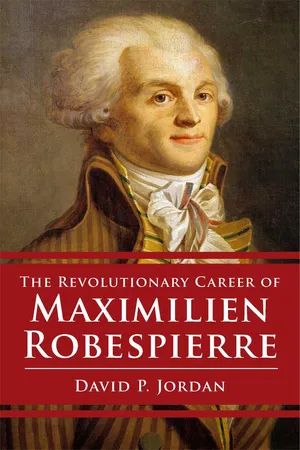 eBook - ePub
- David P. Jordan(Author)
- 2013(Publication Date)
- Free Press(Publisher)
CHAPTER 9 Robespierre the Ideologue PLATE XI (Phot. Bibl. nat. Paris) T HE PERIOD FROM June 2 till July 27, 1793, from the purging of the Convention to the election of Robespierre to membership on the Committee of Public Safety, his first (and only) official position of authority, is the last time he can be contemplated performing the tasks he believed providence had set him. Once he joined the inner circles of government, disappeared into the Green Room of the Tuileries where the great committee met secretly, he not only spent less time in the public gaze, but he ceased to be a critic of the government. He had been made, he several times declared, to criticize and correct those who ruled, but not to rule himself. He was the representative of the people and had consistently declined all offices and appointments that might make him the representative of government. The purge changed everything. “I am utterly tired of the Revolution; I am ill; the country was never in greater danger, and I doubt whether it will survive.” 1 Thus did he lament on the eve of June 2, confounding self and circumstance. But the purge revitalized him as had August 10. His vigor of mind and body returned. Insurrection again made him whole. Urban uprising had rearranged the Revolution, created new possibilities. There was ideological work to be done. Running on nervous energy and willpower, he once more emerged to explain and cajole and seduce. The purge had to be given intellectual coherence, fit into the ongoing history of the Revolution. June 2 did not give Robespierre personal power but the purge destroyed the most stubborn opposition to the Mountain. The way to Jacobin dominance lay open, and Robespierre’s years of cultivation of the Society were about to bear fruit eBook - ePub
Unbearable Life
A Genealogy of Political Erasure
- Arthur Bradley(Author)
- 2019(Publication Date)
- Columbia University Press(Publisher)
6 In this chapter, I explore Robespierre’s politics of the “already dead,” from the Revolutionary Terror up to contemporary revolutionary movements like the Zapatistas. This chapter argues that Robespierre’s political philosophy offers a new conjugation of the politics of unbearable life, which transforms it from an apparently passive and abject fate to be endured into a new revolutionary subject position to be affirmed and mobilized. Why, to recall Maurice Blanchot’s intriguing words from his famous essay “Literature and the Right to Death” (1949), does the guillotine that falls on Robespierre apparently kill no one?In order to begin to understand Robespierre’s claim to be already dead, I think we need to read it as the outworking of a certain biopolitics of retroactivity—of the “always already” (toujours déjà )—that is, as many commentators have noted, paradoxically intrinsic to the revolutionary moment. To recall Jacques Derrida’s famous reflections upon the American Revolution, for example, the Declaration of Independence (1776) is, firstly, a performative speech act that serves to bring the American people into existence ex nihilo: the People “do not exist as an entity, the entity does not exist before this declaration, not as such .”7 Yet, at the same time, he notes, the declaration disguises itself as a constative description of a preexisting authority: it claims to speak in the name of, and by the authority of, the people themselves. If the declaration invents “the People,” that is, it simultaneously claims to have been invented by them in what Derrida calls a gesture of “fabulous retroactivity.”8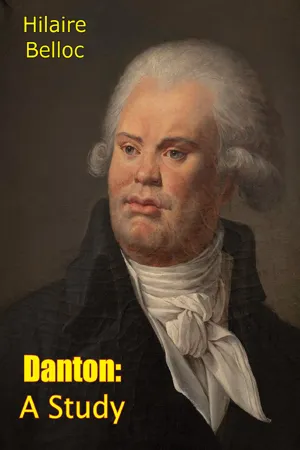 eBook - ePub
- Hilaire Belloc(Author)
- 2023(Publication Date)
- Braunfell Books(Publisher)
CHAPTER VIII—Robespierre
I DESIRE in this additional chapter to show what place Danton filled in the Revolution by describing the madness and the reaction that followed his loss; and the extent to which his influence, in spite of these, was permanent.When Danton disappeared, one man remained the master of the terrible machine which he had created. It remains to show what were the fortunes of his work when death had come to complete the results of his abdication.The genius of the dead man had foreseen a necessity, had met it with an institution, and that institution had proved his wisdom by its immense success. France was one within, and was beginning on her frontiers the war whose success was not to end until it had rebuilt all Europe. This unprecedented power dominated a country long used to centralisation, and was strengthened by the accidents of the time, by the even play of the government over a surface where all local obstacles had broken down, by the tacit acquiescence of every patriotic man (for it was the thing that saved the nation), by the very abuse of punitive measures. This power was destined to change from a machine to a toy.They say the children of that time had little models of the guillotine to play with. The statement is picturesque and presumably false, but it will serve well for a simile. A man unused to action, dreaming of a perfect state which was but a reflection of his own intensely concentrated mind, acquired the control of the guillotine. Unfortunately the model was of full size.The punishment of death had hitherto been inflicted, for the most part, with a clear and definite, though often with an immoral, object. In the hands of Robespierre it was used to defend a theory and a whim. The men of the time loved their country ardently, and believed with the firmness of a large and generous faith in those principles upon which all our civilisation is at present based. France and the Republic were, in their minds, one thing, and a thing which they spared no means to make survive the most terrible struggle into which any nation has ever dared to enter. They killed that they might be obeyed in a time which verged on anarchy, and they desired to be obeyed because, but for obedience to government, France and all her liberties would have perished. Such a motive for punishment is just, and its execution is honest.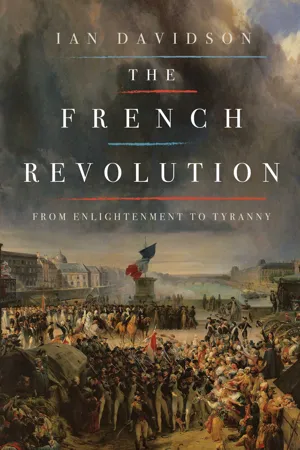 eBook - ePub
- Ian Davidson(Author)
- 2016(Publication Date)
- Pegasus Books(Publisher)
23THE FALL OF RobespierreIN THE THREE MONTHS following the fall of Danton, Robespierre tried desperately to ride the Revolution by intensifying the Terror and by advancing more and more arguments to explain the steady dismantling of the laws underpinning the state. Eventually, the atmosphere of fear became so frenzied that his enemies brought him down.The intensification of the Terror went hand in hand with a further centralisation of the government. After Robespierre’s victories in the spectacular show trials in March and April 1794, first of the Hébertistes, then of the Dantonistes, the CSP moved swiftly to tighten control of all political institutions, and in particular to rein in any activities which were most directly influenced by the sans-culottes. The armées révolutionnaires, which had been created the previous autumn in direct response to the demands of the sans-culottes, were now closed down, as were the special commissioners for investigating food hoarding (commissaires aux accaparements); both were deemed too close in political sympathy to the Hébertistes. The government also removed virtually any outlet for the expression of popular anger: all denunciations to the Tribunal révolutionnaire would now come directly from one of the two governing comités, at first, officially, from the Comité de sûreté générale (CSG) and soon, encroachingly, after it set up its own police department, from the CSP.One significant date in the insanity of the Terror was April 22, 1794, when the Tribunal révolutionnaire sent to the guillotine two notable and thoroughly respectable Revolutionaries, together with an extremely distinguished public servant of the ancien régime.Jacques Guillaume Thouret was a leading constitutional lawyer who had played a key role, in the early days of the Revolution, in the reorganisation of France into its eighty-three départements and in the development of the new French judicial structure, notably the jury system. His crime under the Terror was simply to become a suspect. Isaac René Guy Le Chapelier was another Revolutionary lawyer, who left his name to posterity with the Loi Le Chapelier, which forbade the formation of trade unions, earning him the hatred of the sans-culottes. His crime before the Tribunal révolutionnaire was modérantisme, or moderation, which was newspeak for being an anti-revolutionary. The Montagnards eBook - PDF
Paris in 1789-94
Farewell Letters of Victims of the Guillotine
- John Goldworth Alger(Author)
- 2011(Publication Date)
- Gorgias Press(Publisher)
CHAPTER XI T H E FALL OF Robespierre Duplay Household—Habits—Last Speech—Insurrection of Commune— Captured—Guillotined—His Notebook—Character DISLIKE him as we may, and must, Robespierre is neverthe-less the central figure of the second stage of the Revolution, just as Mirabeau is the central figure of the first, and when he disappears, the Revolution loses its chief interest. Despite his sallow complexion, the convulsive movements of his hands, shoulders, and neck, his green spectacles, his foppish attire, his shrill voice (but latterly modulated), his averted gaze, his hollow rhetoric, he escapes ridicule by horror. One thing alone, as Renan says, 1 does not admit of laughter—the atrocious. You may laugh at savants, poets, philosophers, religionists, politicians, plebeians, rich bour-geois. You will never laugh at Nero or Robespierre. Everything relating to him is accordingly of interest, and there is no lack of materials. The references to him in the Moniteur alone would fill a book, for, with the single ex-ception of Barère, who was virtually his echo, he occupies much more space in the index to that journal than any other man. Hamel published in 1867 a minute biography of him, but new light has since been thrown on his Paris home by M. Lenotre, 2 and I have found in the National Archives some details of his tragical end correcting or supplementing those hitherto related. We have, therefore, abundant data for depicting his manner of life and the closing scene of horror. The picture may not materially modify the popular conception of him, but it will give us a more complete portrait. On Sunday the 17th July 1791 there had been an 1 Avenir de la Science, p. 440. 1 Parts Révolutionnaire, 1895. 439 440 P A R I S IN 1789-94 affray between the National Guard and the mob on the Champ de Mars, where a petition was being signed for the deposition of Louis XVI., who, three weeks before, had been brought back from Varennes. eBook - PDF
- Holger Ross Lauritsen, Mikkel Thorup, Holger Ross Lauritsen, Mikkel Thorup(Authors)
- 2011(Publication Date)
- Continuum(Publisher)
[ . . . ] [T]he prince must [ . . . ] preserve its power in spite of the people, without incurring the possible charge of usurpation’. Throughout the revolution, and especially in the Terror, determining a ‘regular and legitimate act’ from a seditious one, and the will of the people from a faction, was the entire problem. Robespierre and his cohort always believed they were acting for the people while they were preserving their power, but they were unable to defend themselves from the charge of usurp-ation. Hence the label assigned to Robespierre and others on 9 Thermidor that has resonated ever since: tyranny (ibid., Book III, chapter 18). Minimizing Rousseau’s Influence on the Terror The Terror was a complex phenomenon that transpired in the empty demo-cratic space opened by the collapse of the Old Regime. The people were in charge but could not be found; to represent them was to betray them. The revolutionary state was unable to achieve a complete monopoly on violence, though it killed many people trying to do so. Circumstances were what ultimately drove the Terror. The foundational and constitutive moment of modern French democracy was unstable, chaotic, dense, indecisive (in Schmitt’s sense) and caught in an intensifying whirlwind of conflicting forces. The Terror was over-determined, and its essence was irreducible to ideas and books alone. 62 Rousseau and Revolution Rousseau undoubtedly played a crucial role in the French Revolution. There were indeed many Rousseaus. By the mid-1790s his influence was felt everywhere, even indirectly. The two different examples discussed here – empirical evidence of his minor explicit role in 1793–4, and a counter-factual reading of the Social Contract as a resource for a critique of the Terror – could be explored further, and numerous exceptions could be found. The view that draws a straight line from Rousseau to the Terror flourished in the Cold War and continues to linger.
- John Wilson Croker(Author)
- 2010(Publication Date)
- Gorgias Press(Publisher)
Ilis power was not founded on an irresistible military force. Ilis force teas the PEOPLE itself. l i e was really their child and champion, the incarnate type of Public Opinion *—-which, in revolutionary times, only means the opinion of the most violent of the Public. That the predisposition of Robespierre's personal character may have coincided with the bloody extravagances of the times we do not deny; but we are satisfied that the bloody extravagances of the times outran his predisposition. No doubt there were in the French people millions of poor persecuted Royalists and Christians, who deplored and detested—even independently of their own per-sonal sufferings—this frightful system : perhaps even it might be truly said that a numerical majority of the nation, including * La Revolution iiicarnée c'est Ro-bespierre ; avec soli liorriule bornie ibi, sa naiveté de .--an-r, et sa conscience;)!?/-!? et c/ncllc,— 2 D 400 Robespierre. women and children, was entirely innocent; but, that the great and predominant mass—which the republican constitution desig-nated as active citizens , and which, politically and practically, constituted the nation —concurred zealously—furiously—in all the worst revolutionary extremities, cannot be denied—and France can no more divest herself of a part in the guilt of Robespierre than in the glories of Napoleon : in truth she had a more immediate and direct share in the guilt than in the glory. The truth of this view of the case is strongly confirmed, indeed we may say placed beyond question, by the circumstances that produced and accompanied his fall. It was not as a man of blood that the parties most immediately active in his overthrow—the Collots, Billauds, Barreres, Talliens, Fouchds, &c.—attacked him.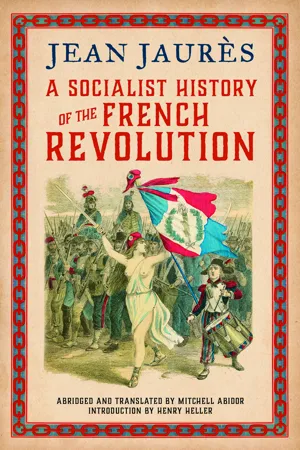 eBook - ePub
- Jean Jaurès, Mitchell Abidor(Authors)
- 2015(Publication Date)
- Pluto Press(Publisher)
the further sale of national lands, the establishing of a thriving industry to support the military, and pushing a democratic ideal heretofore unknown. And so, Jaurès says, “In the spring of 1794 the bloody battles of the Revolution didn’t seem to have damaged its military élan, its economic activity, or its prodigious intellectual and moral strength, which it placed at the service of a lofty ideal.”But even so, “the Jacobins and Robespierre had entered their final stage ….”)The Political ProblemWhen the Hébertist and Dantonist heads had fallen; when a few days later, in a sinister second liquidation, those accused of fomenting the prison plot—Chaumette, Gobel, Arthur Dillon, Hébert’s widow and the unfortunate Lucile [Desmoulins]—already dead to herself after Camille’s death—climbed the scaffold in their turn; when this cartload of people had emptied its heads into the basket; when Hébertism and Dantonism as factions were nothing but a memory, Robespierre and the Revolution faced the decisive test.Nothing stood in Robespierre’s way, but what was he going to do?The Revolution was no longer threatened either by a demagogic organization that would have drowned it in an abject and ferocious anarchy, or by a half-hearted conspiracy of the indulgent who, by their impatient and hostile policies seemed to surrender the repentant Revolution to the revived boldness of its enemies. What was the Revolution going to do?The opposing forces of demagogy and moderantisme, between which Robespierre balanced his policies, had fallen; he now had to find his equilibrium within himself, in his own ideas, in his own policies.The extreme tension in all the revolutionary springs, in all the forces of life and death could not persist. The Terror couldn’t be the normal system of ruling, and war couldn’t continue indefinitely. The maximum wasn’t a law that would be forever appropriate for a society based on private property and private production. Finally, the quasi-dictatorship of the Committee of Public Safety could not be permanent. Now that there was no longer any Hébertist party to sustain the tension of the springs of terrorism, now that there was no longer a Dantonist party to relax revolutionary energy so abruptly that the Revolution risked collapsing, one policy was possible, and one alone.
Index pages curate the most relevant extracts from our library of academic textbooks. They’ve been created using an in-house natural language model (NLM), each adding context and meaning to key research topics.

