History

New Zealand Wars
The New Zealand Wars were a series of conflicts between the indigenous Māori people and the British colonial forces in the 19th century. These wars were fueled by land disputes, cultural differences, and the desire for power and control. The conflicts resulted in significant loss of life and had a lasting impact on the social, political, and economic landscape of New Zealand.
Written by Perlego with AI-assistance
Related key terms
1 of 5
10 Key excerpts on "New Zealand Wars"
 eBook - ePub
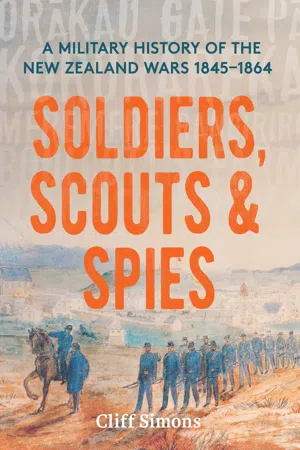
Soldiers, Scouts and Spies
A military history of the New Zealand Wars 1845–1864
- Cliff Simons(Author)
- 2019(Publication Date)
- Massey University Press(Publisher)
1THE New Zealand Wars
Many of us have been brought up on a kind of history which sees the human drama throughout the ages as a straight conflict between right and wrong. Sooner or later, however, we may find ourselves awakened to the fact that in a given war there have been virtuous and reasonable men earnestly fighting on both sides. Historians ultimately move to a higher altitude and produce a picture which has greater depth because it does justice to what was thought and felt by the better men on both sides.—Sir Herbert Butterfield1T HE NEW ZEALAND WARS were a series of small campaigns fought between Britain, its colonists and the nascent government of New Zealand, and some of the Māori inhabitants. They spanned a period of nearly thirty years between 1845 and the early 1870s, although some historians consider that they continued through to Parihaka in 1881 and even to the arrest of Rua Kēnana at Maungapōhatu in 1916. The wars have had a dramatic effect on the governance, land ownership and development of the nation through to the present day. They have cast an immense shadow across the nation’s history, they are the origin of many of the issues that have caused ongoing friction between Māori and the Crown, and they continue to fuel anger and disaffection among various interest groups today.The first of the wars flared up a mere five years after the two races had appeared to have made an encouraging start towards building a nation together. In simplified terms, the Treaty of Waitangi (Te Tiriti o Waitangi), signed on 6 February 1840, promised a partnership between the two peoples, and as the various chiefs signed the document, Queen Victoria’s representative, Captain Hobson R.N., who was soon to become the first governor of New Zealand, is said to have uttered the words he had no doubt just learned: ‘He iwi kotahi tātou’; we are now (all) one people.2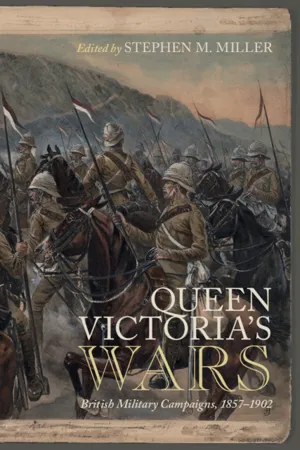 eBook - PDF
Queen Victoria's Wars
British Military Campaigns, 1857–1902
- Stephen M. Miller(Author)
- 2021(Publication Date)
- Cambridge University Press(Publisher)
5 The New Zealand Wars, 1845–1872 John Crawford Background The wars between Māori and the British armed forces and British (Pākehā) settlers that raged across much of New Zealand’s North Island in the mid-nineteenth century remain the most divisive and con- troversial chapter in New Zealand’s history. Pākehā land hunger, sense of racial superiority, and Māori resolve to retain control of their land were at the heart of these conflicts. Also important was a determination among Māori to defend the right to control their own affairs. They believed this right had been guaranteed in the Treaty of Waitangi, under which New Zealand became a British colony in 1840. 1 Traditionally Māori society was organized into iwi (tribes) and hapu (lineage groups). Warfare was a significant part of Māori life, but increased greatly in scale and ferocity after the introduction of firearms to New Zealand. Māori quickly became adept at the use of small arms and also made limited use of artillery. The design of their pā (fortified strongholds) was radically changed to provide protection against musket fire and to maximize the effectiveness of defensive fire. Between 1807 and 1839, the Musket Wars saw casualties, displacement of popu- lation, and changes in tribal boundaries on an unprecedented scale. The introduction of European diseases and the Musket Wars led to a sharp fall in the Māori population from about 100,000 in 1769 to about 60,000 in 1858; by which time the Pākehā population had reached a similar level. All these developments facilitated British colonization. 2 Relations between Pākehā and Māori were, from the outset, marked by occasional outbreaks of violence usually prompted by cross-cultural 1 Vincent O’Malley, The New Zealand Wars Ngā Pakanga o Aotearoa (Wellington: Bridget Williams Books, 2019), 9–28. eBook - ePub
War and Remembrance
Recollecting and Representing War
- Renée Dickason, Delphine Letort, Michel Prum, Stéphanie A.H. Bélanger, Renée Dickason, Delphine Letort, Michel Prum, Stéphanie A.H. Bélanger(Authors)
- 2022(Publication Date)
- McGill-Queen's University Press(Publisher)
In the latter part of the twentieth century, this gave way to a new approach, which exposed the underlying assumptions informing the national narrative of identity and the relationship between Maori and Pakeha. From “revisionist historians” to self-termed “neo-revisionists,” the New Zealand Wars have been the focus of research and discussion relating to the colonial project in New Zealand as well as to the necessary transition to a postcolonial era. The recognition of the New Zealand Wars as a pivotal episode in the nation’s history has been very much connected to the national process of reconciliation, in which New Zealand has been engaged since 1985, mainly through the Tribunal of Waitangi. Tribunal historiography has unearthed contending discourses and voices, and generally helped to produce innovative research on topics and issues that used to be considered definitively settled.It is thus symptomatic that Conservative prime mister John Key, in an obvious reiteration of the old traditional discourse on the country’s benevolent treatment of its Indigenous minority, caused a major uproar in late 2014 when he stated that New Zealand had been “settled peacefully.” Historians immediately reacted, recalling the nineteenth-century wars and the devastation they caused.76 As New Zealand again turns to introspection on the occasion of the celebration of the centenary of the First World War and of events traditionally connected to its coming of age (such as the battle of Gallipoli), it is fitting that other defining moments of its history also be recalled and given official attention. There is a growing sense that the “historical amnesia” pertaining to the New Zealand Wars is political because “they do not rouse nationalist pride.” As was ironically asked by a leading scholar on the subject: “Who wants troubling introspection when we can have heart-warming patriotism instead?”77As to the Maori Warrior myth, it remains an enduring vision that is perpetuated by Maori themselves. Aside from the clichés amplified by the media (essentially with regard to rugby hakas), the Maori Warrior is periodically revived in times of protest. This produced a striking effect when, in February 2016, Maori in traditional dress and facial tattoos led the demonstrations against the Pacific Trade Agreement in all of New Zealand’s major cities.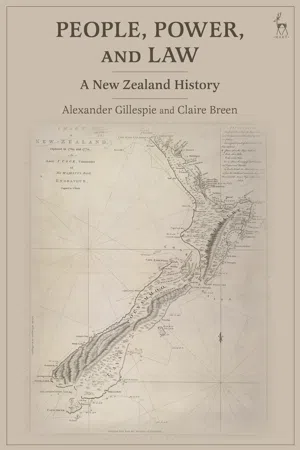 eBook - ePub
People, Power, and Law
A New Zealand History
- Alexander Gillespie, Claire Breen(Authors)
- 2022(Publication Date)
- Hart Publishing(Publisher)
Chapter 3 , despite the promises of the Treaty Te Tiriti, and some initial efforts to accommodate Māori custom, customary law was ultimately superseded by English law, which was then used to settle the land by Europeans and/or secure the full submission of Māori. This situation, coupled with a combination of others factors, including fear, attitudes of cultural superiority, and the personal determination of various Governors to impose their will, were key catalysts for the New Zealand Wars Ngā Pakanga o Aotearoa. The ensuing conflict was met with the full military and legal power of the Crown. Māori paid a heavy price in lost land, resources, and people.This chapter comprises five main phases of conflict, and related laws.The first, in the 1840s, was the conflict between colonial authorities and Ngāpuhi, led by Hōne Heke Pōkai in the North, as well as conflict stemming from the increasing settlement of the Cook Strait area.The second period of warfare occurred in the 1860s, when a disputed land purchase in Taranaki led to war between Te Āti Awa and colonial forces, led by Governor Browne, from 1860–61. The fallout from this conflict led to further war, between 1863 and 1864, as Governor Grey invaded the Waikato so as to crush the Kīngitanga.The third period began in Taranaki, and then spread to Hawke’s Bay, as colonial forces, and Māori allies, in response to the perceived threat posed by Pai Mārire (Hauhau), fought a particularly brutal conflict.The fourth phase occurred between 1868 and 1872, as the government tried to deal with the leaders Tītokowaru, in South Taranaki, and Te Kooti, who fought in the East Coast, Bay of Plenty, and Central North Island.The final phase of conflict occurred in 1881, as colonial forces invaded the pacifist settlement of Parihaka, which had been resisting land confiscation.Included in this chapter are the apologies from the Crown with regard to each conflict. Crown apologies commenced in the latter decades of the twentieth century, and continue through to the time of writing of this work. eBook - PDF
- V. Agnew, J. Lamb, V. Agnew, J. Lamb(Authors)
- 2009(Publication Date)
- Palgrave Macmillan(Publisher)
Yet the New Zealand Wars raged across the whole of the North Island for almost 30 years with heroism and massacre on both sides. They wrenched New Zealand history into new shapes. They left deep wounds, concealed but not healed by the scabs of legend, and we’re still paying for them in more ways than one. The wars helped make Ma – ori and Pa – keha – , lumping Ma – ori tribes into a people and splitting Pa – keha – settlers off from the old British. They were New Zealand’s great civil war, the grand clash of its two peoples.” Curiously, the idea of a civil war, something new to New Zealanders, is very much like “overseas” history, invoking as it does the nation-making American civil war in particular. 4 Declared in the later nineteenth century “a simple nullity” by Judge James Prendergast, the Treaty of Waitangi was revived in the 1980s after the Wai- tangi Tribunal was established in 1975 to investigate and report to Parlia- ment on historical injustices relating to Maori. Parliament, however, is not bound by the Treaty and could at any time vote out the scattered references to it in currently existing legislation. The Treaty today underpins official protocols of biculturalism but its articles have little foothold in law. 5 As Angela Ballara puts it, “Methodologically, contemporary academic histo- rians usually stand apart from belief in… any megaprocess at all. Nothing they write about is part of any manifest destiny, or if it is, the historian is not concerned with it” (126). The history of New Zealand can manifest no “logic.” Ballara is wary of “logical continuity,” dramatized as the “overview of the whole past,” which “raises the suspicion that scholars are not acting as historians, but propagandists for some teleological vision… like idealist philosophers (Hegel, Marx, Toynbee)” (127).
- Geoffrey Clarke, Mirani Litster, Geoffrey Clarke, Mirani Litster(Authors)
- 2022(Publication Date)
- ANU Press(Publisher)
The records describe at least one major foray a year from 1807 to 1818 CE, rising to two or three per year up to 1828 CE (Crosby 1999:29–31). This is a high frequency of warfare; in fact, level 4 on the five-point scale used by Ember et al. (2013:53). These conflicts, however, were part of the so-called ‘musket wars’, implying the proposition that early access to firearms, axes, potatoes and other goods of European origin by the Bay of Islands people led to more frequent expeditionary wars against tribes that had few or no such commodities. Attacked tribes then hastened to acquire firearms and turn on less fortunate groups again, so that a front of asymmetric military and economic advantage rolled across New Zealand. Irrespective of debate about this hypothesis (Anderson et al. 2014:175–177; Ballara 1998:234– 239; Crosby 1999:13; Fitzpatrick 2007; Wright 2011), it is undeniable that involvement of a European presence muddies the waters for using historical data from the contact period to represent the frequency and scale of Maori war during the 600 preceding years of exclusive Maori habitation (c.f. Ferguson and Whitehead 1992; Gat 2015), the period of particular interest here. The prehistory of Maori warfare, insofar as it can be discerned, might shed some light upon how the historical conflicts developed, but it is at least as important for thinking about the role of warfare in the larger-scale development of Maori society. eBook - PDF
Texts and Contexts
Reflections in Pacific Islands Historiography
- Doug Munro, Brij V. Lal(Authors)
- 2005(Publication Date)
- University of Hawaii Press(Publisher)
1 ( 1968 ): 94 – 97 . 18 . Alan Ward, “The Origins of the Anglo-Maori Wars: A Reconsideration,” NZJH 1 , no. 2 ( 1967 ): 149 . 19 . Ibid., 165 . As W. H. Oliver wrote, Sinclair went on to purposefully study the major divisions of New Zealand history—“A Destiny at Home,” in Essays in Honour of Sir Keith Sinclair, special issue of NZJH 21 , no. 1 ( 1987 ): 10 . A bibliogra-phy of Sinclair’s massive scholarly (and smaller literary) output can be found in the same issue of NZJH on pages 189 – 93 . His significant subsequent publications include Kinds of Peace: Maori People after the Wars, 1870–1885, published in 1991 , and an autobiography (Halfway Round the Harbour) that appeared shortly before Sinclair’s death in 1993 . 20 . Ward’s high praise for Davidson’s qualities as a Ph.D. supervisor is expressed in George Shepperson, P.E.H. Hair, and Doug Munro, “J. W. Davidson at Cambridge University: Some Student Evaluations,” History in Africa: A Journal of Method 27 ( 2000 ): 226 n. It is not generally known that Ward’s original Ph.D. topic in 1962 was a history of the Melanesian Mission. 21 . Judith Binney, NZJH 9 , no. 2 ( 1975 ): 194 . 22 . Quoted in Alan Ward, A Show of Justice: Racial “Amalgamation” in Nine-teenth Century New Zealand (Canberra, 1974 ), 34 . All subsequent references to this work are to the 1974 edition, unless otherwise stated. 23 . Jenny Murray, Review ( 1995 edition), The Press (Christchurch), 10 June 1995 . 24 . Lorenzo Veracini, “Negotiating Indigenous Resistance in the South Pacific: v i n c e n t o ’ m a l l e y 164 Australia, Aotearoa/New Zealand and Kanaky-New Caledonia. Three Cases in Historical Redescription” (Ph.D. thesis, Griffith University, 2001 ), 149 . 25 . Mark Francis, “Settler Historiography in New Zealand: Politics and Biog-raphy in the Early Colonial Period,” Political Science 52 , no. eBook - PDF
- S. Fenton, S. May, S. Fenton, S. May(Authors)
- 2002(Publication Date)
- Palgrave Macmillan(Publisher)
Colonial relations between Ma ¯ori and Pa ¯keha ¯ were subsequently for- malised by the British Crown in the nineteenth century and were inter- rupted by only brief periods of antagonism, notably the Land Wars in the 1860s. The foundational colonial document, Te Tiriti o Waitangi (the Treaty of Waitangi) – signed on 6 February 1840 between the British Crown and local Ma ¯ori chiefs – was a surprisingly progressive document for its time. The Treaty specifically attempted to establish the rights and responsibilities of both parties as a mutual framework by which colonisation could proceed. Captain Hobson, the Crown’s representative, was instructed to obtain the surrender of Aotearoa/New Zealand as a sovereign state to the British crown, but only by ‘free and intelligent consent’ of the ‘natives’. In return, Ma ¯ori iwi were to be guaranteed possession of ‘their lands, their homes and all their treasured possessions (taonga)’. Consequently, the Treaty had come to be commemorated as the central symbol of this appar- ently benign history. The words ‘he iwi tahi ta ¯tou’ (we are all one people) – spoken by William Hobson, at the Treaty’s signing – provided its leitmotif. In short, while undeniably a white settler colony in origin, the emergence of Aotearoa/New Zealand as a nation-state was seen to have avoided the worst excesses of colonialism. Ma ¯ori were highly regarded, intermixing and miscegenation were common, and Ma ¯ori language and culture were incor- porated, at least to some degree, into Aotearoa/New Zealand life. Or so the story went. From the 1970s, a quite different story emerged into the public domain. A generation of young, urban and educated Ma ¯ori articulated a history of continued conflict and oppression of Ma ¯ori by the Pa ¯keha ¯ (Sharp, 1990); a 96 Ethnonational Identities theme that was to be taken up in subsequent revisionist histories of the country (see Orange, 1987; Kawharu, 1989; Walker, 1990: Sinclair, 1993; Belich, 1986, 1996, 2001). eBook - PDF
Empire and the Making of Native Title
Sovereignty, Property and Indigenous People
- Bain Attwood(Author)
- 2020(Publication Date)
- Cambridge University Press(Publisher)
7 A Colony in Crisis and a Select Committee, 1843–1844 From December 1843 there was a growing sense in many quarters that New Zealand was in a state of crisis. On arriving there, the new governor, Robert FitzRoy, had found that the colony was in deep trouble. But, to make matters worse, he made a series of moves that would provoke a barrage of criticism from the New Zealand Company’s agents and allies, while in both the northern and southern districts of the colony he found Ma ̄ ori and settlers challenging the Crown’s authority. Many of the steps FitzRoy took aroused spirited public debate in New Zealand and London about native title, the Crown’s right of pre-emption and native policy more generally. Some of the most important decisions FitzRoy made during his brief governorship sprang from his belief that the natives had greater military power than the government could marshal. His distinctive take on this matter, and the fact there was actually no consensus among the British as to whether the natives were capable of besting the British Empire in battle, gives lie to a popular historical view that the British recognised the sovereignty and rights of the New Zealanders because of the natives’ military might. As events played themselves out in New Zealand, reports of the Wairau melee reached London. These caused a hardening in the position taken by the New Zealand Company and its allies. These critics of the Colonial Office claimed that the future of the colony was at stake and that major changes were required in the way that the government was treating key matters, most especially native title. Indeed, a major public battle took place when the Company secured a parliamentary select committee inquiry into its affairs and those of the colony. In the political contestation that took place in London in 1844, the Company and its allies as well as the Colonial Office and its supporters attributed ever greater significance to the Treaty of Waitangi. eBook - PDF
Possessing the Pacific
Land, Settlers, and Indigenous People from Australia to Alaska
- Stuart Banner(Author)
- 2009(Publication Date)
- Harvard University Press(Publisher)
status within the community. A Briton earning his fortune in business would normally purchase land for the social benefits it would bring, often when he could scarcely expect the land to turn a profit. Land was, for the British, the basic source of political rights. Voting in Britain and its colo-nies, including New Zealand, was contingent on the ownership of land. Indeed, in New Zealand local elections, until near the end of the nine-teenth century, the more land one owned, the more votes one could cast. Meanwhile, undeveloped land in nineteenth-century Britain and its colo-nies was increasingly coming to be revered precisely as a refuge from the corrupting values of the marketplace, a contrast celebrated especially in poetry and painting. There would be serious misunderstandings between Maori and British conceptions of property, but they were not caused by any failure on the part of the British to perceive the nonmonetary virtues of land. As Tom Brooking suggests, “One of the great misfortunes of New Zealand is that it has been settled by two peoples who are romantic and even sentimental about land.” 12 The British struggled for several decades to understand the Maori sys-tem of property rights. Looking back on the process in the 1870s, the law-yer and government official Henry Sewell recalled: “It was as difficult for us to enter into and comprehend the tribal and communistic rights of the Natives, as it was for the Natives to enter into and comprehend our sys-tem of individual titles.” The British were heirs to a long tradition of thought, as old as ancient Rome and elaborated by writers like Hobbes and Locke, associating communal ownership with primitive peoples and individual property rights with civilization. Some of the difficulty can be attributed to simple prejudice, an unwillingness to accept the practices of savages as worthy of consideration.
Index pages curate the most relevant extracts from our library of academic textbooks. They’ve been created using an in-house natural language model (NLM), each adding context and meaning to key research topics.

